🏗️
🛤️
💪
🧬 KNOW PRIMARY · AGES 6–11

BIOLOGY

🔬 Tiny Rooms, Giant Life, The Microscopic World of Cells!

📖 350 Topics 🆓 FREE + PRO ⏱️ 5 min per comic 🧠 Quiz included
🔬
1960s
Fibers First Spotted
🧵
1970s
Three Types Named
🚂
1980s
Motor Proteins Found
🧬
1990s
Spindle Role Mapped
🏗️
TODAY
Cell Scaffolding Revealed
🏗️ CYTOSKELETON: SKYSCRAPER
TOPIC 15 · BIOLOGY · STRUCTURE · TRACK · FIBER
PAGE 1 OF 5 — INTERNAL SCAFFOLDING
THE HOOK
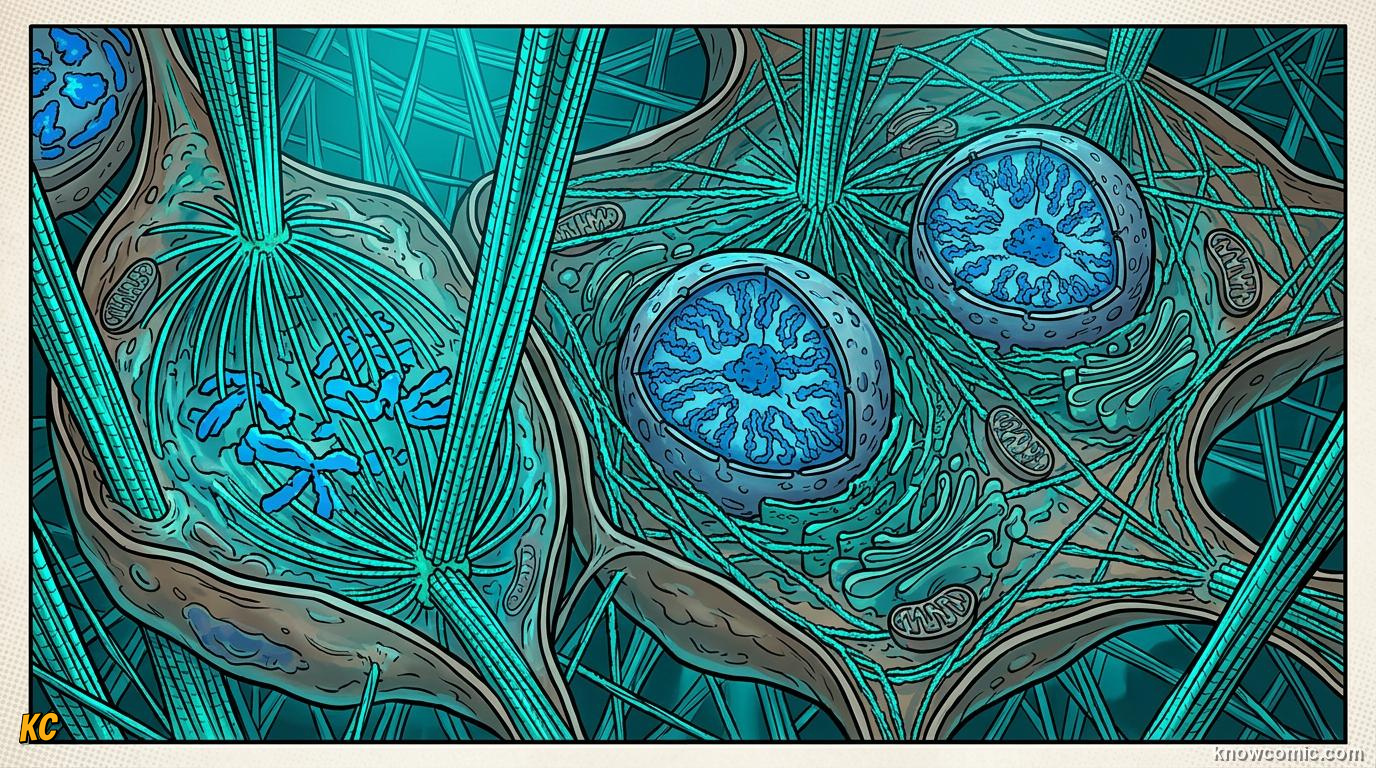
Comic panel about cytoskeleton: skyscraper: The Hook, educational kids illustration
A SKYSCRAPER INSIDE EVERY CELL
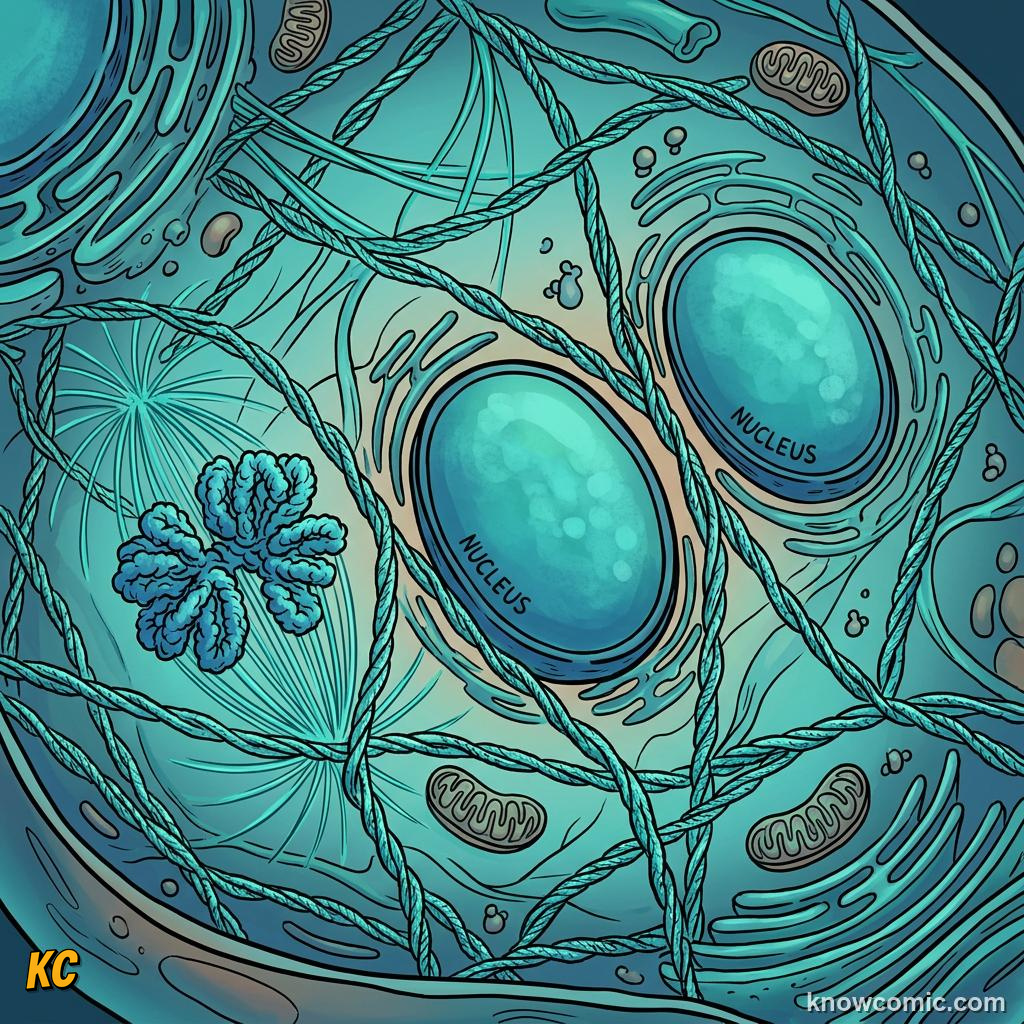
Cells are not shapeless blobs of jelly. Inside every cell runs a crisscrossing network of protein fibers called the cytoskeleton. Like the steel frame of a skyscraper, these fibers give the cell structure, strength, and shape. They also act as microscopic roads and railway tracks, guiding organelles and molecules to where they need to go. Without a cytoskeleton, cells would collapse, stop moving, and struggle to divide properly.
⚡ DID YOU KNOW?
The cytoskeleton is made entirely of proteins, yet it is strong enough to help whole cells crawl across a surface. White blood cells use their cytoskeleton to chase and engulf invading germs.
FRAME!
SHAPE
Comic panel about cytoskeleton: skyscraper: A Skyscraper Inside Every Cell, Shape, educational kids illustration
🏗️ Fibers brace the cell like internal scaffolding
📐 Different cell types get different shapes from them
TRACKS
Comic panel about cytoskeleton: skyscraper: Tracks, educational kids illustration
🛤️ Organelles travel along cytoskeleton fibers
🚂 Motor proteins carry cargo on these routes
PAGE 2 OF 5 — THREE FIBER TYPES
THREE BUILDING BLOCKS
Comic panel about cytoskeleton: skyscraper: Three Building Blocks, educational kids illustration
MICROTUBULES, ACTIN, INTERMEDIATE
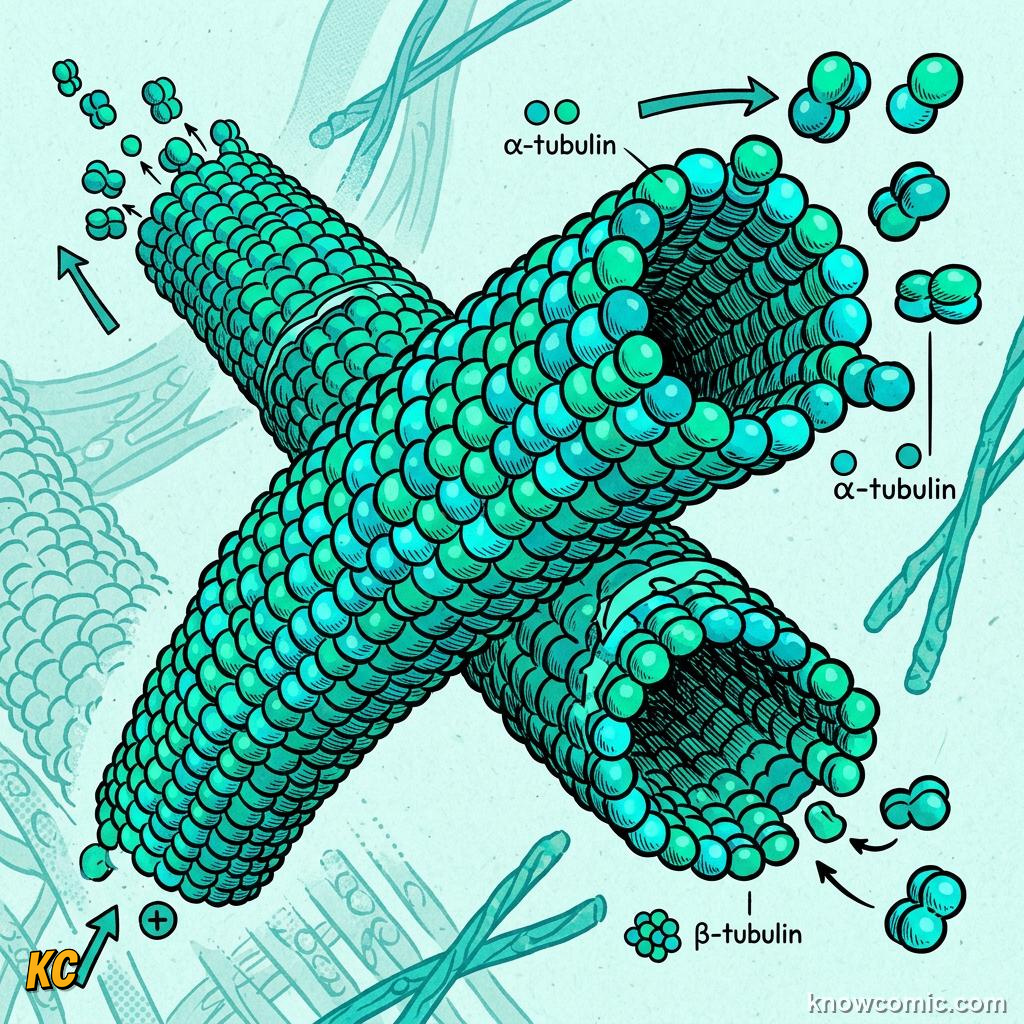
The cytoskeleton has three main fiber types, each built from different proteins and sized for different jobs. Microtubules are the thickest hollow tubes, made from tubulin protein. Microfilaments, also called actin filaments, are the thinnest and most flexible strands, built from actin protein. Intermediate filaments sit in the middle, providing steady mechanical strength. Together these three fiber families form a balanced framework that can be rigid in some places and dynamic in others.
📏 SIZE MATTERS
Microtubules are the highway lanes for long-distance transport. Actin filaments handle quick shape changes at the cell edge. Intermediate filaments anchor structures and resist pulling forces without breaking easily.
FIBERS!
MICROTUBULES
Comic panel about cytoskeleton: skyscraper: Microtubules, Actin, Intermediate, educational kids illustration
🛤️ Hollow tubes made of tubulin protein
🧭 They radiate from the centrosome like spokes
ACTIN
Comic panel about cytoskeleton: skyscraper: Actin, educational kids illustration
💪 Thin actin filaments sit just under the membrane
🏃 They push and pull to change cell shape fast
INTERMEDIATE
Comic panel about cytoskeleton: skyscraper: Intermediate, educational kids illustration
🔗 Medium-width fibers resist stretching forces
🧱 They help hold the nucleus and cell together
PAGE 3 OF 5 — MOTOR PROTEINS & TRANSPORT
KINESIN
Comic panel about cytoskeleton: skyscraper: Kinesin, educational kids illustration
🚂 Kinesin walks toward the plus end of microtubules
📦 It hauls vesicles toward the cell membrane
DYNEIN
Comic panel about cytoskeleton: skyscraper: Dynein, educational kids illustration
🔄 Dynein walks the opposite direction on microtubules
🎯 It pulls cargo back toward the cell center
MOTOR CREW
Comic panel about cytoskeleton: skyscraper: Motor Crew, educational kids illustration
PROTEINS THAT WALK THE TRACKS
Motor proteins are molecular machines that step along cytoskeleton fibers while carrying cargo. Kinesin and dynein walk on microtubules, often moving vesicles, mitochondria, or other organelles in opposite directions. Myosin walks along actin filaments and powers muscle contraction in your body. Each motor protein uses energy from ATP with every step, turning chemical fuel into physical movement inside the cell. These walkers make the cytoskeleton far more than a static frame.
🚂 TWO-WAY TRAFFIC
Kinesin and dynein move in opposite directions on microtubules, like trains running on parallel tracks. That setup lets the cell ship materials outward and bring supplies back inward without collisions.
MOVE!
PAGE 4 OF 5 — MITOSIS & CELL MOVEMENT
SPINDLE POWER
Comic panel about cytoskeleton: skyscraper: Proteins That Walk The Tracks, Spindle Power, educational kids illustration
MICROTUBULES BUILD THE SPINDLE
When a cell prepares to divide, microtubules assemble into a football-shaped structure called the mitotic spindle. Spindle fibers attach to chromosomes and pull them apart so each new daughter cell gets a full set of genetic material. Actin filaments also help by pinching the cell in two during the final split. The cytoskeleton is essential for growth, repair, and reproduction because without it, cells could not divide cleanly or move to where the body needs them.
🧬 DIVISION DAY
The mitotic spindle is built fresh for each round of cell division, then disassembled when the job is done. Microtubules constantly grow and shrink, making the cytoskeleton a living, changing framework.
DIVIDE!
SPINDLE
Comic panel about cytoskeleton: skyscraper: Microtubules Build The Spindle, educational kids illustration
🧬 Spindle fibers pull chromosomes apart at mitosis
⚖️ Each daughter cell gets matching DNA sets
CRAWL
Comic panel about cytoskeleton: skyscraper: Crawl, educational kids illustration
🦠 White blood cells crawl using actin at their front edge
🎯 They chase germs through reshaping their cytoskeleton
MUSCLE
Comic panel about cytoskeleton: skyscraper: Muscle, educational kids illustration
💪 Myosin slides along actin to contract muscle fibers
🏋️ Your movement depends on this cytoskeleton duo
PAGE 5 OF 5 — THE SKYSCRAPER RECAP
FRAME & FUNCTION
Comic panel about cytoskeleton: skyscraper: Frame &Amp; Function, educational kids illustration
THE CYTOSKELETON HOLDS IT ALL TOGETHER
From giving cells their shape to powering movement and division, the cytoskeleton is one of the busiest systems inside every living cell. Microtubules, actin filaments, and intermediate filaments each bring different strengths to the framework. Motor proteins turn those fibers into active transport routes. During mitosis, microtubules form the spindle that separates chromosomes. Whether you flex a muscle or heal a cut, your cells rely on this internal skyscraper frame working around the clock.
🌍 BIG PICTURE
Cytoskeleton fibers are constantly being built and broken down. That dynamic rebuilding lets cells adapt their shape in seconds while still keeping enough strength to survive everyday stresses.
STRONG!
ROLES
Comic panel about cytoskeleton: skyscraper: The Cytoskeleton Holds It All Together, Roles, educational kids illustration
🏗️ Shape, support, transport, and cell division
🛤️ All powered by protein fiber networks
REMEMBER
🏗️ KEY FACTS
The cytoskeleton has microtubules, actin microfilaments, and intermediate filaments. Motor proteins like kinesin, dynein, and myosin walk along fibers carrying cargo. Microtubules form the mitotic spindle during cell division.
🛤️ Microtubules = thick transport highways
💪 Actin = quick shape changes and muscle power
🧬 Spindle fibers pull chromosomes apart
🧠 QUIZ TIME!
CYTOSKELETON: SKYSCRAPER · 5 QUESTIONS
QUESTION 01
What is the main job of the cytoskeleton?
QUESTION 02
Which cytoskeleton fiber is the thickest and made of tubulin?
QUESTION 03
Which motor protein walks along actin and helps muscles contract?
QUESTION 04
What structure do microtubules form during cell division?
QUESTION 05
How many main types of cytoskeleton fibers are there?
0/5
LOADING...
💬 REACTIONS & COMMENTS
No comments yet, be the first!
← TOPIC 14 📋 ALL TOPICS ALL TOPICS →