🔬 Tiny Rooms, Giant Life, The Microscopic World of Cells!
📖 350 Topics🆓 FREE + PRO⏱️ 5 min per comic🧠 Quiz included
🦠
ANCIENT
Cyanobacteria Photosynthesize
→
🤝
~1.5 BYA
Endosymbiosis Merger
→
🟢
1817
Chlorophyll Named
→
🔬
1960s
Grana Structure Seen
→
🌍
TODAY
Sun Traps Power Life
☀️ CHLOROPLASTS: SUN TRAP
TOPIC 08 · BIOLOGY · PLANT · PHOTOSYNTHESIS · GREEN
PAGE 1 OF 5 — THE GREEN MACHINES
THE HOOK
MEET THE SUN TRAPS
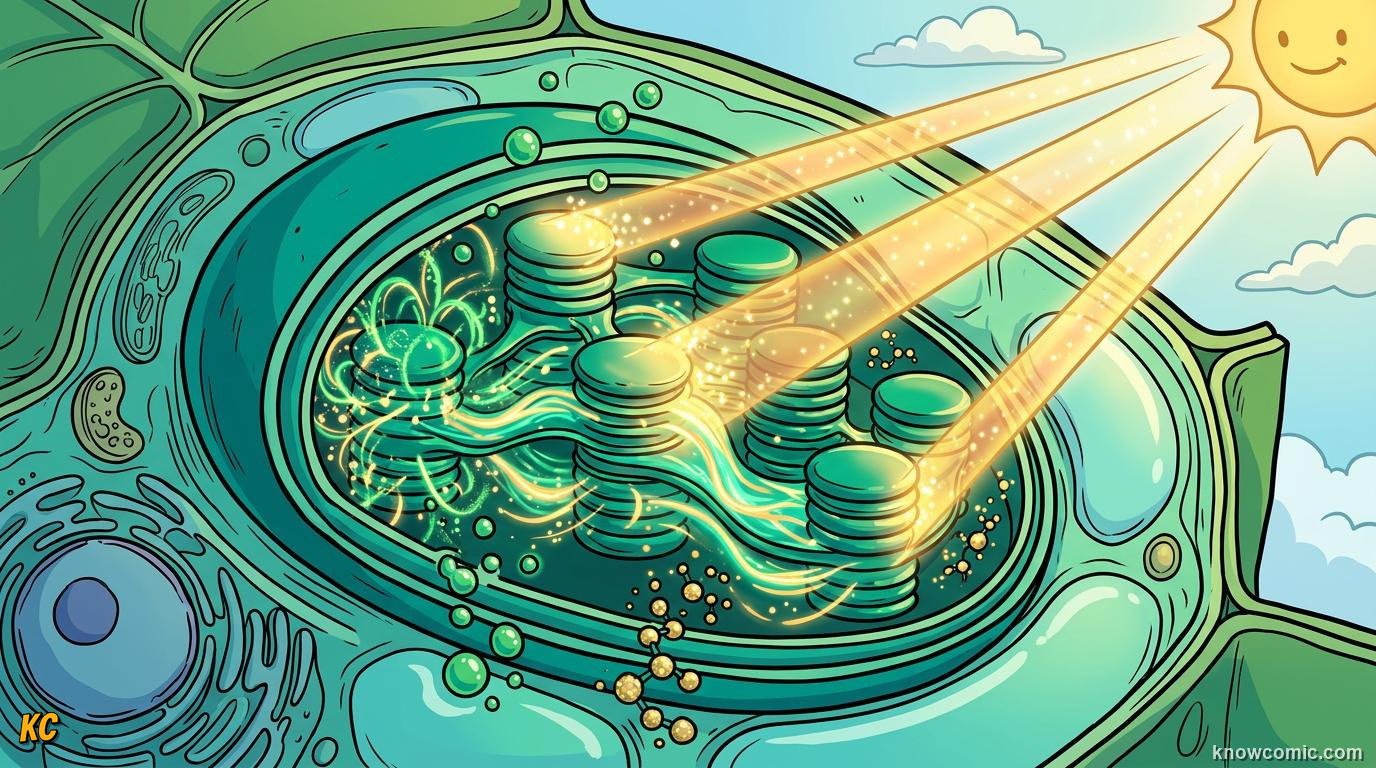
Deep inside plant and algae cells float tiny green organelles called chloroplasts. They are nature's solar panels, turning sunlight into stored chemical energy. Without them, there would be no green forests, no seaweed forests in the sea, and no sugar built from thin air. Every salad leaf and every blade of grass owes its life to these microscopic sun traps.
⚡ DID YOU KNOW?
A single leaf can hold dozens to hundreds of chloroplasts. Packed together, they give plants their green colour and catch as much sunlight as the leaf can use.
GREEN!
WHERE
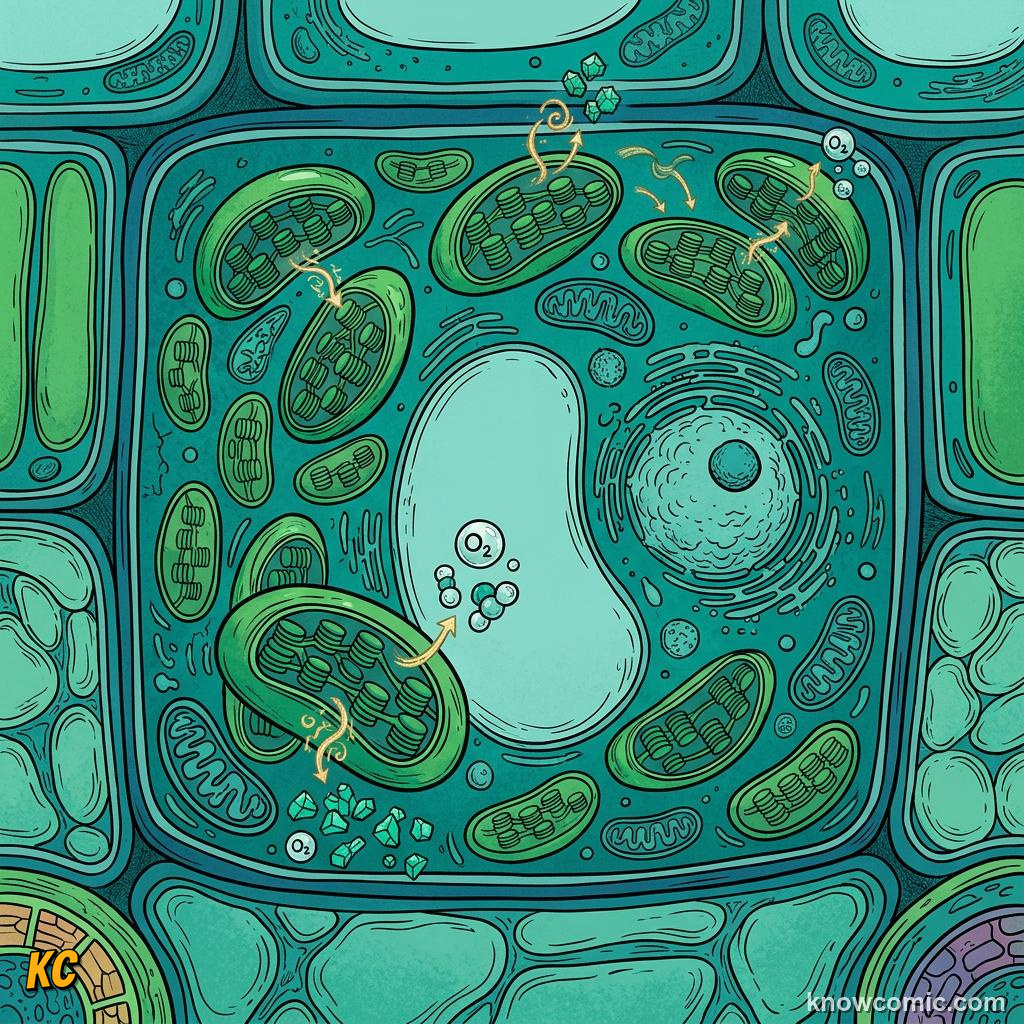
🌱 Found in plant cells and algae cells
🚫 Animal cells do not have chloroplasts
WHY GREEN
🟢 Chlorophyll gives them their green colour
☀️ Chlorophyll captures light energy from the Sun
PAGE 2 OF 5 — PHOTOSYNTHESIS
LIGHT TO LIFE
TURNING LIGHT INTO SUGAR
Chloroplasts run photosynthesis, one of the most important chemical jobs on Earth. They use sunlight, water, and carbon dioxide from the air to build glucose, a sugar the plant uses for energy and growth. Oxygen is released as a bonus gas that animals and humans breathe. Plants literally manufacture food from light and thin air inside these green organelles.
🍬 SUGAR FACTORY
The word photosynthesis means "making with light." Chloroplasts combine carbon dioxide and water using solar energy to produce glucose and release oxygen into the atmosphere.
SUGAR!
SUNLIGHT IN
☀️ Light energy enters through the leaf
🟢 Chlorophyll absorbs red and blue light
CO₂ FROM AIR
💨 Carbon dioxide enters through leaf pores
💧 Water travels up from the roots
OUTPUTS
🍬 Glucose feeds the plant's growth
🫁 Oxygen drifts out for us to breathe
PAGE 3 OF 5 — INSIDE THE CHLOROPLAST
GRANA
📚 Grana are stacks of disc-shaped thylakoids
☀️ Light reactions happen on these stacks
STROMA
🥣 Stroma is the fluid filling around the grana
🍬 Sugar-building steps finish here
TINY FACTORY FLOOR
GRANA AND STROMA WORK TOGETHER
Zoom into a chloroplast and you see two main zones. Grana look like stacks of green coins. They hold thylakoid membranes where chlorophyll captures sunlight and splits water. The stroma is the watery space surrounding those stacks, where enzymes stitch carbon dioxide into glucose. Light hits the grana first, then the stroma finishes building sugar molecules the cell can store and use.
🔬 MICRO VIEW
Under an electron microscope, grana appear as neat stacks inside the chloroplast. Scientists count these stacks to study how efficiently a plant captures light.
STACKS!
PAGE 4 OF 5 — AN ANCIENT MERGER
ENDOSYMBIOSIS
ONCE A FREE-LIVING BACTERIUM
Chloroplasts did not start as plant parts. Scientists believe they began as ancient cyanobacteria, tiny photosynthetic bacteria that lived on their own. Roughly 1.5 billion years ago, a larger cell swallowed a cyanobacterium but did not digest it. Instead, the two lived together. This partnership is called endosymbiosis, and it gave rise to green plants and algae as we know them today.
🧬 CLUES INSIDE
Chloroplasts have their own loop of DNA and a double outer membrane, just like a bacterium trapped inside a host cell. These clues support the endosymbiosis story.
MERGER!
CYANOBACTERIA
🦠 Cyanobacteria were early photosynthesizers
🌊 They still live in oceans and ponds today
DOUBLE WALL
🛡️ Two membranes wrap each chloroplast
🏠 Inner membrane came from the swallowed cell
OWN DNA
🧬 Chloroplasts carry a small ring of DNA
📖 It resembles bacterial DNA, not plant nucleus DNA
PAGE 5 OF 5 — ENGINE OF THE FOOD CHAIN
BASE OF LIFE
THE WORLD RUNS ON SUN TRAPS
Every bite of food you eat traces back to photosynthesis. Plants and algae capture sunlight in chloroplasts and store energy in sugar. Herbivores eat the plants, and carnivores eat the herbivores, but the original energy came from the Sun trapped by chlorophyll. Forests, farms, and ocean algae all depend on these green organelles. They are the invisible engine powering Earth's food chain and filling the air with oxygen.
🌍 BIG PICTURE
Scientists estimate that photosynthesis in plants and algae produces most of the oxygen in Earth's atmosphere and forms the base of nearly every food web on the planet.
LIFE!
OXYGEN GIFT
🫁 Oxygen from chloroplasts fills our air
🌊 Ocean algae trap Sun light underwater too
REMEMBER
☀️ KEY FACTS
Chloroplasts live in plant and algae cells. Chlorophyll captures sunlight for photosynthesis, which makes glucose and oxygen. Inside, grana stacks and stromal fluid work as a team. Endosymbiosis from ancient cyanobacteria explains why chloroplasts have their own DNA and double membranes.
🟢 Chlorophyll traps sunlight in green cells
📚 Grana plus stroma build sugar from air
🦠 Born from an ancient bacterial partnership
🧠 QUIZ TIME!
CHLOROPLASTS: SUN TRAP · 5 QUESTIONS
QUESTION 01
In which types of cells are chloroplasts found?
QUESTION 02
Which pigment captures light energy inside chloroplasts?
QUESTION 03
What are the main products of photosynthesis in chloroplasts?
QUESTION 04
What are the grana and stroma inside a chloroplast?
QUESTION 05
According to endosymbiosis, chloroplasts evolved from which organism?