📖 100 Topics🆓 ALL FREE⏱️ 5 min per comic🧠 Quiz included
📹
WATCH
Hours of Film
→
📊
REPORT
Data & Notes
→
🎯
SPOT
Weak Links
→
📋
BRIEF
Coach Gets Intel
→
🏆
EDGE
Hidden Advantage
🔍 SCOUTS & ANALYSTS
TOPIC 59 · WORLD CUP 2026 · LEVEL 5 · INSIDE THE TOURNAMENT
PAGE 1 OF 5 · THE HIDDEN ARMY
BEHIND THE SCENES
WHO ARE THE SCOUTS?
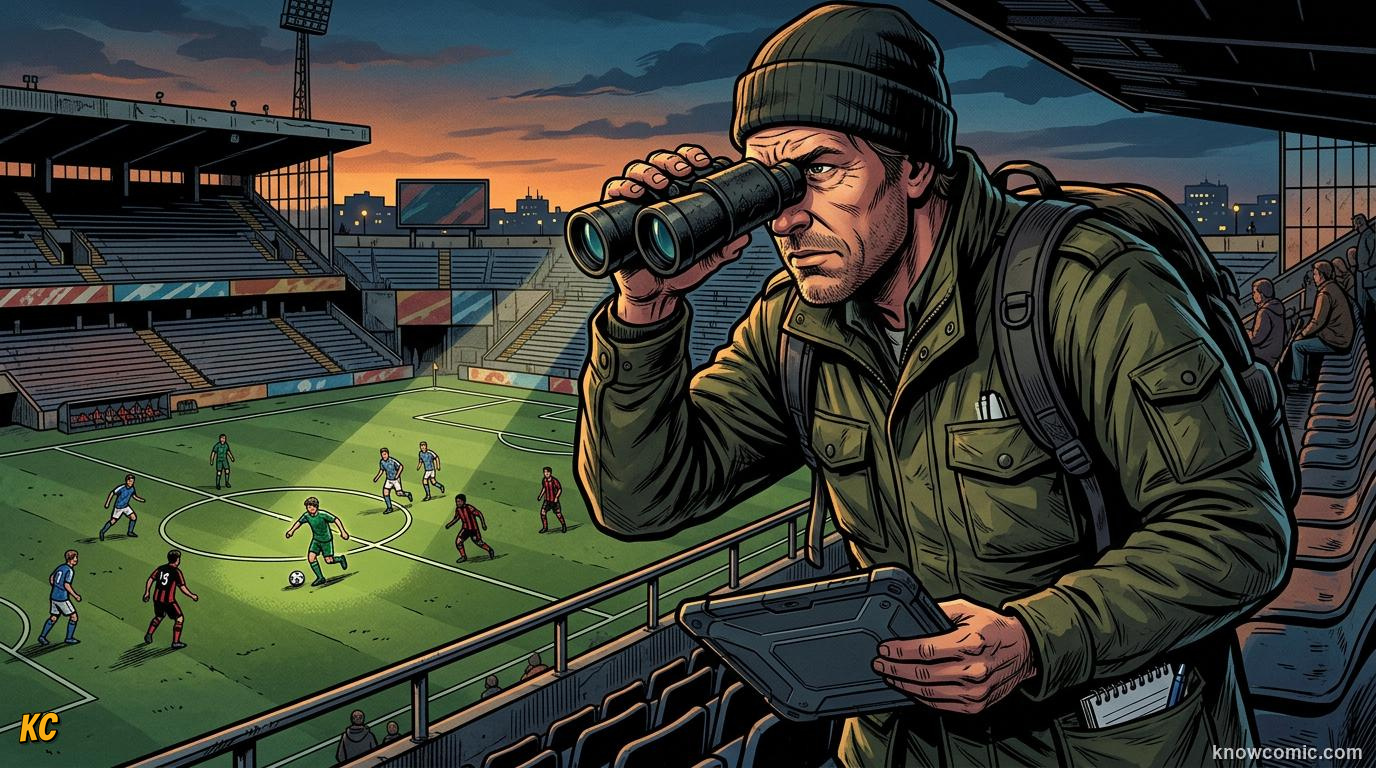
Fans see eleven players on the pitch, but every World Cup squad travels with a secret army of scouts and analysts. These are the people who watch football when everyone else sleeps. They sit in dark rooms with six screens playing different matches at once. Some flew to obscure league games months ago to watch a teenage winger nobody had heard of. Others never leave the hotel but tag every pass, sprint, and tackle with software. Scouts report on opponents. Analysts turn raw video into battle plans. Youth scouts hunt the next superstar in dusty stadiums far from the cameras. At World Cup 2026, data is as important as dribbling. GPS vests track how far players run. Heat maps show where a fullback gets tired. A scout might notice that a rival centre-back always steps forward on corners, leaving space behind. That tiny detail can win a knockout game. Coaches get dossiers thicker than phone books. Players receive short clips on tablets: "This is their left winger's favourite move." The hidden army never scores goals, but they help others score plenty.
⚡ DID YOU KNOW?
Top World Cup nations employ 10 to 20 full-time analysts during the tournament. Some teams review over 100 hours of opponent footage before a single knockout match.
WATCH!
SCOUTS

🌍 Travel to watch live matches
✍️ Write reports on players
ANALYSTS
💻 Tag video with software
📈 Turn stats into tactics
PAGE 2 OF 5 · VIDEO ANALYSIS
FILM ROOM
BREAKING DOWN THE OPPONENT
Modern World Cup preparation runs on video. Analysts clip every opponent goal from the last two years. They study how teams defend corners, who takes throw-ins quickly, and which striker drops deep to create space. Software lets them draw lines on the pitch and measure passing lanes in centimetres. A typical report includes three sections: strengths to respect, weaknesses to attack, and set-piece patterns to copy or block. Before a quarterfinal, players might watch a 12-minute highlight reel made just for them. Defenders see how the rival striker moves off the shoulder. Midfielders see where the number ten likes to receive the ball. Goalkeepers study penalty takers from past tournaments. Analysts also cut "what if" clips showing what happens when you press their left back early. The coach turns all of this into one clear message: "They panic when we speed up after the 70th minute." Video cannot replace talent, but it removes guesswork. Teams that ignore film often look surprised on the pitch.
⚡ SET PIECES
Analysts map every corner and free kick an opponent takes. Some nations score over 30 percent of World Cup goals from set pieces, making this homework vital.
FILM!
CLIPS
✂️ Short reels for each player
🎯 Focus on one habit at a time
DATA
📊 Heat maps show danger zones
🏃 Sprint counts reveal fatigue
LIVE
📡 Scouts watch rivals live at camp
🔄 Reports update after every match
PAGE 3 OF 5 · FINDING WEAKNESSES
PATTERNS
🔁 Same mistake repeated often
⚠️ One flaw can decide a tie
MATCHUPS
⚡ Speed vs slow defenders
📏 Height vs short keepers
THE SECRET EDGE
HOW SCOUTS SPOT A CRACK
Great scouting is about patterns, not luck. A scout rewinds the same corner kick ten times and notices the tallest defender always blocks the near post while nobody marks the far edge. That becomes a training drill the next morning. Analysts track "transition moments" when teams switch from attack to defence. Some nations leave huge gaps if they lose the ball quickly. Others struggle when pressed high because their goalkeeper passes short under pressure. Scouts also study individuals. Does their star winger always cut inside on his stronger foot? Does their captain argue with the referee when losing? Psychology matters. World Cup knockout games are tight. One weakness exploited twice can end a dream. Coaches trust scouts who prove their hunches with evidence. "I feel their left side is slow" is useless. "Their left back was beaten four times in the last two games after minute 65" wins the meeting. The best intel stays secret inside the camp. Leaks to journalists can warn rivals before kickoff.
⚡ OPPOSITION SCOUTS
FIFA allows teams to watch rivals train from a distance, but serious scouting happens through broadcast and match footage. Spy stories make headlines, but video libraries do the real work.
SPOT!
PAGE 4 OF 5 · DISCOVERING STARS
TOMORROW'S HEROES
YOUTH SCOUTING AT THE WORLD CUP
Scouting is not only about beating the next opponent. World Cup stadiums become shopping windows for the future. Club scouts from Europe, South America, and Asia sit in the stands with notebooks and laptops, hunting teenagers who shine on the biggest stage. A 19-year-old who scores in a group game might earn a move to a giant club overnight. National team scouts look further ahead too. Who might lead the squad in 2030? They watch youth tournaments, school games, and lower-league matches years before a World Cup call-up. Good scouts judge character as well as skill. Does the kid work hard when losing 3-0? Do they celebrate teammates or hog the ball? Famous discoveries include players spotted in dusty fields who later became Ballon d'Or winners. The job requires patience and a sharp eye. One scout might watch 50 matches to find one gem. At World Cup 2026, with more nations and more stories, unknown names will burst onto the world stage. The scouts who found them first will smile quietly in the stands.
⚡ FAMOUS FINDS
Legends like Lionel Messi were spotted as boys by club scouts who saw something special in small-sided games long before the world knew their names.
FIND!
EYE TEST
👁️ Scouts trust live viewing
🌱 Youth games hide future stars
CHARACTER
💪 Attitude matters as much as skill
🤝 Team players rise faster
WORLD STAGE
🌍 One great game changes a career
📞 Clubs call agents within hours
PAGE 5 OF 5 · THE INTEL GAME
WINNING WITH INFO
SCOUTS SHAPE THE TOURNAMENT
World Cup winners rarely surprise opponents with raw magic alone. They combine talent with preparation. Scouts and analysts give coaches the confidence to change shape at halftime because the data supports it. They help a substitute know exactly where to run on his first touch. They warn goalkeepers which penalty taker bluffs left but shoots right. The work is invisible when it succeeds. Fans credit the striker, not the analyst who clipped the defensive error. Technology keeps advancing. Artificial intelligence now suggests patterns humans might miss, but human judgment still matters. A scout's gut feeling after watching a player live can override a spreadsheet. At World Cup 2026, the nations that blend old-school watching with modern data will hold an edge. The hidden army never lifts the trophy, yet no trophy lift happens without them. Next time you watch a perfectly timed run or a blocked corner routine, remember someone spent nights finding that opening.
⚡ WORLD CUP 2026
With 48 teams and more matches than ever, scouting departments will be busier than any previous tournament. Information overload is the new challenge.
Scouts and analysts watch hours of video, write reports on opponents, spot weaknesses, and discover young talent. Their hidden work helps coaches and players win World Cup matches.
📹 Video turns patterns into plans
🎯 Small details win big games
🌟 Scouts find tomorrow's stars