☮️
🕊️
⚽ FOR KIDS & EVERYONE · NO EXPERIENCE NEEDED

WORLD CUP
2026

☮️ Christmas Truce 1914 · ⚽ Football Stops Wars · 🕊️ Beautiful Game

📖 100 Topics 🆓 ALL FREE ⏱️ 5 min per comic 🧠 Quiz included
🕊️
1914
Christmas Truce
☮️
1969
Football War Ends
🤝
2009
Ivory Coast WC Unity
🌍
2022
Qatar Unity Moments
TODAY
Football as Bridge
☮️ FOOTBALL & PEACE
TOPIC 97 · WORLD CUP 2026 · LEVEL 8 · HISTORY & HUMANITY
PAGE 1 OF 5 — 1914: THE CHRISTMAS TRUCE
WORLD WAR ONE, DECEMBER 1914
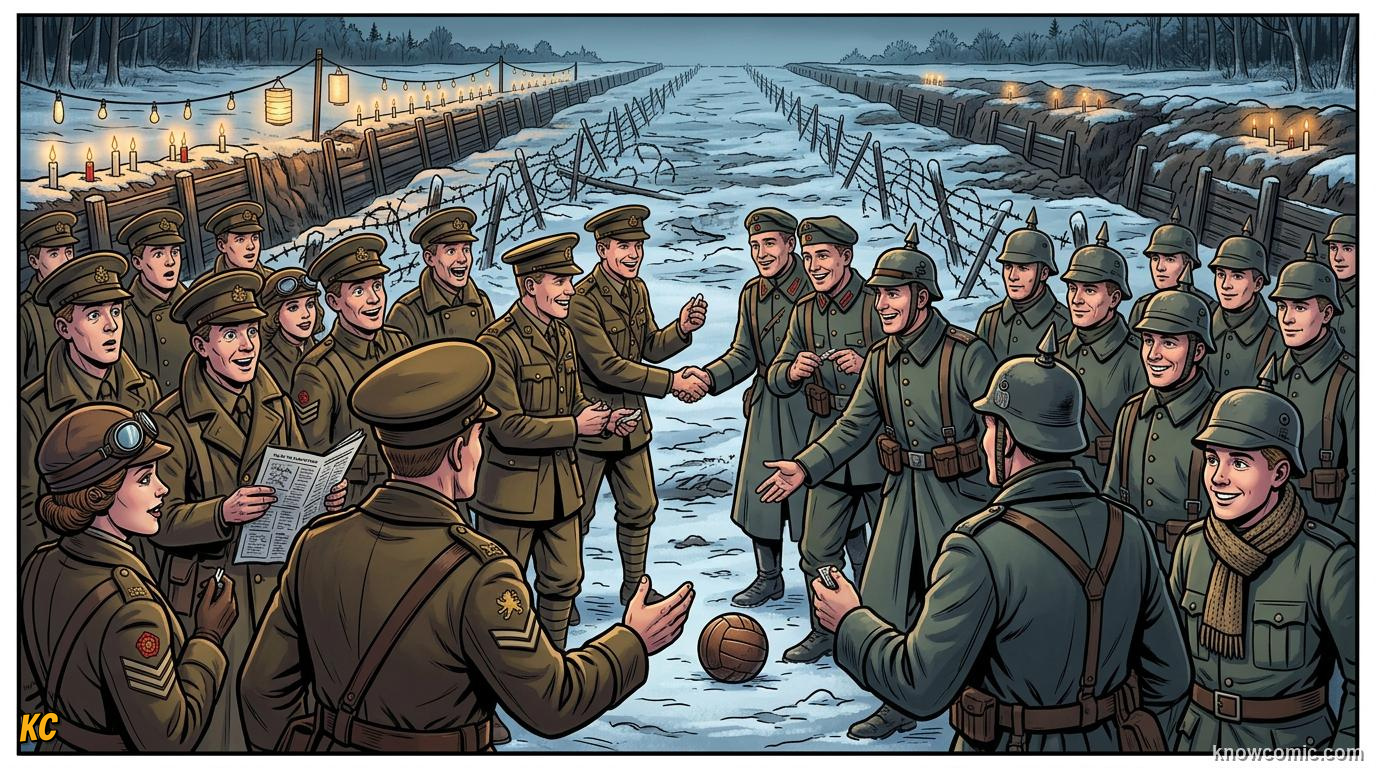
Comic panel titled the day enemies played football together, labelled world war one, december 1914, from the KnowComic World Cup 2026 lesson on football & peace
THE DAY ENEMIES PLAYED FOOTBALL TOGETHER
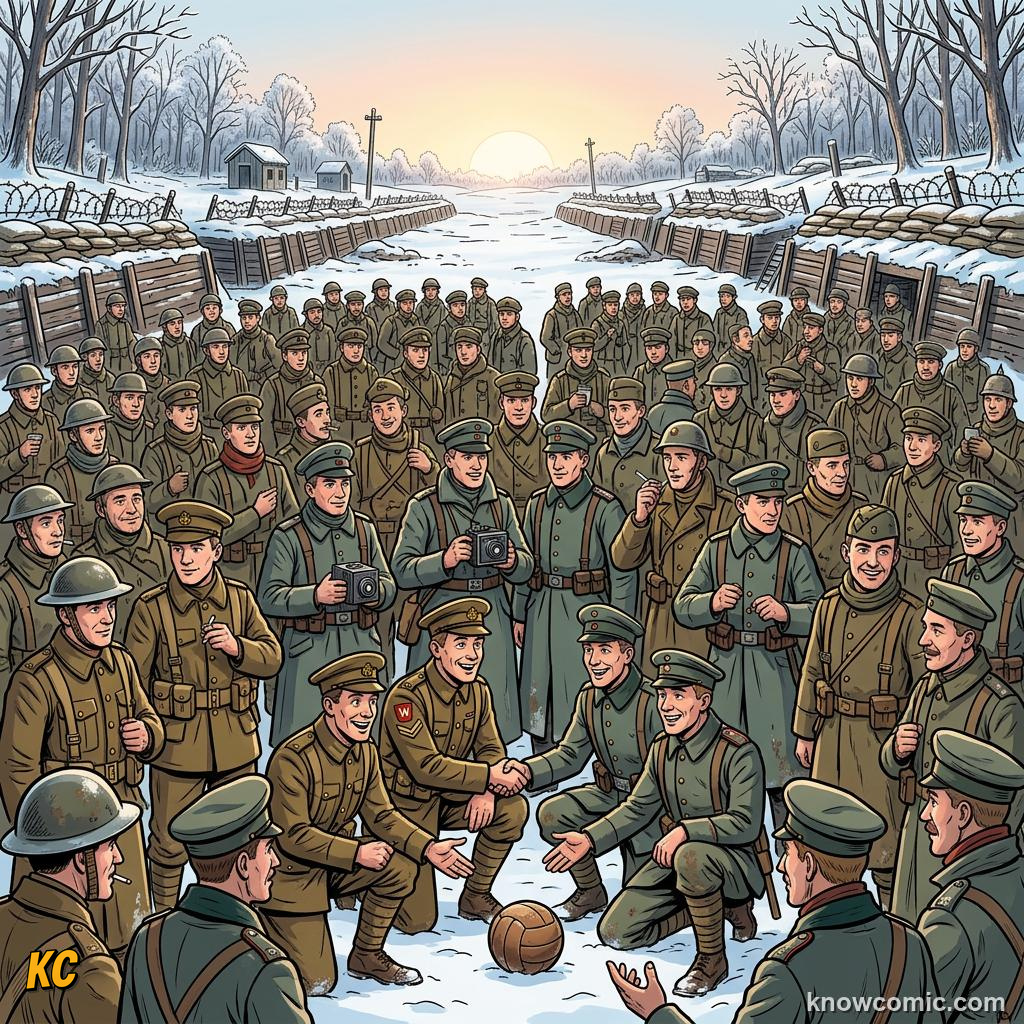
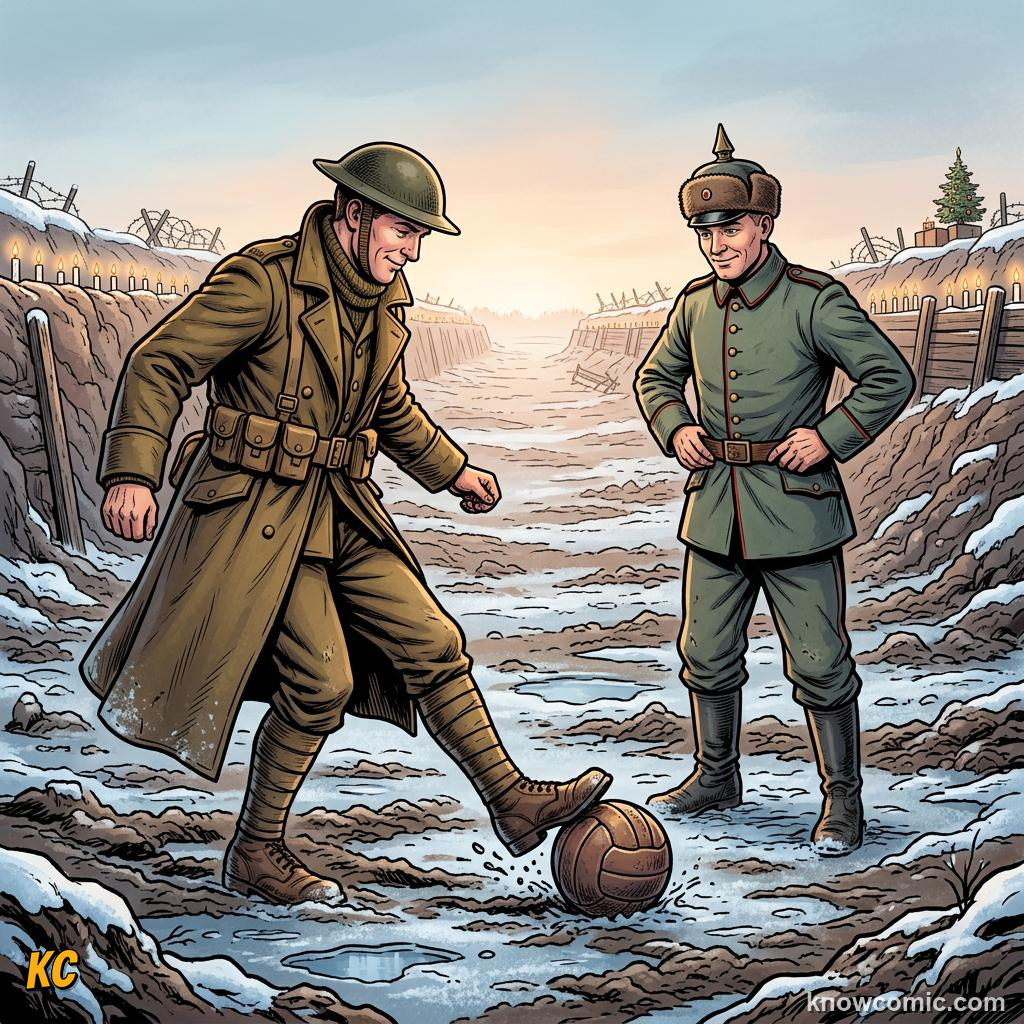
On Christmas Day 1914, something happened on the Western Front in Belgium that nobody had ordered and nobody had planned, and that still moves people to tears more than a century later. British and German soldiers had been fighting each other in the mud and cold for months, losing thousands of men on both sides in one of the deadliest conflicts in human history. Then, on Christmas Eve, German soldiers began lighting candles and singing carols from their trenches. British soldiers heard them and cautiously called back. On Christmas morning, men from both sides climbed out of their trenches into the open ground called No Man's Land, shook hands with the enemy they had been trying to kill, and began to play football on the frozen ground between the two lines of trenches. There was no referee, no proper pitch, no nets, and certainly no score agreed upon. But for a few extraordinary hours, men from two nations at war forgot they were supposed to be fighting and played the beautiful game together. Officers on both sides recorded the event in letters home. Some described it as one of the most moving moments they had ever witnessed. The truce did not end the war, and fighting resumed afterwards, but the Christmas Truce of 1914 became one of the most famous stories of human connection ever told, and football was at its heart.
⚡ DID YOU KNOW?
The Christmas Truce of 1914 was not organised by any military commander. It began spontaneously when German soldiers lit candles and sang carols, and British soldiers across No Man's Land answered back with their own songs.
PEACE!
NO MAN'S LAND
Comic panel titled the strange case of the war football helped start, labelled no man's land, from the KnowComic World Cup 2026 lesson on football & peace
🕊️ British and German soldiers met in the middle
🤝 Shook hands with their enemies
⚽ Kicked a ball on the frozen ground
THE STORY
Comic panel titled the strange case of the war football helped start, labelled the story, from the KnowComic World Cup 2026 lesson on football & peace
🕯️ Germans lit candles and sang carols first
📜 Soldiers wrote home about it with wonder
🌍 No orders needed, it just happened
PAGE 2 OF 5 — THE FOOTBALL WAR OF 1969
WHEN FOOTBALL SPARKED A WAR
Comic panel titled the strange case of the war football helped start, labelled when football sparked a war, from the KnowComic World Cup 2026 lesson on football & peace
THE STRANGE CASE OF THE WAR FOOTBALL HELPED START
Football has usually brought people together, but in 1969 it was at the centre of the strangest and most tragic episode in the sport's relationship with politics. Honduras and El Salvador, two Central American neighbours with longstanding tensions over land, migration, and political disputes, met in a three-match World Cup qualifying series in June 1969. The matches were extraordinarily tense. After each of the first two games, there were riots involving fans of both nations. The third and deciding match, played in Mexico City on a neutral ground, was won by El Salvador three to two in extra time. Within days, El Salvador had launched a military attack on Honduras. The four-day war that followed left around three thousand people dead before a ceasefire was arranged. The conflict became known internationally as the Football War, though historians note that football was merely the trigger for tensions that had been building for many years over serious political and economic grievances. The war ended with a formal peace treaty signed a decade later in 1980. The story is a reminder that while sport can be a powerful force for connection, it can also be a mirror that reflects the real tensions between communities, and it is the job of leaders and nations to resolve those tensions rather than let sport become the flame that ignites them.
⚡ DID YOU KNOW?
The Football War of 1969 between Honduras and El Salvador lasted just four days. Football was the trigger, but the real causes were longstanding disputes over land rights, migration, and economic inequality between the two countries.
RIVALRY!
THE MATCH
Comic panel titled the football captain who asked a nation to stop fighting, labelled the match, from the KnowComic World Cup 2026 lesson on football & peace
⚽ El Salvador beat Honduras 3-2 in extra time
🏟️ Third match played in neutral Mexico City
😡 Riots followed each of the three games
THE WAR
Comic panel titled the football captain who asked a nation to stop fighting, labelled the war, from the KnowComic World Cup 2026 lesson on football & peace
💥 Military conflict began within days of the match
⏱️ War lasted just four days
☮️ Peace treaty eventually signed in 1980
THE LESSON
Comic panel titled the football captain who asked a nation to stop fighting, labelled the lesson, from the KnowComic World Cup 2026 lesson on football & peace
🧠 Football reflected deeper tensions, not caused them
🤝 Sport must not substitute for real diplomacy
🌍 Today the two nations play peacefully
PAGE 3 OF 5 — IVORY COAST 2005: A TEAM STOPS A WAR
CIVIL WAR
Comic panel titled the football captain who asked a nation to stop fighting, labelled civil war, from the KnowComic World Cup 2026 lesson on football & peace
🌍 Ivory Coast split by civil war since 2002
🇨🇮 North and south of the country at war
😢 Thousands killed, millions displaced
THE MESSAGE
Comic panel titled the football captain who asked a nation to stop fighting, labelled the message, from the KnowComic World Cup 2026 lesson on football & peace
📺 Drogba's plea broadcast live on national TV
🤲 Begged the warring sides to stop fighting
☮️ A ceasefire followed within weeks
DIDIER DROGBA'S PLEA
Comic panel titled the football captain who asked a nation to stop fighting, labelled didier drogba's plea, from the KnowComic World Cup 2026 lesson on football & peace
THE FOOTBALL CAPTAIN WHO ASKED A NATION TO STOP FIGHTING
In 2002 the Ivory Coast, also called Cote d'Ivoire, fell into a brutal civil war that split the country between the government-controlled south and rebel-held north. By 2005 thousands of people had been killed and millions had been displaced from their homes. Then the national football team did something that politicians, peacekeepers, and diplomats had been unable to do. Ivory Coast qualified for the 2006 World Cup in Germany for the very first time in their history, and in the dressing room after the qualification victory, captain Didier Drogba, one of the most famous footballers in Africa, grabbed a television microphone and broadcast a message to the entire nation: he begged the warring sides to lay down their arms and give peace a chance in honour of the team's achievement. His teammates knelt on the ground together, united, from both the north and south of the divided country, showing visually that a team could represent a whole nation regardless of which side of a political divide each player came from. A ceasefire between the government and rebel forces followed within weeks. Historians debate how much Drogba's speech directly caused the peace, but no one doubts that it was one of the most extraordinary moments of football's power to reach across political division and speak to something shared and human.
⚡ DID YOU KNOW?
Didier Drogba deliberately asked for the World Cup qualifier celebration match to be played in Bouake, in the rebel-held north of Ivory Coast, as a gesture of unity, bringing the national team to a part of the country it had not visited during the civil war.
UNITY!
PAGE 4 OF 5 — FOOTBALL AS A BRIDGE ACROSS BORDERS
SPORT DIPLOMACY
Comic panel titled how football opens doors that politics closes, labelled sport diplomacy, from the KnowComic World Cup 2026 lesson on football & peace
HOW FOOTBALL OPENS DOORS THAT POLITICS CLOSES
Football has a unique ability to create moments of genuine human connection between people from nations that might otherwise have no positive relationship at all. When the United States and Iran met at the 1998 World Cup in France, the two countries had not had formal diplomatic relations for nearly twenty years following the Iranian Revolution and hostage crisis. Yet on the pitch in Lyon, the American and Iranian players exchanged white flowers and posed for a team photograph together before kick-off, a gesture of goodwill that was watched by hundreds of millions of people around the world. Iran won the match one to nil, but both sides called the encounter a victory for football and humanity. This type of sporting diplomacy has happened repeatedly throughout World Cup history. Nations that are in conflict or have strained diplomatic relations are still required to show up to a match, shake hands with the opposition, and play the game fairly under a shared set of rules. There is something profoundly democratic about the World Cup: it places every nation on an equal pitch, and for ninety minutes it asks them to compete, not with weapons or armies, but with skill, fitness, and teamwork. Football cannot solve the world's political problems, but it can remind us, every four years in front of billions of people, that those problems are not the whole story of who we are.
⚡ DID YOU KNOW?
When the USA played Iran at the 1998 World Cup, they exchanged white flowers and posed for a joint photo before the match. The two countries had been without formal diplomatic relations for nearly 20 years at the time.
BRIDGE!
USA vs IRAN 1998
Comic panel titled why a football can go where a diplomat cannot, labelled usa vs iran 1998, from the KnowComic World Cup 2026 lesson on football & peace
🌸 Both teams exchanged white flowers
📸 Posed for a joint team photo
🤝 No diplomatic relations for 20 years
EQUAL PITCH
Comic panel titled why a football can go where a diplomat cannot, labelled equal pitch, from the KnowComic World Cup 2026 lesson on football & peace
⚖️ Every nation plays by the same rules
🌍 Rich or poor, large or small, all equal
🏆 Merit decides who wins, not power
OTHER MOMENTS
Comic panel titled why a football can go where a diplomat cannot, labelled other moments, from the KnowComic World Cup 2026 lesson on football & peace
🌏 North and South Korea in the same WC in 2002
🤝 Players from warring nations swap jerseys
⭐ Football creates memories that outlast politics
PAGE 5 OF 5 — WHY FOOTBALL REACHES WHERE NOTHING ELSE CAN
THE BEAUTIFUL GAME'S POWER
Comic panel titled why a football can go where a diplomat cannot, labelled the beautiful game's power, from the KnowComic World Cup 2026 lesson on football & peace
WHY A FOOTBALL CAN GO WHERE A DIPLOMAT CANNOT
Football reaches people that politicians, religious leaders, and even artists sometimes cannot. The reason is partly that a football is one of the simplest objects in the world: round, light enough for a child to kick, and understandable to anyone who sees it rolling across the ground. Every culture on earth has some version of kicking a ball. The rules of football can be explained in a few minutes. You do not need to speak the same language to play it together. All of this means that a ball dropped between two groups of people who would otherwise have nothing to say to each other can, sometimes, open a conversation that words alone could not start. The United Nations actually recognises football as a tool for development and peace, and organisations around the world use the sport to bring together communities divided by conflict, poverty, and discrimination. The 2026 World Cup will, like every World Cup, bring together nations whose governments may be in dispute, whose citizens may have been told to distrust each other, and ask them to come and compete on a shared green pitch under shared rules watched by a shared global audience. For ninety minutes at a time, that is a kind of peace. The Christmas Truce of 1914 proved something that a hundred years of World Cups has confirmed: when you give people a ball, they would often rather play than fight.
BEAUTIFUL!
UN RECOGNITION
Comic panel labelled un recognition, illustrating football & peace in KnowComic's World Cup 2026 series
🌐 UN recognises football as a peace tool
🤝 Sport used in conflict zones worldwide
⚽ Ball needs no translator
REMEMBER
☮️ KEY FACTS
Christmas Truce 1914: enemy soldiers played football in No Man's Land. Ivory Coast 2005: Drogba's plea after World Cup qualification helped bring a ceasefire. USA vs Iran 1998: flowers and a joint photo between nations with no diplomatic relations.
🕯️ 1914 truce began with carols, not orders
🌍 Football War: sport mirrors real tensions
🕊️ 2026 brings 48 nations to one pitch
🧠 QUIZ TIME!
FOOTBALL & PEACE · 5 QUESTIONS
QUESTION 01
How did the 1914 Christmas Truce begin on the Western Front?
QUESTION 02
The Football War of 1969 was fought between which two countries?
QUESTION 03
Didier Drogba's famous peace plea in 2005 was made on behalf of which country?
QUESTION 04
What gesture did the USA and Iran make before their 1998 World Cup match?
QUESTION 05
Why does the United Nations formally recognise football as a tool for peace?
0/5
LOADING...
No comments yet, be the first!
← TOPIC 96 📋 ALL TOPICS TOPIC 98 →