🏛️
🗿
🏺
✦ ART & CULTURE ✦

ART &
CULTURE!

🎨 From Cave Walls to Masterpieces, Humanity's First Art!

📖 200 Topics ⏱️ 5 min per comic 🧠 Quiz included
🗿
600 BCE
Stiff Kouros Statues
🏃
480 BCE
Statues Come Alive
🏛️
447 BCE
The Parthenon Rises
🏺
100 BCE
Romans Copy Everything
🏟️
TODAY
Still the Gold Standard
🗿 GREEK IDEALISM
TOPIC 03 · ART & CULTURE · ANCIENT GREECE · 600–100 BCE
PAGE 1 OF 5 — THE MARBLE WAKES UP
ATHENS · ANCIENT GREECE
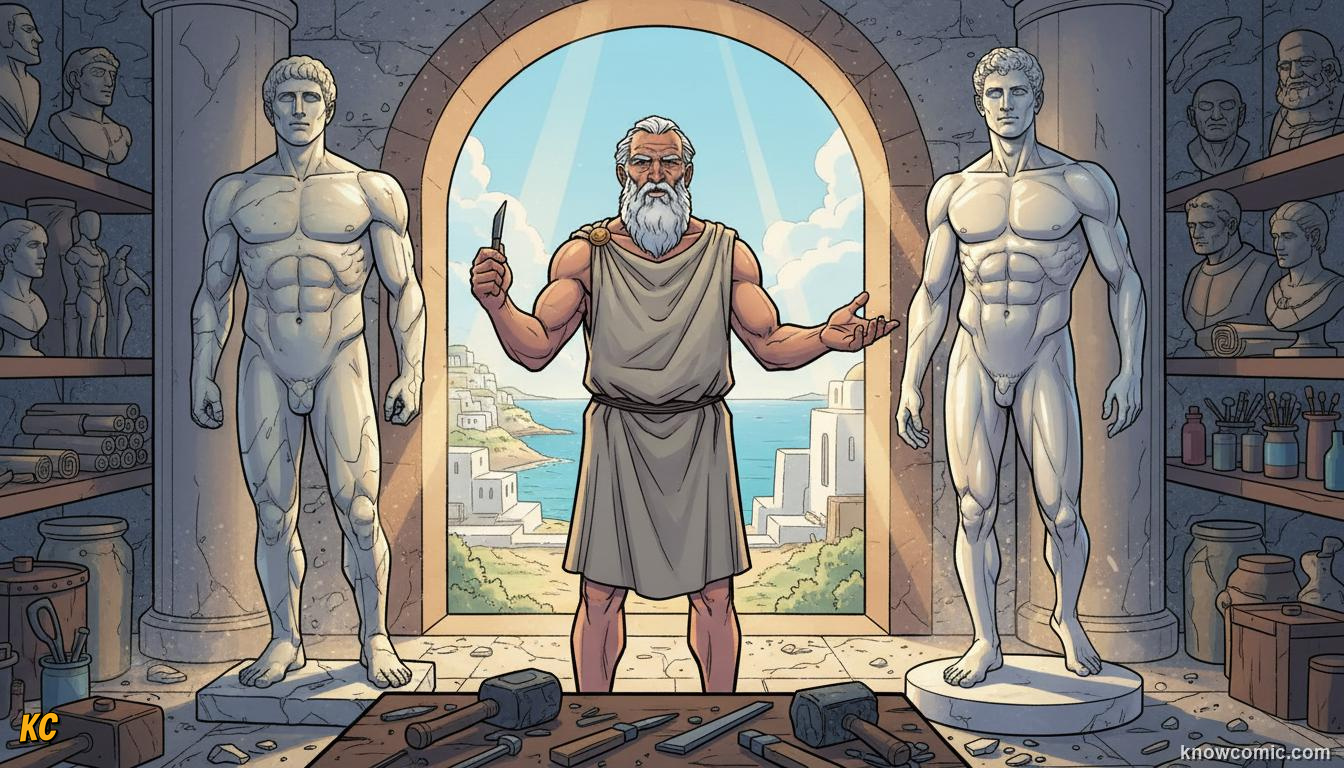
A Greek sculptor in his workshop beside a stiff old statue and a new lifelike marble athlete that seems ready to move
THE STATUES LEARNED TO MOVE
For centuries, Greek statues stood stiff as boards: arms glued to their sides, fists clenched, one foot forward, copying the frozen pose of Egyptian art. Then, around 2,500 years ago, something amazing happened. Greek sculptors began to study real bodies, real muscles and real movement. Their marble figures shifted their weight onto one leg, turned their heads, and seemed to breathe. For the first time in history, stone looked truly alive. Art would never be the same again.
⚡ DID YOU KNOW?
The relaxed standing pose, weight on one leg and hip tilted, is called contrapposto. Sculptors still use it today, and you probably stand that way while waiting for the bus.
ALIVE!
BEFORE: KOUROS
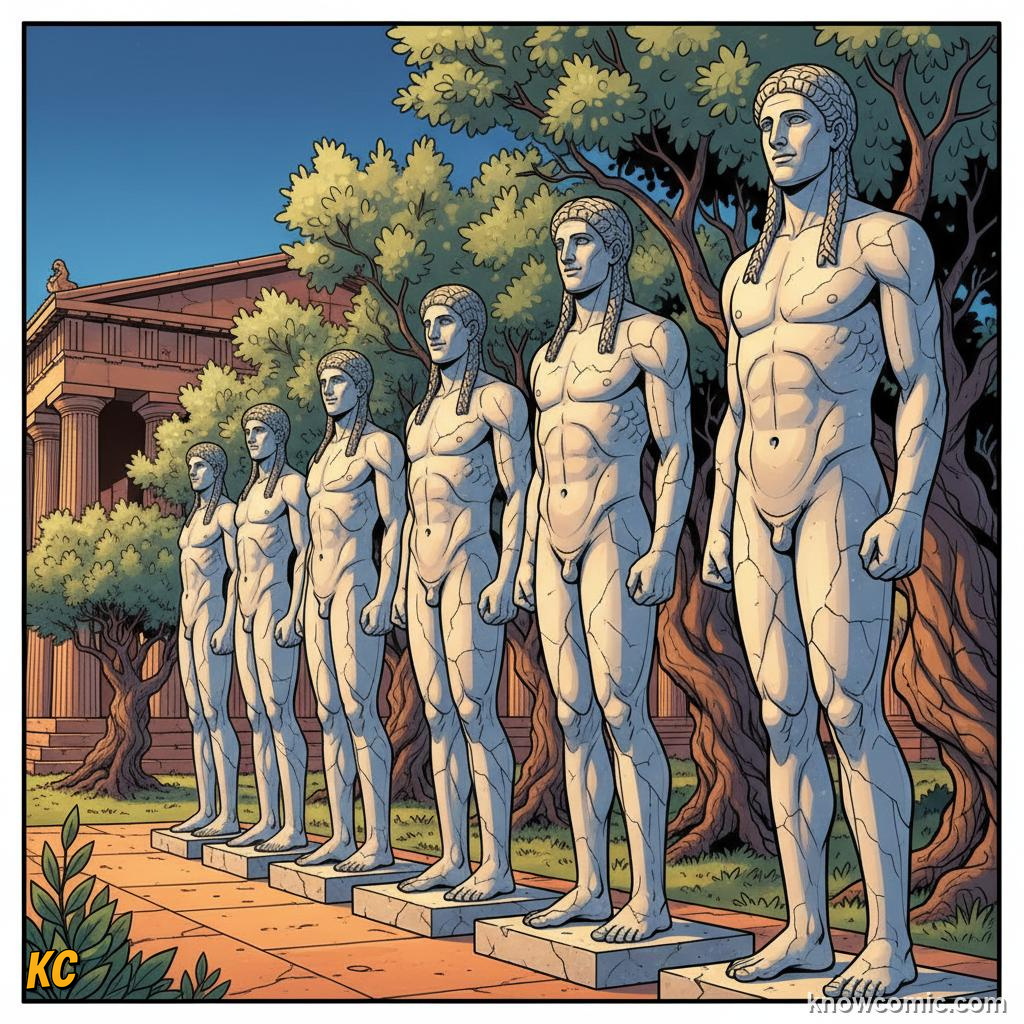
A row of stiff archaic Greek kouros statues with rigid arms, clenched fists and faint smiles
🗿 Early statues stood stiff and frozen
😐 They all wore the same faint "archaic smile"
🇪🇬 The pose was borrowed from Egypt
AFTER: ALIVE
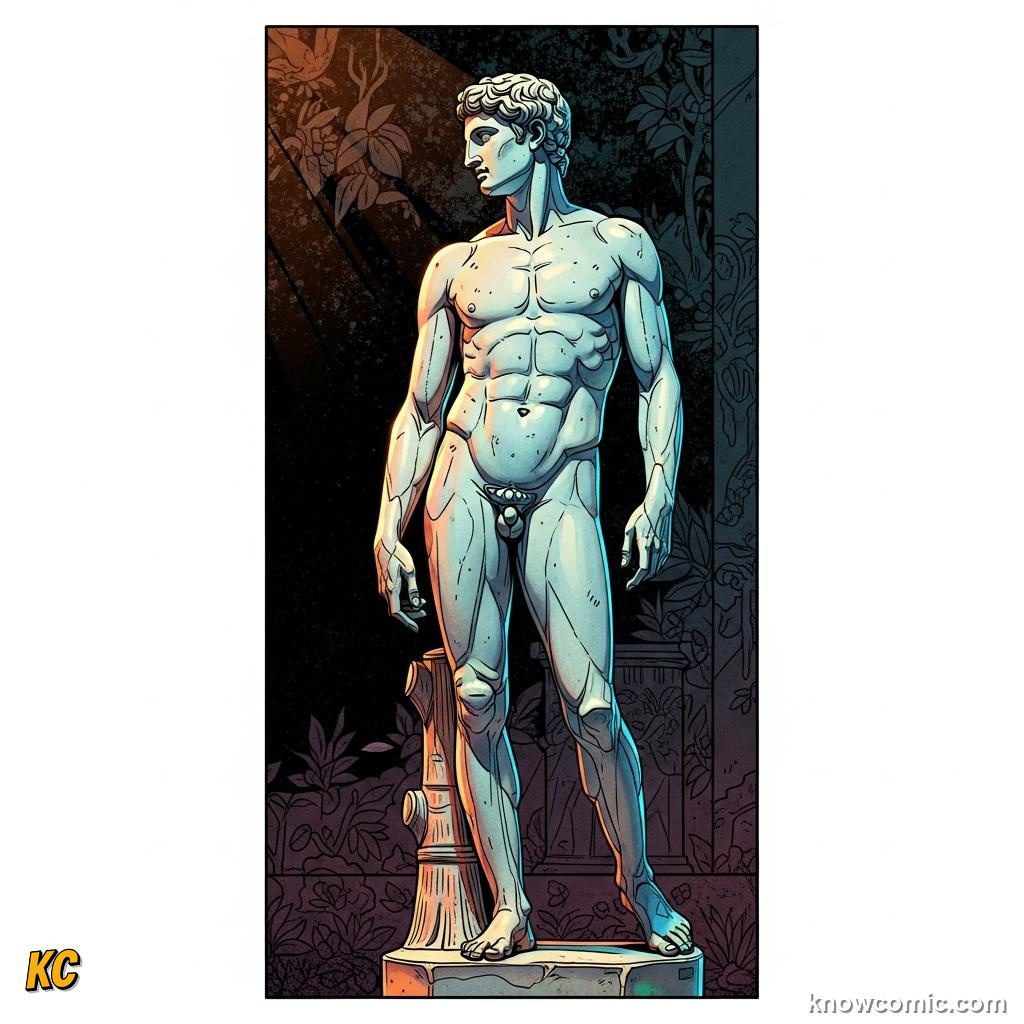
A lifelike classical Greek marble statue standing relaxed with weight on one leg
🏃 Weight shifted onto one relaxed leg
💪 Muscles, veins and skin looked real
⚡ The figure seemed about to step forward
PAGE 2 OF 5 — THE HUNT FOR PERFECTION
IDEALISM
A magnificent Greek marble statue of a discus thrower frozen mid-spin showing perfect athletic form
NOT REAL BODIES, PERFECT BODIES
Here is the secret of Greek idealism: the statues do not show people as they really were. They show people as they could be at their absolute best. Sculptors watched athletes train for the Olympic Games, studied every muscle, then combined the best features into one flawless figure. No scars, no wrinkles, no bad hair days. A famous sculptor named Polykleitos even wrote a rulebook of perfect body maths, called the Canon, where every part fits the whole in exact proportion. Beauty, the Greeks believed, was a kind of mathematics.
PERFECT!
BODY MATHS
A Greek sculptor measuring a marble statue with calipers to check its perfect proportions
📐 Polykleitos wrote the Canon of proportions
🧮 Every body part followed exact ratios
OLYMPIC MODELS
Greek athletes running and throwing in an ancient stadium while an artist sketches them
🏃 Olympic athletes were the artists' models
🏆 Winners sometimes got their own statue
GODS AS HUMANS
A majestic Greek marble statue of Zeus with flowing beard and powerful ideal body
⚡ Gods like Zeus got perfect human bodies
✨ A perfect body showed a perfect spirit
PAGE 3 OF 5 — CHISELS, BRONZE AND SECRET COLOURS
THE TOOLS
Greek sculptor's tools laid on a bench: bronze chisels, wooden mallets, drills, rasps and calipers with marble dust
🔨 Mallets, chisels and drills shaped the stone
⏳ One statue could take years to finish
SECRET COLOURS
A Greek marble statue half painted in bright colours showing that ancient statues were not plain white
🌈 Greek statues were painted in bright colours
🕰️ The paint wore off over the centuries
INSIDE THE WORKSHOP
Greek sculptors carving a colossal marble figure in a busy workshop filled with dust and tools
STONE, SWEAT AND LIQUID METAL
Carving began at the marble quarry, where workers cut huge blocks using wooden wedges soaked in water that swelled and split the rock. In the workshop, sculptors chipped away for months with bronze chisels, finishing the surface with rasps and polish until it glowed like skin. Many famous statues were not marble at all but bronze, cast by the lost-wax method: sculptors made a wax model, coated it in clay, melted the wax out and poured liquid bronze into the gap. And here is the biggest surprise: when finished, statues were painted head to toe in bold, bright colours.
🎨 THE WHITE MARBLE MYTH
We imagine Greek statues as pure white, but that is only because the paint faded. Scientists shine ultraviolet light on statues to reveal ghost patterns of their original rainbow colours.
TAP-TAP!
PAGE 4 OF 5 — ATHENS BUILDS A MASTERPIECE
THE GOLDEN AGE
The gleaming Parthenon temple on the Acropolis of Athens with marble columns and sculpted figures, citizens below
A TEMPLE LIKE A GIANT SCULPTURE
In 447 BCE, Athens began building the Parthenon, a marble temple for the goddess Athena on the rocky hill called the Acropolis. The master sculptor Phidias filled it with carvings: battling centaurs, parading citizens, and gods lounging at a feast. The builders even used optical tricks, curving the floor and tilting the columns slightly inward so the whole temple looks perfectly straight to your eye. Inside stood Phidias' wonder: a 12-metre statue of Athena covered in gold and ivory, glittering in the dim light.
GLORIOUS!
GIANT ATHENA
The colossal gold and ivory statue of Athena inside the Parthenon towering over tiny visitors
🌟 Athena stood 12 metres tall in gold and ivory
🦉 She held a small winged victory in one hand
STORY VASES
A Greek terracotta vase painted with black and red figures of heroes and chariots
🏺 Vases told hero stories in red and black
📚 They are like ancient comic books in clay
THE FRIEZE
Marble relief frieze of Greek riders and citizens in procession carved in shallow depth
🐎 A 160-metre carved parade wrapped the temple
🚶 Riders, musicians and citizens march forever
PAGE 5 OF 5 — TWO THOUSAND YEARS OF ECHOES
THE LEGACY
Children sketching in a bright museum hall lined with classical Greek marble statues
THE STYLE THAT NEVER DIED
Greek idealism set the standard for Western art for the next two thousand years. The Romans loved Greek statues so much they ordered marble copies by the shipload, and those copies are often the only versions that survive today. A thousand years later, Renaissance masters like Michelangelo dug up Greek and Roman sculptures and learned perfection all over again. Even now you can spot Greek ideas everywhere: in museum halls, on sports trophies, in superhero bodies, and in any building with grand marble columns.
🏛️ THANK THE COPYCATS
Most original Greek bronzes were melted down long ago for their metal. Without the Roman habit of copying Greek art in marble, we would barely know what it looked like.
ECHOES!
VISIT TODAY
Visitors on the sunny Acropolis of Athens walking toward the Parthenon ruins
🏛️ The Parthenon still crowns Athens today
🖼️ Greek marbles fill the world's museums
🏟️ Stadium statues still copy Greek poses
REMEMBER THIS
📌 KEY FACTS
🏃 Greek statues came alive with contrapposto

📐 Beauty followed body maths, the Canon

🌈 Statues were painted, not plain white

🏛️ The Parthenon was Athens' marble masterpiece

🏺 Roman copies saved Greek art for us
🧠 QUIZ TIME!
GREEK IDEALISM · 5 QUESTIONS
QUESTION 01
What kind of human body did Greek idealist artists want to show?
QUESTION 02
What is contrapposto?
QUESTION 03
What did Greek statues originally look like?
QUESTION 04
What was the Canon of Polykleitos?
QUESTION 05
Why are Roman copies of Greek statues so important today?
0/5
LOADING...
← TOPIC 02 📋 ALL TOPICS TOPIC 04 →