☦️
✦ ART & CULTURE ✦

ART &
CULTURE!

🎨 From Cave Walls to Masterpieces, Humanity's First Art!

📖 200 Topics ⏱️ 5 min per comic 🧠 Quiz included
330 CE
Constantinople Founded
🏛️
537 CE
Hagia Sophia Rises
🔨
726 CE
The Icons Are Smashed
☦️
843 CE
The Icons Return
TODAY
Still Painted by the Same Rules
✨ BYZANTINE ICONS
TOPIC 05 · ART & CULTURE · BYZANTINE EMPIRE · 330–1453 CE
PAGE 1 OF 5 — STEPPING INTO A GOLDEN HEAVEN
CONSTANTINOPLE · A GREAT CHURCH
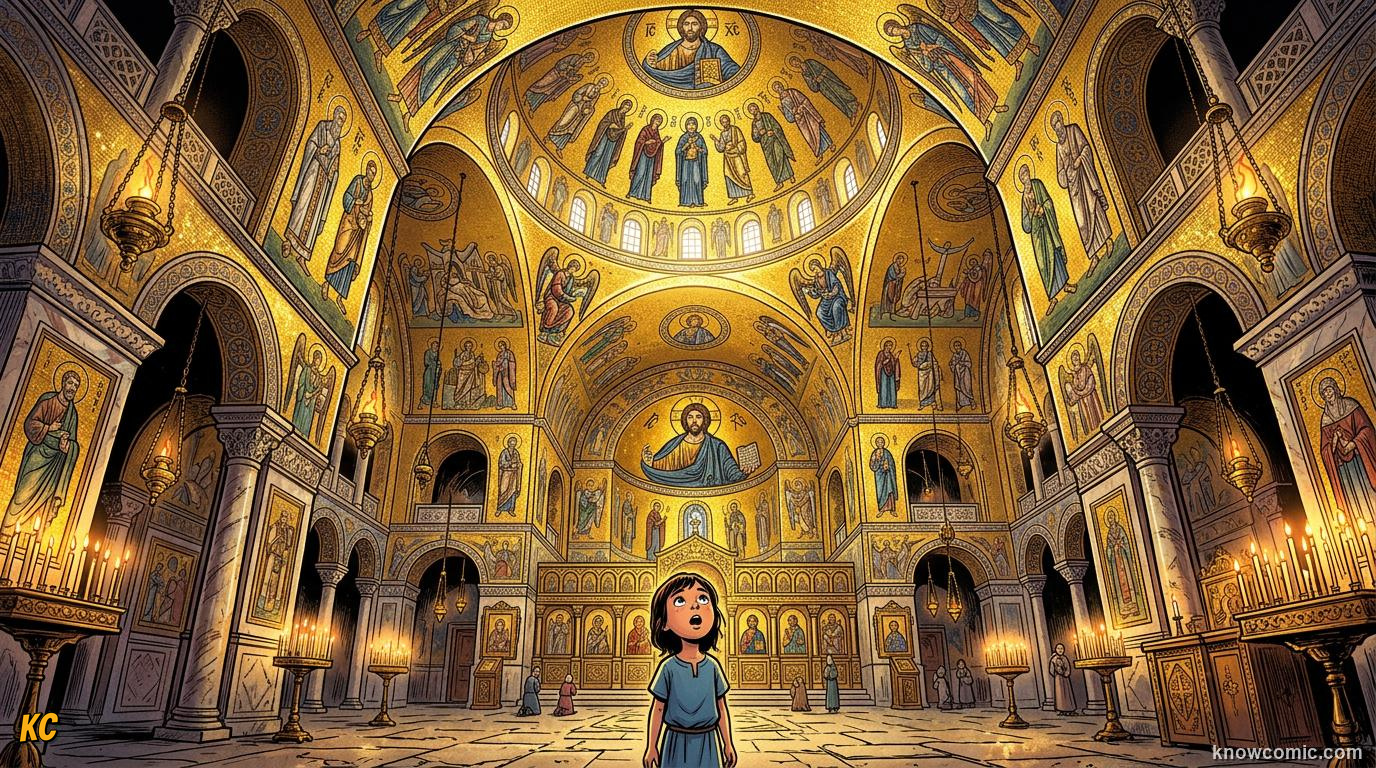
The glowing interior of a Byzantine church covered in shimmering gold mosaics of saints lit by candlelight
A ROOM MADE OF LIGHT AND GOLD
Step through the doors of a Byzantine church and the whole room glows. The walls and ceilings shimmer with gold, and giant calm figures of Christ, Mary and the saints look down at you from above. This was the art of the Byzantine Empire, the Christian half of the old Roman world, ruled from the city of Constantinople. Byzantine artists were not trying to copy the real world like the Greeks and Romans did. They were trying to build a doorway to heaven that you could actually stand inside.
⚡ DID YOU KNOW?
Gold backgrounds have no sky, ground or shadow on purpose. Heaven has no morning or night, so the artists removed all sense of time and place.
GLOW!
WHAT IS BYZANTINE?
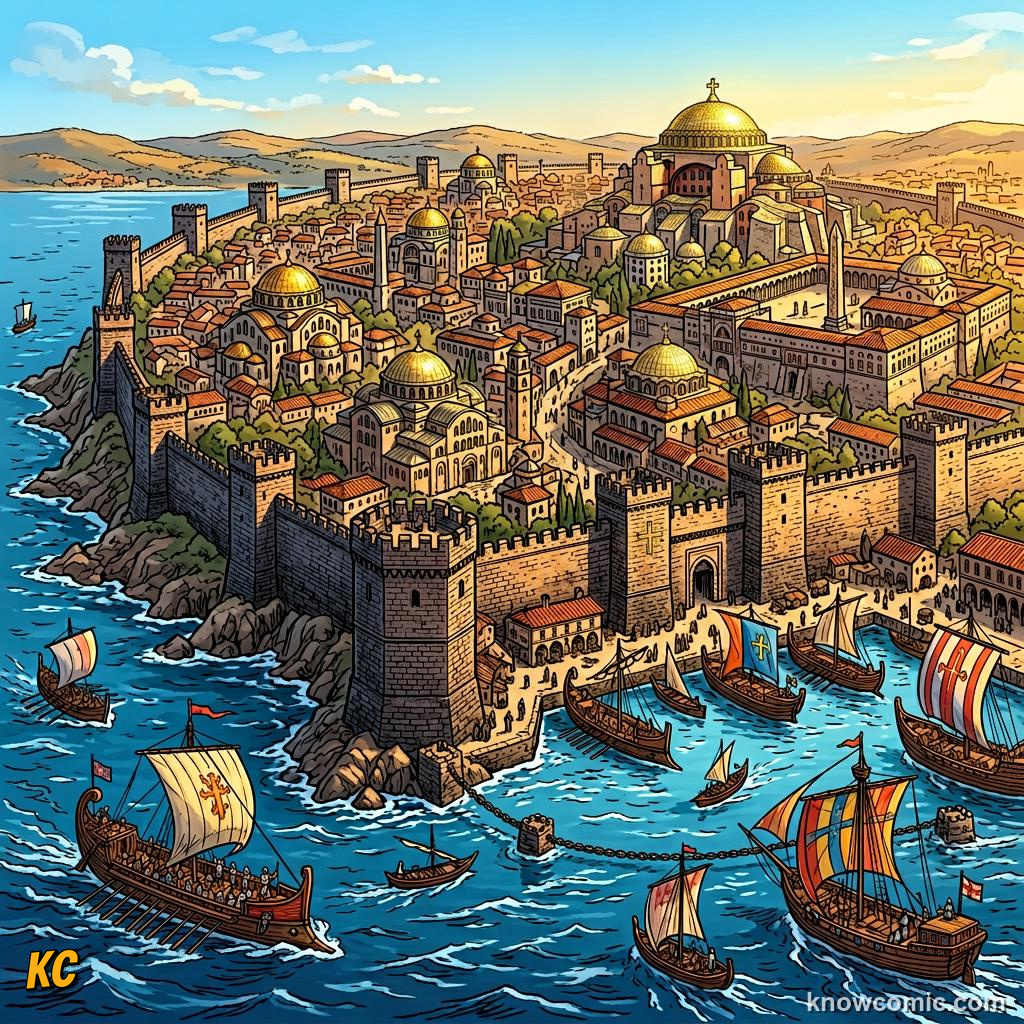
A walled medieval city of domes and towers beside the sea, the Byzantine capital Constantinople
🏰 The Christian eastern half of the Roman Empire
🌊 Ruled from Constantinople, today's Istanbul
⏳ It lasted over 1,000 years after Rome fell
NOT OF THIS WORLD
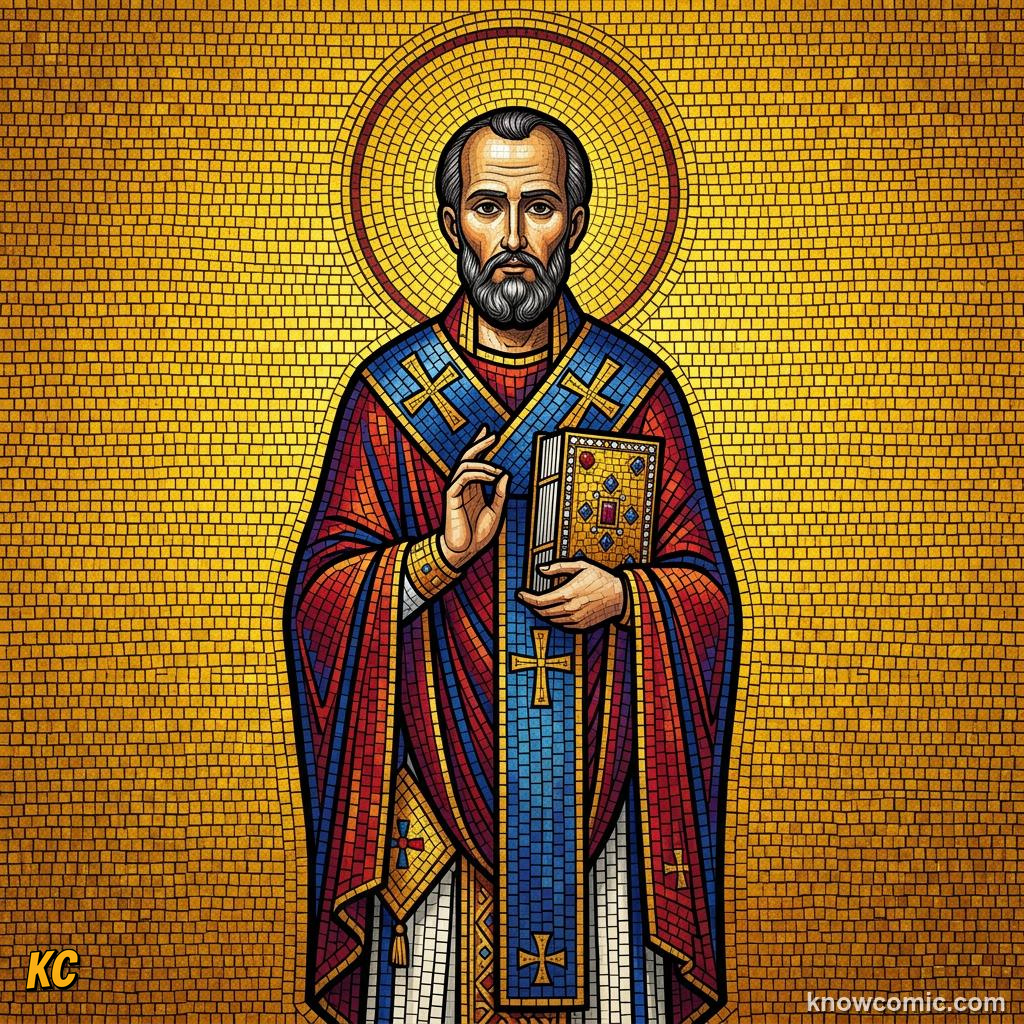
A flat golden Byzantine mosaic saint with a halo standing calmly against a plain gold background
🌅 No real backgrounds, just endless gold
🧍 Figures stand flat, calm and still
🙏 Everything points your mind to God
PAGE 2 OF 5 — A WINDOW YOU CAN PRAY THROUGH
THE HOLY IMAGE
A Byzantine icon of Christ on a wooden panel with a golden halo, large eyes, long nose and small mouth
AN ICON IS A WINDOW, NOT A PORTRAIT
The most special Byzantine artworks were icons, holy paintings of Christ, Mary and the saints made on wooden panels. People did not treat an icon as a normal picture. They believed it was like a window: when you looked at it, you were looking through to the holy person in heaven, and your prayers passed back the other way. That is why the faces look so unusual. They have huge wide eyes to see the soul, long thin noses, tiny mouths that never need food, and a shining gold halo of light. The figures stare straight out at you so you can meet their gaze and pray.
WINDOW!
THE HOLY FACE
Close-up of a Byzantine icon face with large dark eyes, a long nose and a golden halo
👁️ Big eyes to look into your soul
✨ A gold halo means the person is holy
ALWAYS THE SAME
Three almost identical Byzantine icons of the same saint showing how strictly the style was copied
📜 Strict rules told artists how to paint each saint
🔁 Copied faithfully so saints stayed recognisable
PORTABLE FAITH
A small wooden Byzantine icon held in two hands, worn smooth from years of touching and kissing
🪵 Small panels people could carry and hold
💋 Believers kissed and prayed before them
PAGE 3 OF 5 — A PICTURE MADE OF A MILLION SPARKLES
TINY TESSERAE
A hand holding tiny glass and gold mosaic cubes called tesserae above a tray of sorted colours
🔲 Pictures built from tiny cubes called tesserae
🥇 Gold cubes had real gold leaf inside glass
TILTED ON PURPOSE
Close-up of a gold mosaic wall where the cubes are set at slightly different angles, catching the light
📐 Each cube was set at a slightly different angle
🕯️ So they catch candlelight and seem to flicker
THE MOSAIC MAKERS
Byzantine craftsmen on scaffolding pressing tiny gold and coloured tesserae into wet plaster on a church wall
PRESSED IN ONE CUBE AT A TIME
A glowing mosaic was made the slow way, one little cube at a time. Workers spread a layer of wet plaster on the wall, sketched the design, then pressed in thousands of tesserae before the plaster dried. The famous gold cubes were made by trapping a wafer-thin sheet of real gold leaf between two layers of glass. The clever trick was to push each cube in at a slightly different tilt. As people walked past with flickering candles and oil lamps, the uneven surface threw the light in every direction, so the saints seemed to sparkle, shift and almost come alive. Icons on wood used a different method called egg tempera, mixing coloured powder with egg yolk and brushing it over a smooth white panel and gold leaf.
🔬 COUNTING THE CUBES
A single large church could be covered with tens of millions of tesserae. Skilled teams could spend many years finishing the walls of just one building.
SHIMMER!
PAGE 4 OF 5 — A FLOATING DOME AND A WAR ON IMAGES
HAGIA SOPHIA
The vast interior of Hagia Sophia with its enormous golden dome floating above a ring of windows
THE CHURCH OF HOLY WISDOM
The greatest Byzantine building of all was Hagia Sophia, the Church of Holy Wisdom, finished for Emperor Justinian in 537 CE. Its gigantic dome is ringed with so many windows that it seems to float on a circle of light, as if it is hanging from heaven by a golden chain. When Justinian first walked inside, the story says he cried out that he had outdone the great temple of King Solomon. But Byzantine art also went through a furious argument called Iconoclasm, which means image breaking. For around a hundred years, some emperors decided that holy images were wrong and ordered thousands of icons and mosaics to be smashed and scraped off the walls.
WISDOM!
THE FLOATING DOME
A huge golden dome seen from below, with a ring of bright windows around its base
💡 A ring of windows circles the dome's base
🪶 The light makes the heavy dome look weightless
THE IMAGE WAR
Byzantine iconoclasts whitewashing and scraping a painted holy figure off a church wall
🔨 Iconoclasts believed holy images were wrong
🧱 They smashed and painted over countless icons
ICONS RETURN
A joyful Byzantine procession carrying holy icons back into a church to celebrate their return
🎉 In 843 CE the icons were finally allowed back
☦️ The happy day is still remembered every year
PAGE 5 OF 5 — A STYLE THAT NEVER DIED
THE LEGACY
A modern Orthodox church glowing with golden icons while a family lights candles before them
A THOUSAND YEARS, STILL GLOWING
In 1453 the city of Constantinople fell and the Byzantine Empire ended, but its art simply refused to die. The icon tradition lived on in Orthodox Christian countries like Greece, Russia, Serbia and Bulgaria, where artists still paint icons today using almost the same rules and gold backgrounds as a thousand years ago. The golden Byzantine style also taught medieval European painters how to make holy images shine, and it inspired the famous icons of Russia. Even now, many icon painters pray and fast before they begin, and they say they are not painting an icon but writing one, like a sacred message in pictures.
🏛️ FROZEN IN TIME
An icon painted last week can look almost exactly like one from the year 1000. The strict rules mean the style barely changed for more than a thousand years.
ETERNAL!
SEE THEM TODAY
Tourists admiring the golden mosaics inside a historic Byzantine church
🕌 Hagia Sophia still stands in Istanbul
🇮🇹 Ravenna in Italy keeps dazzling mosaics
☦️ Every Orthodox church glows with icons
REMEMBER THIS
📌 KEY FACTS
✨ Gold backgrounds turned churches into heaven

👁️ Icons were holy windows, not real portraits

🔲 Mosaics were built from tiny tilted tesserae

🔨 Iconoclasm smashed icons, then 843 brought them back

☦️ The style still lives in Orthodox art today
🧠 QUIZ TIME!
BYZANTINE ICONS · 5 QUESTIONS
QUESTION 01
What feeling were Byzantine churches designed to give visitors?
QUESTION 02
How did Byzantine people think of an icon?
QUESTION 03
What are the tiny cubes that Byzantine mosaics are made from called?
QUESTION 04
Why were the gold mosaic cubes pressed in at slightly different angles?
QUESTION 05
What happened during the period called Iconoclasm?
0/5
LOADING...
← TOPIC 04 📋 ALL TOPICS TOPIC 06 →