🏰
🪨
✦ ART & CULTURE ✦

ART &
CULTURE!

🎨 From Cave Walls to Masterpieces, Humanity's First Art!

📖 200 Topics ⏱️ 5 min per comic 🧠 Quiz included
1000 CE
A White Mantle of Churches
🪨
1066 CE
Normans Build in Stone
🚪
1120 CE
Sermons Carved in Stone
🧱
1135 CE
Mighty Pilgrim Churches
🏰
TODAY
Fortress Churches Still Stand
🏰 ROMANESQUE GRANDEUR
TOPIC 06 · ART & CULTURE · MEDIEVAL EUROPE · 1000–1150 CE
PAGE 1 OF 5 — CHURCHES BUILT LIKE FORTRESSES
MEDIEVAL EUROPE · A NEW CHURCH
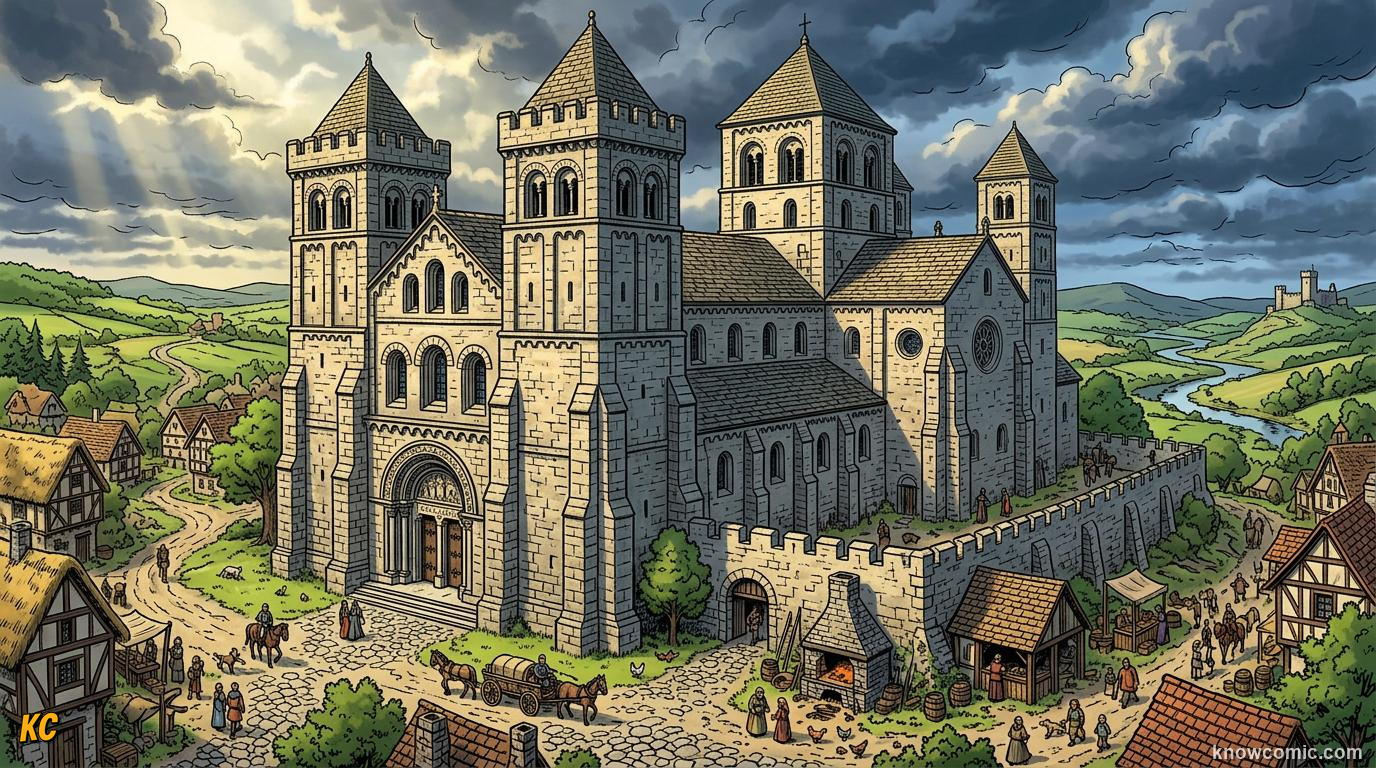
A massive Romanesque stone church with thick walls, round arches and sturdy towers standing like a fortress
MIGHTY, HEAVY AND BUILT TO LAST
After the year 1000, Europe felt safer and richer, and people began building stone churches everywhere. One monk wrote that the land was putting on a shining white mantle of new churches. We call this style Romanesque, which means in the Roman manner, because the builders copied the round arch of the ancient Romans. These buildings are huge, heavy and a little dark, with thick walls, sturdy towers and small windows. They look more like castles than the light, airy churches that came later, and they were made to feel powerful, safe and everlasting.
⚡ DID YOU KNOW?
Some Romanesque walls are several metres thick. They really could double as a fortress, and frightened villagers sometimes sheltered inside during attacks.
MIGHTY!
THE ROUND ARCH
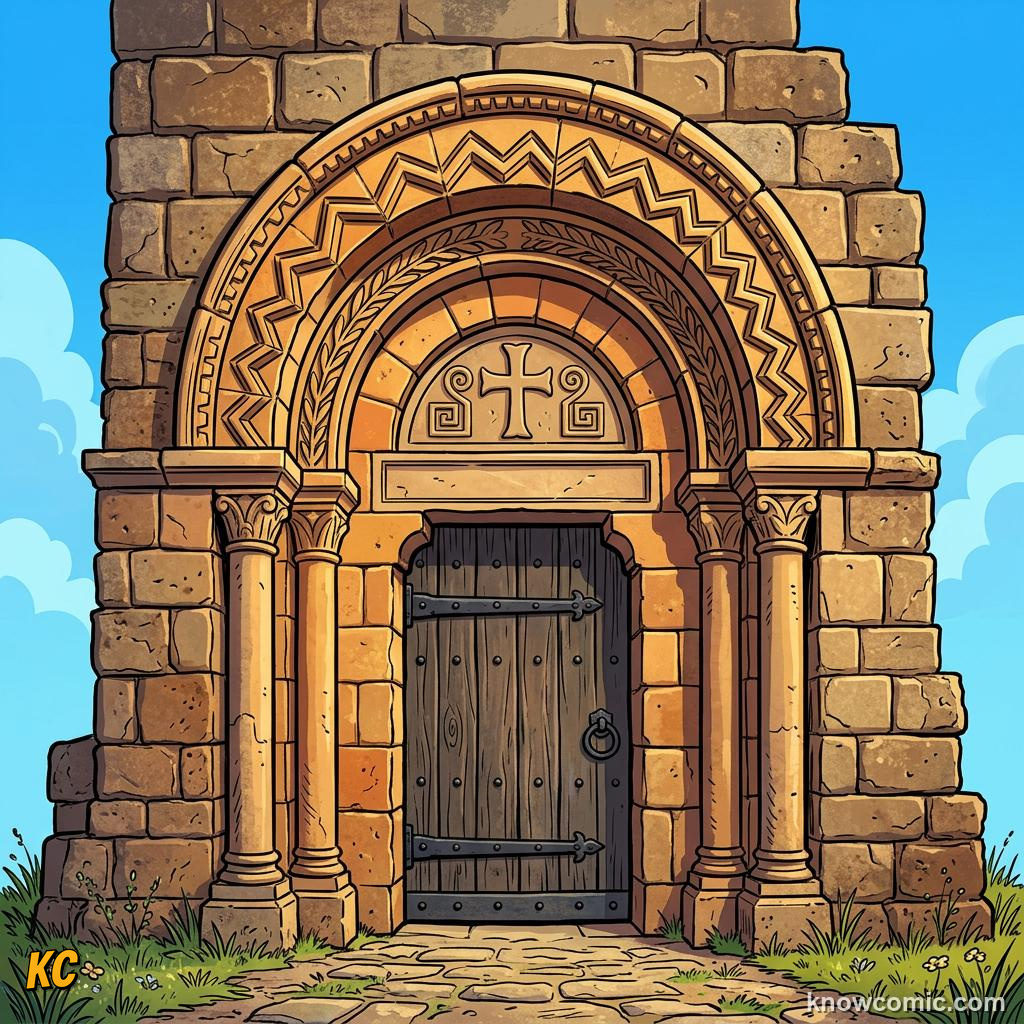
A rounded semicircular stone Romanesque doorway with bands of carved decoration
🏛️ Copied from the ancient Roman arch
⌓ A smooth half-circle over doors and windows
💪 Strong, but it needs thick walls to hold it
THICK AND DARK
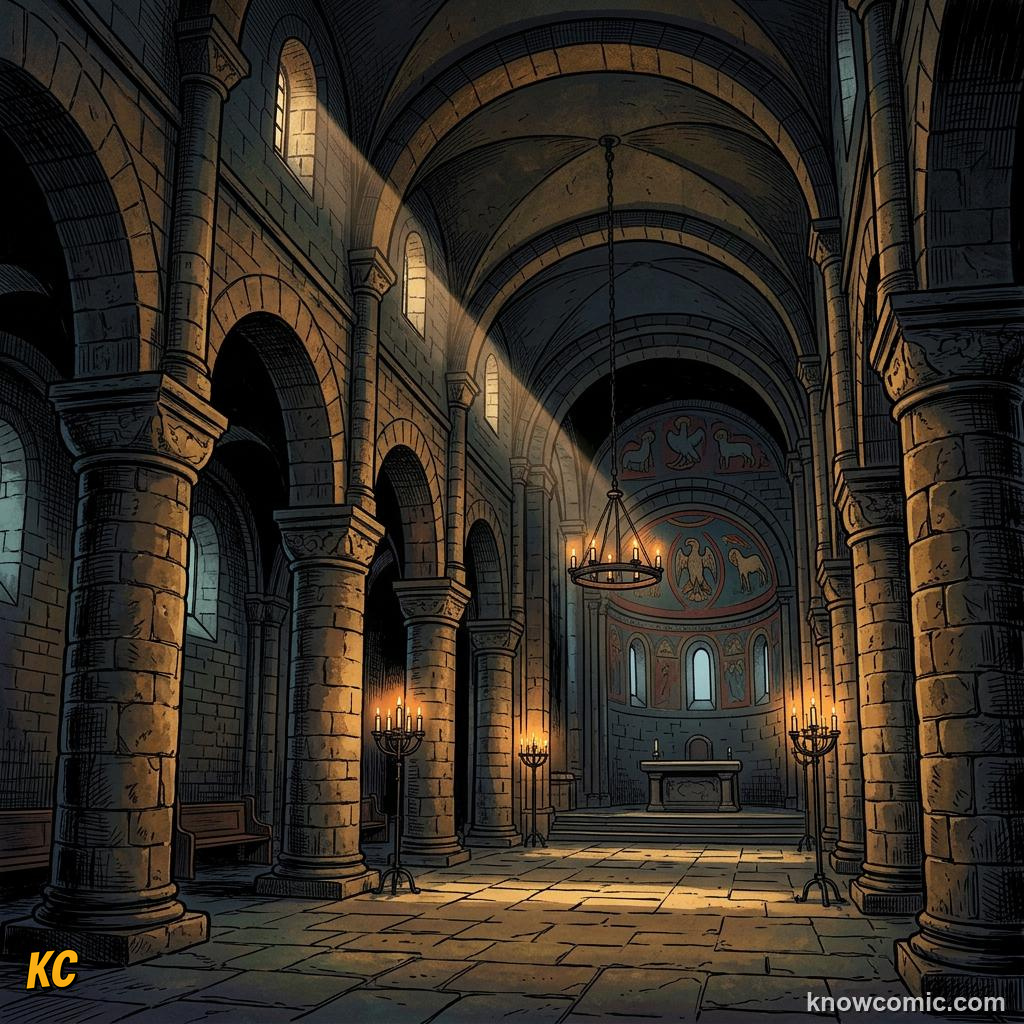
The dim interior of a Romanesque church with massive stone pillars and tiny windows letting in beams of light
🧱 Heavy walls hold up the stone roof
🪟 Windows stayed small to keep walls strong
🕯️ Insides were cool, dim and candlelit
PAGE 2 OF 5 — SERMONS YOU COULD READ WITHOUT WORDS
THE GREAT DOORWAY
A carved Romanesque church doorway with a half-moon tympanum showing Christ and crowds of villagers looking up at it
A BIBLE CARVED IN STONE
In the Middle Ages, almost nobody could read, so churches taught their lessons with pictures instead of words. Above the main door sat a great half-moon panel of carved stone called a tympanum. It often showed Christ in glory, or the Last Judgment, with happy souls going up to heaven on one side and frightening monsters dragging wrongdoers away on the other. As villagers walked in, they could read this stone sermon with their eyes. Carvers also covered the columns, arches and doorways with saints, beasts and Bible stories, turning the whole entrance into a picture book that everyone could understand.
STONE!
THE TYMPANUM
Close-up of a carved Romanesque tympanum showing the Last Judgment with angels and figures
⌓ A half-moon of stone above the main door
⚖️ Often showed the Last Judgment scene
READING PICTURES
Medieval villagers gathered at a church doorway pointing up at the carved stone Bible scenes
📖 Most ordinary people could not read words
👀 The carvings taught Bible stories with pictures
MONSTERS & BEASTS
A carved Romanesque column capital covered with twisting dragons and grotesque beasts
🐉 Column tops were carved with dragons and demons
😮 They warned, amazed and decorated all at once
PAGE 3 OF 5 — HOW TO HOLD UP A STONE SKY
THE BARREL VAULT
A long curved Romanesque barrel vault ceiling of stone stretching down a church like a tunnel
🛢️ A stone ceiling shaped like a long tunnel
⌓ The round arch stretched along the whole roof
MASON'S MARKS
A medieval stonemason carving a small personal mark into a finished block of stone
✒️ Masons signed their blocks with secret marks
👷 Big teams of skilled stoneworkers did the job
THE BUILDERS
Medieval builders on wooden scaffolding lifting stone blocks with a crane to build round arches
HOLDING UP A STONE SKY
Putting a heavy stone roof over a whole church was a giant puzzle. Romanesque masons repeated the round arch over and over to make a barrel vault, a long curved ceiling of stone. All that weight pushed down and outward, so the walls had to be thick and the windows small, which is exactly why the insides feel so dim. To build each arch, workers first made a wooden frame, laid the stones over it, then dropped in the top stone, called the keystone, to lock everything in place before removing the frame. A single great church could take many years, sometimes longer than one person's whole lifetime.
🔨 A LIFETIME OF WORK
Builders often started a church knowing they would never see it finished. Their children and grandchildren would carry on the same project for decades.
VAULT!
PAGE 4 OF 5 — THE AGE OF PILGRIMS
A PILGRIM CHURCH
The interior of a great Romanesque pilgrimage church with rows of round arches and pilgrims walking down the aisle
CHURCHES FOR HUGE CROWDS
Many Romanesque churches grew along pilgrim roads, the routes people walked for months to pray at the bones of a saint, which were called relics. To handle the crowds, builders made special pilgrimage churches with wide side aisles and a walkway that looped all the way around behind the altar. This clever ring let streams of visitors shuffle past the glittering golden shrine of the relic without ever blocking the church service. Monasteries beside these churches became great centres of art, where monks copied out books by hand and painted them with tiny, glowing pictures.
PILGRIMS!
ON THE ROAD
A line of medieval pilgrims with walking staffs and hats travelling a road toward a distant church
🚶 Pilgrims walked for weeks or months
🗺️ They followed routes linking holy shrines
GOLDEN RELICS
A jewelled golden reliquary shaped like a small shrine glowing on an altar
✨ Saints' relics were kept in golden shrines
💎 People travelled far just to see them
MONK ARTISTS
A medieval monk in a monastery carefully painting a colourful illustrated manuscript
📜 Monks copied whole books by hand
🎨 They painted them with tiny glowing pictures
PAGE 5 OF 5 — STRONG ENOUGH TO LAST 900 YEARS
THE LEGACY
Modern visitors admiring a beautifully preserved Romanesque church with round arches and carved doorway
BUILT TO STAND FOREVER
Around 1150 a new idea appeared. Builders discovered clever tricks that let walls grow thin and windows grow huge, and that exciting style became Gothic, our next topic. But Romanesque churches were made so solidly that hundreds of them still stand across Europe today, almost a thousand years later. Their round arches, mighty towers and carved doorways set the pattern for what a grand church should look like. In Britain this sturdy style is often called Norman, after the Normans who built castles and cathedrals like Durham. Romanesque proved that art and engineering together could create something truly built to last.
🏛️ STILL STANDING
The famous Leaning Tower of Pisa is Romanesque. It tilts because the soft ground sank, not because the strong stone work failed.
ENDURE!
SEE THEM TODAY
Tourists exploring the round arches and cloister of an old Romanesque cathedral
🏰 Durham Cathedral towers over England
🇮🇹 The Leaning Tower of Pisa is Romanesque
🌿 Peaceful stone cloisters survive across Europe
REMEMBER THIS
📌 KEY FACTS
⌓ Romanesque means building with the Roman round arch

🧱 Thick walls and small windows held up stone roofs

🚪 Carved doorways and tympanums taught the Bible

🚶 Pilgrim churches were built for huge crowds

🏰 The mighty style still stands after 900 years
🧠 QUIZ TIME!
ROMANESQUE GRANDEUR · 5 QUESTIONS
QUESTION 01
What did Romanesque builders copy, giving the style its name?
QUESTION 02
Why did Romanesque churches have thick walls and small windows?
QUESTION 03
What was the carved half-moon panel above a church door called?
QUESTION 04
Why were churches covered in carved Bible scenes and figures?
QUESTION 05
Why did big pilgrimage churches have a walkway looping around the altar?
0/5
LOADING...
← TOPIC 05 📋 ALL TOPICS TOPIC 07 →