THE REMAINDER THEOREM
PAGE 1 OF 5, THE ONE-STEP REMAINDER TRICK
SECRET WEAPON

FIND THE LEFTOVER WITHOUT THE LONG WORK
You already know how to divide a polynomial f(x) by a linear divisor like (x − a) using the bracket method from Topic 02. The Remainder Theorem gives you a lightning shortcut: the remainder is exactly f(a). No quotient line, no multiply-subtract cycles. Just substitute x = a into f(x) and evaluate. That single number is what would sit at the bottom of a full long division. Exams love this because it turns a multi-step process into one clean calculation, and it connects directly to finding factors and roots in the next panels.
⚡ THE RULE
When f(x) is divided by (x − a), the remainder is f(a). Example: for f(x) = x² − 5x + 6 divided by (x − 2), compute f(2) = 4 − 10 + 6 = 0.
f(a)!
LONG WAY
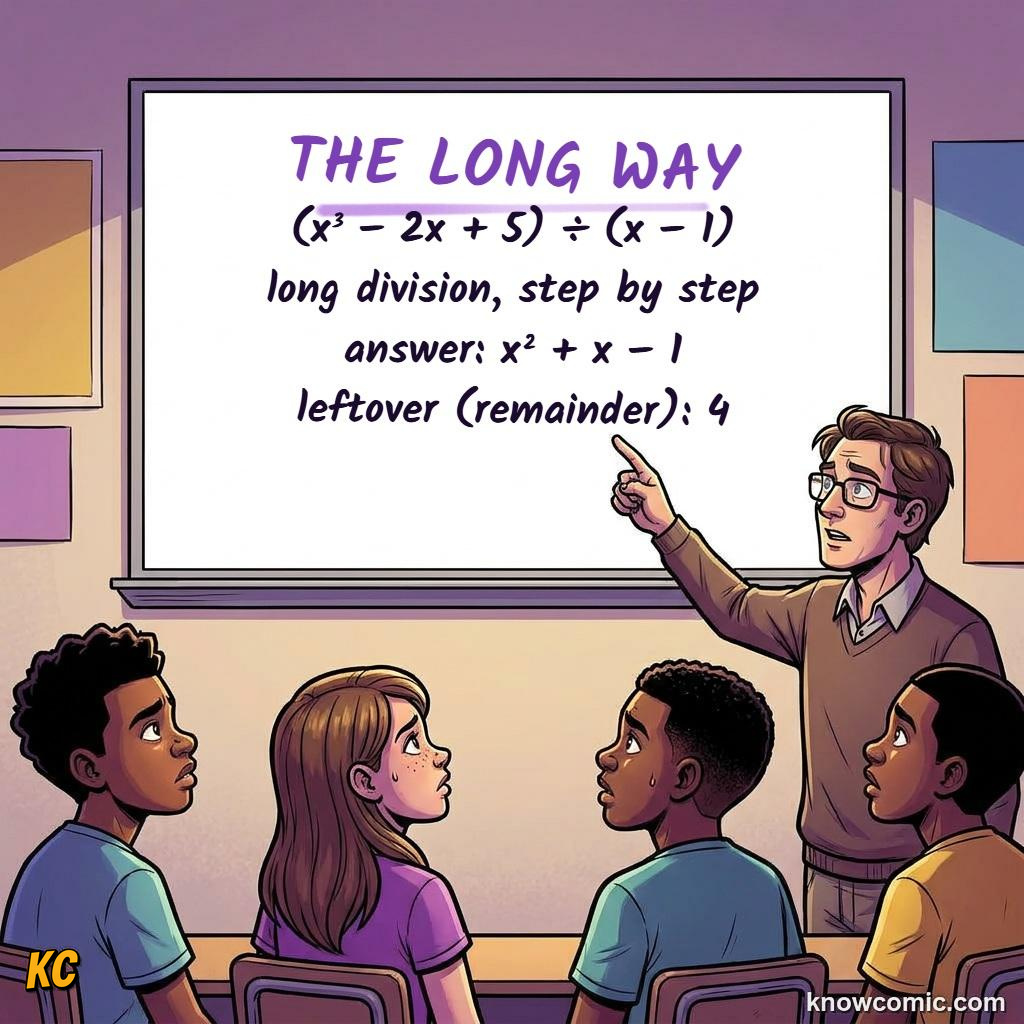
📜 Many steps
⏱️ Slow but thorough
✅ Shows quotient too
⏱️ Slow but thorough
✅ Shows quotient too
SHORT CUT

⚡ One substitution
🎯 Remainder only
🏆 Exam favourite
🎯 Remainder only
🏆 Exam favourite