🔊
📢
🤫
🎵 KNOW PRIMARY · AGES 6–11

MUSIC
UNIVERSE

📢 Loud and Soft, Explore the Power of Sound Waves!

📖 200 Topics 🆓 FREE + PRO ⏱️ 5 min per comic 🧠 Quiz included
〰️
WAVE
Energy Moves
📏
AMPLITUDE
Wave Height
ENERGY
Power in the Wave
📊
DECIBELS
Measure Loudness
👂
VOLUME
Loud or Soft
📢 AMPLITUDE AND VOLUME
TOPIC 03 · MUSIC UNIVERSE · DECIBELS · LOUD · SOFT
PAGE 1 OF 5 — WHAT IS VOLUME?
LOUD AND SOFT
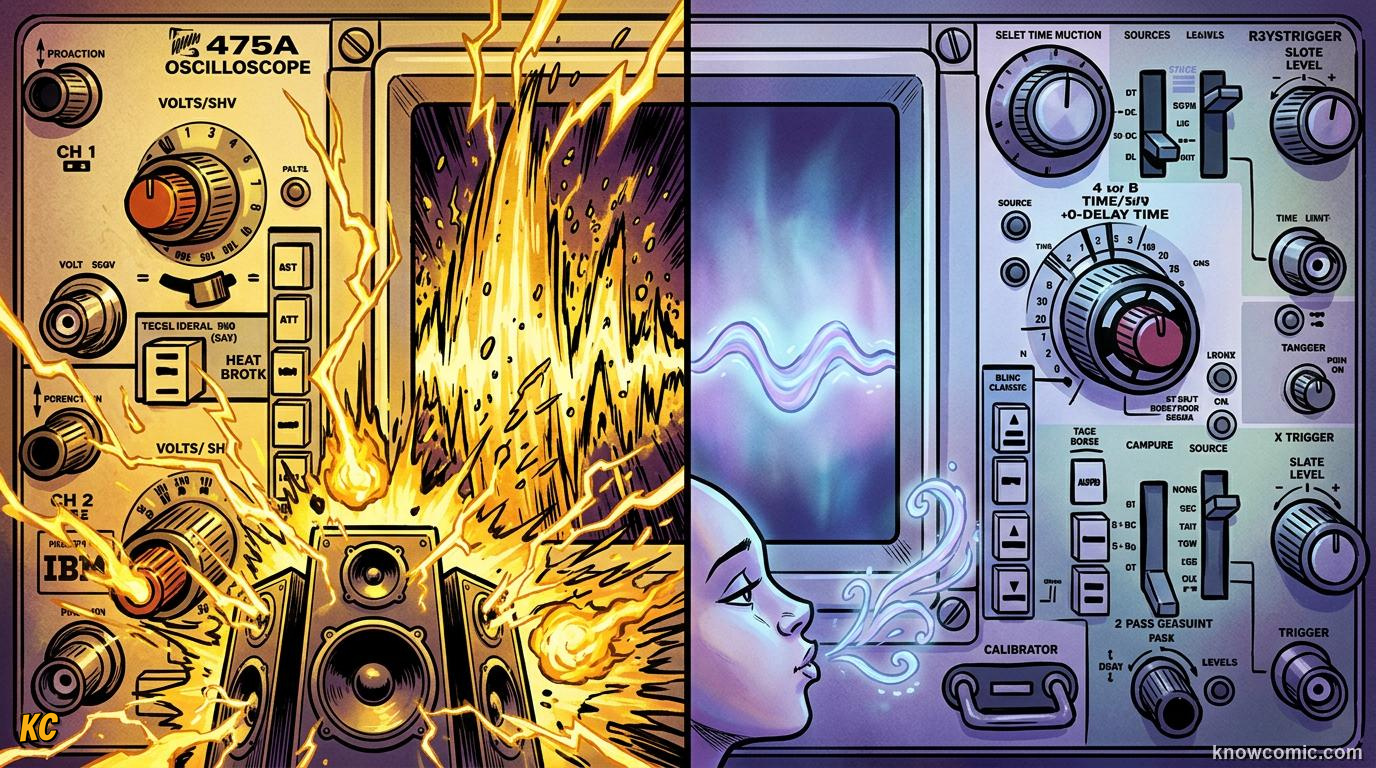
Comic illustration: large and small sound waves showing loud versus soft volume
VOLUME IS HOW LOUD!
Volume is determined by amplitude, the height and power of a sound wave. Larger waves carry more energy, creating louder sounds, while smaller waves are perceived as quieter or more delicate. When a drummer hits hard, the wave grows tall. When you whisper, the wave stays small. Same pitch can be loud or soft depending on how much energy goes into the vibration!
⚡ DID YOU KNOW?
A whisper is about 30 decibels, normal conversation is near 60 decibels, and a rock concert can blast past 110 decibels. Your ears can tell the difference instantly!
VOLUME!
LOUD

Comic illustration: tall sound wave with high amplitude creating a loud sound
📢 Big amplitude, big energy
🔊 Thunder, concerts, sirens
SOFT
Comic illustration: small sound wave with low amplitude creating a quiet sound
🤫 Small amplitude, gentle energy
🍃 Leaves rustling, soft humming
PAGE 2 OF 5 — AMPLITUDE EXPLAINED
WAVE HEIGHT
Comic illustration: measuring amplitude as the height of a sound wave from center to peak
HOW TALL IS THE WAVE?
Amplitude is the distance from the middle of a wave to its highest peak (or lowest trough). Imagine drawing a line through the center of a wave. How far the bump rises above that line is the amplitude. A tall wave means the source pushed air particles with great force. A short wave means a gentle push. Amplitude does not change pitch. It only changes how loud or soft the sound feels!
🌊 WAVE FACT
Doubling the amplitude does not just double the loudness. Because energy grows with the square of amplitude, a wave twice as tall carries four times as much energy!
TALL!
BIG WAVE
Comic illustration: high amplitude wave pushing air particles with strong force
💪 Strong push on particles
🔊 More energy reaches your ear
SMALL WAVE
Comic illustration: low amplitude wave with a gentle push on air particles
🪶 Gentle push on particles
🤫 Less energy, quieter sound
NOT PITCH
Comic illustration: same pitch at different amplitudes showing loud and soft versions
🎵 Same note, different volume
📏 Amplitude ≠ frequency
PAGE 3 OF 5 — EVERYDAY VOLUME
WHISPER
Comic illustration: person whispering with small low-amplitude sound waves
🤫 About 30 decibels
🪶 Tiny amplitude, gentle air push
THUNDER
Comic illustration: thunderstorm with massive high-amplitude sound waves
⚡ Over 120 decibels nearby
💥 Huge amplitude, massive energy
SOUND LEVELS
Comic illustration: decibel scale from whisper to concert showing everyday sound levels
VOLUME ALL AROUND US!
Every day you hear sounds at very different volumes. A library whisper is soft and delicate. Normal talking sits in the middle. A school bell rings loud enough to grab everyone's attention. A concert speaker blasts energy across a huge crowd. Each one has a different amplitude. Musicians use volume to tell stories: a soft lullaby calms you, a loud chorus excites you!
🎵 FUN FACT
Orchestras use symbols like p (piano, meaning soft) and f (forte, meaning loud) to tell musicians how hard to play. Volume is a huge part of making music feel emotional!
LOUD!
PAGE 4 OF 5 — DECIBELS EXPLAINED
MEASURING LOUDNESS
Comic illustration: decibel meter measuring sound levels from quiet to loud
DECIBELS MEASURE VOLUME!
Scientists measure loudness in decibels, written as dB. The scale starts near 0 dB for the faintest sounds humans can hear. Every 10 dB increase feels roughly twice as loud to our ears. Normal conversation sits around 60 dB. A busy street might hit 80 dB. Sounds above 85 dB for long periods can damage hearing, which is why concerts and power tools require ear protection. Decibels do not measure pitch, only loudness!
👂 EAR FACT
Prolonged exposure above 85 dB can harm the tiny hair cells inside your cochlea. Once damaged, they do not grow back. Protect your ears at loud events!
DECIBEL!
0–40 dB
Comic illustration: quiet sounds like rustling leaves at low decibel levels
🍃 Leaves, ticking clock
🤫 Very quiet, safe for ears
60–80 dB
Comic illustration: conversation and traffic at moderate decibel levels
🗣️ Talking, vacuum cleaner
📊 Everyday comfortable range
100+ dB
Comic illustration: concert and siren at high decibel levels requiring ear protection
🎸 Concerts, jet engines
🛡️ Wear ear protection!
PAGE 5 OF 5 — AMPLITUDE AND VOLUME RECAP
PUT IT TOGETHER
Comic illustration: amplitude and volume recap with wave height and decibel scale
THE WHOLE STORY
Every sound wave has an amplitude, the height from center to peak. Tall waves carry more energy and feel loud. Short waves carry less energy and feel soft. We measure loudness in decibels (dB). Amplitude controls volume, not pitch. That is why you can whisper or shout the same word. Musicians and engineers use volume to create emotion, and protecting your ears at high decibel levels keeps your hearing healthy for life!
🎯 REMEMBER
Amplitude = wave height = volume. Big amplitude = loud. Small amplitude = soft. Decibels (dB) measure loudness. Frequency controls pitch (Topic 02). Amplitude controls volume. Protect ears above 85 dB!
POWER!
KEY IDEAS
Comic illustration: key facts about amplitude, decibels, and volume
📏 Amplitude = wave height
📊 dB = loudness measure
NEXT UP
Comic illustration: preview of the next music universe topic
🎶 Pitch = frequency (Topic 02)
🔜 More sound science ahead!
🧠 QUIZ TIME!
AMPLITUDE AND VOLUME · 5 QUESTIONS
QUESTION 01
What does volume tell us about a sound?
QUESTION 02
What is amplitude?
QUESTION 03
What unit is used to measure loudness?
QUESTION 04
What happens when amplitude increases?
QUESTION 05
At what decibel level should you protect your ears during long exposure?
0/5
LOADING...
← TOPIC 02 📋 ALL TOPICS TOPIC 04 →