📖 350 Topics🆓 FREE + PRO⏱️ 5 min per comic🧠 Quiz included
🏛️
~250 BC
Archimedes and the lever
→
⚖️
ANCIENT
Balance scales invented
→
🏗️
1800s
Steam cranes and machines
→
🕰️
1700s
Clock gears use torque
→
🤖
TODAY
Robots rotate with precise torque
🔧 TORQUE & LEVERS
TOPIC 10 · PHYSICS · ROTATION · BALANCE · TURNING
PAGE 1 OF 5, WHAT IS TORQUE?
TURNING FORCE
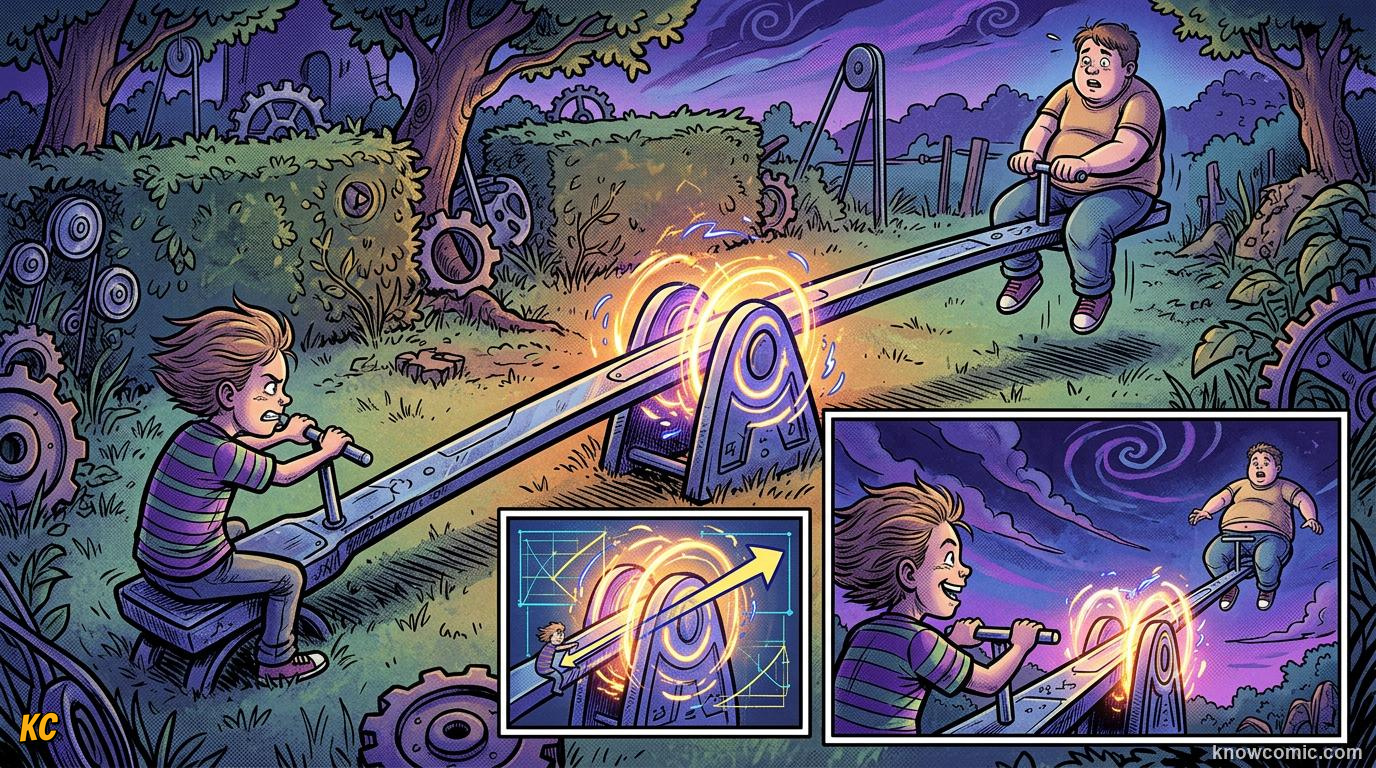
PUSHING A DOOR AT THE HANDLE
When you push a door near the hinges, it barely moves. Push at the handle and it swings easily. Same force, different result. That is because rotation depends on torque, not just force. Torque is the turning effect of a force around a pivot. The Greek mathematician Archimedes famously said that with a long enough lever and a place to stand, he could move the world. He was describing the power of torque.
📐 TORQUE FORMULA
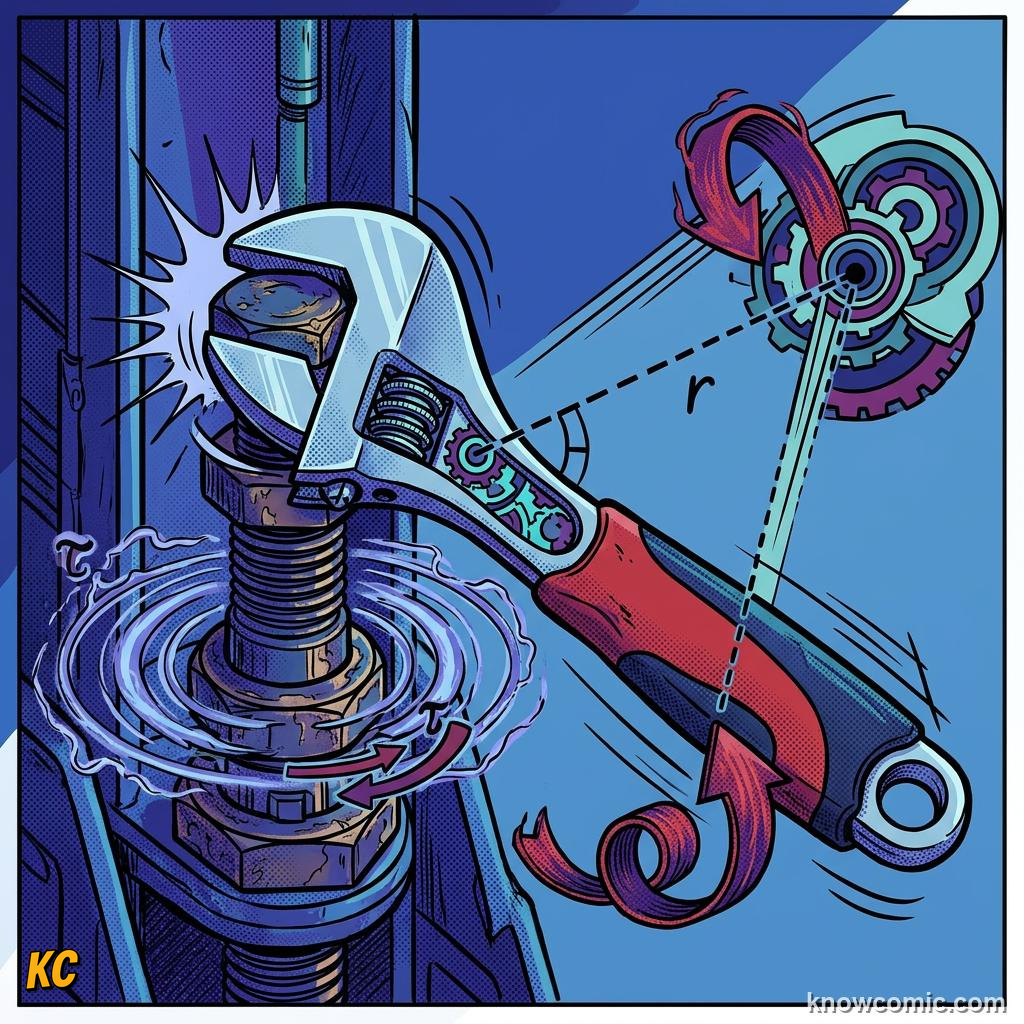
τ = r × F. Torque equals the lever arm (distance from pivot) times the force, considering the angle of push.
TURN!
LEVER ARM
📏 r = distance from pivot to force
→ Longer arm = more torque
🔧 Wrench handle = longer lever arm
UNITS
⚡ Torque unit: newton-metre (N·m)
🔄 More torque = faster spin-up
⚖️ Balance when torques are equal
PAGE 2 OF 5, HOW LEVERS WORK
THE SIMPLE MACHINE
A RIGID BAR AND A PIVOT
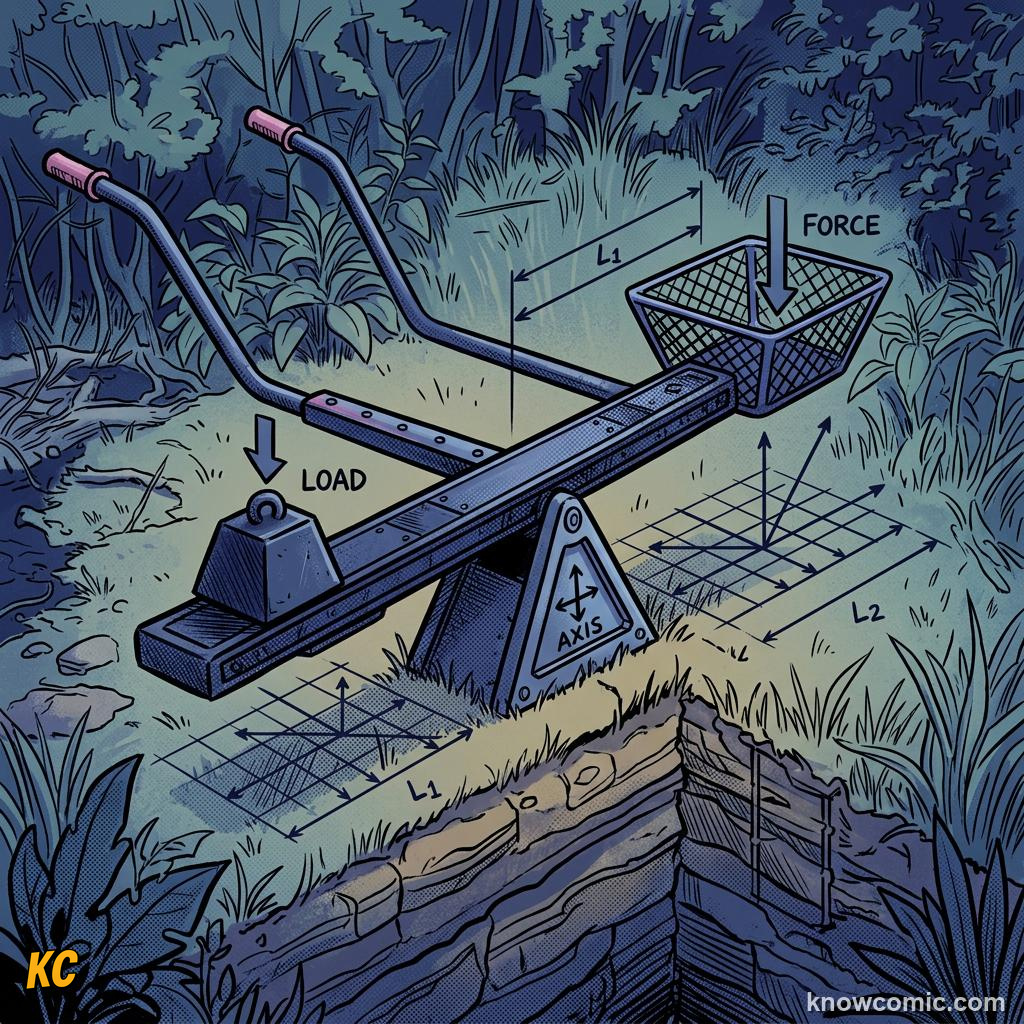
A lever is one of the oldest simple machines. It is a stiff bar that rotates around a fixed point called the fulcrum. You apply an input force (effort) on one side and get an output force (load) on the other. If the effort arm is longer than the load arm, a small push can lift a heavy weight. That trade-off is mechanical advantage: you gain force but must move the effort through a greater distance. Every crowbar, seesaw, and bottle opener uses this idea.
LIFT!
FULCRUM
📍 Fulcrum = pivot point
↔️ Bar rotates around it
⚖️ Seesaw fulcrum in the middle
EFFORT & LOAD
💪 Effort = force you apply
📦 Load = weight you move
⚖️ Balance: τ effort = τ load
MECHANICAL ADVANTAGE
📐 MA = effort arm ÷ load arm
→ Longer effort side = easier lift
🏋️ Small force, big result
PAGE 3 OF 5, THREE CLASSES OF LEVER
CLASS 1
⚖️ Fulcrum in the middle
🎢 Seesaw, scissors, pliers
↔️ Effort and load on opposite sides
CLASS 2
📦 Load between fulcrum and effort
🛒 Wheelbarrow, nutcracker
💪 Always multiplies force
CLASS 3 LEVERS
EFFORT BETWEEN FULCRUM AND LOAD
In a third-class lever, the effort sits between the fulcrum and the load. Your forearm is a classic example: the elbow is the fulcrum, your biceps pulls near the elbow, and the load is in your hand. Tweezers and fishing rods work the same way. These levers do not multiply force. Instead they multiply speed and distance at the load end, which is why your hand can move fast even though the muscle force is smaller than the weight you hold.
🔧 THREE CLASSES SUMMARY
Class 1: fulcrum middle. Class 2: load middle. Class 3: effort middle. Each rearranges the same torque balance.
PIVOT!
PAGE 4 OF 5, TORQUE IN THE REAL WORLD
FROM CRANES TO CLOCKS
ENGINEERING WITH TURNING FORCE
Construction cranes use long arms so a motor at the base can generate enough torque to lift tonnes of steel. Counterweights on the short end balance the load on the long end, just like a balanced seesaw. Inside mechanical clocks, tiny gears transfer torque from a spring or weight through carefully sized lever arms so hands tick at exactly the right speed. Electric motors spin because magnetic forces create torque on a coil. Almost every machine that rotates is built around this one idea.
GEARS!
🏗️ CRANES
🏗️ Long boom = huge lever arm
⚖️ Counterweight balances load
📐 Engineers calculate max torque
🚗 Engine torque spins wheels
🔧 Lug nuts tightened with torque
🏎️ More torque = stronger acceleration
PAGE 5 OF 5, BALANCE AND ROTATION
WHEN TORQUES CANCEL
EQUILIBRIUM MEANS NO SPIN
An object stays still when all forces and all torques balance out. On a level seesaw, a lighter person sits farther from the pivot to match the torque of a heavier person closer in. The product of force and distance must be equal on both sides. When clockwise torque equals counterclockwise torque, there is no net rotation. Gymnasts tuck their bodies to change their rotational inertia. Divers spin faster when they pull arms in, because the same torque produces greater angular acceleration when mass is closer to the axis.
⚖️ BALANCE RULE
Clockwise torques = counterclockwise torques. F₁r₁ = F₂r₂ when the system is in rotational equilibrium.
BALANCE!
ROTATION
🔄 Net torque causes angular acceleration
🎯 τ net = I × α
🤸 Tuck in = spin faster
REMEMBER
🔧 KEY FACTS
Torque τ = r × F creates rotation. Levers trade distance for force. Three lever classes place fulcrum, load, and effort differently. Balanced torques mean no turning.
✅ Torque depends on distance and force
✅ Longer lever arm = more turning power
✅ Class 2 levers multiply force
✅ Equal torques = rotational balance
🧠 QUIZ TIME!
TORQUE & LEVERS · 5 QUESTIONS
QUESTION 01
What is torque?
QUESTION 02
In a first-class lever, where is the fulcrum?
QUESTION 03
Which everyday tool is a second-class lever?
QUESTION 04
A seesaw balances when two children sit so that:
QUESTION 05
Why does a longer wrench loosen a bolt more easily?