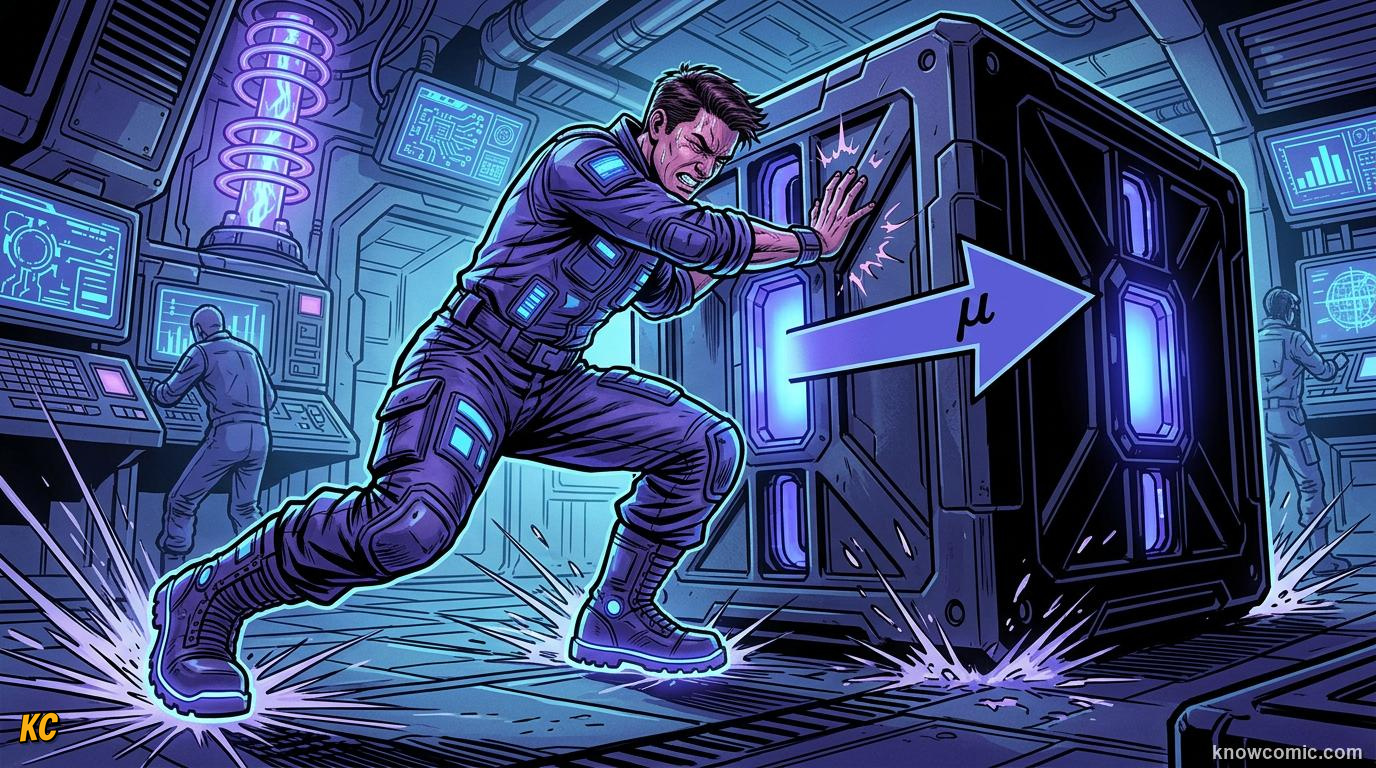
Friction is the force that resists sliding when two surfaces touch. Even smooth-looking objects are bumpy at the microscopic level. Those tiny peaks and valleys interlock, creating grip. Without friction you could not walk, write, or pick up a glass. Every step you take relies on your shoe pushing backward against the ground, and friction pushing forward to move you ahead. Friction is not always your enemy. It is the reason cars can accelerate and brakes can stop.
📐 FRICTION FORMULA
f = μN. Friction force equals the coefficient of friction μ times the normal force N pressing the surfaces together.
GRIP!
NORMAL FORCE
⬆️ N = surface push-back on object
→ Heavier object = more friction
📦 More weight = tighter contact
COEFFICIENT μ
🧊 Ice: low μ, slippery
🏀 Rubber on dry road: high μ
🔬 Depends on both materials
PAGE 2 OF 5, STATIC FRICTION
HOLDING STILL
FRICTION BEFORE THINGS MOVE
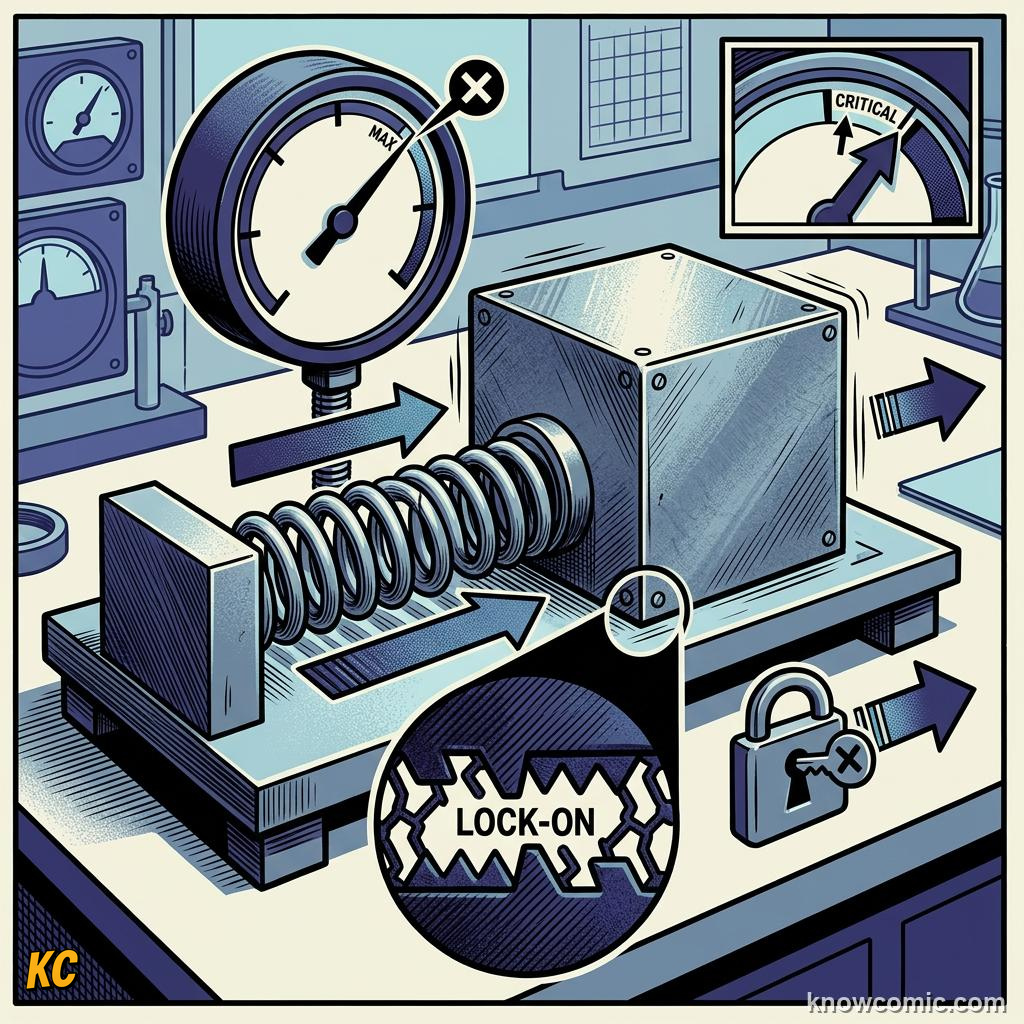
Static friction acts on objects that are not sliding yet. Push lightly on a heavy box and it stays put because static friction matches your push. Push harder and static friction grows to match, up to a maximum value. This maximum static friction is what you must overcome to start motion. That is why a parked car needs more force to begin rolling than to keep rolling on a flat road. Static friction is your friend when you want things to stay in place.
HOLD!
MAXIMUM VALUE
📐 fs ≤ μsN
→ Grows to match applied force
🛑 Stops at maximum limit
PUSH TEST
📦 Light push: box stays still
💪 Harder push: friction rises too
🏁 Break limit: box starts sliding
EVERYDAY GRIP
👟 Shoe grip on pavement
🧗 Climbing holds you up
✋ Hands gripping a rope
PAGE 3 OF 5, KINETIC FRICTION
SLIDING FRICTION
🏒 fk = μkN once sliding
→ Opposes direction of motion
📉 Usually smaller than static max
HEAT
🔥 Sliding converts motion to heat
🛞 Brakes get hot stopping a car
⚡ Energy lost as thermal energy
ONCE IT SLIDES
KINETIC FRICTION OPPOSES SLIDING
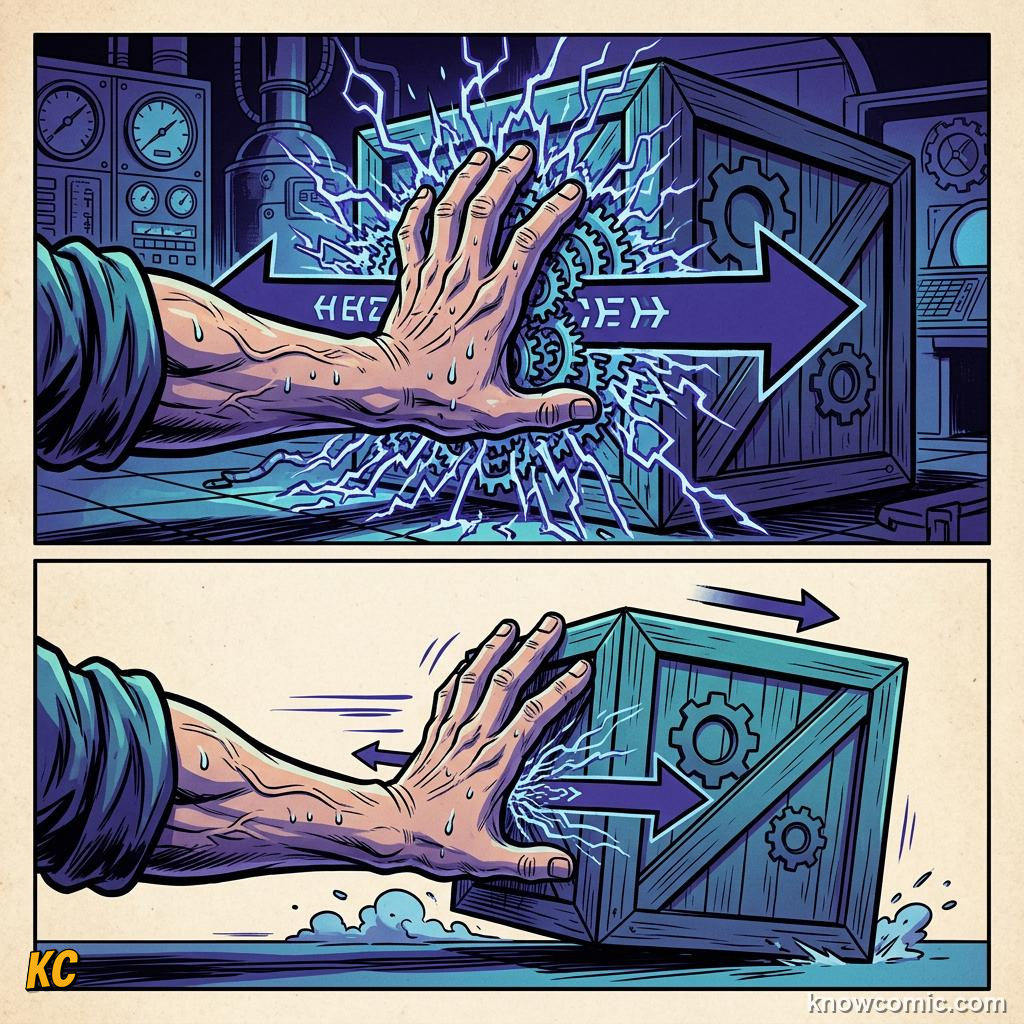
Once surfaces break free and slide, static friction is replaced by kinetic friction. Kinetic friction is approximately constant while the sliding continues. For most material pairs, the maximum static friction is greater than kinetic friction. That is why it takes a harder push to start a heavy crate moving than to keep it moving at steady speed. You feel a small jerk when the box breaks free because the opposing force suddenly drops.
⚖️ KEY COMPARISON
Static friction: prevents motion, varies up to a max. Kinetic friction: opposes sliding, roughly constant. Usually μs ≥ μk.
SLIP!
PAGE 4 OF 5, SURFACE SCIENCE
WHAT CHANGES FRICTION?
MATERIAL, ROUGHNESS, AND LUBRICATION
Friction depends on the materials in contact and how they interact at the microscopic level. Rough surfaces generally grip more than polished ones, though very smooth surfaces can stick through molecular attraction. Lubricants like oil fill the gaps between surfaces so peaks do not interlock as strongly, reducing both static and kinetic friction. Water on a road lowers tyre grip. Sand on ice increases it. Engineers choose surfaces and coatings carefully to get the right amount of friction for each job.
SURFACE!
🛞 TYRES
🛞 Tread grips through static friction
💧 Wet roads reduce μ dramatically
🏁 Racing tyres tuned for max grip
🛢️ LUBRICATION
🛢️ Oil separates metal surfaces
⚙️ Less wear, less heat in engines
🧊 Ice acts as a lubricant for skates
🔥 HEAT & WEAR
🔥 Rubbing wears surfaces down
⚡ Kinetic friction wastes energy
🛠️ Design balances grip and wear
PAGE 5 OF 5, GRIP VS SLIP IN LIFE
FRICTION EVERYWHERE
WHEN YOU WANT GRIP OR SLIDE
Athletes need high static friction so cleats grip the pitch before they sprint. Bowlers rely on kinetic friction between ball and lane to hook the shot. Musicians rosin their bow strings to increase friction and produce sound. When you want less friction, you polish, lubricate, or use wheels and ball bearings to roll instead of slide. Understanding the difference between static and kinetic friction helps engineers design safer cars, faster skis, and quieter machine parts.
👟 START vs KEEP GOING
More force needed to overcome static friction and start sliding. Less force needed to maintain sliding against kinetic friction.
Static friction prevents sliding up to fs ≤ μsN. Kinetic friction opposes sliding: fk = μkN. Maximum static friction is usually greater than kinetic friction. Sliding creates heat.
✅ Static = before motion starts
✅ Kinetic = during sliding
✅ μs usually ≥ μk
✅ Friction depends on surface and normal force
🧠 QUIZ TIME!
STATIC VS KINETIC FRICTION · 5 QUESTIONS
QUESTION 01
What does static friction do?
QUESTION 02
How is kinetic friction usually related to maximum static friction?
QUESTION 03
What happens to energy when two surfaces slide against each other?
QUESTION 04
The formula f = μN shows that friction increases when:
QUESTION 05
Why is it harder to start pushing a heavy crate than to keep it moving?