📖 350 Topics🆓 FREE + PRO⏱️ 5 min per comic🧠 Quiz included
⭕
ANCIENT
Perfect circles assumed
→
☀️
1543
Copernicus: Sun-centred model
→
📐
1609
Kepler: Laws 1 and 2
→
🎵
1619
Kepler: Third law
→
🛰️
TODAY
Satellites use Kepler orbits
🪐 KEPLER'S PLANETARY LAWS
TOPIC 13 · PHYSICS · ORBITS · ELLIPSES · SOLAR SYSTEM
PAGE 1 OF 5, ELLIPSES NOT CIRCLES
BREAKING THE CIRCLE MYTH
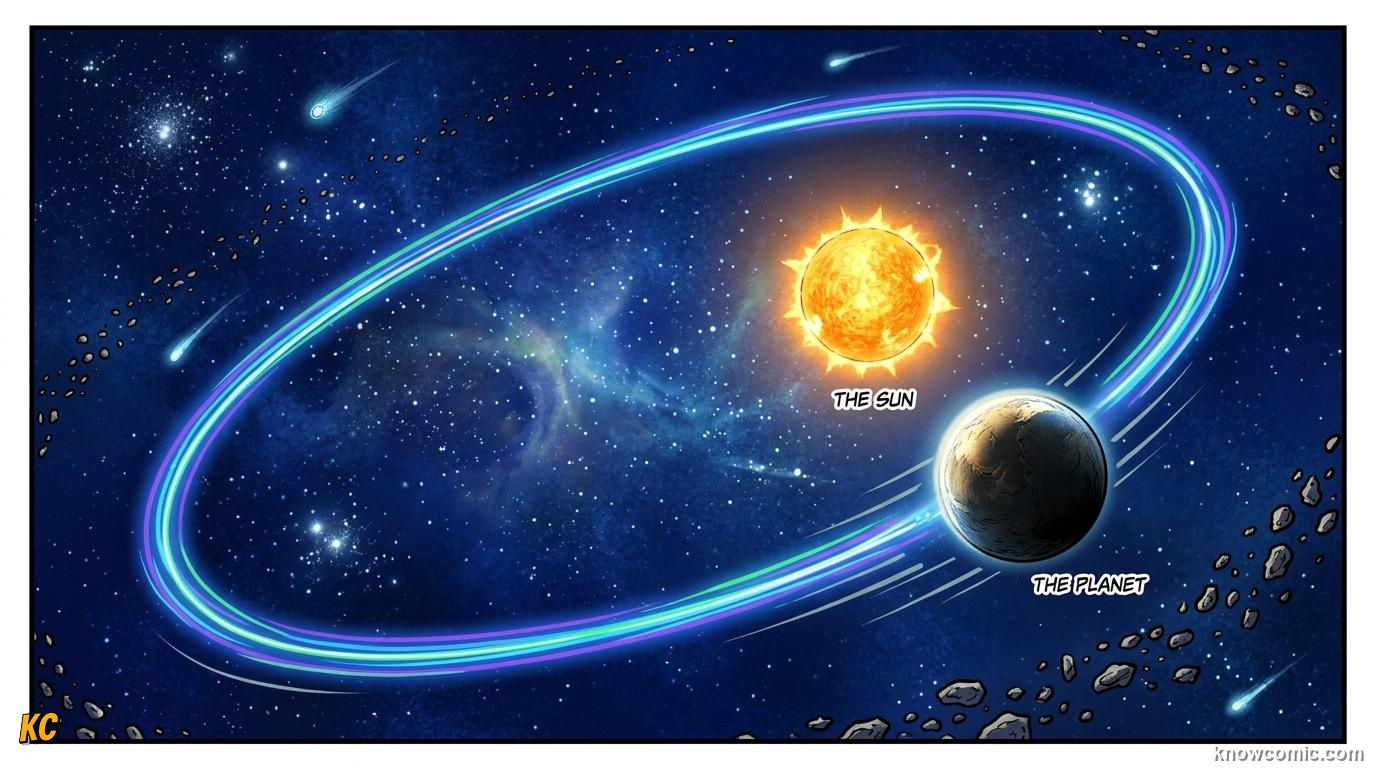
PLANETS DON'T MOVE IN CIRCLES
For centuries, astronomers pictured planets tracing perfect circles around the Earth or the Sun. Johannes Kepler shattered that idea. Using the precise observations of Tycho Brahe, he discovered that Mars and every other planet follow elliptical paths. An ellipse is a stretched circle with two focal points. The Sun sits at one focus, not at the centre. This was revolutionary: the heavens were not made of ideal geometric perfection, but of real, measurable curves that could be described with mathematics.
🔭 TYCHO'S DATA
Kepler spent years analysing Tycho Brahe's ultra-precise Mars observations. Only then could he see that no circle, no matter how cleverly adjusted, fit the real data.
ORBIT!
CIRCLE
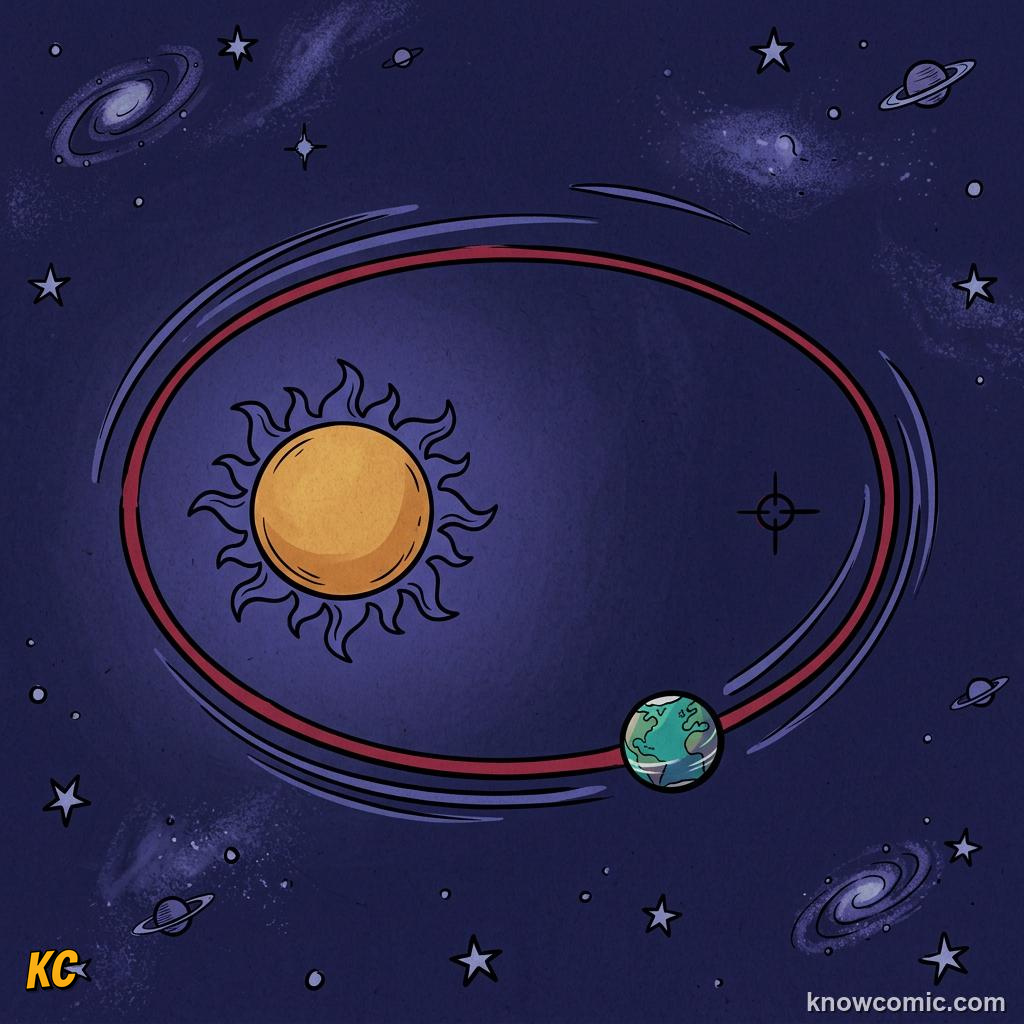
⭕ Circle: one centre point
📏 Same distance everywhere
❌ Does not match real planets
ELLIPSE
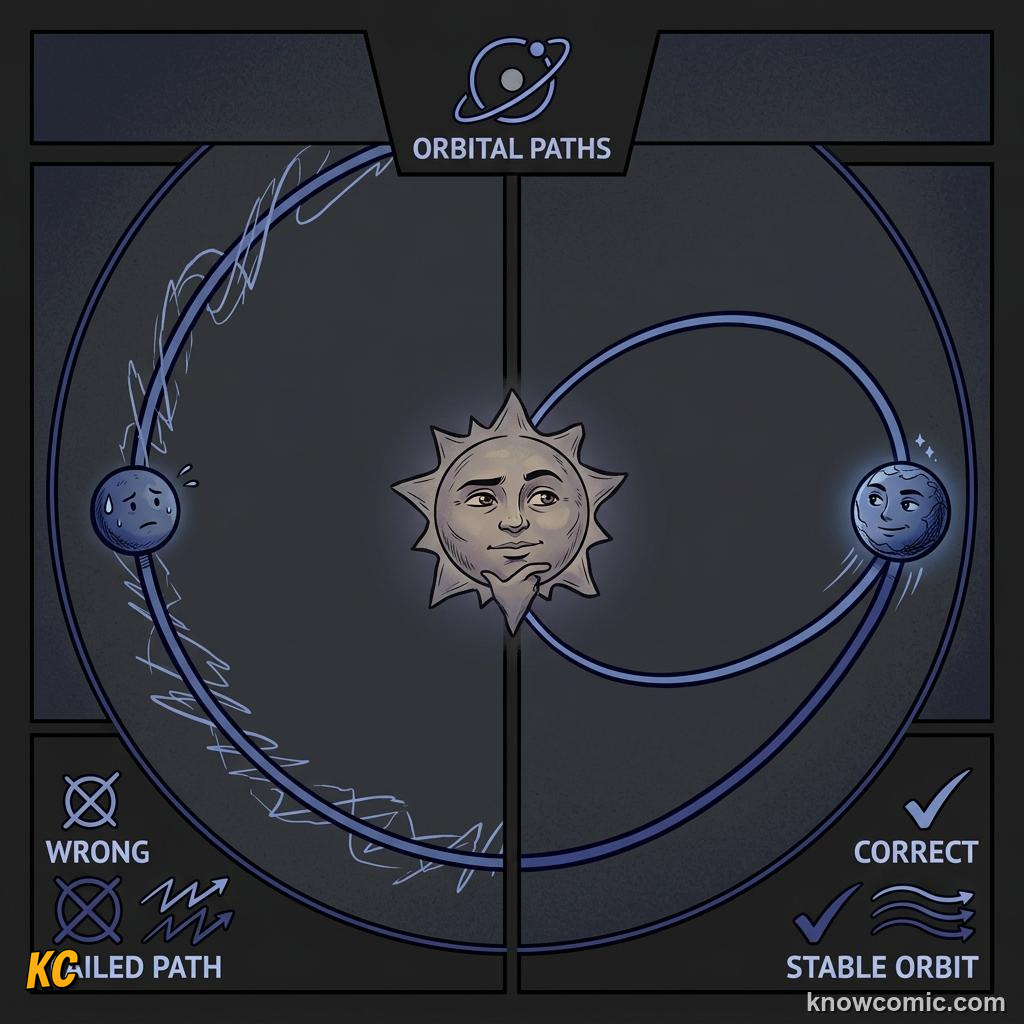
📐 Ellipse: two focal points
☀️ Sun at one focus
✅ Matches real planetary motion
PAGE 2 OF 5, KEPLER'S FIRST LAW
LAW 1: THE ORBIT SHAPE
EVERY PLANET ORBITS IN AN ELLIPSE
Kepler's first law states that each planet moves in an ellipse with the Sun at one focus. The other focus is empty space. Most planetary orbits are nearly circular, but none are perfect circles. Mars has a noticeably oval orbit. Comets have extremely stretched ellipses that can take them far beyond Neptune. Kepler published this law in his book Astronomia Nova in 1609, alongside his second law. Together they replaced the old idea of uniform circular motion with a model grounded in real observation.
FOCUS!
PERIHELION
☀️ Closest approach to the Sun
🏃 Planet moves fastest here
📛 Called perihelion
APHELION
🌌 Farthest point from the Sun
🐢 Planet moves slowest here
📛 Called aphelion
1609
📖 Astronomia Nova, 1609
🔬 Laws 1 and 2 published
🪐 Based on Mars data
PAGE 3 OF 5, KEPLER'S SECOND LAW
SWEEPING AREAS
📐 Draw line from Sun to planet
🟦 Area swept = wedge shape
⏱️ Same area every equal time
CHANGING SPEED
🏃 Fast near the Sun
🐢 Slow far from the Sun
⚖️ Area law links both
LAW 2: EQUAL AREAS IN EQUAL TIMES
A PLANET SWEEPS EQUAL AREAS
Kepler's second law says that a line joining a planet and the Sun sweeps out equal areas in equal intervals of time. Near the Sun the planet must move faster to cover a long arc in a short time. Far from the Sun it moves slower but sweeps the same area because the radius is longer. This law explains why Earth feels slightly different seasons: we move a little faster when closer to the Sun in early January. It also appeared in Astronomia Nova in 1609 and gave astronomers a powerful tool for predicting where a planet would be on any given date.
🧊 COMET EXAMPLE
Halley's Comet races through the inner solar system in weeks, then crawls through the outer regions for decades. The area law explains this dramatic speed change perfectly.
SWEEP!
PAGE 4 OF 5, KEPLER'S THIRD LAW
LAW 3: THE HARMONIC LAW
T² IS PROPORTIONAL TO r³
Kepler's third law connects how long a planet takes to orbit with how far it sits from the Sun. The square of the orbital period T is proportional to the cube of the average orbital radius r. Planets farther out take much longer to complete one lap. Mars needs about 687 Earth days. Jupiter needs nearly 12 Earth years. Kepler published this harmonic law in Harmonice Mundi in 1619, ten years after his first two laws. It unified the whole solar system into one mathematical pattern and later helped Isaac Newton derive the law of universal gravitation.
HARMONY!
🌍 EARTH
🌍 1 AU from the Sun
⏱️ Period ≈ 365 days
📐 Reference for other planets
🪐 JUPITER
🪐 ~5.2 AU from the Sun
⏱️ Period ≈ 12 Earth years
📈 Farther = much longer year
1619
📖 Harmonice Mundi, 1619
🎵 Third law: the harmonic law
🔗 Links all planets together
PAGE 5 OF 5, KEPLER'S LEGACY
FROM SKY TO SPACE
THREE LAWS THAT CHANGED EVERYTHING
Kepler's laws turned astronomy from guesswork into precise physics. Newton showed that gravity explains why the laws work. Today every satellite, space probe, and space station relies on elliptical orbital mechanics. NASA uses Kepler's equations to plan Mars missions and to keep the International Space Station aloft. The James Webb Space Telescope orbits the Sun at a special point called L2, calculated using the same principles Kepler discovered four centuries ago with nothing but pen, paper, and Tycho's star charts.
🚀 MODERN USE
GPS satellites, weather satellites, and the Hubble Space Telescope all follow elliptical or near-circular orbits predicted by Kepler's laws.
STARS!
NEWTON
🍎 Newton explained why laws work
🌍 Gravity pulls planets toward Sun
🔗 Kepler + Newton = modern physics
REMEMBER
🪐 KEY FACTS
Law 1: elliptical orbits, Sun at one focus. Law 2: equal areas in equal times. Law 3: T² proportional to r³. Laws 1 and 2 in Astronomia Nova (1609). Law 3 in Harmonice Mundi (1619).
✅ Planets orbit in ellipses, not circles
✅ Faster near Sun, slower far away
✅ Farther planets have longer years
✅ Still used for every space mission
🧠 QUIZ TIME!
KEPLER'S PLANETARY LAWS · 5 QUESTIONS
QUESTION 01
What shape do planets follow according to Kepler's first law?
QUESTION 02
What does Kepler's second law tell us about planetary speed?
QUESTION 03
Kepler's third law relates orbital period T to average distance r. Which is correct?
QUESTION 04
When did Kepler publish his first two planetary laws?