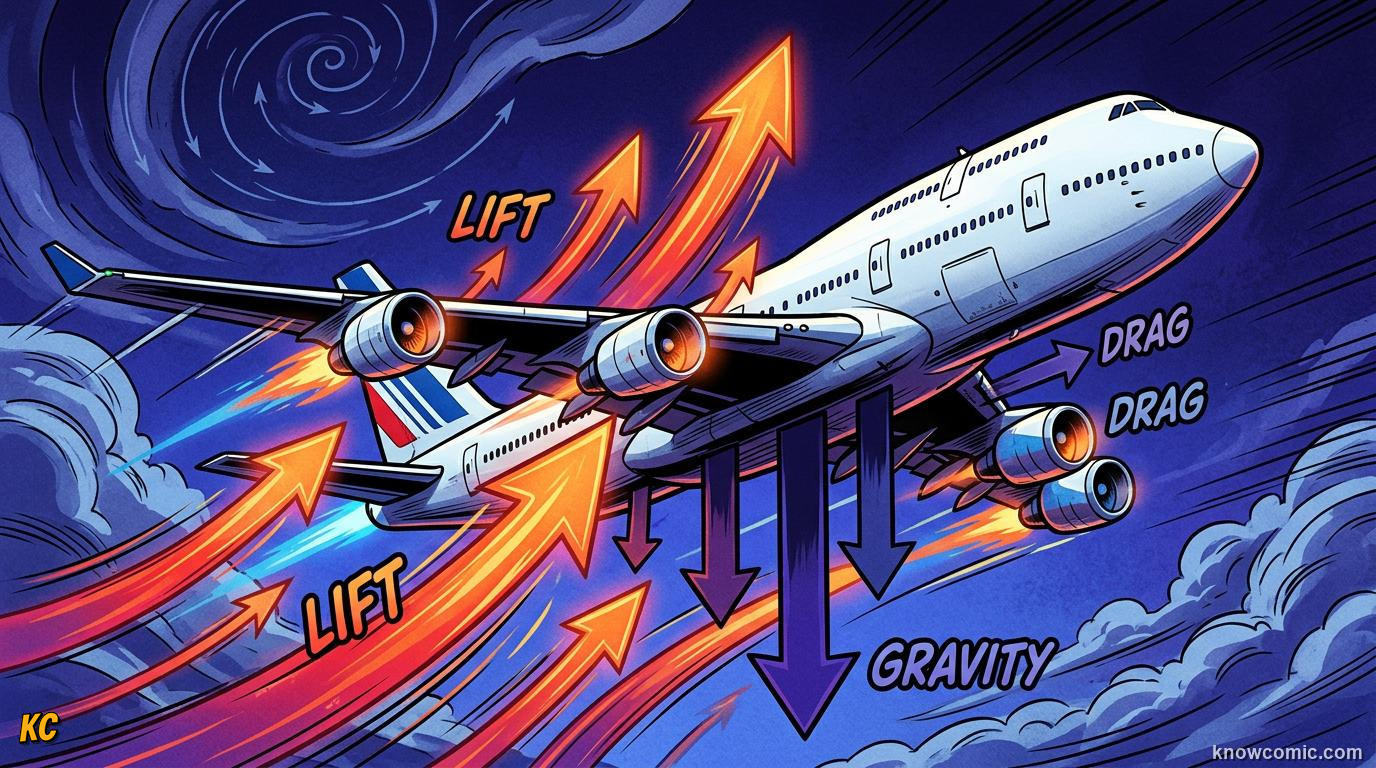
A fully loaded airliner weighs hundreds of tonnes, yet it climbs into the sky. Gravity pulls it down constantly. To stay aloft, the wings must produce an upward force called lift that matches or exceeds weight. Lift does not come from magic or from the engines pushing the plane up. Engines push the plane forward; the wings interact with moving air to generate lift. Understanding flight means understanding how air flows around a specially shaped wing and how that flow creates forces strong enough to conquer gravity.
⚖️ FORCE BALANCE
Level flight means lift equals weight and thrust equals drag. Change any one force and the plane climbs, descends, speeds up, or slows down.
LIFT!
WEIGHT DOWN
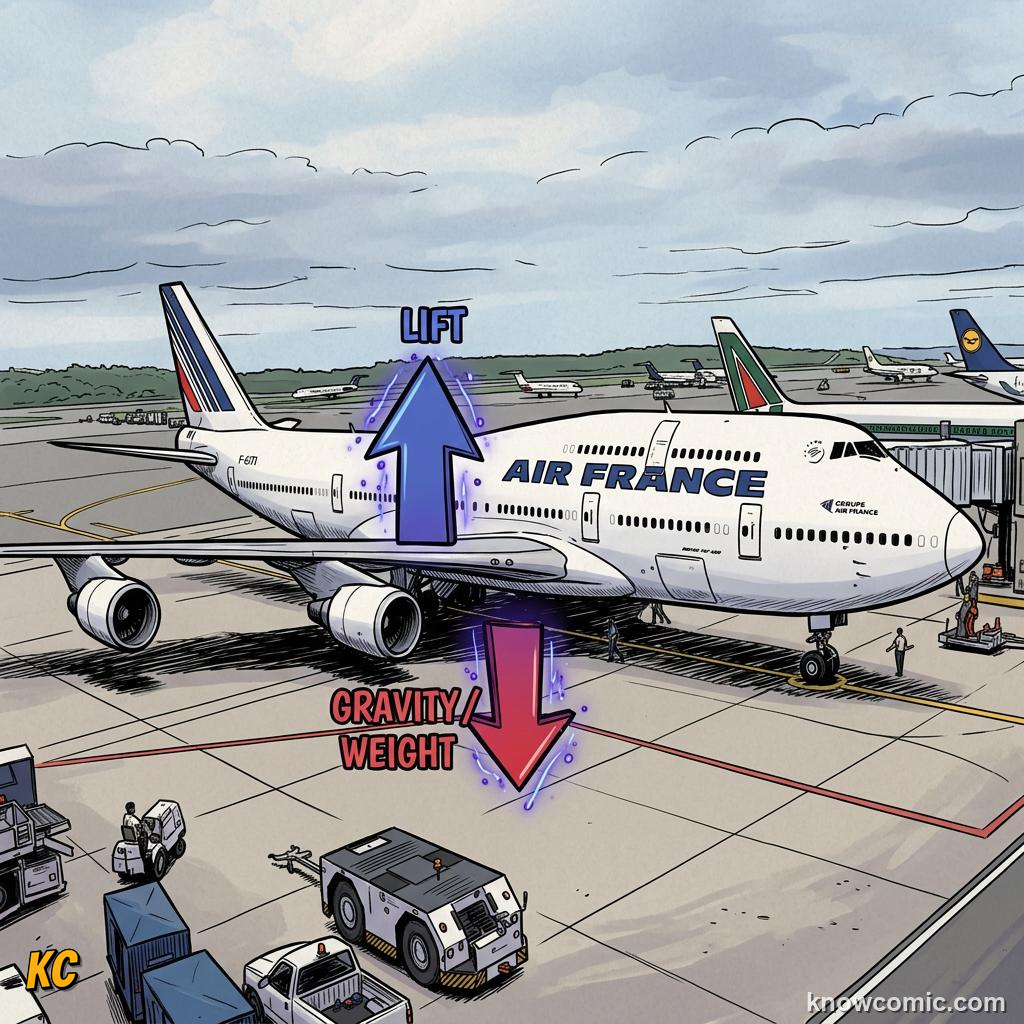
⬇️ Gravity pulls plane down
⚖️ Weight = mass × g
🌍 Always present in flight
LIFT UP
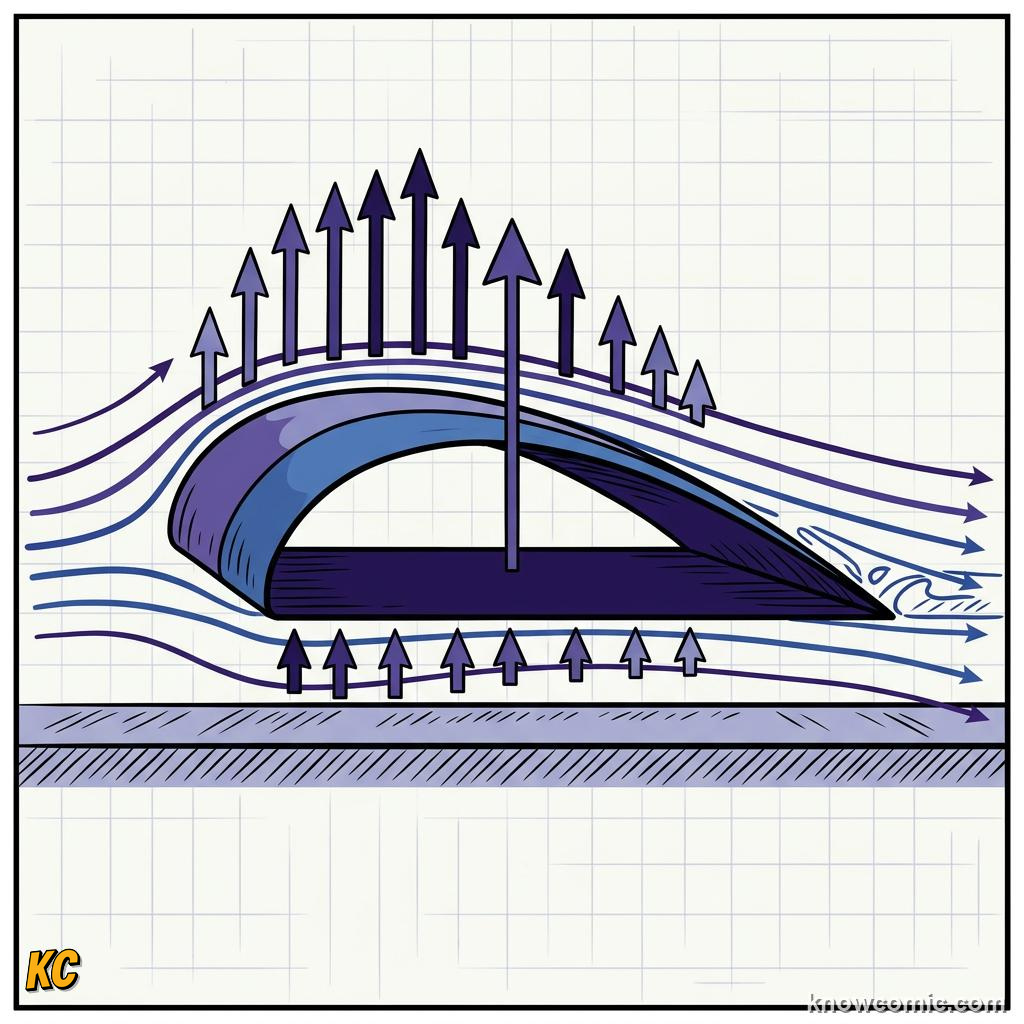
⬆️ Wings push air, air pushes wing
🪽 Lift opposes weight
✈️ No lift = no flight
PAGE 2 OF 5, THE AIRFOIL SHAPE
CURVED WING DESIGN
THE WING IS AN AIRFOIL
An airplane wing is not flat. Its cross-section, called an airfoil, is curved on top and flatter underneath. As the plane moves forward, air splits to flow over and under the wing. The curved upper surface forces air to travel a longer path, so air above the wing moves faster than air below. According to Bernoulli's principle, faster-moving fluid has lower pressure. Lower pressure above and higher pressure below creates an upward push on the wing. This is one key piece of the lift story, though not the whole picture.
WING!
FAST AIR ABOVE
💨 Air above moves faster
📉 Lower pressure on top
⬆️ Upward pressure difference
SLOW AIR BELOW
🐢 Air below moves slower
📈 Higher pressure underneath
🔼 Net push lifts the wing
⬇️ Wing pushes air downward
💨 Air changes direction
🔄 Momentum transfer to air
REACTION
⬆️ Air pushes wing upward
⚖️ Equal and opposite forces
🍎 Newton's third law
NEWTON'S THIRD LAW
TURN THE AIR DOWN, RISE UP
Bernoulli's pressure difference is only part of the story. Newton's third law gives another powerful explanation: for every action there is an equal and opposite reaction. A wing angled through oncoming air deflects a stream of air downward. Pushing air down means the air pushes back upward on the wing. The more air you deflect and the harder you deflect it, the more lift you generate. This is why a flat plate tilted at an angle can produce lift, even without a fancy curved shape. Real wings use both Bernoulli pressure effects and Newtonian downward deflection together.
🤝 BOTH IDEAS MATTER
Lift is not caused by Bernoulli alone or Newton alone. Pressure differences and downward momentum transfer both contribute to the total upward force on a wing.
PUSH!
PAGE 4 OF 5, ANGLE OF ATTACK
TILTING THE WING
ANGLE OF ATTACK CONTROLS LIFT
Angle of attack is the angle between the wing and the oncoming airflow. Increase it slightly and lift grows because the wing deflects more air downward and changes pressure more strongly. Pilots use this during takeoff and landing. But tilt too far and smooth airflow separates from the upper surface, causing a stall. In a stall, lift collapses even though the plane is still moving. Speed matters too: slower flight needs a higher angle of attack to maintain lift, which is why landing approaches are carefully controlled. Good pilots manage speed, angle, and engine power together.
TILT!
TAKEOFF
🛫 High speed + wing tilt
⬆️ Strong lift overcomes weight
🚀 Plane climbs into sky
STALL
⚠️ Angle too steep
💨 Airflow separates from wing
📉 Lift drops suddenly
LANDING
🛬 Slower speed, more wing tilt
🔧 Flaps increase wing area
✈️ Controlled descent to runway
PAGE 5 OF 5, FLIGHT EVERYWHERE
AERODYNAMICS IN NATURE
THE SAME PHYSICS, MANY FORMS
Birds, bats, and insects all generate lift with shaped wings and controlled angles of attack. Gliders have no engines but ride rising air currents for hours. Helicopters spin narrow airfoils called rotor blades to push air down and lift off vertically. Formula 1 cars use inverted wings to push down onto the track for grip, which is lift turned upside down. Engineers test every design in wind tunnels, measuring pressure and airflow. The physics you learn from a simple paper airplane applies to the largest jet in the sky.
🦅 NATURE GOT THERE FIRST
Birds evolved airfoil-shaped wings millions of years before humans built the Wright Flyer. Engineers still study bird flight to design more efficient aircraft.
SOAR!
DRAG & THRUST
⬆️ Lift vs ⬇️ weight (vertical)
➡️ Thrust vs ⬅️ drag (horizontal)
⚖️ All four forces in balance
REMEMBER
✈️ KEY FACTS
Lift comes from wing shape and angle of attack. Bernoulli: faster air above means lower pressure. Newton: deflecting air down pushes wing up. Both ideas work together. Too much angle causes a stall.
✅ Airfoil shape creates pressure difference
✅ Deflecting air down creates upward push
✅ Angle of attack controls lift amount
✅ Bernoulli and Newton both explain lift
🧠 QUIZ TIME!
THE PHYSICS OF FLIGHT · 5 QUESTIONS
QUESTION 01
What is the upward force that keeps an airplane in the air?
QUESTION 02
According to Bernoulli's principle, what happens to air pressure where air moves faster?
QUESTION 03
How does Newton's third law explain wing lift?
QUESTION 04
What happens when a wing's angle of attack becomes too steep?