🤸
⚖️
🎪
⚛️ KNOW SECONDARY · AGES 12–18

PHYSICS

⚛️ From Newton's Apple to Quantum Weirdness!

📖 350 Topics 🆓 FREE + PRO ⏱️ 5 min per comic 🧠 Quiz included
🏛️
ANCIENT
Builders balance heavy stones
⚖️
1600s
Archimedes on levers and balance
🎪
1800s
Circus tightrope acts grow famous
🚗
1900s
Engineers design low, stable cars
🤸
TODAY
COM guides robots and athletes
🤸 CENTER OF MASS
TOPIC 15 · PHYSICS · BALANCE · STABILITY · GRAVITY
PAGE 1 OF 5, THE INVISIBLE BALANCE POINT
WHERE WEIGHT ACTS
Comic illustration of center of mass marked on a balanced human figure
EVERY OBJECT HAS A CENTER OF MASS
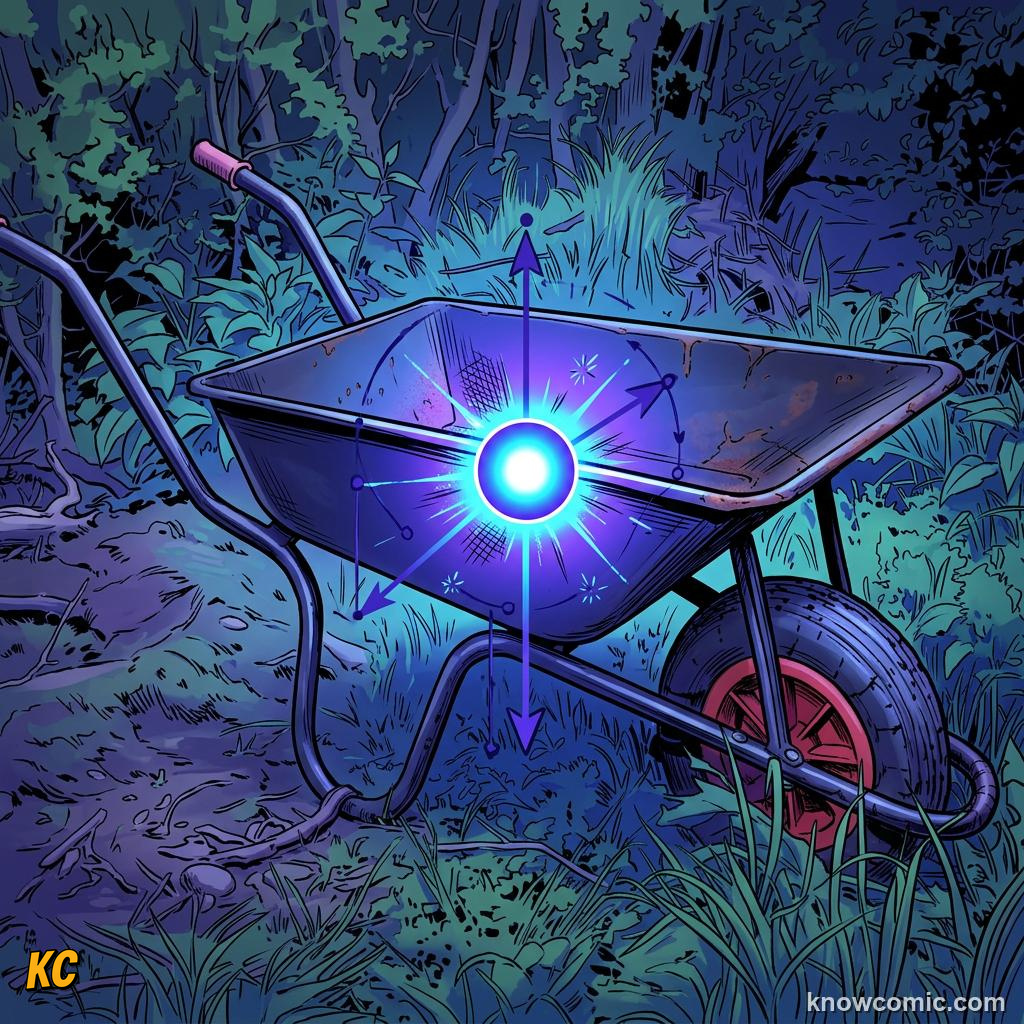
Imagine an object made of millions of tiny particles, each pulled downward by gravity. The center of mass (COM) is the single point where you can treat the entire object's weight as if it acts. For a uniform ruler, the COM sits at the geometric middle. For an irregular shape, it shifts toward heavier parts. You cannot see it, but it controls balance, tipping, and how objects spin. Gymnasts tuck their bodies to move their COM. Engineers place heavy batteries low in electric cars to keep the COM near the ground and improve stability.
📍 DEFINITION
The center of mass is the average position of all the mass in an object. Gravity pulls on every particle, but the net effect equals a single downward force through the COM.
BALANCE!
UNIFORM SHAPES
Comic illustration of center of mass at the middle of uniform shapes
📏 Uniform rod: COM at midpoint
🔵 Solid sphere: COM at centre
📐 Symmetry often reveals COM quickly
IRREGULAR SHAPES
Comic illustration of center of mass shifted toward heavier side of an object
🔨 Heavy end pulls COM toward it
🧍 Human COM: near lower belly
📦 Lopsided loads shift COM sideways
PAGE 2 OF 5, STABILITY AND TIPPING
STAYING UPRIGHT
Comic illustration showing vertical line from center of mass over base of support
SUPPORT MUST LIE BELOW THE COM
An object standing on the ground is stable when the vertical line drawn downward through its center of mass passes inside its base of support. The base is the area bounded by whatever touches the ground: your feet, a chair's legs, or a truck's tires. Gravity pulls the COM straight down. If that line lands inside the base, the object stays up. If you lean too far and the line falls outside the base, gravity creates a tipping torque and the object falls. Wide bases and low COMs make things harder to knock over.
STABLE!
BASE OF SUPPORT
Comic illustration of base of support under a standing person
👣 Feet apart = wider base
🪑 More contact points = more stable
📐 COM line must stay inside base
TIPPING POINT
Comic illustration of an object tipping when center of mass moves outside base
↗️ Lean until COM line exits base
💥 Gravity pulls object into a fall
🏗️ Tall narrow objects tip easily
LOW COM WINS
Comic illustration comparing stability of low versus high center of mass
⬇️ Lower COM = harder to tip
🚗 Race cars sit close to the ground
🏋️ Sumo wrestlers crouch for stability
PAGE 3 OF 5, THE TIGHTROPE POLE
WITHOUT A POLE
Comic illustration of tightrope walker without pole wobbling
😰 High COM above thin wire
↔️ Small sway moves COM off wire
🌀 Easy to lose balance
WITH A LONG POLE
Comic illustration of tightrope walker using long pole for balance
🪵 Pole spreads mass sideways
⬇️ COM drops closer to the wire
🔄 Pole twists slowly, buys time to react
WHY THE POLE WORKS
Comic illustration explaining tightrope pole physics and center of mass
LOWER COM, SLOWER TILT
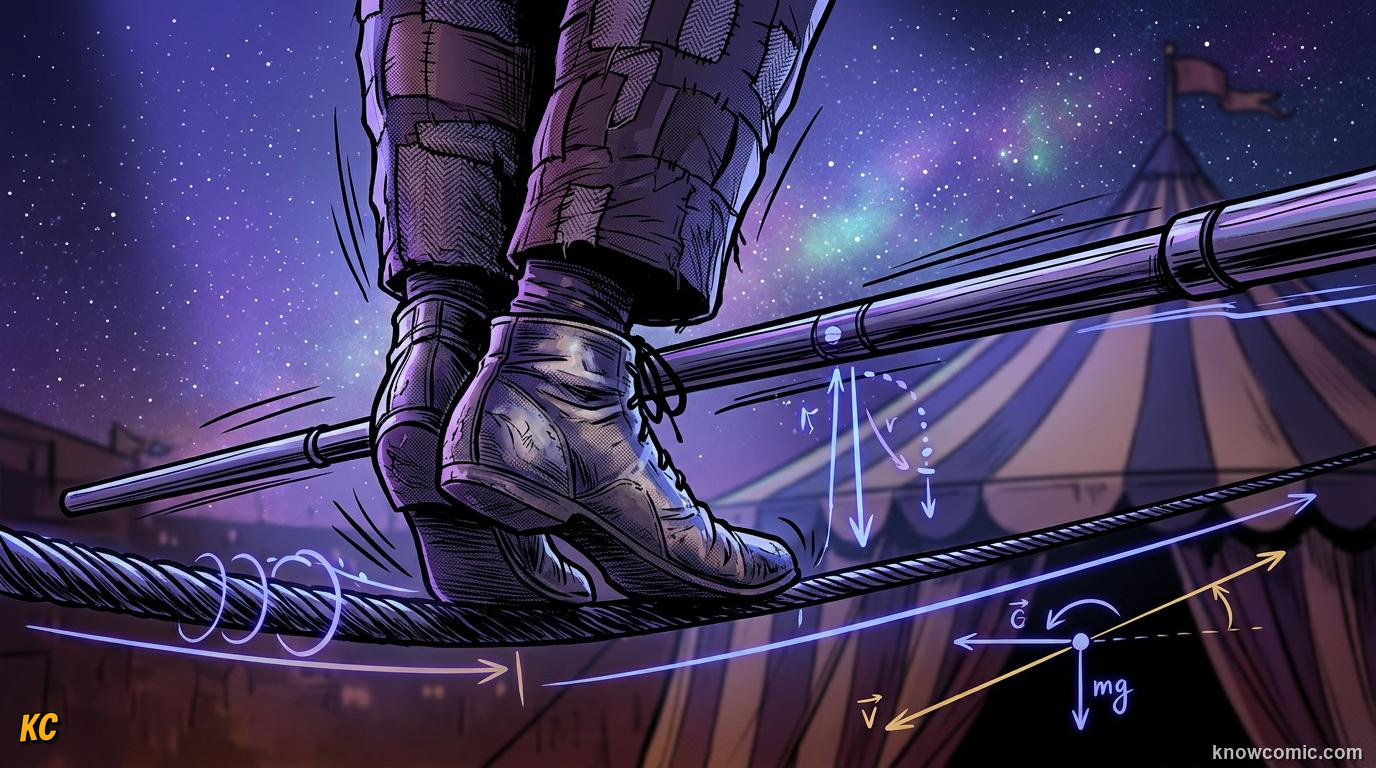
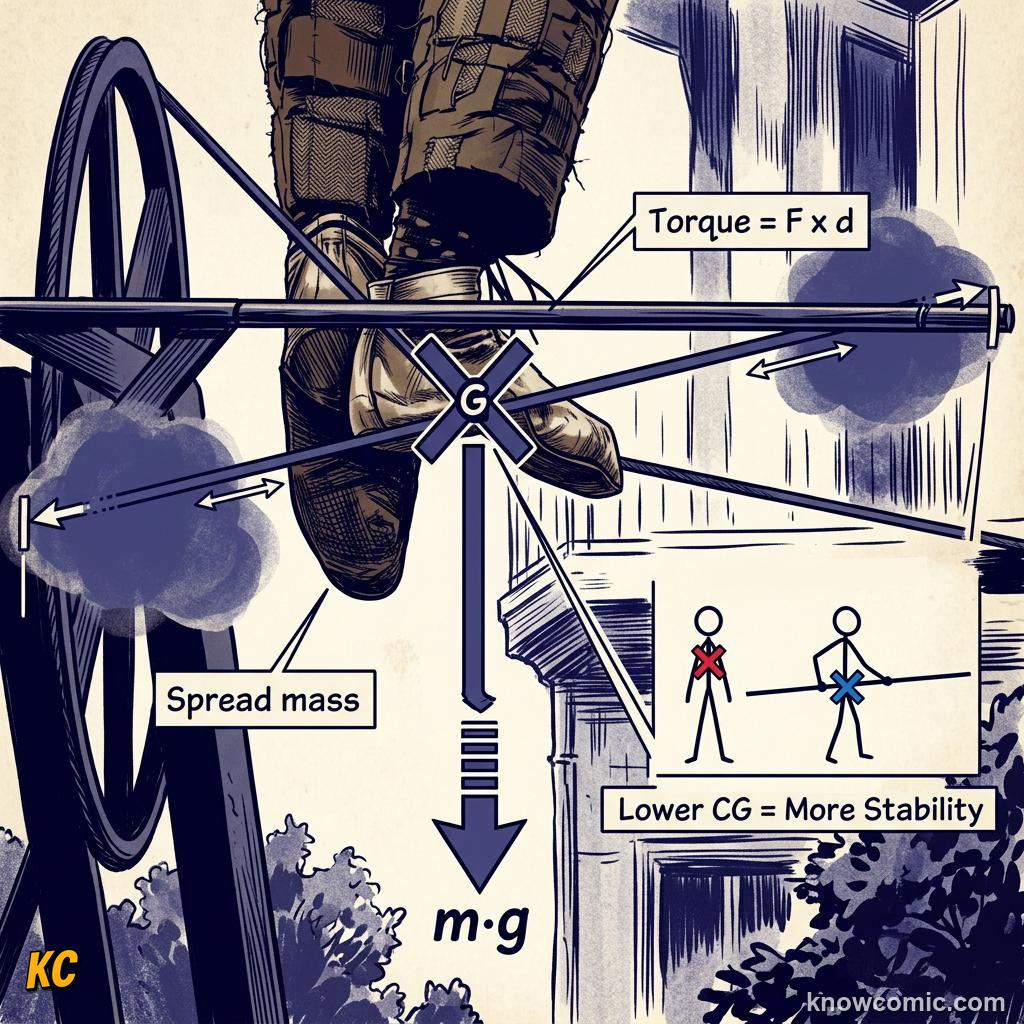
A tightrope walker's wire is an extremely narrow base of support. Carrying a long, heavy pole does two jobs at once. First, it lowers the combined center of mass of walker plus pole, so the vertical line through the COM stays over the wire more easily. Second, the pole increases rotational inertia: tilting the pole takes more time and effort, giving the walker precious seconds to shift weight and correct a wobble. Skilled walkers also bend their knees and spread their arms for the same reason. Circus physics is center-of-mass engineering in real time.
🎪 TIGHTROPE TRICK
A long pole lowers the system's COM and increases rotational inertia. Both effects make it easier to keep the COM line above the wire.
POLE!
PAGE 4 OF 5, COM IN MOTION
PROJECTILE MOTION
Comic illustration of center of mass following parabolic path during projectile motion
THE COM FOLLOWS A SMOOTH PATH
Watch a spinning diver or a tumbling cat. The body twists and folds, but the center of mass follows a smooth parabolic arc, just like a simple thrown ball. Internal forces can change rotation, but only external forces like gravity change the motion of the COM as a whole. This is why a exploding firework's glowing fragments spread outward yet their combined COM still traces one clean curve through the sky. Sports analysts track an athlete's COM to measure jump height and sprint efficiency. In space, astronauts float, but their COM still moves when they push off a wall.
ARC!
🤸 GYMNASTICS
Comic illustration of gymnast tucking to shift center of mass
🤸 Tuck pulls COM inward
🔄 Faster spin when COM closer to axis
🎯 COM arc sets landing spot
🚗 VEHICLE DESIGN
Comic illustration of low center of mass in stable vehicle design
🔋 Heavy battery pack under floor
🏎️ Lower COM resists rollover
📊 Crash tests track COM shift
🏗️ LEANING TOWERS
Comic illustration of leaning tower with center of mass over base
🏛️ Pisa leans but COM still over base
⚠️ Tilt too far and COM exits base
🔧 Engineers monitor COM every year
PAGE 5 OF 5, BALANCE EVERYWHERE
FINDING THE COM
Comic illustration of finding center of mass by balancing an object on a finger
BALANCE IT ON YOUR FINGER
You can locate the COM experimentally. Balance a ruler horizontally on one finger: the COM sits directly above your finger because that is where torques cancel. Hang a shape from a string and draw a vertical line down the string. Rotate the hanging point and draw again. Where the lines cross is the COM. Ships carry ballast low in the hull so the COM stays below the waterline, resisting capsizing. Cranes have counterweights that shift the COM of the crane-plus-load system back over the support. From circus acts to skyscrapers, the same invisible point decides whether things stand or fall.
⚓ STABILITY RULE
An object in stable equilibrium stays upright when the vertical line through its COM passes through the base of support below it.
CENTER!
SPORTS
Comic illustration of athletes using center of mass for balance in sports
⛷️ Skiers shift COM to turn and stop
🏄 Surfers move COM over the board
🥋 Martial artists lower COM to resist pushes
REMEMBER
🤸 KEY FACTS
Center of mass is where an object's weight effectively acts. For stability, support must lie below the COM and the vertical COM line must stay inside the base. Lower COM and wider base mean greater stability.
✅ COM is the average position of all mass
✅ COM line inside base = stable
✅ Lower COM is harder to tip over
✅ Tightrope poles lower COM and slow tilt
🧠 QUIZ TIME!
CENTER OF MASS · 5 QUESTIONS
QUESTION 01
What is the center of mass?
QUESTION 02
When is a standing object in stable equilibrium?
QUESTION 03
Why does a tightrope walker carry a long pole?
QUESTION 04
What happens when an object leans until the COM line falls outside its base?
QUESTION 05
Which change makes an object hardest to tip over?
0/5
LOADING...
← TOPIC 14 📋 ALL TOPICS TOPIC 16 →