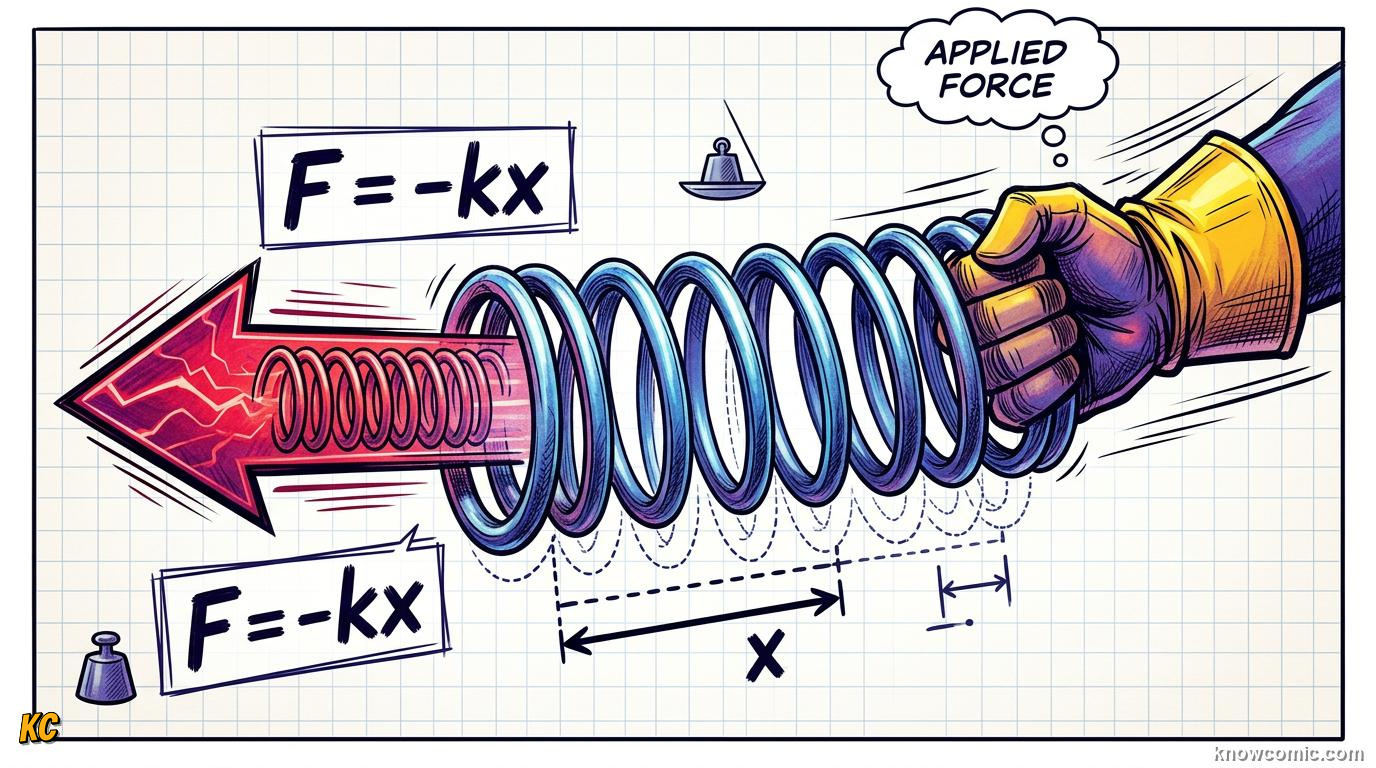
Elastic materials return to their original shape after being stretched or squeezed. Pull a spring and its coils resist, storing energy inside the material. Release it and that stored energy drives a restoration force that snaps the spring back. Rubber bands, diving boards, and archery bows work the same way. The material's internal bonds are slightly pulled apart when deformed, then pull themselves back together when the load is removed. This elastic behaviour is everywhere in engineering, from mattress coils to the suspension that keeps car rides smooth.
🔄 ELASTICITY
A material is elastic if it returns to its original shape after the deforming force is removed. The restoration force always opposes the direction of stretch or compression.
SPRING!
STRETCH
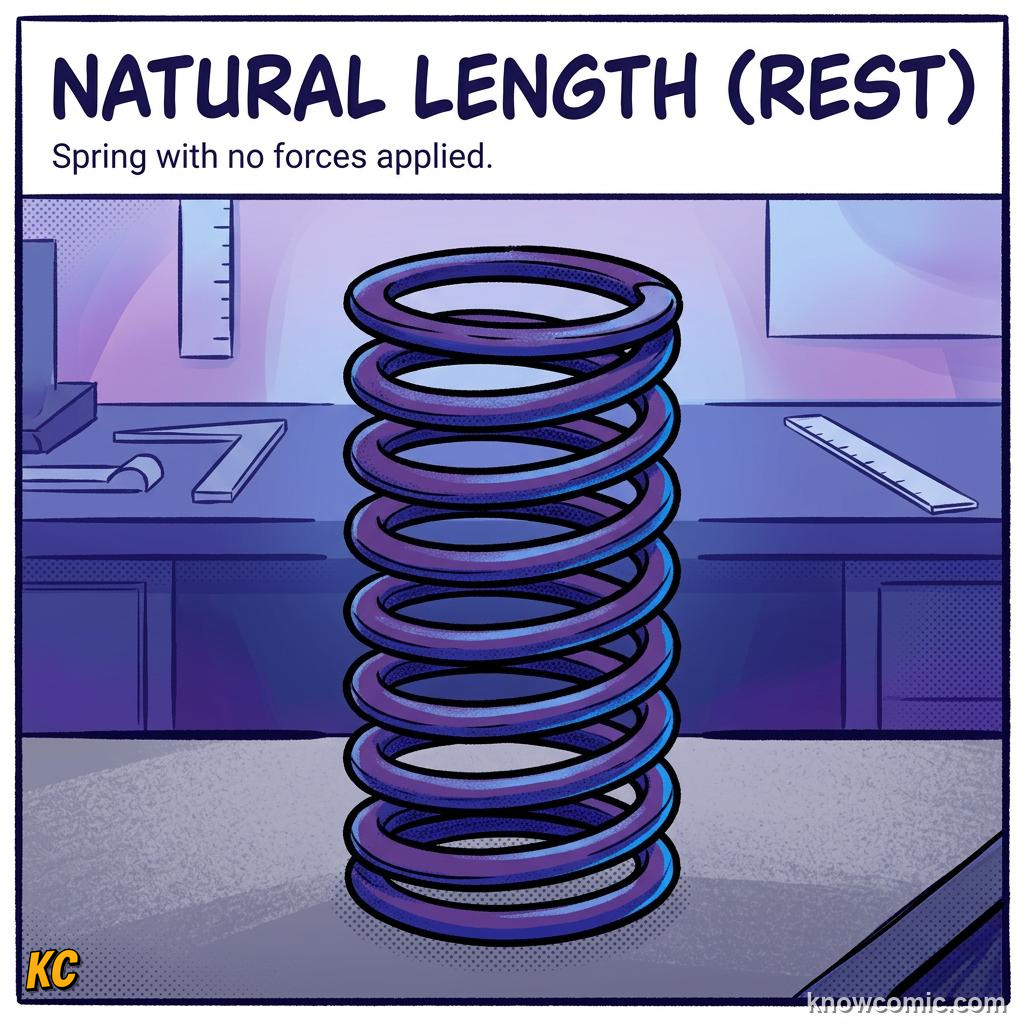
↔️ Pull spring: coils spread apart
⬅️ Restoration force pulls inward
📏 Extension = change in length
SQUEEZE
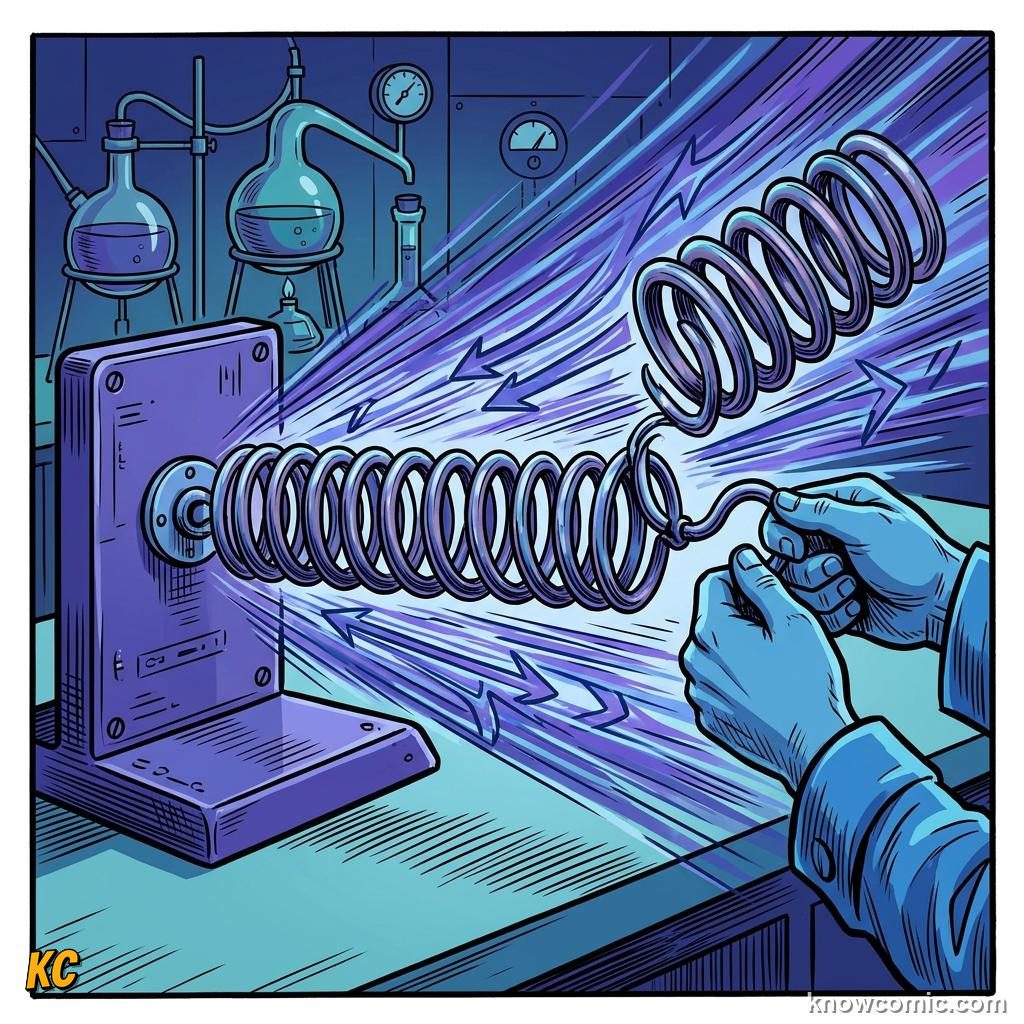
🔽 Push spring: coils pack tighter
⬆️ Restoration force pushes outward
💪 Same elastic rules apply
PAGE 2 OF 5, HOOKE'S LAW
F = kx
FORCE GROWS WITH STRETCH
In 1660, Robert Hooke discovered a simple rule for springs within their elastic range: the restoration force is proportional to the extension. Write it as F = kx, where F is the force in newtons, x is the extension (or compression) in metres, and k is the spring constant in newtons per metre. A stiff spring has a large k and resists strongly. A soft spring has a small k and stretches easily. Double the extension and you double the force. Plot force against extension and you get a straight line through the origin, one of the cleanest relationships in all of physics.
HOOKE!
F = FORCE
💪 F = restoration force (N)
↔️ Always opposes deformation
📈 Bigger stretch = bigger F
k = STIFFNESS
🔩 Large k = stiff spring (N/m)
🪶 Small k = stretchy spring
🏗️ Thicker wire usually means larger k
x = EXTENSION
📏 x = change from natural length
➕ Stretch and compress both count
📐 Measured in metres (m)
PAGE 3 OF 5, THE ELASTIC LIMIT
WITHIN LIMIT
✅ Small stretch: F = kx works
🔄 Spring returns to original length
📊 Force-extension graph is straight
BEYOND LIMIT
⚠️ Over-stretch: bonds break permanently
📉 Spring stays longer or bent
❌ Hooke's law no longer applies
ELASTIC vs PLASTIC
EVERY MATERIAL HAS A LIMIT
Hooke's law only works while the material stays in its elastic region. Stretch a spring gently and it obeys F = kx perfectly. Pull too hard and you cross the elastic limit: internal bonds slip or break, and the spring becomes permanently longer. That is plastic deformation. Engineers must design car suspensions, bridge cables, and trampoline mats to stay below the elastic limit during normal use. A force-extension graph shows a straight line in the elastic region, then curves and flattens as the material yields and eventually breaks at its breaking point.
⚠️ ELASTIC LIMIT
Beyond the elastic limit, deformation becomes permanent. The material will not fully return to its original shape even after the force is removed.
LIMIT!
PAGE 4 OF 5, ENERGY IN SPRINGS
STORED ENERGY
STRETCH IT, STORE ENERGY
When you stretch a spring, you do work against the restoration force and that energy is stored as elastic potential energy. Release the spring and the energy converts into kinetic energy of a moving object. A pinball launcher, a mousetrap, and a pole vaulter's bent pole all rely on this transfer. For an ideal spring, the stored energy is E = ½kx². Notice the x squared: stretching twice as far stores four times as much energy because the force itself grows as you pull. Trampolines and bungee cords are carefully designed so the elastic limit is never crossed during normal jumps.
STORE!
🏹 ARCHERY
🏹 Bow limbs bend, store energy
➡️ String releases, arrow flies
🎯 Draw length sets stored energy
🚗 SUSPENSION
🛞 Coil springs absorb bumps
🔄 Compress and rebound elastically
⚙️ k chosen for comfort and load
⚖️ SCALES
⚖️ Spring stretches under load
📏 Extension proportional to weight
🔢 F = kx reads mass on dial
PAGE 5 OF 5, ELASTICITY EVERYWHERE
BEYOND COIL SPRINGS
MATERIALS FIGHT TO SNAP BACK
Hooke's law started with springs, but the idea of a restoration force applies broadly. Rubber bands, steel beams, and even your tendons resist deformation elastically up to a point. Diving boards bend and rebound. Building girders flex slightly under load but return when the load is removed. Seismometers use delicate springs to detect earthquakes. Not every material follows F = kx exactly, but the core lesson holds: elastic objects store energy when deformed and push or pull back toward their rest shape. Understanding k, x, and the elastic limit lets engineers build things that flex safely without breaking.
📐 HOOKE'S LAW
F = kx, where F is restoration force, k is spring constant, and x is extension. Valid only within the elastic limit.
RESTORE!
LAB TEST
📎 Hang masses on a spring
📏 Measure extension for each load
📊 Plot F vs x to find k
REMEMBER
🌀 KEY FACTS
Elastic materials return to shape after deformation. Hooke's law: F = kx within the elastic limit. Restoration force opposes stretch. Beyond the elastic limit, deformation is permanent.
✅ F = kx: force proportional to extension
✅ k measures spring stiffness (N/m)
✅ Elastic limit marks permanent change
✅ Stored energy: E = ½kx²
🧠 QUIZ TIME!
ELASTICITY & HOOKE'S LAW · 5 QUESTIONS
QUESTION 01
What does Hooke's law state?
QUESTION 02
What is the spring constant k?
QUESTION 03
What happens when you stretch a spring beyond its elastic limit?
QUESTION 04
If you double the extension of a spring (within the elastic limit), what happens to the restoration force?