📖 350 Topics🆓 FREE + PRO⏱️ 5 min per comic🧠 Quiz included
🏛️
ANCIENT
Levers move pyramid stones
→
⚙️
200s BCE
Archimedes studies simple machines
→
🏗️
1400s
Cranes and pulleys at cathedrals
→
🏭
1800s
Factory gears drive industry
→
🔧
TODAY
Machines in every toolbox
⚙️ MECHANICAL ADVANTAGE
TOPIC 17 · PHYSICS · PULLEYS · GEARS · EFFICIENCY
PAGE 1 OF 5, FORCE MULTIPLIERS
SIMPLE MACHINES
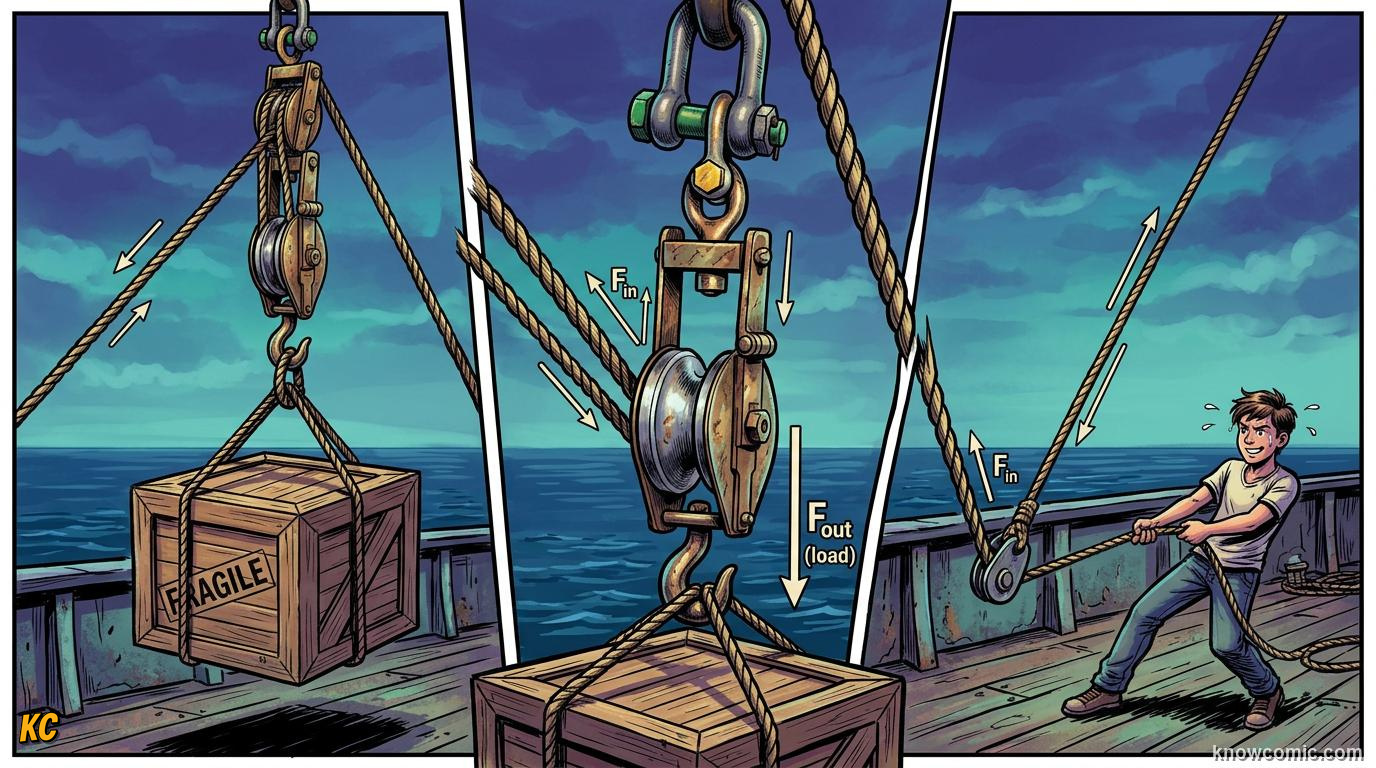
DO MORE WITH LESS FORCE
You cannot create energy from nothing, but you can trade force for distance. Simple machines like levers, pulleys, gears, and screws let you apply a smaller input force to produce a larger output force on a load. The catch is you must push or pull over a greater distance. Ancient builders used ramps and levers to move blocks weighing many tonnes. Mechanical advantage (MA) quantifies this boost: MA equals output force divided by input force. An MA of 4 means the machine delivers four times the force you put in, ideal for lifting heavy loads with human muscle.
⚙️ MECHANICAL ADVANTAGE
MA = output force ÷ input force. An MA greater than 1 means the machine multiplies force. You pay for it by moving farther than the load moves.
MULTIPLY!
INPUT FORCE
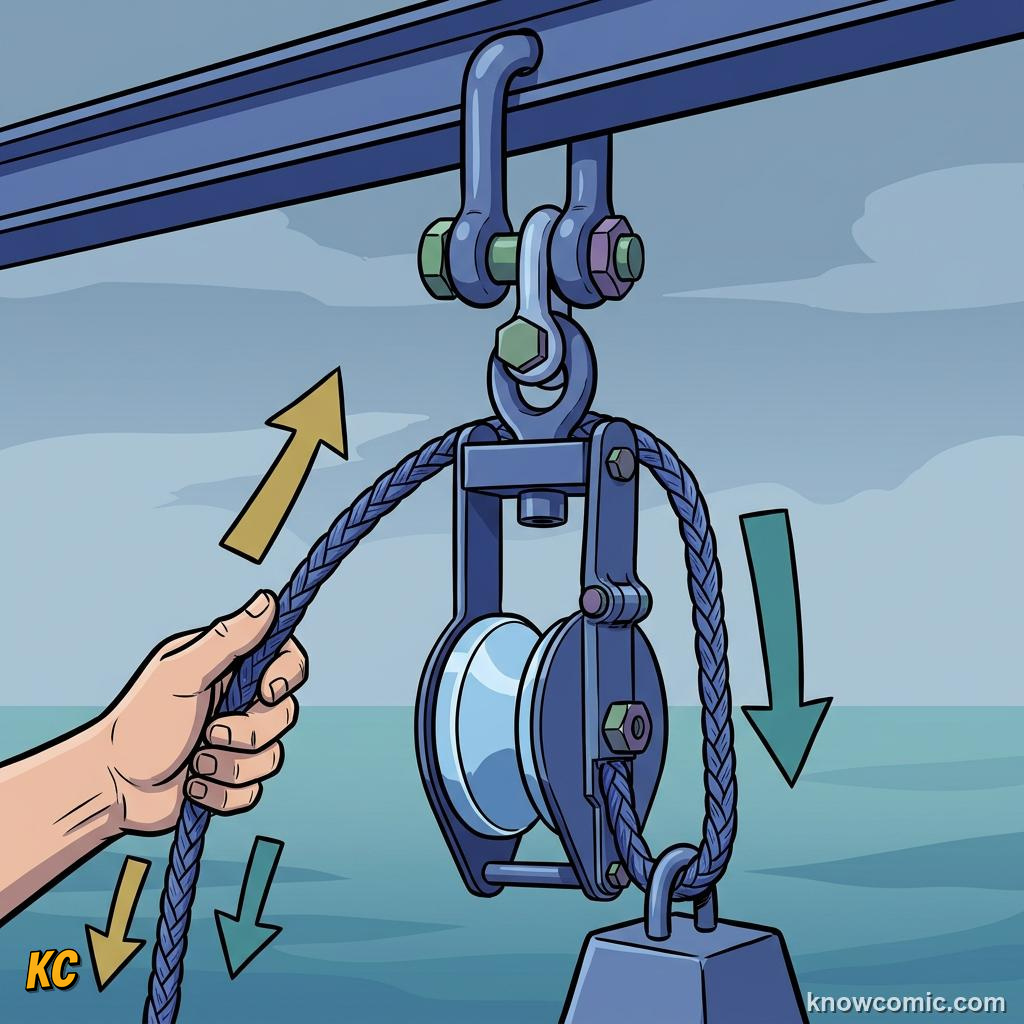
💪 Effort you apply (input)
📏 You move a longer distance
🔋 Same work, spread differently
OUTPUT FORCE
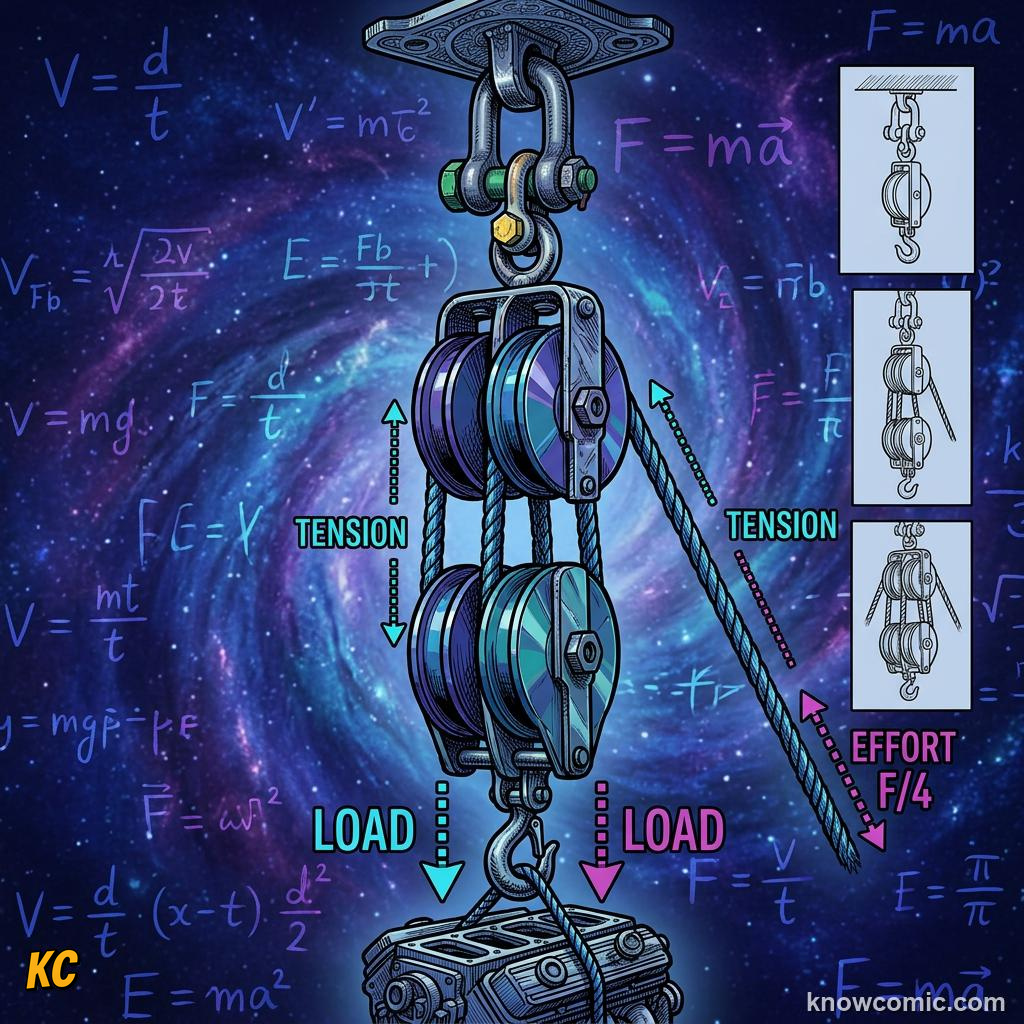
🏋️ Force on the load (output)
⬆️ Load moves a shorter distance
⚖️ MA = output ÷ input force
PAGE 2 OF 5, PULLEYS AND LEVERS
CLASSIC MACHINES
PULLEYS REDIRECT AND SHARE LOAD
A single fixed pulley changes the direction of force but gives MA = 1. Add movable pulleys and each supporting rope strand shares the load. A block and tackle with four strands supporting the load can give MA ≈ 4: you pull with one quarter the force, but haul four times as much rope. A lever works by pivoting on a fulcrum. Push down on the long end and the short end lifts a heavy load. The mechanical advantage equals the ratio of effort-arm length to load-arm length. Crowbars, seesaws, and wheelbarrows are all levers in disguise.
LIFT!
FIXED PULLEY
🔄 Pull down to lift load up
📐 MA = 1 (no force gain)
🏗️ Still useful on construction sites
MOVABLE PULLEY
🔗 Two rope strands share load
⚙️ MA = 2 for one movable pulley
📏 Pull twice the rope distance
LEVER
⚖️ Fulcrum = pivot point
📏 Long effort arm = high MA
🪨 Archimedes: "Give me a lever..."
PAGE 3 OF 5, GEARS AND SCREWS
GEAR RATIOS
⚙️ Small gear driving large = force gain
🔢 MA ≈ teeth on driven ÷ driver
🚲 Bike gears climb hills easier
THE SCREW
🔩 Screw = ramp wrapped in a circle
🔄 Many turns, huge force on wood
🏗️ Jacks and presses use screw threads
INCLINED PLANE
RAMPS ARE SIMPLE MACHINES TOO
An inclined plane lets you push a load up a slope instead of lifting it straight up. The longer and gentler the ramp, the less force you need, but the farther you must push. Mechanical advantage equals the ramp length divided by the height gained. Wheelchair ramps, loading docks, and mountain roads all use this trade-off. Gears connect rotating machines: a small driver gear turning a larger driven gear multiplies torque (turning force) while reducing rotation speed. Bicycle derailleurs switch gear ratios so you can pedal easily uphill or sprint on flat ground.
🔄 WORK TRADE-OFF
Ideal machines conserve work: input work = output work. Less force means more distance. You never get more energy out than you put in.
GEAR!
PAGE 4 OF 5, EFFICIENCY AND FRICTION
REAL MACHINES LOSE ENERGY
FRICTION EATS YOUR ADVANTAGE
Perfect machines would deliver 100% of input work to the load. Real machines never do. Friction in axles, rope bending over pulleys, and gear teeth rubbing together convert some energy into waste heat. Efficiency measures how much useful work you get out compared to what you put in: efficiency = useful output work ÷ input work, usually expressed as a percentage. A well-oiled pulley might reach 90% efficiency. A rusty one might drop to 60%. Lubrication, ball bearings, and smooth surfaces reduce friction and keep mechanical advantage closer to the ideal value calculated from geometry alone.
FRICTION!
IDEAL MA
✨ Assumes zero friction
📐 Calculated from geometry only
🔢 Pulley strands, gear teeth, lever arms
ACTUAL MA
🔧 Measured in real conditions
📉 Always less than ideal MA
🛢️ Oil and bearings help close the gap
EFFICIENCY
📊 Efficiency = output work ÷ input work
🔥 Lost energy becomes heat
✅ Good machines: 80–95% efficient
PAGE 5 OF 5, MACHINES IN THE WORLD
HUMAN INGENUITY
SIMPLE MACHINES BUILT CIVILISATION
Every crane on a skyline, every bicycle climbing a hill, and every bottle opener in a kitchen relies on mechanical advantage. Compound machines combine several simple ones: a crane uses levers, pulleys, and gears together. Your body uses levers too: your forearm pivoting at the elbow is a third-class lever. Understanding MA = output force ÷ input force helps engineers design safe lifts, mechanics tune gearboxes, and students predict whether a machine can handle a given load. The physics is ancient, but the applications surround us every single day.
⚙️ KEY FORMULA
Mechanical advantage = output force ÷ input force. MA > 1 multiplies force at the cost of moving a greater distance.
POWER!
EVERYDAY TOOLS
🔧 Wrench = lever on a bolt
✂️ Scissors = double lever system
🚪 Doorknob = wheel and axle
REMEMBER
⚙️ KEY FACTS
MA = output force ÷ input force. Simple machines trade distance for force. Pulleys, levers, gears, and screws all provide MA. Real efficiency is always below 100% because of friction.
✅ MA = output ÷ input force
✅ More force = more distance moved
✅ Friction reduces actual MA
✅ Efficiency = useful output ÷ input work
🧠 QUIZ TIME!
MECHANICAL ADVANTAGE · 5 QUESTIONS
QUESTION 01
How is mechanical advantage defined?
QUESTION 02
A machine has MA = 5. What does this mean?
QUESTION 03
Why does a block and tackle with more rope strands make lifting easier?
QUESTION 04
Why is the efficiency of a real machine always less than 100%?
QUESTION 05
When a simple machine gives you greater output force, what is the trade-off?