💧
🔧
🚛
⚛️ KNOW SECONDARY · AGES 12–18

PHYSICS

⚛️ From Newton's Apple to Quantum Weirdness!

📖 350 Topics 🆓 FREE + PRO ⏱️ 5 min per comic 🧠 Quiz included
🏺
ANCIENT
Water studied in sealed vessels
📜
1640s
Pascal proves pressure spreads evenly
🏭
1790s
Hydraulic press invented
🚗
1900s
Hydraulic brakes on cars
🚛
TODAY
Hydraulics power heavy machinery
💧 FLUID PRESSURE
TOPIC 18 · PHYSICS · PASCAL · HYDRAULICS · FLOW
PAGE 1 OF 5, FORCE IN A FLUID
FLUID BASICS
Comic illustration of pressure spreading through liquid inside a sealed container
PRESSURE PUSHES ON EVERY SURFACE
A fluid is any substance that flows: liquids like water and oil, and gases like air. When you squeeze a fluid, it pushes back. Pressure measures how hard a force acts over an area: P = F ÷ A, where P is pressure, F is force, and A is area. Push on a small area and pressure skyrockets. Spread the same force over a larger area and pressure drops. Liquids are nearly incompressible, meaning you cannot squeeze them into a much smaller volume. Instead of squashing, liquid transmits force through pipes, pistons, and sealed systems.
💧 PRESSURE FORMULA
P = F ÷ A. Pressure equals force divided by area. Same force on a smaller area means higher pressure.
SQUEEZE!
LIQUIDS
Comic illustration showing liquid molecules packed tightly and barely compressible
💧 Liquids barely compress
🔄 Force moves, volume stays same
🔒 Ideal for sealed hydraulic systems
ENCLOSED FLUID
Comic illustration of force applied to liquid inside a closed pipe system
🔧 Sealed pipes carry pressure
⬆️ Push one end, other end feels it
📐 Same pressure at every depth (in a static fluid)
PAGE 2 OF 5, PASCAL'S PRINCIPLE
BLAISE PASCAL
Comic illustration of Blaise Pascal demonstrating pressure transmission in a sealed fluid
PRESSURE SPREADS WITHOUT WEAKENING
In the 1640s, French scientist Blaise Pascal showed something remarkable about enclosed fluids. Pascal's principle states that a change in pressure applied to an enclosed fluid is transmitted undiminished to every portion of the fluid and to the walls of the container. Squeeze the fluid at one point and the same pressure increase appears everywhere inside the system. The fluid does not absorb the push like a sponge. It passes the pressure along, which is why hydraulic machinery can multiply force so effectively. This single idea powers brakes, lifts, excavators, and aircraft control systems.
PASCAL!
THE EXPERIMENT
Comic illustration of Pascal's barrel experiment with a long tube and water pressure
🏺 Pascal's barrel burst demo
💧 Water poured down a tall tube
💥 Tiny added weight, huge pressure
UNDIMINISHED
Comic illustration of equal pressure arrows throughout an enclosed fluid system
➡️ Pressure change travels everywhere
📏 Same increase at every point
🔒 Works only in enclosed fluid
KEY IDEA
Comic illustration summarizing Pascal principle with pressure arrows in a hydraulic chamber
🧠 Pascal's principle = pressure sharing
💪 Small push, big result possible
🔧 Foundation of all hydraulics
PAGE 3 OF 5, HYDRAULIC MULTIPLICATION
SMALL PISTON
Comic illustration of a small hydraulic piston with narrow area receiving input force
👆 Small area A₁, force F₁
📐 High pressure P = F₁ ÷ A₁
🦶 Brake pedal or lift control
LARGE PISTON
Comic illustration of a large hydraulic piston with wide area producing greater output force
🏋️ Large area A₂, force F₂
⚖️ Same pressure: F₂ = P × A₂
⬆️ F₂ ÷ F₁ = A₂ ÷ A₁
FORCE MULTIPLIER
Comic illustration of connected hydraulic pistons showing force multiplication from small to large piston
TWO PISTONS, ONE FLUID, HUGE GAIN
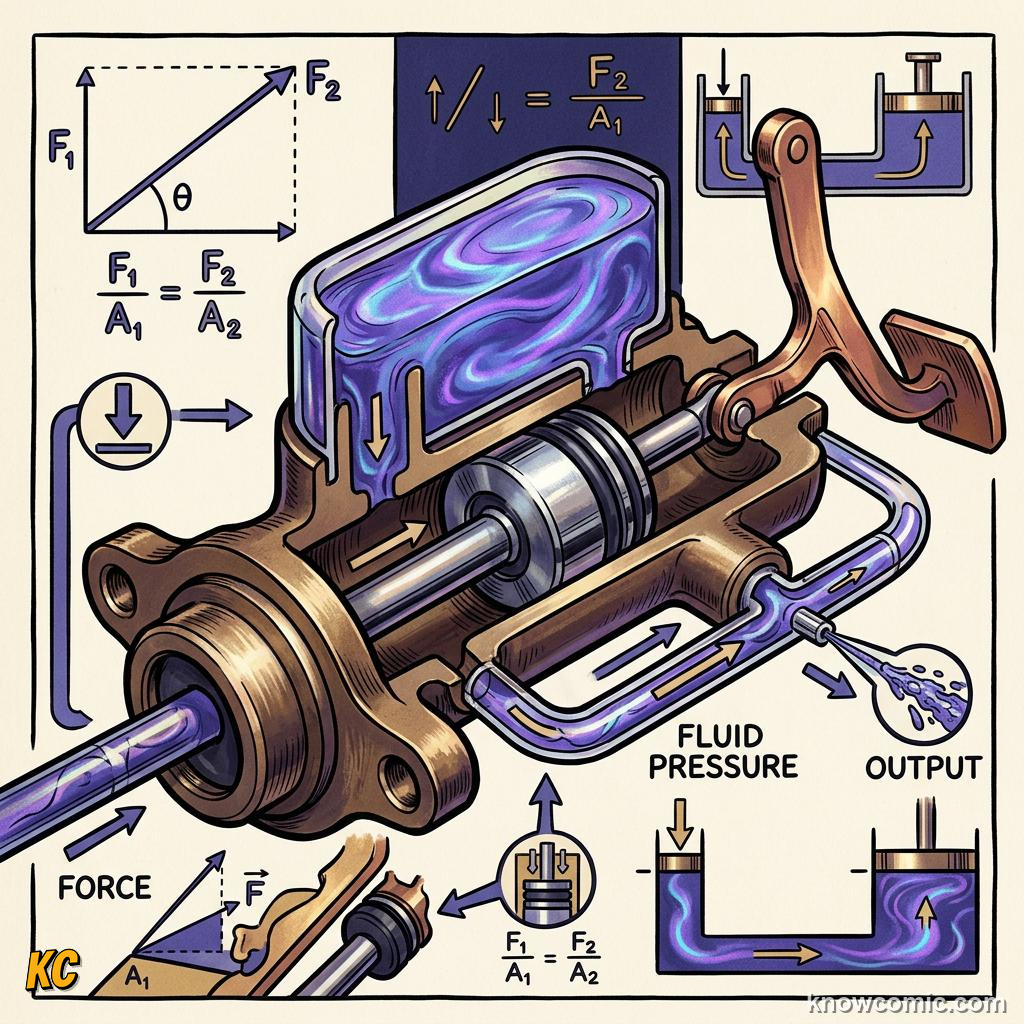
Connect two pistons with a pipe full of hydraulic fluid and Pascal's principle does the rest. Push down on the small piston with force F₁ over area A₁. The pressure P = F₁ ÷ A₁ spreads through the fluid. The large piston with area A₂ feels the same pressure, so it pushes up with force F₂ = P × A₂. Because A₂ is bigger, F₂ is bigger too. If the large piston has ten times the area, you get ten times the output force. You must move the small piston ten times farther, but that is an easy trade when you need to lift a car or stop a truck.
⚙️ HYDRAULIC GAIN
Force ratio F₂ ÷ F₁ = A₂ ÷ A₁. Double the piston area and you double the output force. Energy is conserved: more force means less distance moved.
MULTIPLY!
PAGE 4 OF 5, BRAKES AND LIFTS
REAL HYDRAULICS
Comic illustration of hydraulic car brakes and a garage lift using pressurized fluid
A LIGHT TAP STOPS A HEAVY TRUCK
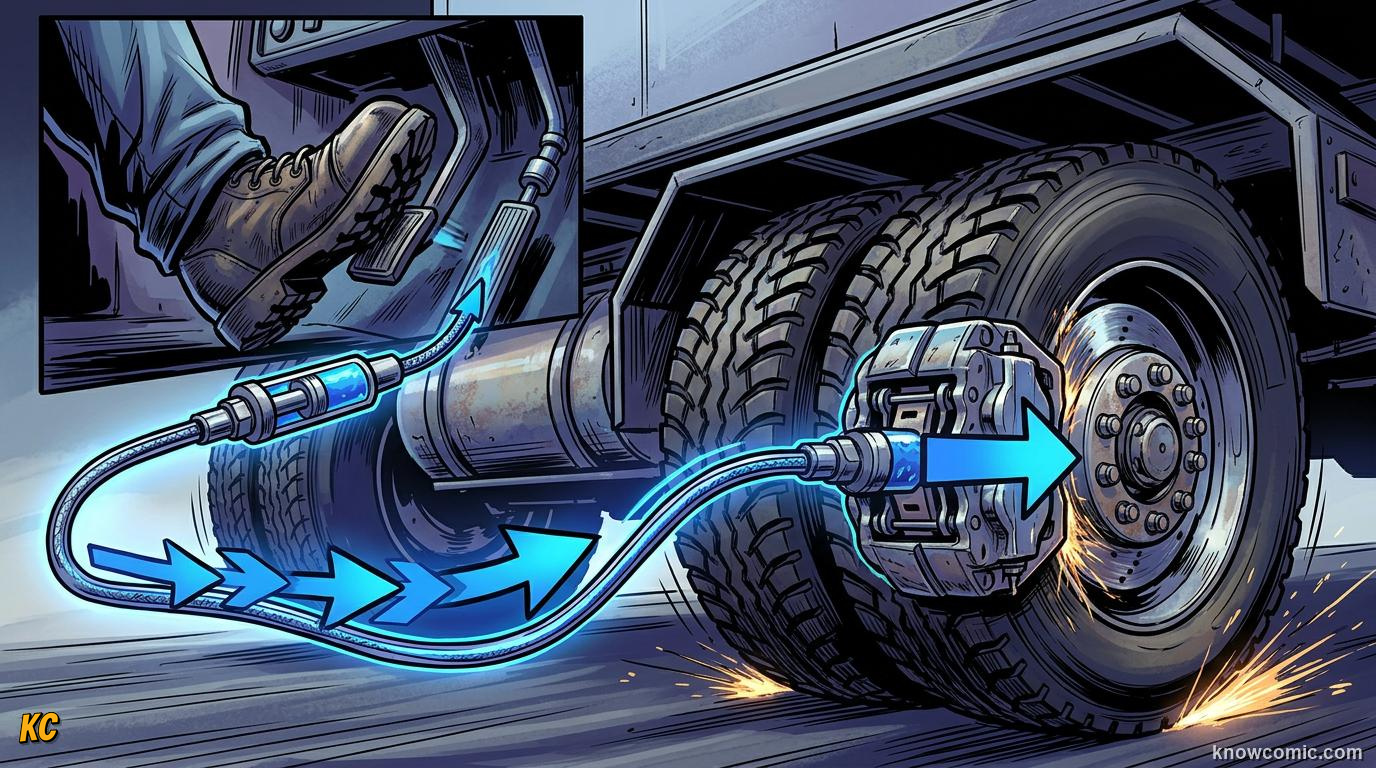
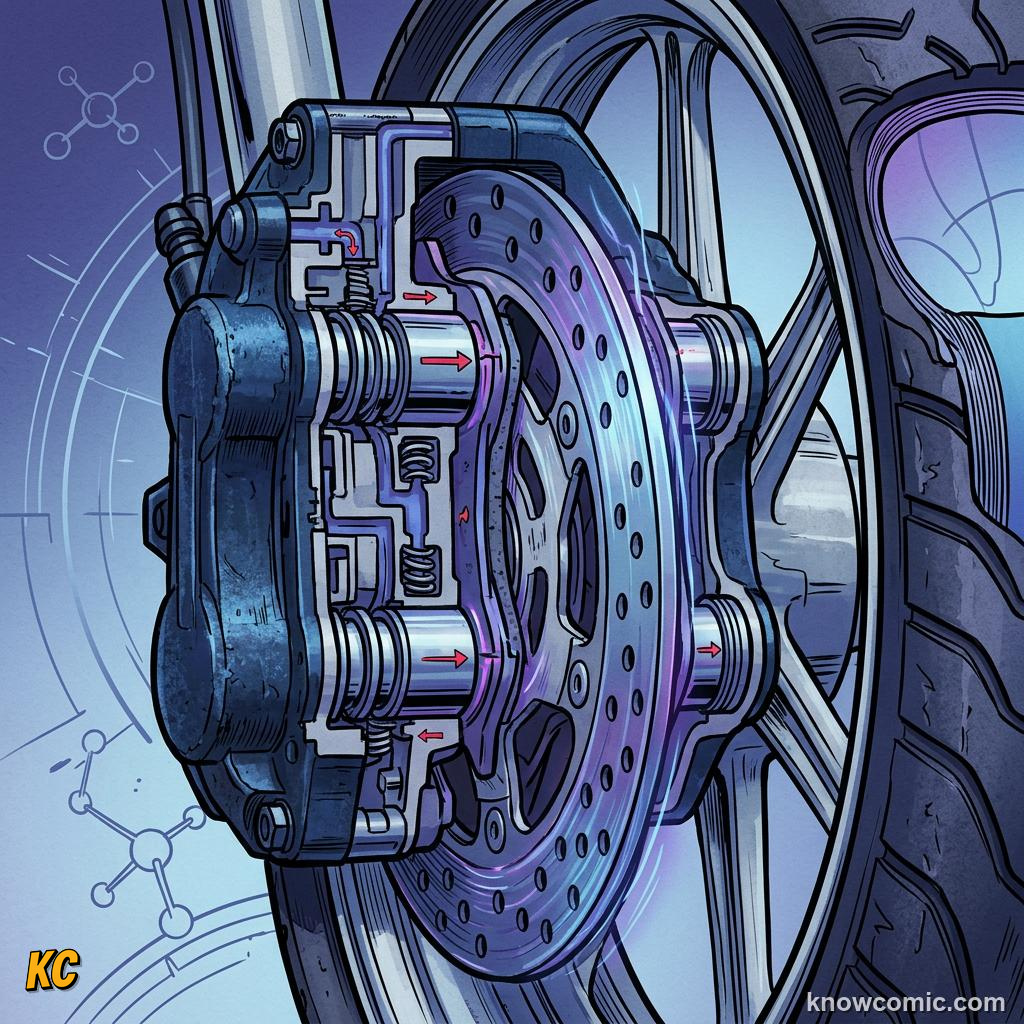
Car hydraulic brakes are a perfect everyday example. Press the brake pedal and a master cylinder pushes brake fluid through sealed lines to calipers at each wheel. The fluid cannot compress, so pressure built at the pedal arrives at the brake pads with enormous force. A multi-ton truck can halt because your foot only needs to create pressure; the system multiplies that pressure into clamping force on large brake discs. Hydraulic lifts in garages work the same way: a small pump piston raises a platform holding a whole vehicle. Forklifts, diggers, and aircraft landing gear all rely on pressurized fluid doing heavy work through narrow pipes.
STOP!
CAR BRAKES
Comic illustration of brake pedal master cylinder and brake fluid lines to wheel calipers
🦶 Pedal pushes master cylinder
🛢️ Brake fluid carries pressure
🛑 Pads clamp spinning discs
HYDRAULIC LIFT
Comic illustration of a hydraulic car lift raising a vehicle in a garage
🚗 Lifts cars with fluid pressure
⬆️ Small pump, large ram piston
🔧 Used in garages worldwide
HEAVY MACHINERY
Comic illustration of excavator and forklift arms powered by hydraulic cylinders
🏗️ Excavators dig with hydraulics
📦 Forklifts lift heavy pallets
✈️ Aircraft use hydraulic controls
PAGE 5 OF 5, POWER ALL AROUND US
MODERN WORLD
Comic illustration of trucks cranes and industrial machines powered by hydraulic systems
PASCAL'S IDEA BUILT THE MODERN WORLD
From the 1640s experiments of Blaise Pascal to today's construction sites and highways, fluid pressure has become one of engineering's most useful tools. Hydraulics let humans control forces far beyond muscle strength using nothing more than oil, pipes, and pistons. The liquid does not compress; it simply moves the force somewhere else, often magnified along the way. Understanding P = F ÷ A and Pascal's principle helps you see why a gentle pedal press can lock brake pads against tonnes of moving metal, and why the same physics lifts skyscraper girders and steers giant ships.
💧 PASCAL'S PRINCIPLE
A pressure change in an enclosed fluid is transmitted undiminished throughout the fluid. That is the engine behind every hydraulic machine.
FLOW!
EVERYWHERE
Comic illustration of everyday and industrial hydraulic applications
🚛 Trucks rely on air brakes too
🏗️ Cranes use hydraulic rams
🌊 Dams control water with gates
REMEMBER
💧 KEY FACTS
P = F ÷ A. Liquids are nearly incompressible. Pascal's principle: enclosed fluid transmits pressure undiminished. Hydraulic systems multiply force using pistons of different areas. Brakes and lifts are everyday examples.
✅ P = force ÷ area
✅ Pascal: pressure spreads evenly in sealed fluid
✅ F₂ ÷ F₁ = A₂ ÷ A₁ for hydraulic pistons
✅ Brakes and lifts use pressurized fluid
🧠 QUIZ TIME!
FLUID PRESSURE · 5 QUESTIONS
QUESTION 01
What does Pascal's principle state?
QUESTION 02
How is pressure defined?
QUESTION 03
Why are liquids ideal for hydraulic systems?
QUESTION 04
A hydraulic system has a small piston (area A₁) and a large piston (area A₂). How does output force F₂ compare to input force F₁?
QUESTION 05
How do car hydraulic brakes multiply the force from your foot?
0/5
LOADING...
← TOPIC 17 📋 ALL TOPICS TOPIC 19 →