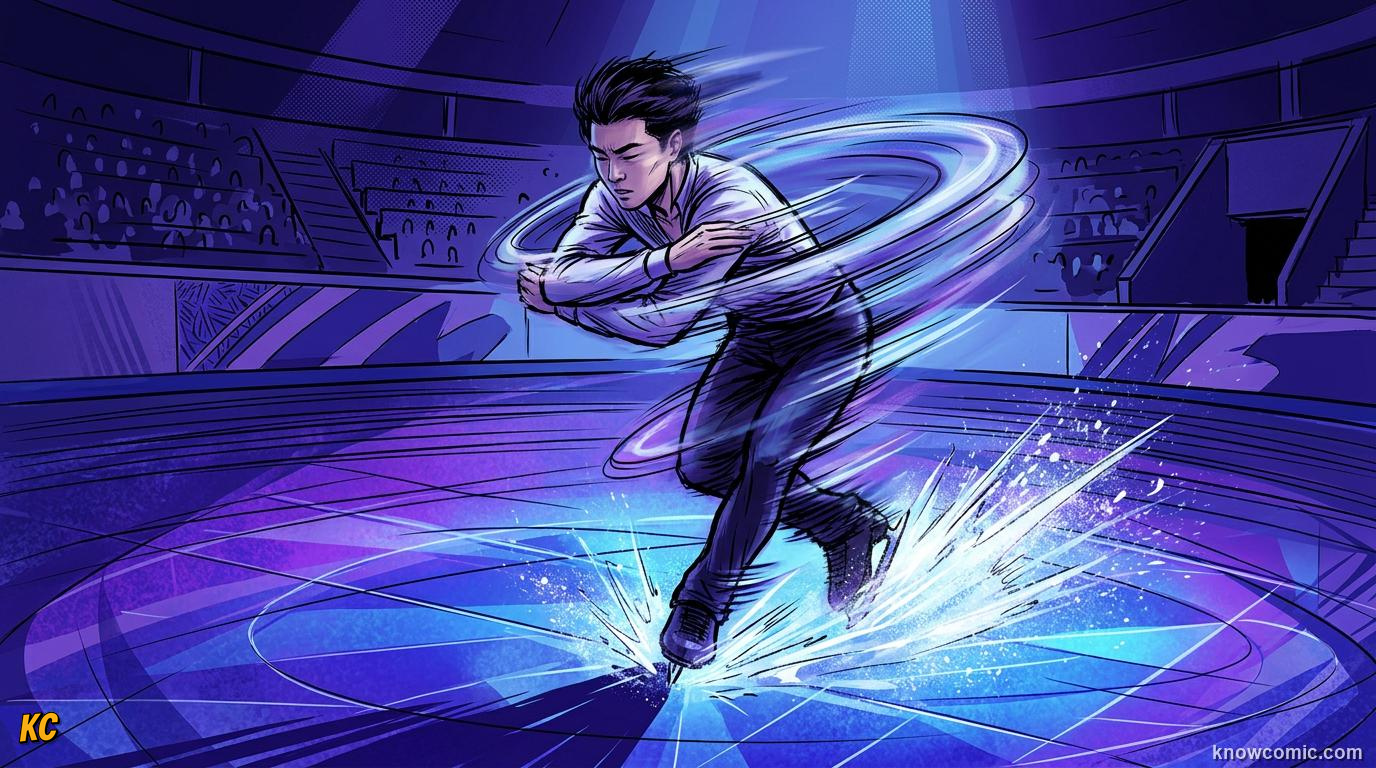
Linear momentum describes straight-line motion: p = mv. Angular momentum describes spinning motion. For a rigid body rotating about a fixed axis, angular momentum L equals moment of inertia I times angular velocity ω: L = Iω. The moment of inertia I measures how hard it is to start or stop a spin. Mass far from the axis counts more than mass close in. Angular velocity ω tells how fast something turns, usually in radians per second. A heavy, wide spinning wheel has large L. A fast-spinning compact top has large L too, even if it is light.
🌀 ANGULAR MOMENTUM
L = Iω. L is angular momentum, I is moment of inertia, and ω is angular velocity. Bigger I or faster spin means bigger L.
SPIN!
MOMENT OF INERTIA

📏 I depends on mass distribution
👐 Arms out: large I, slow spin
🎯 Mass near axis: smaller I
ANGULAR VELOCITY
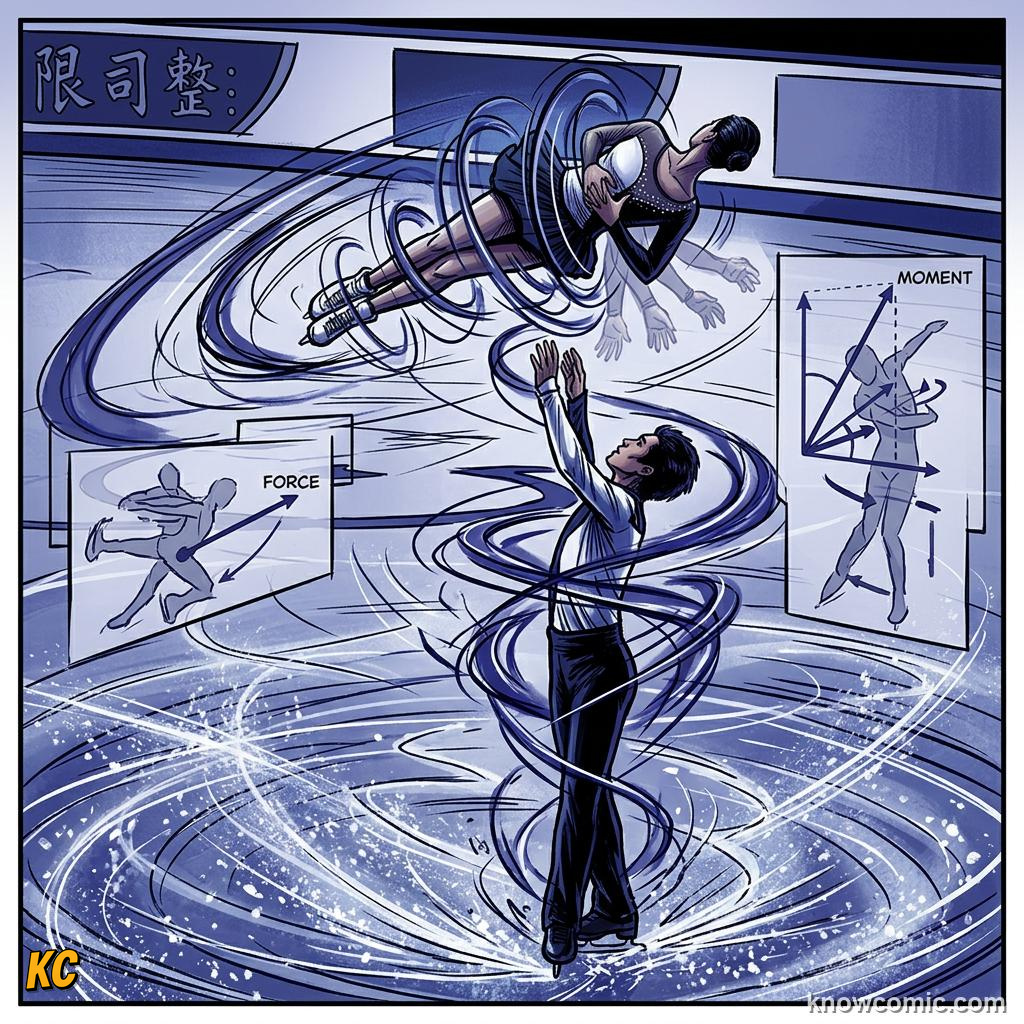
🔄 ω = how fast it turns
⏱️ More revolutions per second, higher ω
🌀 Spinning top: high ω, stable feel
PAGE 2 OF 5, CONSERVATION RULE
NO NET TORQUE
L STAYS CONSTANT WITHOUT EXTERNAL TORQUE
Just as linear momentum is conserved when no net external force acts, angular momentum is conserved when no net external torque acts on a system. Torque is the rotational version of force: it twists objects and can change spin rate. If friction, pushes, and pulls from outside cancel out so the net external torque is zero, total angular momentum L stays fixed. A spinning figure skater on smooth ice is a classic example: ice friction is small, so L hardly changes during a fast spin. Change the shape of the body and I changes, but L = Iω must stay the same, so ω adjusts automatically.
CONSERVE!
TORQUE
🔧 Torque twists, force pushes
↻ Net torque changes spin rate
⚖️ τ = r × F (lever arm matters)
CLOSED SYSTEM
🔒 No outside twist: L fixed
🔄 Internal moves reshuffle I and ω
✅ Total L unchanged
THE SWAP
📉 I down, ω must go up
📈 I up, ω must go down
🌀 L = Iω stays balanced
PAGE 3 OF 5, THE SKATER TRICK
ARMS OUT
👐 Arms wide: large I
🐢 Same L, slower spin
⛸️ Classic starting pose
ARMS IN
🤸 Arms pulled tight: small I
💨 ω shoots up, blur of spin
🌀 L stays nearly constant
PIROUETTE PHYSICS
PULL IN ARMS, SPIN FASTER
Watch a figure skater start a spin with arms stretched wide, then pull them tight to the body. Arms out spread mass far from the spin axis, giving a large moment of inertia I and a slow angular velocity ω. Pulling arms in moves mass closer to the axis, shrinking I dramatically. With almost no external torque from the ice, angular momentum L = Iω stays nearly constant. Smaller I means ω must rise, and the skater blurs into a rapid pirouette. Here is the twist: muscles do work when pulling the arms inward. Rotational kinetic energy KE = ½Iω² can increase even while L is conserved, because the skater's body supplies energy through that muscular effort.
⛸️ SKATER SECRET
Pull arms in: I decreases, ω increases, L stays constant. Muscles do work, so rotational kinetic energy can rise even though angular momentum is conserved.
FASTER!
PAGE 4 OF 5, GYROSCOPES AND PRECESSION
SPINNING WHEEL MAGIC
GYROSCOPES RESIST BEING TIPPED
A gyroscope is a fast-spinning wheel mounted so it can rotate freely in multiple directions. Its large angular momentum makes it surprisingly stable. Try to tip a spinning gyroscope and it fights back, staying aligned with its spin axis. When a steady external torque acts perpendicular to the spin axis, the gyroscope does not simply fall over. Instead it precesses: the spin axis slowly sweeps around in a circle. Precession is a direct consequence of angular momentum conservation combined with the torque twisting the system. Ships, aircraft, and spacecraft have used gyroscopes for decades to sense orientation and stay on course. Your bicycle stays upright partly because spinning wheels carry angular momentum that resists tipping.
GYRO!
SPIN AXIS
🎯 Spin axis points one way
💪 Large L resists tipping
🚲 Bike wheels use the same idea
PRECESSION
🔄 Torque sideways, axis sweeps
⭕ Slow circle: precession
🌀 L and torque together cause it
IN SPACE
🛰️ Reaction wheels steer satellites
🌌 No air, spin still conserved
⭐ Collapsing stars spin ultra-fast
PAGE 5 OF 5, SPIN EVERYWHERE
THE BIG PICTURE
ANGULAR MOMENTUM SHAPES THE SPINNING WORLD
From pirouetting skaters to wobbling tops, from bicycle wheels to orbiting planets, angular momentum is one of nature's great accounting rules. L = Iω tells you how much spin a body carries. Conservation when net external torque is zero explains the skater's speed-up trick and why gyroscopes seem to defy gravity. Muscles can add rotational kinetic energy even while L stays fixed. In astrophysics, a dying star collapsing inward shrinks its radius, lowering I, and can spin into a blazing pulsar thousands of times per second. Once you see L = Iω everywhere, spinning starts to make perfect sense.
🌀 CONSERVATION OF L
With zero net external torque, total angular momentum stays constant. Change shape (I) and spin rate (ω) adjusts. Gyroscopes precess when torque acts perpendicular to the spin axis.
WHIRL!
EVERYDAY SPIN
🤸 Divers tuck to spin faster
🪀 Tops stand while spinning fast
🌍 Earth spins because of conserved L
REMEMBER
🌀 KEY FACTS
L = Iω. Angular momentum is conserved when net external torque is zero. Skater pulls arms in: I decreases, ω increases. Muscles do work, so rotational KE can rise. Gyroscopes resist tipping and precess under sideways torque.
✅ L = Iω for spinning bodies
✅ No net torque: L stays constant
✅ Arms in: faster spin, same L
✅ Gyroscopes precess, not fall
🧠 QUIZ TIME!
ANGULAR MOMENTUM · 5 QUESTIONS
QUESTION 01
What is the formula for angular momentum of a rotating body?
QUESTION 02
When is angular momentum conserved?
QUESTION 03
An ice skater pulls her arms in while spinning. What happens?
QUESTION 04
Can rotational kinetic energy increase while angular momentum stays constant?
QUESTION 05
What does a spinning gyroscope do when a torque pushes perpendicular to its spin axis?