🕐
🎸
〰️
⚛️ KNOW SECONDARY · AGES 12–18

PHYSICS

⚛️ From Newton's Apple to Quantum Weirdness!

📖 350 Topics 🆓 FREE + PRO ⏱️ 5 min per comic 🧠 Quiz included
🕐
1600s
Galileo studies swinging pendulums
🔩
1660
Hooke links spring force to stretch
📐
1687
Newton's laws explain oscillation
🎸
1800s
Fourier maps waves as sine sums
🌍
TODAY
Clocks, music, and bridges all oscillate
〰️ SIMPLE HARMONIC MOTION
TOPIC 26 · PHYSICS · PENDULUMS · OSCILLATIONS · SYNC
PAGE 1 OF 5, THE RESTORING FORCE
BACK AND FORTH
Comic panel about simple harmonic motion: Back And Forth, educational kids illustration
WHAT IS SHM?
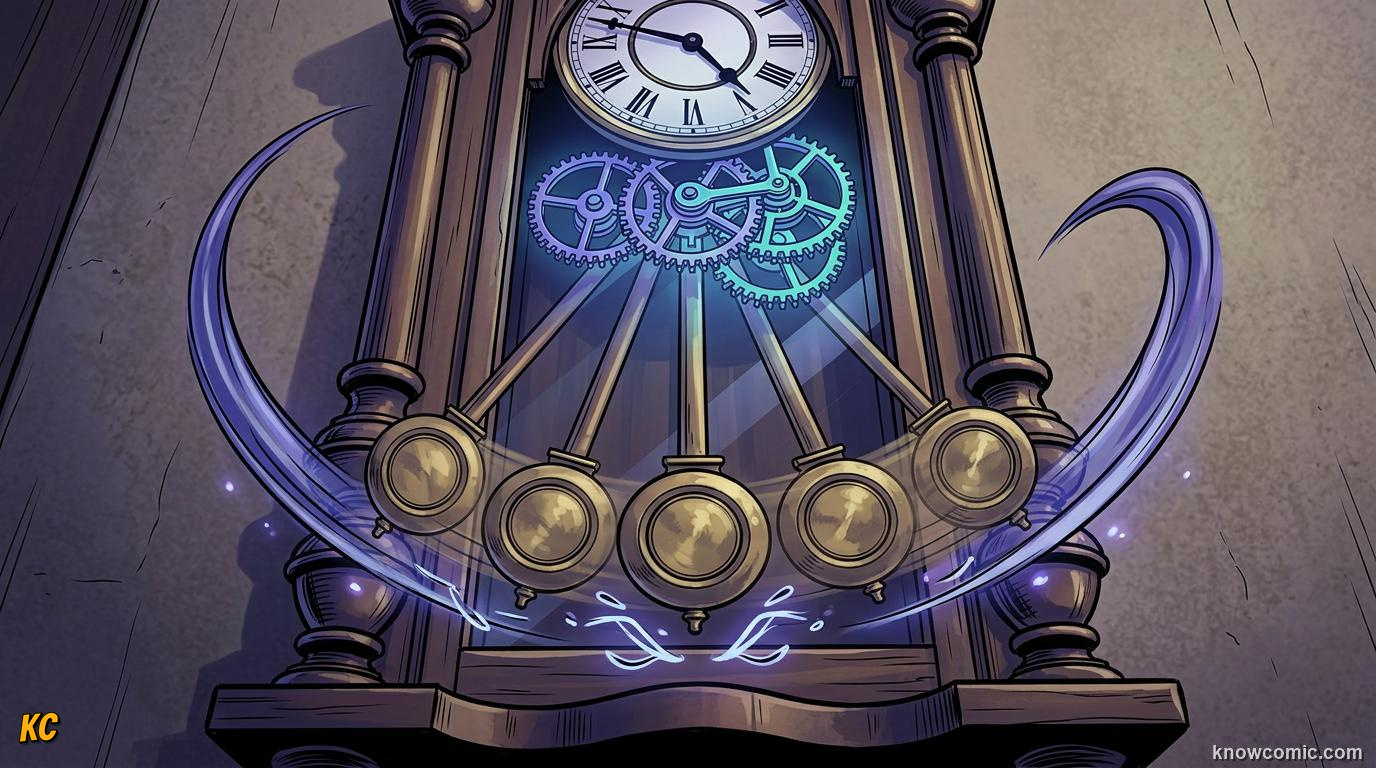
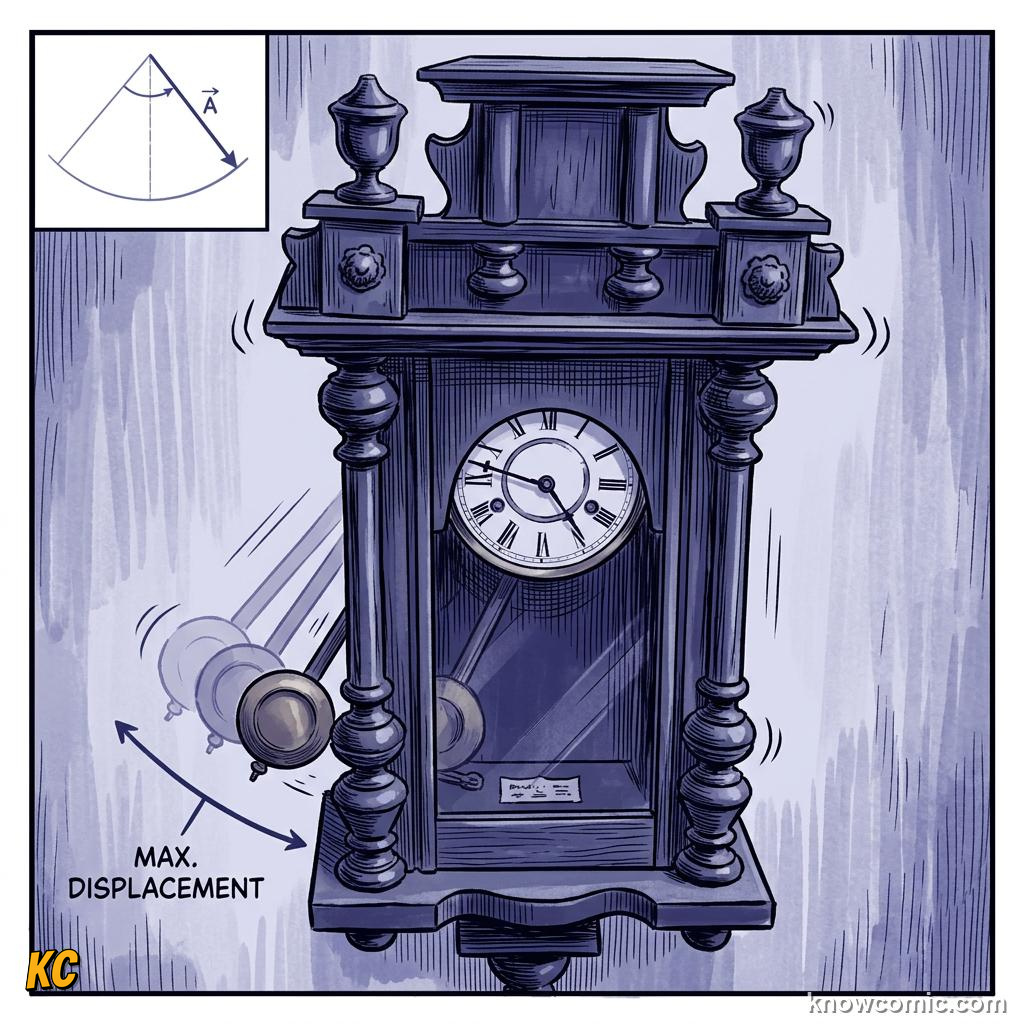
Simple harmonic motion is the smooth back-and-forth swing you see in a playground seat, a grandfather clock, or a plucked guitar string. The object moves away from its rest position, then a restoring force pulls it back toward the center of balance. That force grows stronger the farther you pull, which is why the motion feels springy and repeating. In ideal SHM, the restoring force is directly proportional to displacement from equilibrium. Release the object and it overshoots the center, slows, reverses, and repeats in a steady rhythm. This pattern is one of the most important ideas in all of physics.
〰️ RESTORING FORCE
A restoring force always points back toward equilibrium. For a spring: F = −kx (Hooke's law). The minus sign means the force opposes the stretch or squeeze.
SWING!
EQUILIBRIUM
Comic panel about simple harmonic motion: What Is Shm?, Equilibrium, educational kids illustration
⚖️ Rest position = zero net force
🎯 Center of balance is the goal
🔄 Motion repeats around this point
EVERYWHERE
Comic panel about simple harmonic motion: Everywhere, educational kids illustration
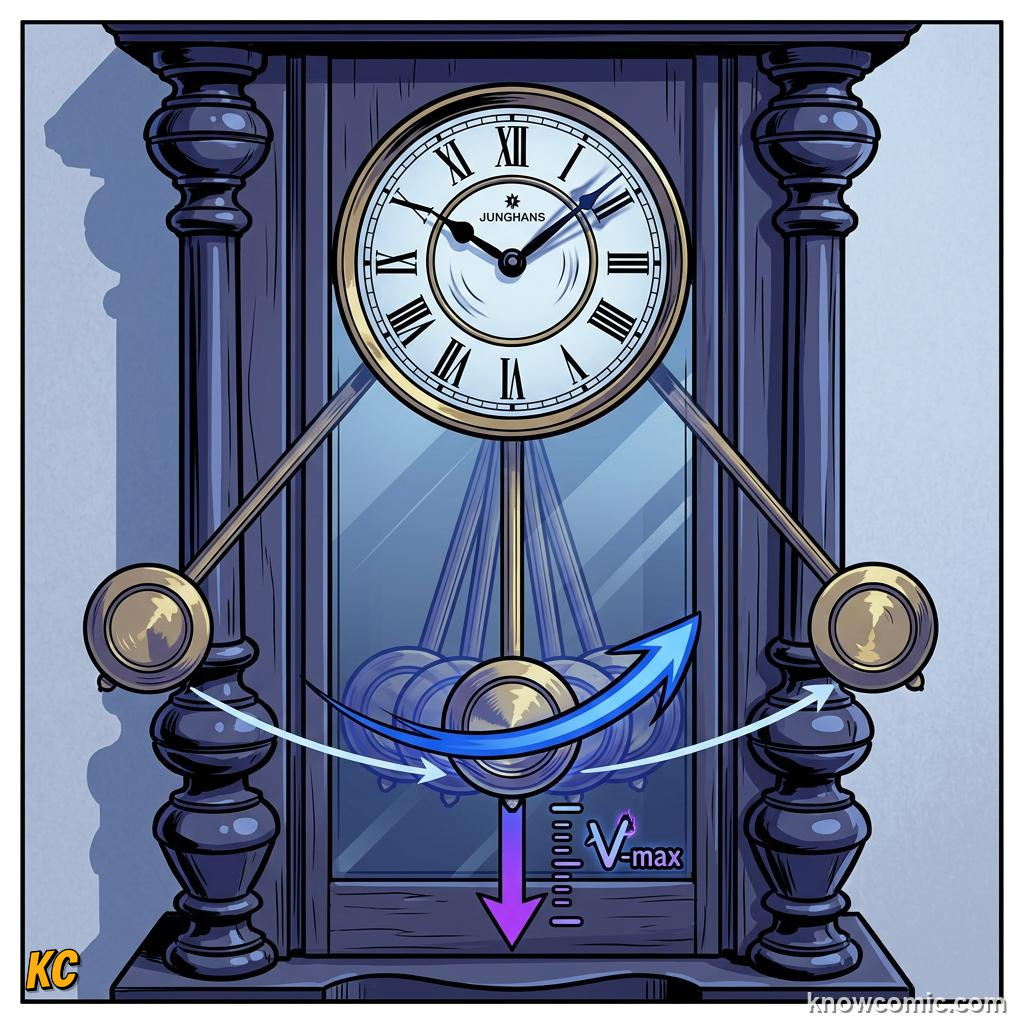
🕐 Clock pendulums tick steadily
🎸 Guitar strings vibrate in SHM
🌊 Many waves start as oscillations
PAGE 2 OF 5, THE SINE WAVE
SMOOTH CURVE
Comic panel about simple harmonic motion: Smooth Curve, educational kids illustration
POSITION FOLLOWS A SINE WAVE
Plot the position of an object in SHM over time and you get a beautiful sine wave (or cosine wave, which is the same shape shifted sideways). At the center the object moves fastest. At the far ends of the swing it momentarily stops, reverses, and heads back. One full trip out and back is called one oscillation. The time for one complete oscillation is the period, written T. The number of oscillations per second is the frequency, f = 1/T. Amplitude is the maximum distance from equilibrium. These sine curves appear in sound, light, radio signals, and earthquake graphs because so many natural systems obey SHM.
📈 SHM GRAPH
Position vs time traces a sine curve. Amplitude = peak height. Period T = time for one full cycle. Frequency f = 1/T measured in hertz (Hz).
WAVE!
AMPLITUDE
Comic panel about simple harmonic motion: Position Follows A Sine Wave, Amplitude, educational kids illustration
📏 Max distance from center
🔊 Louder sound = bigger amplitude
⚡ More energy in the swing
PERIOD
Comic panel about simple harmonic motion: Period, educational kids illustration
⏱️ T = time for one full cycle
🕐 Longer pendulum, longer T
📐 Measured in seconds
FREQUENCY
Comic panel about simple harmonic motion: Frequency, educational kids illustration
🎵 f = 1/T in hertz (Hz)
🎸 High pitch = high frequency
🔄 More cycles per second
PAGE 3 OF 5, THE PENDULUM CLOCK
LONGER ROPE
Comic panel about simple harmonic motion: Longer Rope, educational kids illustration
📏 Longer L means slower swing
⏱️ Period T increases with √L
🕐 Tall clocks need long pendulums
MASS MYTH
Comic panel about simple harmonic motion: Mass Myth, educational kids illustration
🪨 Heavy bob vs light bob
❌ Mass does NOT change period
✅ Only length and gravity matter
PENDULUM FORMULA
Comic panel about simple harmonic motion: Pendulum Formula, educational kids illustration
T = 2π√(L/g)
A simple pendulum is a mass on a light string swinging through small angles. Its period depends on the length L of the string and the gravitational field g, but surprisingly not on the mass of the bob. Hang a feather-sized weight or a bowling ball on the same length of string and, ignoring air drag, they swing with the same period. The formula T = 2π√(L/g) shows that a longer pendulum takes more time per swing, and stronger gravity (like on Earth compared to the Moon) shortens the period. Galileo noticed this regularity centuries ago, and it led to accurate mechanical clocks that changed navigation forever.
⚡ DID YOU KNOW?
On the Moon, g is about one-sixth of Earth's. The same pendulum length would swing roughly 2.4 times slower there, so each tick takes much longer.
TICK!
PAGE 4 OF 5, SYNC AND VIBRATION
THE UNIVERSE'S BEAT
Comic panel about simple harmonic motion: T = 2Π√(L/G), The Universe'S Beat, educational kids illustration
OSCILLATIONS LINK TOGETHER
When many objects oscillate near each other, fascinating sync effects appear. Metronomes on a shared platform can lock into the same rhythm. Bridge cables and building floors vibrate at specific natural frequencies. A guitar string does not just vibrate randomly: it settles into standing wave patterns where fixed ends and restoring forces shape the motion. Molecules in a hot object jiggle in SHM-like ways that we feel as temperature. From the quartz crystal ticking inside a wristwatch to the seismic waves rippling through Earth's crust, the mathematical beat of sine waves and restoring forces runs through the physical world.
🎸 STRING PHYSICS
A plucked string vibrates in SHM at its fundamental frequency. Shorter, tighter strings oscillate faster and produce higher musical notes.
SYNC!
SPRINGS
Comic panel about simple harmonic motion: Oscillations Link Together, Springs, educational kids illustration
🔩 Classic SHM example
📐 F = −kx gives sine motion
🚗 Suspension uses spring oscillation
METRONOMES
Comic panel about simple harmonic motion: Metronomes, educational kids illustration
🎵 Pendulums can sync together
↔️ Energy transfers through the base
🔄 Coupled oscillators share rhythm
QUARTZ CLOCK
Comic panel about simple harmonic motion: Quartz Clock, educational kids illustration
⌚ Tiny crystal vibrates electrically
🕐 Steady frequency keeps time
📱 Phones use the same idea
PAGE 5 OF 5, THE CENTER OF BALANCE
NATURE'S RHYTHM
Comic panel about simple harmonic motion: Nature'S Rhythm, educational kids illustration
WHY THINGS RETURN TO CENTER
Every SHM story is the same at heart: a disturbance pushes a system away from balance, and a restoring force brings it back. That tug-of-war creates endless smooth cycles traced as sine waves on a graph. Pendulums gave humanity reliable timekeeping because their period depends only on length and gravity, not on how heavy the bob is. Springs, strings, and atoms all echo the same mathematics. Once you recognize SHM, you start seeing it in heartbeats, ocean tides, radio waves, and the vibrations of molecules themselves. The universe loves to oscillate, and simple harmonic motion is the language it speaks.
BALANCE!
ENERGY SWAP
Comic panel about simple harmonic motion: Why Things Return To Center, Energy Swap, educational kids illustration
⚡ Kinetic energy at center
📐 Potential energy at the ends
🔄 Energy swaps back and forth
REMEMBER
〰️ KEY FACTS
SHM: restoring force pulls object to equilibrium. Position vs time = sine wave. Pendulum period T = 2π√(L/g). Mass does NOT affect pendulum period. Amplitude = max displacement. Period T and frequency f = 1/T describe the beat.
✅ Restoring force → back to center
✅ Graph traces a sine wave
✅ T = 2π√(L/g), mass cancels out
✅ Oscillations sync in nature
🧠 QUIZ TIME!
SIMPLE HARMONIC MOTION · 5 QUESTIONS
QUESTION 01
What is a restoring force in SHM?
QUESTION 02
What shape does a graph of position vs time show for ideal SHM?
QUESTION 03
What is the period formula for a simple pendulum (small angles)?
QUESTION 04
For a simple pendulum, what happens to the period if you double the mass of the bob?
QUESTION 05
If a pendulum's length L increases, what happens to its period T?
0/5
LOADING...
← TOPIC 25 📋 ALL TOPICS TOPIC 27 →