🏎️
💨
🚛
⚛️ KNOW SECONDARY · AGES 12–18

PHYSICS

⚛️ From Newton's Apple to Quantum Weirdness!

📖 350 Topics 🆓 FREE + PRO ⏱️ 5 min per comic 🧠 Quiz included
🦅
NATURE
Birds and fish glide with low drag
📜
1700s
Scientists study fluid resistance
🌀
1871
First wind tunnels built
🏎️
1900s
Streamlined cars and aircraft tested
✈️
TODAY
F1 teams chase every drag point
💨 AERODYNAMIC DRAG
TOPIC 28 · PHYSICS · FORM · TURBULENCE · SPEED
PAGE 1 OF 5, THE INVISIBLE WALL
PUSHING THROUGH AIR
Comic panel about aerodynamic drag: Pushing Through Air, educational kids illustration
WHAT IS AERODYNAMIC DRAG?
Hold your hand out of a car window and you feel air pushing back. That push is aerodynamic drag: a force from the fluid (air) that resists motion through it. Drag always acts opposite to the direction of travel. A cyclist, a jet, and a falling feather all fight drag. Even though air seems empty, it has mass and it must be pushed aside as you move. The faster you go, the harder the air pushes back. Engineers call drag an invisible wall because you cannot see it, yet it limits top speed, burns extra fuel, and shapes every fast vehicle on Earth.
💨 DRAG RULE
Drag force always points opposite to the direction of motion. It slows things down unless another force (like an engine) keeps pushing forward.
PUSH!
OPPOSES MOTION
Comic panel about aerodynamic drag: What Is Aerodynamic Drag?, Opposes Motion, educational kids illustration
⬅️ Drag points backward
➡️ Thrust or pedalling pushes forward
⚖️ Net force decides acceleration
EVERYWHERE IN AIR
Comic panel about aerodynamic drag: Everywhere In Air, educational kids illustration
🚴 Bikes, balls, and birds feel drag
🌊 Same idea works in water too
🏁 Speed records depend on beating it
PAGE 2 OF 5, SMOOTH VS CHAOTIC FLOW
FLOW PATTERNS
Comic panel about aerodynamic drag: Flow Patterns, educational kids illustration
LAMINAR VS TURBULENT FLOW
Air sliding past a surface can move in two very different ways. In laminar flow, layers of air glide smoothly in parallel paths like sheets of paper sliding past each other. In turbulent flow, the air churns into swirling eddies and whirls behind the object. Laminar flow creates less friction and usually less drag. Turbulent flow mixes the air violently and often increases drag, especially when a blunt shape leaves a messy wake. Many fast vehicles start with smooth laminar flow at the nose, but turbulence often appears farther back where the shape widens or ends suddenly.
🌀 TWO TYPES OF FLOW
Laminar = smooth, orderly layers. Turbulent = chaotic swirls and eddies. Turbulence often adds drag and can be seen as a messy wake behind a moving object.
SWIRL!
LAMINAR
Comic panel about aerodynamic drag: Laminar Vs Turbulent Flow, educational kids illustration
📄 Smooth parallel streamlines
✅ Lower skin friction drag
🏎️ Ideal over curved surfaces
TURBULENT
Comic panel about aerodynamic drag: Turbulent, educational kids illustration
🌪️ Swirling eddies and vortices
⚠️ Messy wake behind object
🚛 Common behind blunt shapes
WAKE ZONE
Comic panel about aerodynamic drag: Wake Zone, educational kids illustration
💨 Low-pressure zone sucks back
📉 Pressure drag dominates wake
🔬 Smoke trails reveal turbulence
PAGE 3 OF 5, SHAPE MATTERS
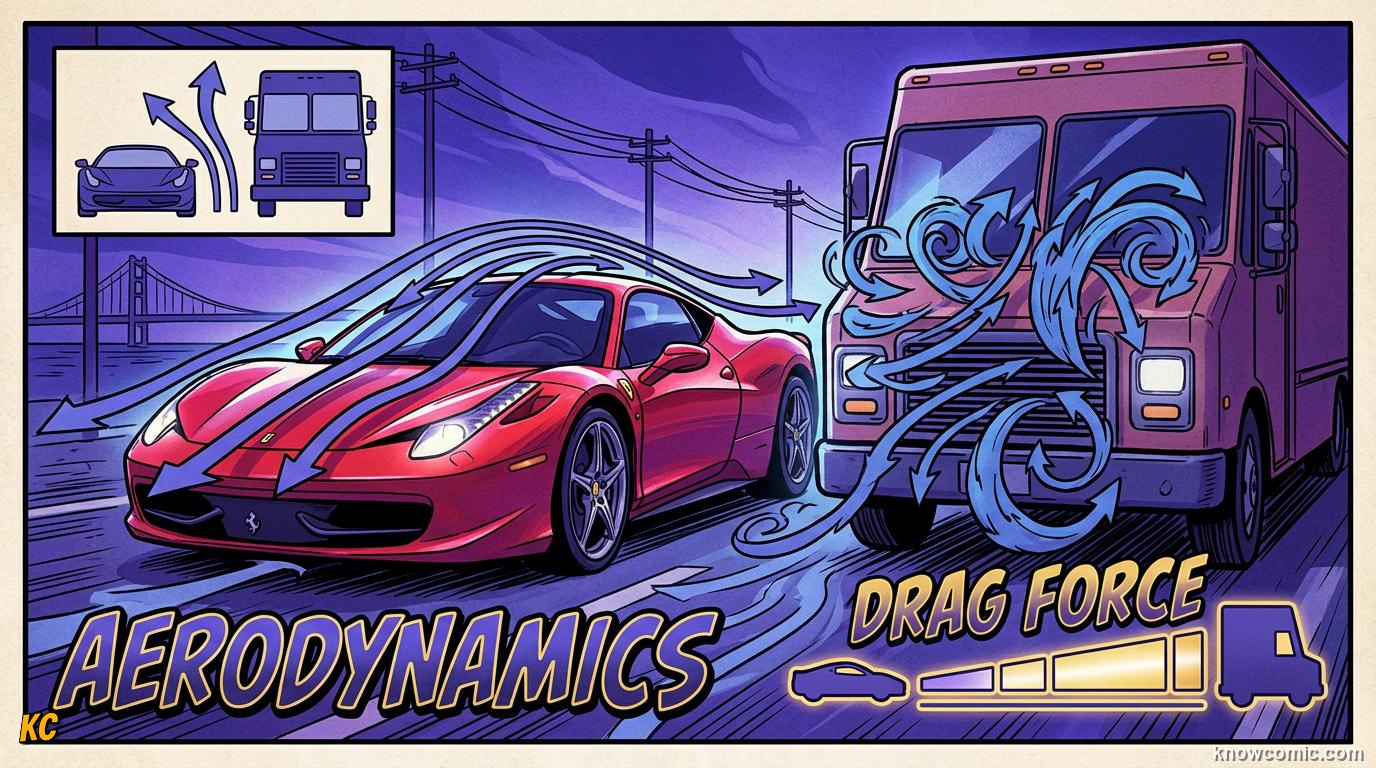
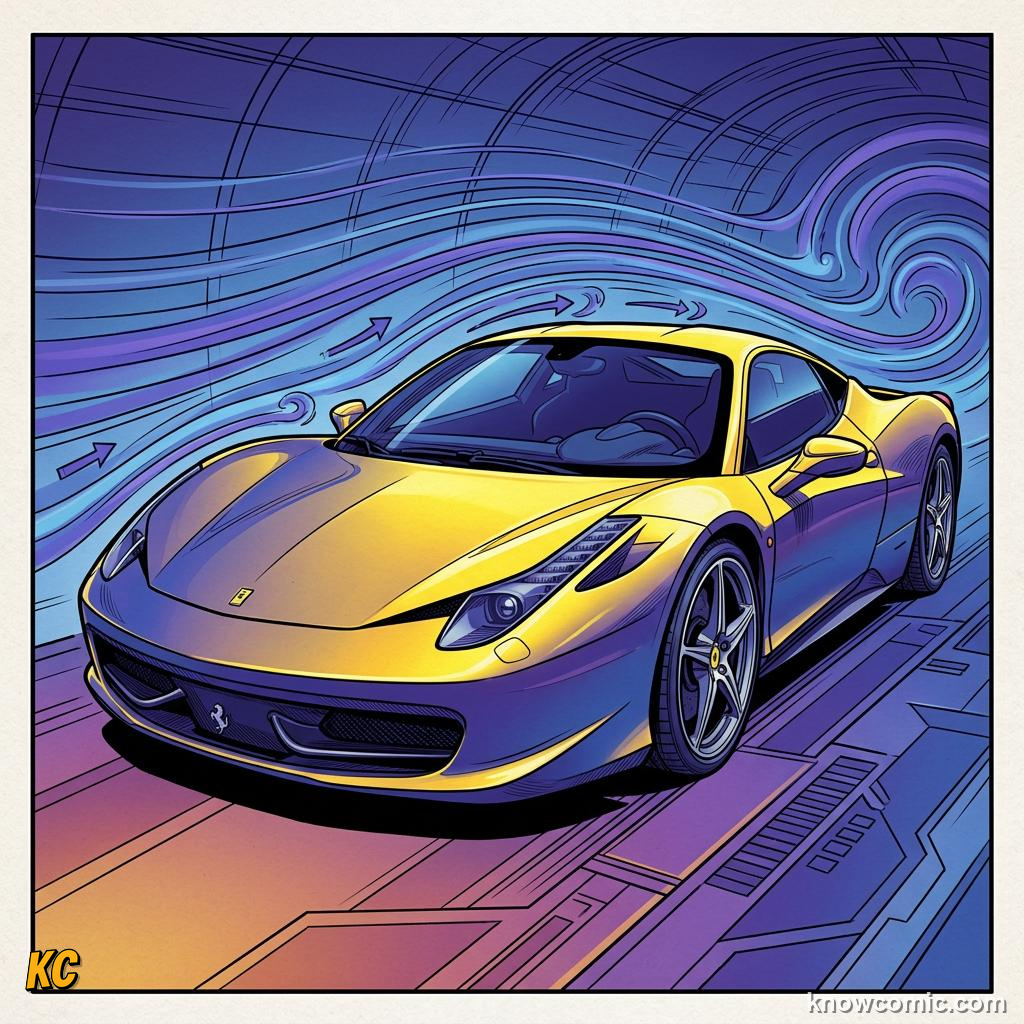
SPORTS CAR
Comic panel about aerodynamic drag: Sports Car, educational kids illustration
🏎️ Low, curved, tapered tail
💨 Cd often near 0.25 to 0.35
⚡ Slips through air efficiently
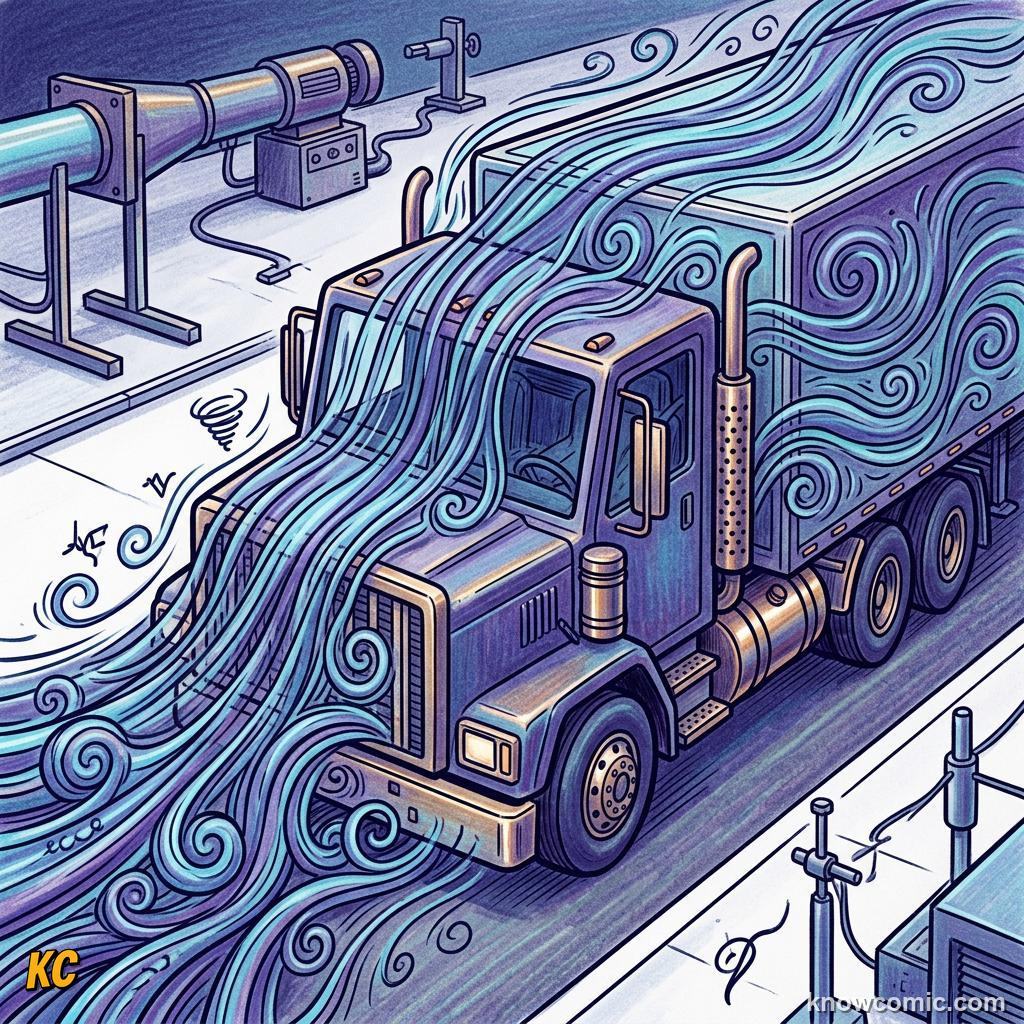
DELIVERY TRUCK
Comic panel about aerodynamic drag: Delivery Truck, educational kids illustration
🚛 Flat front, tall boxy body
🌪️ Huge turbulent wake
⛽ Uses far more fuel at speed
DRAG COEFFICIENT
Comic panel about aerodynamic drag: Drag Coefficient, educational kids illustration
FORM DECIDES THE FIGHT
Two vehicles with the same weight can feel totally different drag because shape matters. A sleek sports car has a low drag coefficient (Cd), a number that describes how easily it cuts through air. A boxy truck has a much higher Cd because its flat front slams into the airflow and its square back leaves a huge low-pressure wake that pulls backward. Engineers round edges, slope the windshield, tuck mirrors, and taper the rear to keep air attached and reduce turbulence. Even small shape changes can cut drag by double-digit percentages. That is why race teams spend millions sculpting bodywork in wind tunnels.
⚡ DID YOU KNOW?
A typical modern sports car might have a drag coefficient around 0.30, while a large truck or van can exceed 0.60. That means the truck fights roughly twice the aerodynamic drag for the same speed.
SLIP!
PAGE 4 OF 5, SPEED AND THE WIND TUNNEL
FASTER MEANS HARDER
Comic panel about aerodynamic drag: Form Decides The Fight, Faster Means Harder, educational kids illustration
DRAG GROWS WITH SPEED
Double your speed and aerodynamic drag does not just double. At highway and aircraft speeds, drag from the air typically grows with the square of speed. Go twice as fast and the air pushes back about four times as hard. That is why fuel use shoots up at high speed and why breaking land-speed records takes enormous power. The drag equation combines air density, speed squared, frontal area, and the drag coefficient. Engineers test shapes in wind tunnels: powerful fans blow air over scale models while sensors measure force and smoke lines reveal flow patterns. Every curve you see on a fast car or jet was shaped to fight this speed-squared penalty.
🌀 DRAG EQUATION
Drag force ≈ ½ × air density × speed² × drag coefficient × frontal area. Double the speed and drag roughly quadruples at the same shape.
ZOOM!
WIND TUNNEL
Comic panel about aerodynamic drag: Drag Grows With Speed, Wind Tunnel, educational kids illustration
🌀 Fans blast controlled airflow
📊 Sensors measure drag force
🏎️ F1 teams test every body panel
SPEED SQUARED
Comic panel about aerodynamic drag: Speed Squared, educational kids illustration
2× speed ≈ 4× drag force
⛽ Fuel burn rises sharply
🚄 High-speed trains need sleek noses
FRONTAL AREA
Comic panel about aerodynamic drag: Frontal Area, educational kids illustration
📐 Bigger target = more air pushed
🚴 Cyclists tuck low to shrink area
✈️ Slim fuselage cuts total drag
PAGE 5 OF 5, BEATING THE INVISIBLE WALL
AERO ENGINEERING
Comic panel about aerodynamic drag: Aero Engineering, educational kids illustration
DESIGNING FOR LESS DRAG
From cycling helmets to cargo planes, beating aerodynamic drag saves energy and unlocks speed. Designers combine smooth form, controlled turbulence, and careful testing to shrink the invisible wall. Birds evolved teardrop bodies and swept wings long before engineers built wind tunnels. Today, electric cars, bullet trains, and Olympic suits all chase lower drag. The goal is never zero drag, but finding the best balance between airflow, stability, cooling, and safety. When you see a sleek sports car beside a flat-front truck, you are looking at two answers to the same physics question: how hard must we push to move through the air?
FAST!
REAL WORLD
Comic panel about aerodynamic drag: Designing For Less Drag, Real World, educational kids illustration
🚴 Aero helmets and racing suits
✈️ Winglets smooth airflow on jets
🔋 EV range depends on drag too
REMEMBER
💨 KEY FACTS
Drag opposes motion through a fluid. Shape (drag coefficient) and frontal area matter hugely. Laminar flow is smooth; turbulent flow adds swirls and wake drag. Drag grows roughly with speed squared. Wind tunnels let engineers measure and improve aerodynamic form.
✅ Drag always opposes motion
✅ Sleek shapes beat boxy ones
✅ Faster speed = much more drag
✅ Wind tunnels test real designs
🧠 QUIZ TIME!
AERODYNAMIC DRAG · 5 QUESTIONS
QUESTION 01
Which direction does aerodynamic drag act on a moving object?
QUESTION 02
What is laminar flow?
QUESTION 03
Why does a sleek sports car usually have lower drag than a boxy truck?
QUESTION 04
What happens to aerodynamic drag when speed doubles (same shape and conditions)?
QUESTION 05
What is a wind tunnel used for?
0/5
LOADING...
← TOPIC 27 📋 ALL TOPICS TOPIC 29 →