📖 350 Topics🆓 FREE + PRO⏱️ 5 min per comic🧠 Quiz included
📜
1687
Newton links force, time, and momentum
→
🔒
1950s
Modern three-point seat belts arrive
→
🎈
1970s
Airbags enter production cars
→
🚗
1990s
Crumple zones become standard design
→
🛡️
TODAY
Crash tests drive smarter restraints
💥 IMPACT & IMPULSE
TOPIC 29 · PHYSICS · SAFETY · CRUMPLE ZONES · FORCE
PAGE 1 OF 5, THE SECRET IS TIME
FORCE OVER TIME
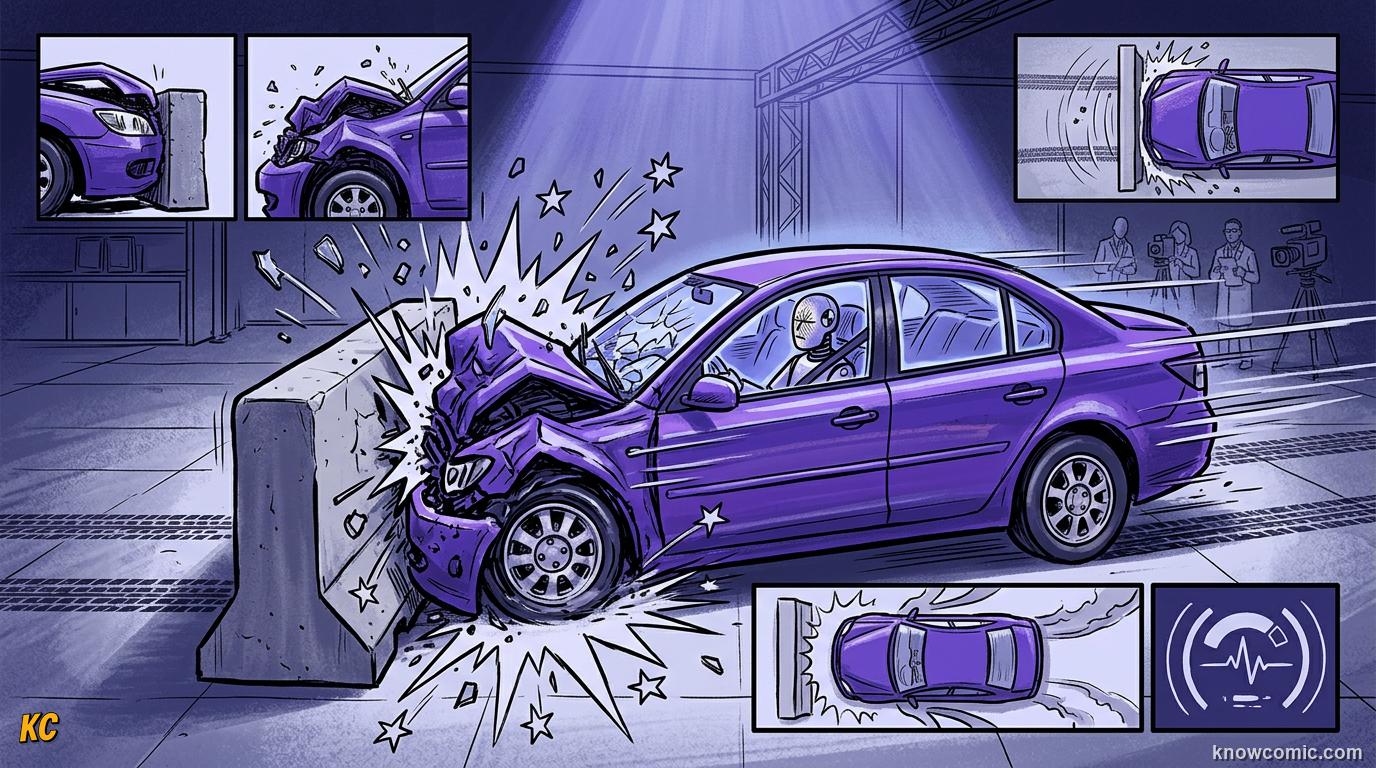
WHAT IS IMPULSE?
When a car hits a barrier, your body does not care only about speed. It cares about how quickly momentum is ripped away. Impulse is the physics name for that shove spread over time. Impulse equals average force multiplied by the time the force acts: J = F × Δt. Units are newton-seconds, the same as a momentum change. A punch, a tackle, and a crash all deliver impulse. The harder the push and the longer it lasts, the bigger the impulse. Engineers who design cars and sports gear think about impulse every day because it tells them how violently an object is stopped or started.
⚡ IMPULSE FORMULA
Impulse J = F × Δt. It measures how much "momentum push" a force delivers during a collision or contact. Bigger force or longer time means bigger impulse.
PUSH!
MOMENTUM CHANGE
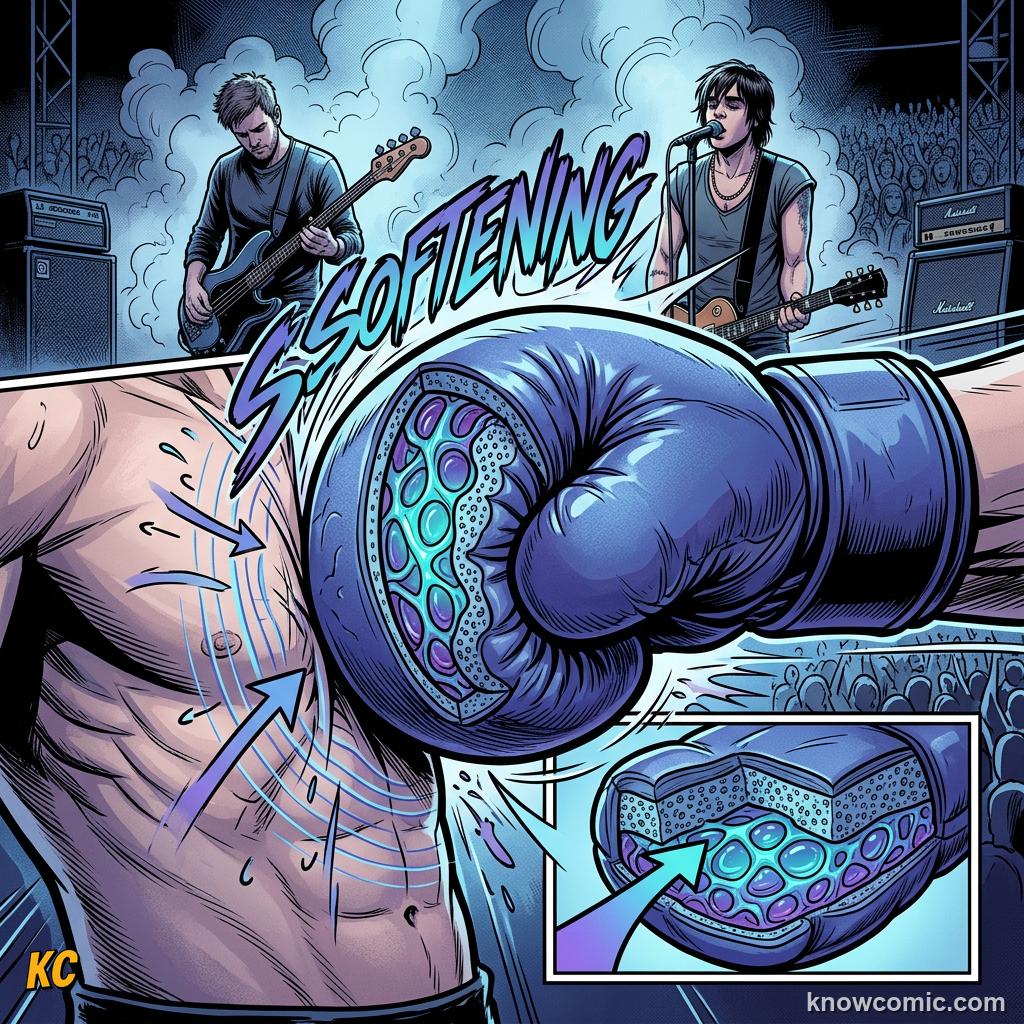
📐 Impulse also equals Δp (change in momentum)
🏃 Faster stop = bigger momentum change
⚖️ Same Δp can feel very different
TIME MATTERS
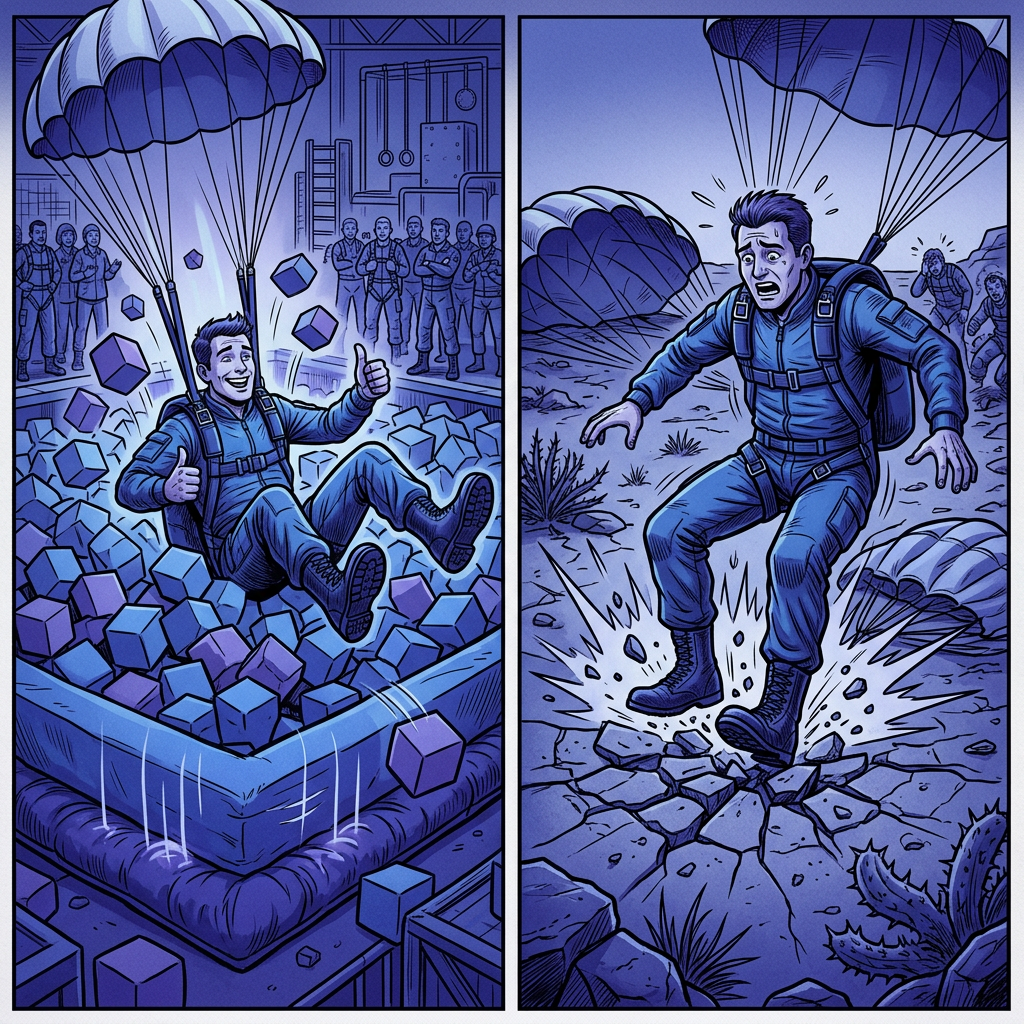
⏱️ Short Δt = huge peak force
🐢 Long Δt = gentler average force
🛡️ Safety gear buys you milliseconds
PAGE 2 OF 5, IMPULSE AND MOMENTUM
THE BIG LINK
IMPULSE EQUALS MOMENTUM CHANGE
Here is the rule that makes crash safety click: impulse equals change in momentum. Write it as J = Δp = m × Δv. If a 70 kg passenger goes from 20 m/s to zero, the momentum change is about 1,400 kg·m/s no matter how the stop happens. That number is fixed by mass and speed. What you can change is how long the stop takes. Spread the same momentum change over more time and the average force drops. Slam it to a halt in a blink and the force skyrockets. Gymnasts bend their knees on landing, boxers wear gloves, and cars crumple at the front for the same physics reason: stretch the impulse over time.
📐 IMPULSE-MOMENTUM THEOREM
J = Δp = m(vf − vi). For a fixed momentum change, average force Favg = Δp / Δt. Double the collision time and you halve the average force.
STOP!
FIXED Δp
🚗 Same speed before crash
📊 Same total momentum change
⏱️ Only contact time can vary
HARD STOP
💥 Hitting a rigid wall
⚡ Force spike in milliseconds
🚑 Injuries rise with peak force
SOFT STOP
🛡️ Padding spreads the stop
📉 Lower peak force on the body
✅ Same final speed: zero
PAGE 3 OF 5, CRUMPLE ZONES
CONTROLLED CRUSH
🔧 Front frame folds on purpose
📏 Adds stopping distance
⏱️ Collision lasts longer
ENERGY ABSORBER
💥 Metal bends, not the cabin
🔋 Kinetic energy goes into deformation
🚫 Often prevents dangerous rebound
SACRIFICIAL STRUCTURE
THE CAR CRUMPLES ON PURPOSE
Modern cars look sleek, but hidden at the front is a crumple zone: a section designed to collapse in a controlled way during a crash. Engineers at companies like Mercedes-Benz pioneered this idea decades ago. Instead of stopping instantly against a solid object, the nose folds, extending the collision over roughly a tenth of a second or more. The passenger cell behind it stays stiff so people are not crushed. Because Δp is fixed, that extra time slashes peak deceleration and the force transmitted to seat belts and bodies. The car may be totaled, but the physics trade is clear: sacrifice sheet metal to protect lives.
⚡ DID YOU KNOW?
Crumple zones also help by reducing rebound. A car that bounces backward after impact can experience an even larger momentum change than one that crushes and stays put.
CRUSH!
PAGE 4 OF 5, AIRBAGS AND SEAT BELTS
RESTRAINT SYSTEMS
SLOWING THE HUMAN BODY
Crumple zones protect the car's structure, but your head and chest still move forward until something stops them. Seat belts hold your torso and are designed to stretch slightly, adding a few milliseconds to the stop. Airbags inflate in a fraction of a second and then deflate as your body presses in, creating a cushioned zone that spreads deceleration over roughly 100 ms instead of a brutal instant against the dashboard. Airbags are not a substitute for belts: belts keep you in position so the bag can work. Together they cut peak force on the chest and skull. Every layer that lengthens Δt is another victory for impulse physics inside the cabin.
🛡️ TEAM WORK
Seat belts + airbags + crumple zones stack their effects. Each device extends stopping time or absorbs energy so the peak force on passengers stays below injury thresholds.
CUSHION!
SEAT BELT
🔒 Keeps you in the seat
📏 Webbing stretches a little
⏱️ Adds time to the momentum change
AIRBAG
🎈 Inflates in ~30 ms
🧸 Soft bag spreads the push
💨 Deflates as you sink in
EVERYWHERE
🪖 Helmets use foam padding
🥊 Gloves extend punch contact time
🤸 Bent knees soften landings
PAGE 5 OF 5, SURVIVING THE IMPACT
PHYSICS SAVES LIVES
TIME IS THE SECRET TO SURVIVAL
You cannot erase momentum in a real crash, but you can choose how fast it disappears. Impulse J = F × Δt ties every safety feature together. Crumple zones, belts, airbags, padded dashboards, and collapsible steering columns all lengthen the collision or add cushioning so the same momentum change produces a smaller peak force on the human body. Crash-test dummies and high-speed cameras let engineers measure exactly how many milliseconds each design buys. The lesson is universal: from catching a fast ball to surviving a highway accident, spreading the stop over time is one of physics' most life-saving tricks.
SAFE!
CRASH TEST
🎥 High-speed cameras measure Δt
🤖 Dummies record peak g-forces
⭐ Star ratings reward longer, softer stops
REMEMBER
💥 KEY FACTS
Impulse J = F × Δt equals momentum change Δp. For a fixed Δp, longer collision time means lower average force. Crumple zones extend the car's stop. Seat belts and airbags extend the body's stop. Safety engineering is applied impulse physics.
✅ J = F × Δt = Δp
✅ Longer Δt lowers peak force
✅ Crumple zones crush on purpose
✅ Belts and airbags work together
🧠 QUIZ TIME!
IMPACT & IMPULSE · 5 QUESTIONS
QUESTION 01
What is the formula for impulse?
QUESTION 02
According to the impulse-momentum theorem, impulse equals what?
QUESTION 03
Why do crumple zones reduce injury in a crash?
QUESTION 04
If momentum change stays the same but collision time doubles, what happens to average force?
QUESTION 05
How do airbags work with seat belts during a frontal crash?