🌫️
〰️
🌀
⚛️ KNOW SECONDARY · AGES 12–18

PHYSICS

⚛️ From Newton's Apple to Quantum Weirdness!

📖 350 Topics 🆓 FREE + PRO ⏱️ 5 min per comic 🧠 Quiz included
🌫️
EVERYDAY
Smoke rises straight then swirls
🔬
1883
Reynolds dyes water in a pipe
📐
1900s
Reynolds number predicts flow type
✈️
1900s
Engineers tame turbulence in pipes and wings
💻
TODAY
Supercomputers still chase turbulent chaos
🌀 TURBULENT VS LAMINAR FLOW
TOPIC 31 · PHYSICS · SMOOTH · CHAOS · REYNOLDS
PAGE 1 OF 5, SMOOTH THEN CHAOTIC
WATCH THE SMOKE

Comic panel about turbulent vs laminar flow: Watch The Smoke, educational kids illustration
TWO WORLDS IN ONE FLUID
Light a candle and watch the smoke rise. At first it climbs in a calm, straight thread. Then, without warning, the thread wobbles and breaks into swirling loops and tangles. That sudden change is one of the most important ideas in fluid physics. Fluids can flow in smooth, orderly layers called laminar flow, or in wild, mixing motion called turbulent flow. The same air or water can switch between the two depending on speed, viscosity, and the size of the channel. Understanding this split helps engineers design quiet pipes, stable aircraft, and efficient blood flow in the body.
🌫️ FLOW TYPES
Laminar flow moves in smooth parallel layers. Turbulent flow churns with eddies and mixing. Many real flows start laminar and become turbulent when speed or disturbances grow.
SWIRL!
LAMINAR
Comic panel about turbulent vs laminar flow: Two Worlds In One Fluid, Laminar, educational kids illustration
〰️ Smooth parallel streamlines
🕯️ Slow smoke near the candle
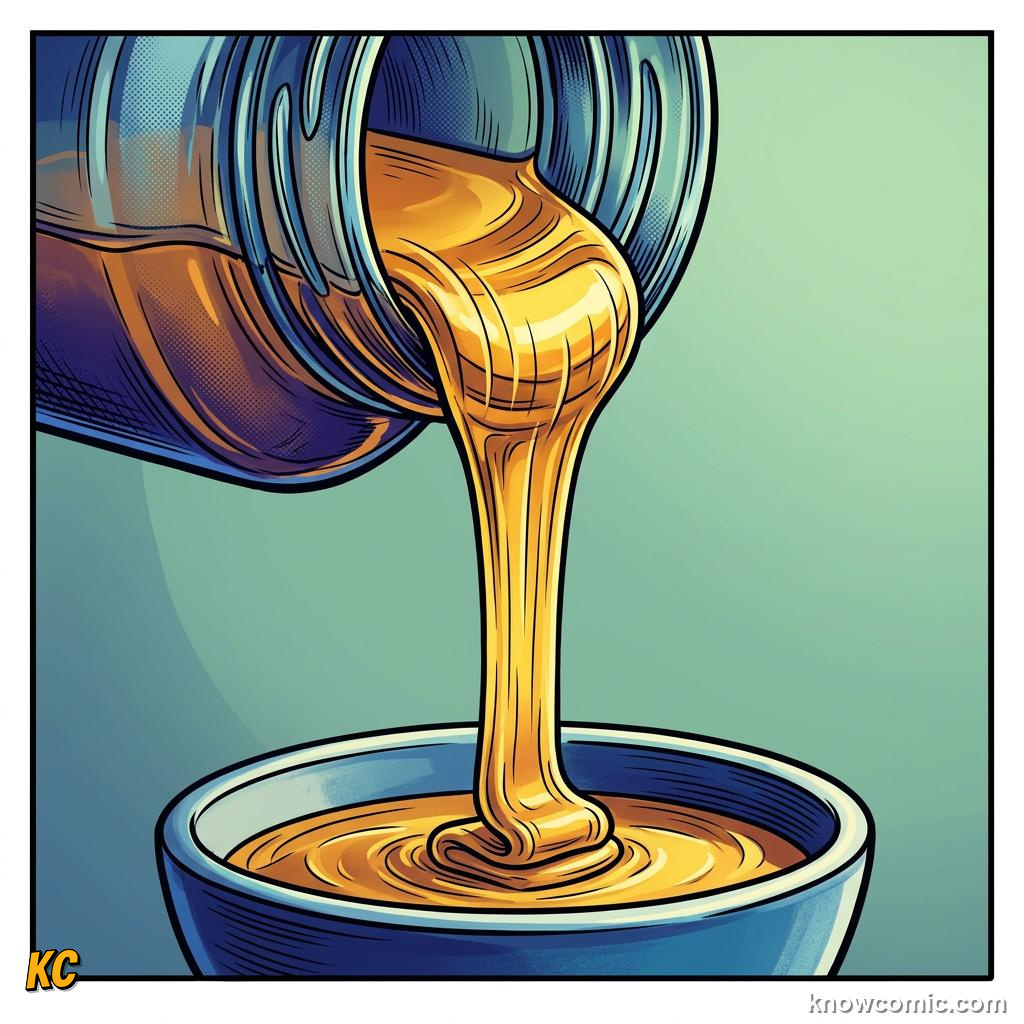
💧 Honey pours in steady sheets
TURBULENT

Comic panel about turbulent vs laminar flow: Turbulent, educational kids illustration
🌀 Swirls, eddies, and mixing
🌪️ Fast rivers and storm gusts
🔊 Turbulence adds noise and drag
PAGE 2 OF 5, THE REYNOLDS NUMBER
INERTIA VS STICKINESS
Comic panel about turbulent vs laminar flow: Inertia Vs Stickiness, educational kids illustration
WHO WINS: SPEED OR VISCOSITY?
In 1883, Osborne Reynolds ran a famous experiment. He injected dye into water flowing through a glass pipe and watched the pattern change as he raised the flow speed. At low speed the dye stayed in one straight streak. At higher speed the streak broke into chaotic swirls. Reynolds showed that the outcome depends on a dimensionless number now called the Reynolds number (Re). Re compares inertial forces, which push fluid along aggressively, to viscous forces, which resist sliding between layers. Low Re favors calm laminar motion. High Re lets disturbances grow into full turbulence.
📐 REYNOLDS NUMBER
For flow in a pipe, Re ≈ (density × speed × diameter) ÷ viscosity. Higher speed, larger pipe, or lower viscosity raises Re and makes turbulence more likely.
Re!
LOW Re
Comic panel about turbulent vs laminar flow: Who Wins: Speed Or Viscosity?, Low Re, educational kids illustration
🍯 Thick, sticky fluids stay calm
🐌 Slow flow resists disturbance
📏 Viscosity keeps layers orderly
HIGH Re
Comic panel about turbulent vs laminar flow: High Re, educational kids illustration
💨 Fast flow amplifies wiggles
🌊 Inertia overwhelms viscosity
🔄 Eddies mix the whole stream
PIPE RULE
Comic panel about turbulent vs laminar flow: Pipe Rule, educational kids illustration
✅ Re below ~2300: laminar
⚠️ ~2300 to 4000: transition zone
🌀 Re above ~4000: turbulent
PAGE 3 OF 5, LAMINAR LAYERS
STREAMLINES
Comic panel about turbulent vs laminar flow: Streamlines, educational kids illustration
📄 Layers slide past each other
🎯 Path of each particle is predictable
🔇 Quiet, low-mixing motion
VELOCITY PROFILE
Comic panel about turbulent vs laminar flow: Velocity Profile, educational kids illustration
🐌 Fluid sticks to pipe walls
🚀 Fastest flow at the center
📊 Parabolic speed curve in pipes
ORDERLY FLOW
Comic panel about turbulent vs laminar flow: Orderly Flow, educational kids illustration
LAMINAR FLOW IN DETAIL
In laminar flow, neighboring layers of fluid move in neat parallel paths without crossing. Imagine stacked sheets of paper sliding smoothly over one another. Viscosity, the internal stickiness of the fluid, keeps those layers coupled. Near a pipe wall, fluid clings to the surface and moves slowly. Farther from the wall, speed increases toward the center. This creates a predictable velocity profile that engineers can calculate exactly. Laminar flow wastes less energy on mixing and often produces less noise. Medical devices, micro-channels, and slow oil pipelines all rely on keeping flow in this calm regime whenever possible.
⚡ DID YOU KNOW?
Reynolds could delay turbulence to much higher Re by smoothing the pipe inlet and reducing vibrations. The transition point depends on disturbances, not only on the formula.
SMOOTH!
PAGE 4 OF 5, TURBULENT CHAOS
WHEN ORDER BREAKS
Comic panel about turbulent vs laminar flow: Laminar Flow In Detail, When Order Breaks, educational kids illustration
TURBULENCE TAKES OVER
Push a fluid fast enough and tiny wiggles in the flow grow instead of fading. Layers fold, twist, and break into eddies of every size. That is turbulent flow: three-dimensional, unsteady, and incredibly hard to predict in detail. Turbulence mixes heat, chemicals, and momentum far more effectively than laminar flow. It also increases friction losses in pipes and adds drag on vehicles. Yet turbulence is not all bad. It helps airplane wings stay attached at high angle, mixes fuel in engines, and stirs nutrients in oceans. Physicists still study turbulence because its fine-scale chaos resists simple equations.
🌀 TURBULENT TRAITS
Turbulent flow has irregular velocity swings, strong mixing, and eddies from large to tiny scales. It is common in fast rivers, jet exhaust, and weather systems.
CHAOS!
EDDIES
Comic panel about turbulent vs laminar flow: Turbulence Takes Over, Eddies, educational kids illustration
🔄 Spinning pockets of fluid
📉 Big eddies spawn smaller ones
⚡ Energy cascades to tiny scales
MIXING
Comic panel about turbulent vs laminar flow: Mixing, educational kids illustration
🌡️ Spreads heat quickly
🧪 Blends chemicals in pipes
☕ Stirred coffee cools faster
DRAG COST
Comic panel about turbulent vs laminar flow: Drag Cost, educational kids illustration
⛽ More pumping power needed
🔊 Pipes rumble and whistle
✈️ Wings need careful design
PAGE 5 OF 5, FROM SMOKE TO SCIENCE
WHY IT MATTERS
Comic panel about turbulent vs laminar flow: Why It Matters, educational kids illustration
READING THE FLOW
From candle smoke to blood in arteries, the laminar-turbulent split shapes how fluids behave. Engineers use Reynolds number to guess which regime they are in before building pipelines, heart valves, or cooling systems. Pilots and car designers fight turbulent wakes that waste fuel. Climate models track turbulent mixing in the atmosphere and oceans. The beauty of turbulence fascinated artists and scientists alike, yet its full mathematical prediction remains one of physics' toughest puzzles. Next time smoke curls into loops, you are watching the same transition Reynolds captured over a century ago.
FLOW!
REAL WORLD
Comic panel about turbulent vs laminar flow: Reading The Flow, Real World, educational kids illustration
🩸 Blood flow in narrow vessels
🚰 Water pipes and HVAC ducts
🌊 Rivers, clouds, and ocean currents
REMEMBER
🌀 KEY FACTS
Laminar flow is smooth and layered. Turbulent flow is chaotic and mixing. Reynolds number compares inertia to viscosity. In pipes, Re below about 2300 is usually laminar and above about 4000 is usually turbulent. Osborne Reynolds demonstrated the transition in 1883 with dye in a glass pipe.
✅ Laminar = smooth layers
✅ Turbulent = swirls and mixing
✅ Higher Re favors turbulence
✅ Smoke shows the transition live
🧠 QUIZ TIME!
TURBULENT VS LAMINAR FLOW · 5 QUESTIONS
QUESTION 01
What best describes laminar flow?
QUESTION 02
What does the Reynolds number compare?
QUESTION 03
For flow in a smooth pipe, which Reynolds number range is usually turbulent?
QUESTION 04
Who famously demonstrated the laminar-to-turbulent transition with dye in a pipe in 1883?
QUESTION 05
What happens to candle smoke as it rises higher?
0/5
LOADING...
← TOPIC 30 📋 ALL TOPICS TOPIC 32 →