📖 350 Topics🆓 FREE + PRO⏱️ 5 min per comic🧠 Quiz included
🪨
ANCIENT
Logs rolled under heavy loads
→
🛞
~3500 BCE
Potter's wheel spins in Mesopotamia
→
🚗
1800s
Rubber tires grip roads
→
🚲
1900s
Bicycles spread worldwide
→
⚙️
TODAY
Gears, trains, and robots roll on
🛞 ROLLING MOTION
TOPIC 32 · PHYSICS · WHEELS · TORQUE · FRICTION
PAGE 1 OF 5, SPIN AND SLIDE
MORE THAN SPINNING
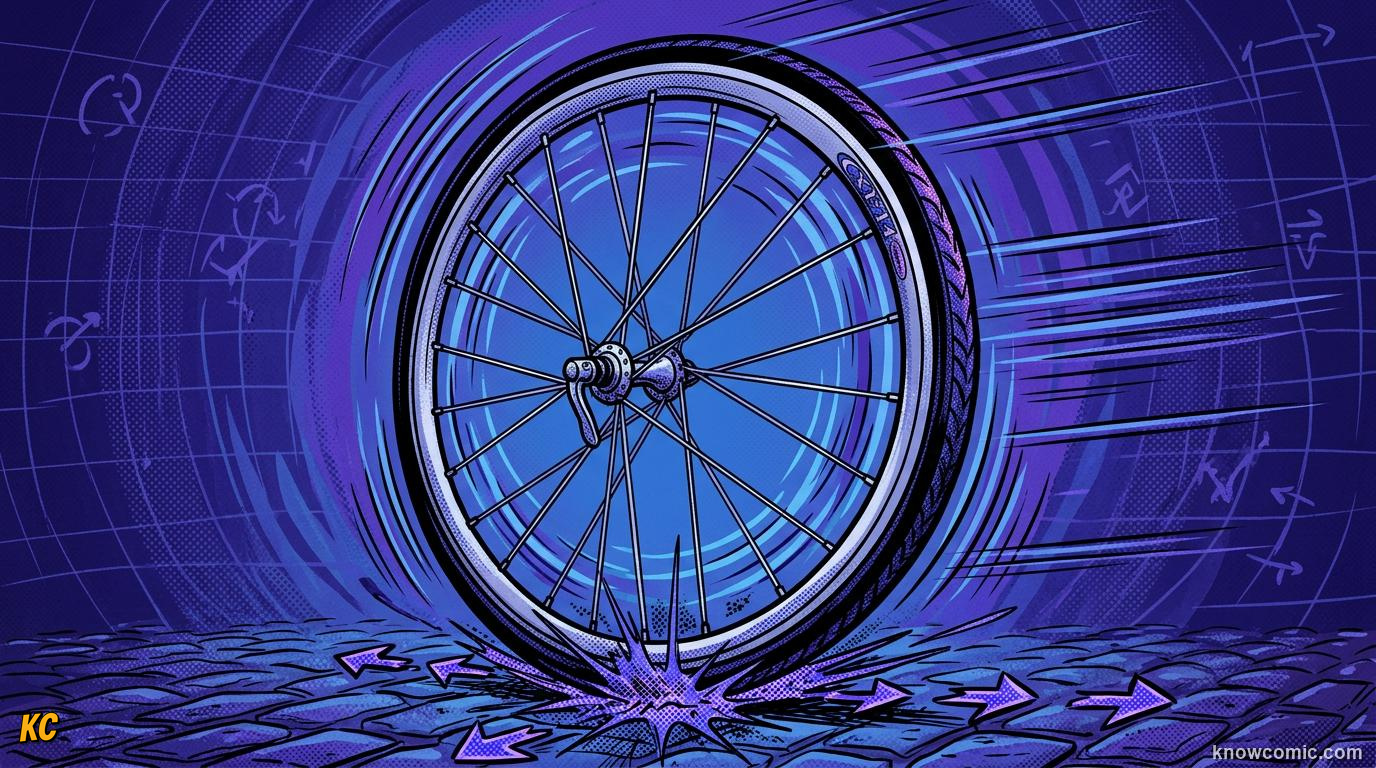
WHAT IS ROLLING MOTION?
A rolling wheel is not just sliding and not just spinning. It is both at once. The center of the wheel moves forward in a straight line while the rim rotates around that center. Every point on the rim follows a curved path called a cycloid. Rolling is one of humanity's most important inventions because it turns rotation into smooth travel with less effort than dragging. Carts, cars, bikes, and conveyor belts all depend on this combined motion. To understand a wheel fully, you must track translation of the whole object and rotation about its center together.
🛞 TWO MOTIONS
Rolling combines translation (the center moves forward) and rotation (the wheel spins about its axle). Both happen simultaneously in every rolling wheel.
ROLL!
TRANSLATION
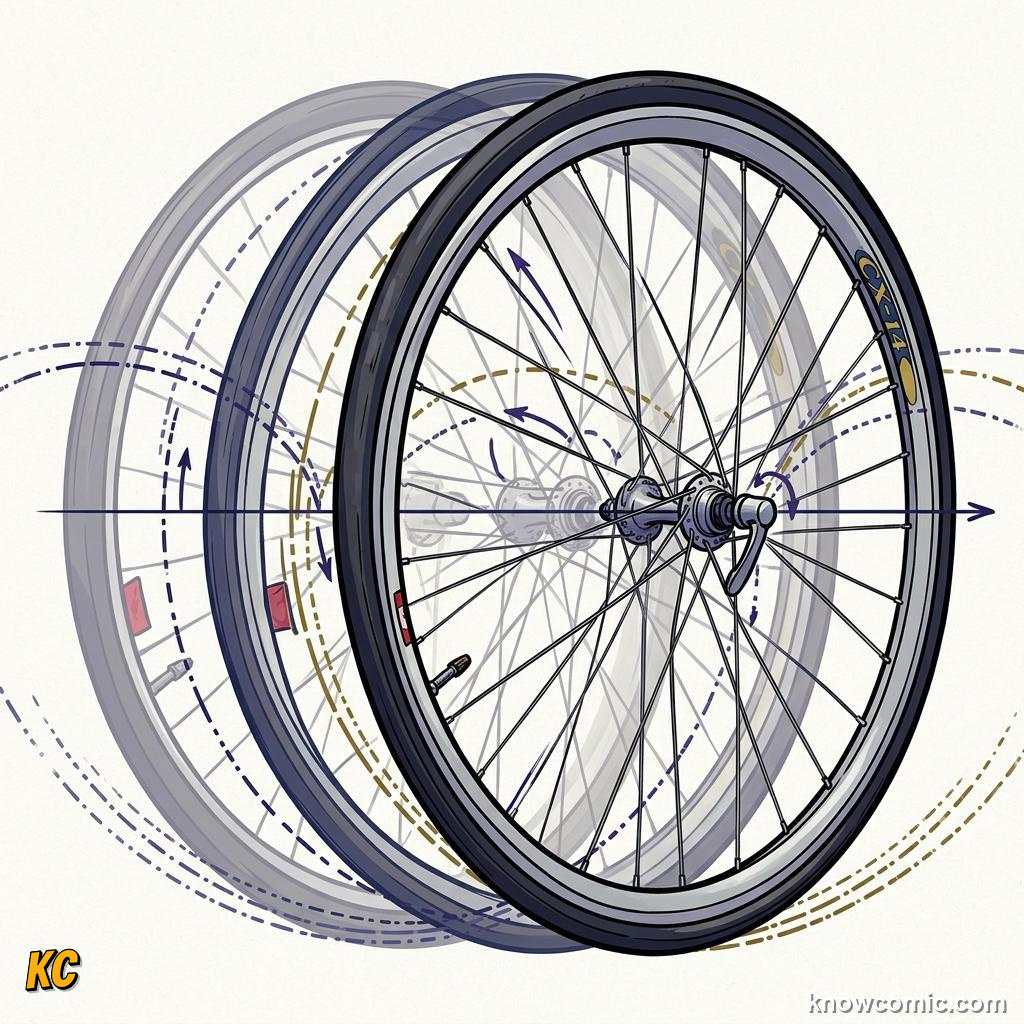
➡️ Center of mass moves forward
📏 Linear velocity v at the hub
🚲 Whole bike frame travels ahead
ROTATION
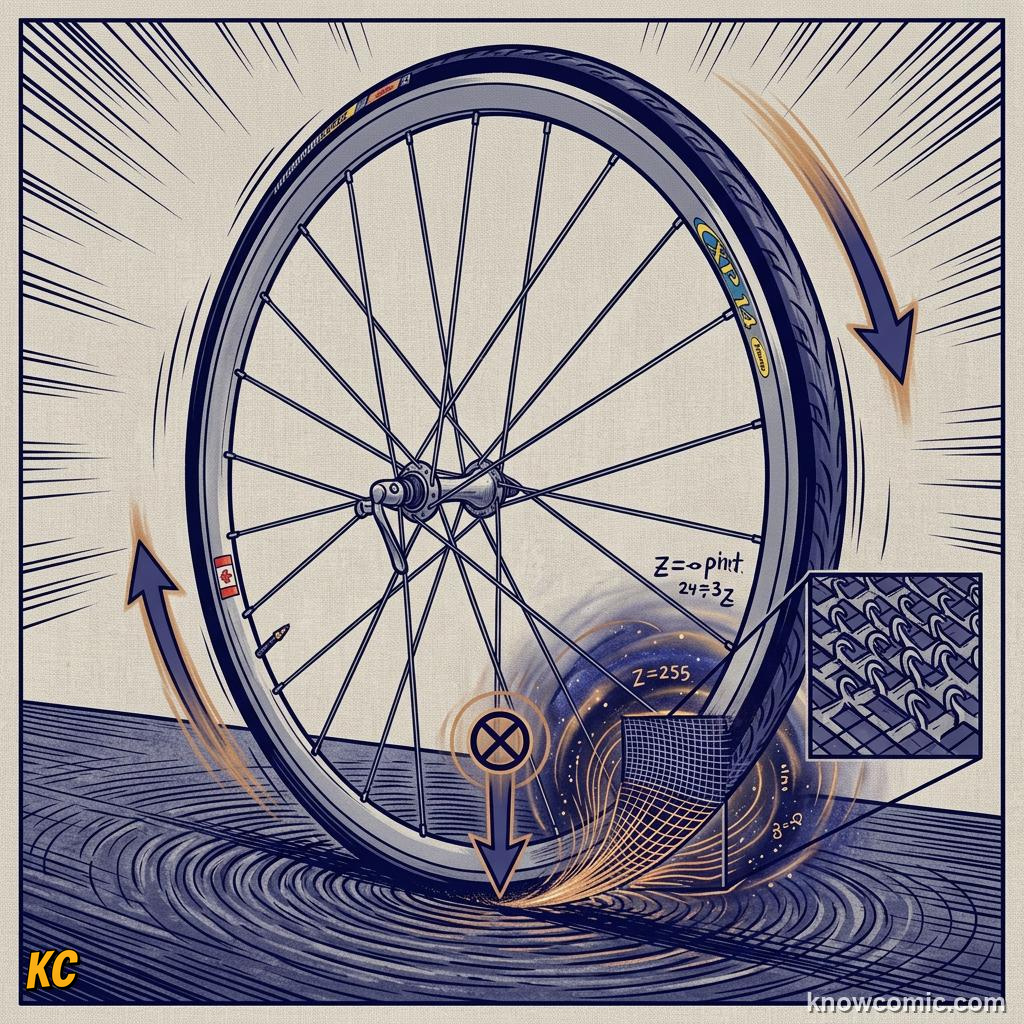
🔄 Rim spins about the axle
⚙️ Angular velocity ω in rad/s
🔝 Top of wheel moves fastest
PAGE 2 OF 5, ROLLING WITHOUT SLIPPING
THE GOLDEN RULE
NO SLIP AT THE CONTACT POINT
When a tire grips the road properly, the bottom of the wheel does not skid. That condition is called rolling without slipping. The contact point is instantaneously at rest relative to the ground, even while the wheel moves forward. Physics links the linear speed of the center to the spin rate with a simple rule: v = ωR, where R is the radius. Double the spin rate and the wheel rolls twice as fast, if it still grips. If the tire spins faster than this match, rubber burns and smoke appears. That is slipping, not true rolling.
📐 NO-SLIP CONDITION
Rolling without slipping means v = ωR. The bottom contact point has zero velocity relative to the surface. The top of the wheel moves at about 2v relative to the ground.
GRIP!
CONTACT POINT
📍 Bottom point velocity = zero
🔒 Momentarily stuck to the road
👟 Like a walking foot on the ground
TOP POINT
🚀 Forward v plus rim speed ωR
⚡ Top moves at about 2v
🎢 Fastest spot on the wheel
SLIPPING
💨 Burnout: ωR greater than v
🧊 Ice: wheel slides, does not roll
⚠️ v and ωR must stay matched
PAGE 3 OF 5, FRICTION AT THE CONTACT
STATIC FRICTION
🛑 Prevents sliding at contact
🔧 Provides torque to spin wheel
🚗 Tire tread grips the pavement
NO WORK DONE
⚡ Contact point not moving
🔋 Static friction does zero work
📈 Energy stays in roll motion
FRICTION HELPS
FRICTION MAKES ROLLING POSSIBLE
Friction often gets a bad reputation as something that slows you down, but rolling wheels need it. Without friction, a wheel on flat ground would spin in place or slide without rotating. Static friction at the contact patch grips the road and lets the tire push backward against the ground so the car moves forward. On a slope, static friction also supplies the torque that starts a disk rolling instead of sliding. If friction is too weak, like on ice, the no-slip condition breaks and the wheel skids. Kinetic friction then wastes energy as heat and wear.
⚡ DID YOU KNOW?
On a frictionless surface, a rolling ball would keep the same translational and rotational speeds separately. Real roads use static friction to link them through v = ωR.
GRIP!
PAGE 4 OF 5, TORQUE AND ENERGY
SPINNING UP
TORQUE STARTS THE ROLL
To get a wheel rolling from rest, something must apply a torque, a twisting force about the axle. On a bike you push the pedals. In a car the engine turns the drive shaft. On a ramp, gravity acting through the center of mass creates a torque about the contact point, and static friction prevents pure sliding so rotation begins. A rolling object stores energy in two forms: translational kinetic energy from the moving center of mass and rotational kinetic energy from spin. Total kinetic energy is the sum of both. Heavier rims store more rotational energy for the same spin rate.
⚙️ ENERGY SPLIT
KE total = ½mv² + ½Iω². For rolling without slipping, v = ωR links the two parts. Moment of inertia I depends on how mass is distributed in the wheel.
TORQUE!
MOMENT OF INERTIA
🎯 Mass far from axle: hard to spin
🚴 Light rims accelerate faster
⚙️ Shape affects I strongly
DOWN A RAMP
📐 Gravity pulls center of mass
🔄 Friction torque starts rotation
🏁 Solid sphere beats hollow ring
GEARS
⚙️ Teeth transfer torque smoothly
🚲 Chain links pedal to rear wheel
🏭 Machines multiply spin speed
PAGE 5 OF 5, THE WHEEL IN MOTION
WORLD ON WHEELS
WHY ROLLING WINS
Rolling beats sliding because contact points touch briefly and lift off instead of grinding along the whole path. That is why suitcases get wheels and factories use conveyor rollers. Every rolling system balances translation, rotation, friction, and torque. Engineers pick tire rubber, tread patterns, and gear ratios to keep the no-slip condition true under load. From skateboards to railway carriages, the same physics applies. Once you see that the bottom of a wheel is momentarily still, the whole mystery of rolling motion clicks into place.
GO!
REAL WORLD
🚗 Car tires and ABS braking
🚂 Steel wheels on smooth rails
⚽ Balls rolling in every sport
REMEMBER
🛞 KEY FACTS
Rolling combines translation and rotation. Rolling without slipping means v = ωR and the contact point is instantaneously at rest. Static friction at the contact prevents sliding and provides torque. Total kinetic energy includes both linear and rotational parts. Without enough friction, wheels slip instead of roll.
✅ Rolling = slide + spin together
✅ v = ωR for no slipping
✅ Static friction at contact point
✅ Bottom of wheel is momentarily still
🧠 QUIZ TIME!
ROLLING MOTION · 5 QUESTIONS
QUESTION 01
What two types of motion combine in rolling?
QUESTION 02
For rolling without slipping, which equation links linear and angular speed?
QUESTION 03
What is the velocity of the bottom contact point during rolling without slipping on flat ground?
QUESTION 04
Which type of friction is essential for rolling without slipping on a road?
QUESTION 05
Roughly how fast does the top of a rolling wheel move relative to the ground (no slipping)?