🚗
🎠
🔄
⚛️ KNOW SECONDARY · AGES 12–18

PHYSICS

⚛️ From Newton's Apple to Quantum Weirdness!

📖 350 Topics 🆓 FREE + PRO ⏱️ 5 min per comic 🧠 Quiz included
🚗
EVERYDAY
Sharp turns push you sideways
🍎
1687
Newton: inertia resists direction change
🎠
CARNIVAL
Spinning rides fling riders outward
⚙️
1800s
Centrifuges separate mixtures by spin
📐
TODAY
Physics class: real vs fictitious forces
🔄 CENTRIFUGAL 'FORCE'
TOPIC 34 · PHYSICS · INERTIA · SPIN · FICTITIOUS FORCES
PAGE 1 OF 5, THE OUTWARD PUSH
TURN THE CORNER

Comic panel about centrifugal 'force': Turn The Corner, educational kids illustration
WHAT IS CENTRIFUGAL 'FORCE'?
Take a sharp turn in a car and your body slides toward the outside door. On a fast merry-go-round you feel pressed against the railing. People call this the centrifugal force, as if something is pushing you away from the center. In an inertial frame of reference, that outward push is not a real force at all. It is a sensation caused by inertia: your body wants to keep moving in a straight line while the car or ride curves away underneath you. The seat, door, or safety belt must pull you inward to make you turn. Physicists call centrifugal force a fictitious or pseudo force because it only appears when you describe motion from a rotating point of view.
🔄 FICTITIOUS FORCE
Centrifugal force is not a real interaction between objects in an inertial frame. It is the feeling you get when a rotating frame accelerates you away from the straight path your inertia prefers.
SPIN!
FEELS REAL
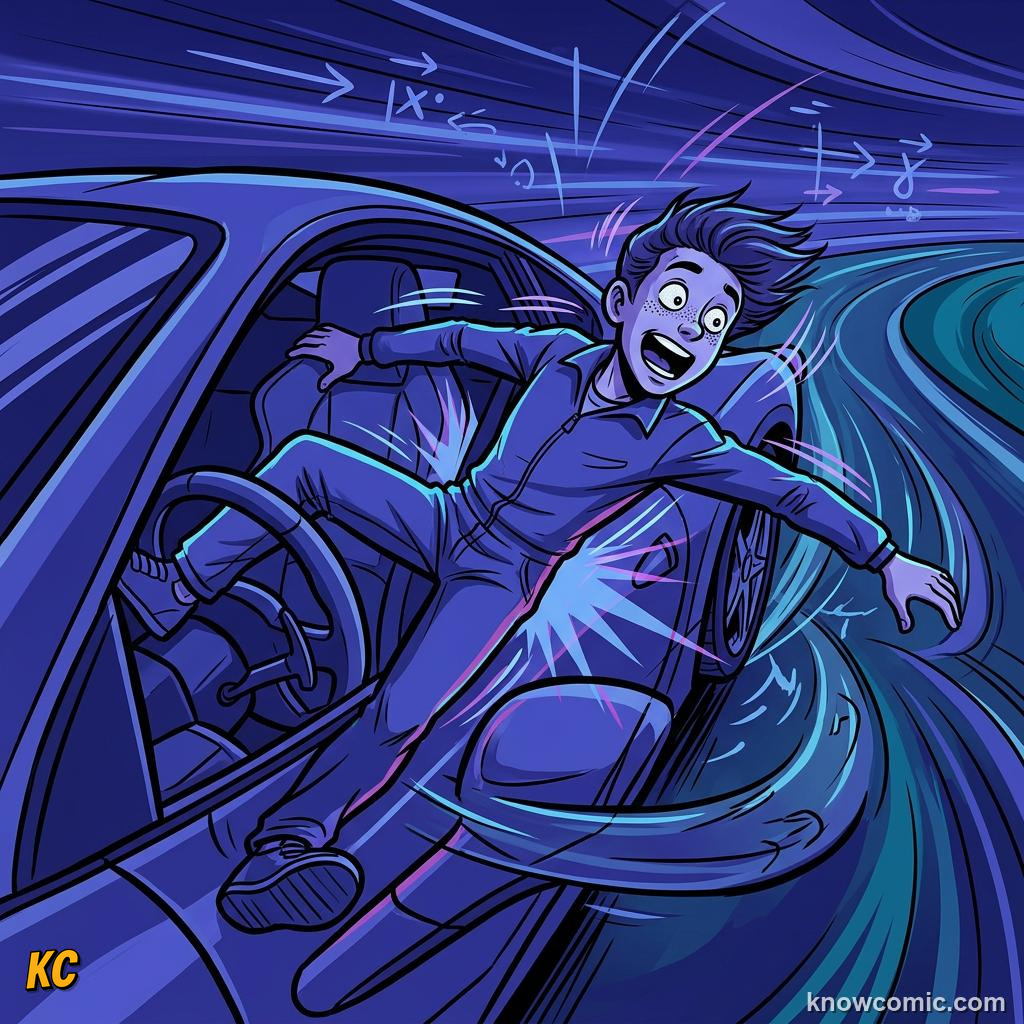
Comic panel about centrifugal 'force': What Is Centrifugal 'Force'?, Feels Real, educational kids illustration
🚗 Body slides toward the outer door
🎢 Roller coasters bank into curves
🧳 Loose items slide across the seat
NOT A REAL PUSH
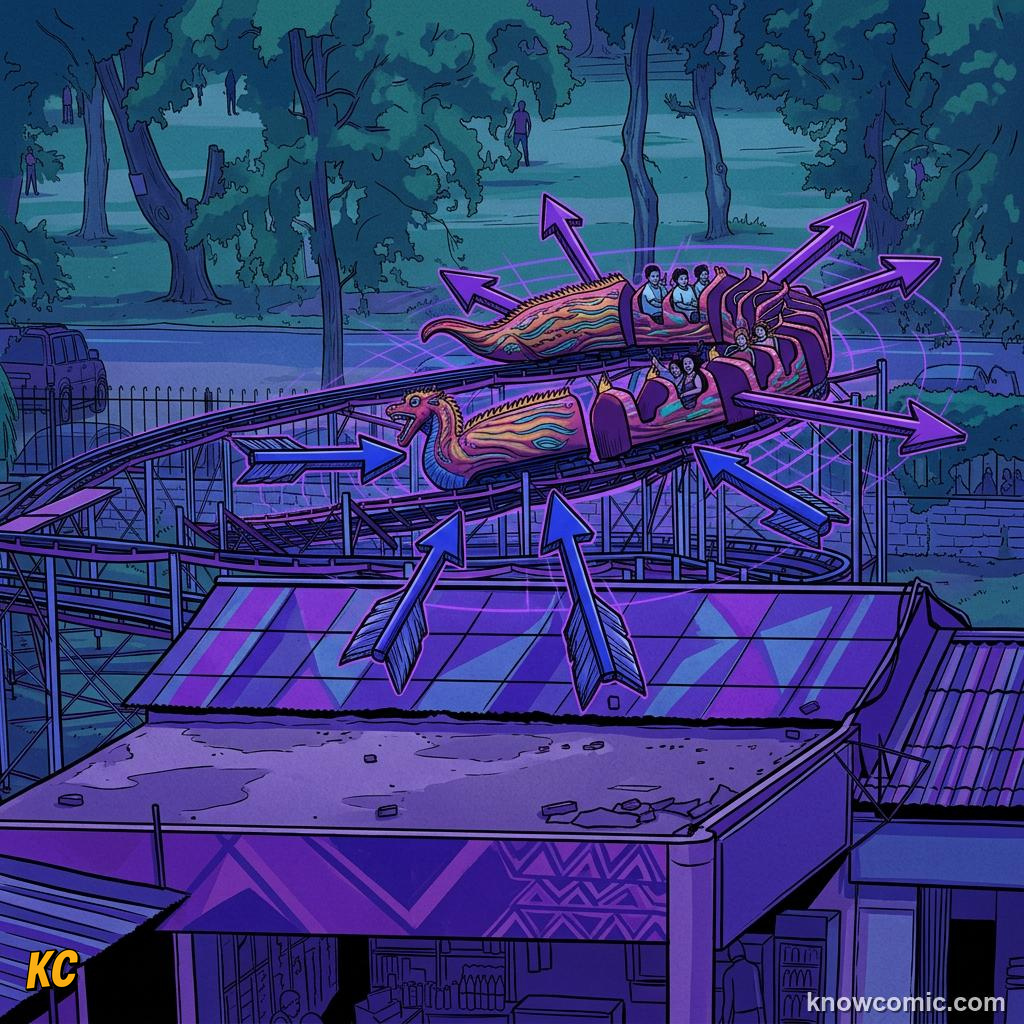
Comic panel about centrifugal 'force': Not A Real Push, educational kids illustration
📐 No object pushes you outward
🪑 Seat and belt pull you inward
🧠 Your brain reports a fake outward force
PAGE 2 OF 5, INERTIA VS CENTRIPETAL
STRAIGHT LINE WINS
Comic panel about centrifugal 'force': Straight Line Wins, educational kids illustration
INERTIA WANTS TO GO STRAIGHT
Newton's first law says an object in motion stays in motion in a straight line unless a net force acts on it. Circular motion is not natural for a free object. To move in a circle, something must constantly pull or push toward the center. That real inward force is called centripetal force, meaning center seeking. Friction from tires, tension in a string, or a seat pushing on you can all supply it. If those inward forces vanish, the object does not fly outward. It simply continues in a straight line tangent to the circle at that instant. The outward feeling happens because the turning surface keeps curving while your body resists the change in direction.
⬅️ CENTRIPETAL
Centripetal force is real and points toward the center of the circle. For a car on a flat turn, static friction between tires and road often provides it. Without enough centripetal force, the car slides off on a straight tangent.
INERTIA!
NEWTON'S FIRST LAW
Comic panel about centrifugal 'force': Inertia Wants To Go Straight, Newton'S First Law, educational kids illustration
➡️ Motion stays straight by default
🔄 Turn needs continuous inward pull
🍎 Same idea as a sliding apple on a tray
CENTRIPETAL FORMULA
Comic panel about centrifugal 'force': Centripetal Formula, educational kids illustration
📐 F = mv²/r toward the center
🏎️ Faster speed needs stronger inward force
📏 Tighter curve (small r) needs more force
LET GO
Comic panel about centrifugal 'force': Let Go, educational kids illustration
✋ Release the string: ball flies straight
🎯 Path is tangent to the circle
❌ Not a sudden outward rocket launch
PAGE 3 OF 5, CAR ON A CURVE
TIRE FRICTION
Comic panel about centrifugal 'force': Tire Friction, educational kids illustration
🛞 Static friction points toward turn center
💧 Wet or icy roads reduce grip
⚠️ Too fast and the car slides straight
BANKED ROADS
Comic panel about centrifugal 'force': Banked Roads, educational kids illustration
🏁 Track tilts so normal force helps turn
🛣️ Highway curves are gently banked
🏎️ Race tracks use steep banking at speed
INSIDE THE CAR
Comic panel about centrifugal 'force': Inside The Car, educational kids illustration
WHY YOU SLIDE ACROSS THE SEAT
When a car steers left, the tires push the car toward the center of the curve. Your body, obeying inertia, tries to keep going straight. The seat and seat belt must exert a real centripetal force on you to match the car's curved path. If friction between you and the seat is weak, you slide toward the right door before the seat catches up. From inside the car, which is a rotating reference frame, it feels like a mysterious outward shove. From the roadside, an observer sees the door push inward on you while the car curves. Same event, two descriptions: one uses fictitious centrifugal force, the other uses real centripetal contact forces.
⚡ DID YOU KNOW?
Seat belts exist partly to supply centripetal force to your upper body during a turn or sudden swerve. Without them, your inertia would let you keep moving straight while the car changes direction.
TURN!
PAGE 4 OF 5, SPINNING FRAMES
MERRY-GO-ROUND
Comic panel about centrifugal 'force': Why You Slide Across The Seat, Merry-Go-Round, educational kids illustration
ROTATING REFERENCE FRAMES
Stand on a spinning merry-go-round and the world appears to rotate around you. In that rotating frame, Newton's laws need an extra term: a fictitious centrifugal force pointing outward from the spin axis. It explains why loose coins slide to the outer rim and why you must hold the bar to stay on. The bar or friction from the platform supplies the real centripetal force keeping you in a circle. Let go and you move in a straight line across the grass, tangent to the circle at the moment of release. Engineers use the same idea in centrifuges, which spin samples so denser particles move outward in the rotating frame and collect at the bottom of a test tube.
🎠 TWO VIEWPOINTS
Ground observer: you need inward force to curve. Rider on the spin: it feels like an outward push balances the bar. Both descriptions work if you include fictitious forces in the rotating frame.
WHIRL!
HOLD THE BAR
Comic panel about centrifugal 'force': Rotating Reference Frames, Hold The Bar, educational kids illustration
🤝 Bar tension pulls you inward
🔄 Faster spin needs stronger grip
😵 Dizziness comes from mixed signals
LET GO
Comic panel about centrifugal 'force': Let Go, educational kids illustration
🏃 You fly off on a straight tangent
📍 Direction set at the release point
🎯 Not radially outward from the center
CENTRIFUGE
Comic panel about centrifugal 'force': Centrifuge, educational kids illustration
🧪 Labs spin blood to separate cells
🥛 Cream rises in a spinning separator
🏭 Industry uses spin to filter mixtures
PAGE 5 OF 5, REAL VS FAKE
THE FULL PICTURE
Comic panel about centrifugal 'force': The Full Picture, educational kids illustration
WHEN TO USE EACH NAME
In introductory physics, centrifugal force is treated as fictitious because no agent pushes you outward in an inertial frame. Centripetal force is the real inward pull from strings, seats, friction, or gravity in an orbit. The outward feeling is inertia, not a new interaction. In a rotating frame, adding a centrifugal term makes the math convenient, and engineers still speak of centrifugal effects in spinning machines. The key is knowing which viewpoint you are using. From the roadside, describe centripetal forces. From the spinning ride, you may add fictitious outward terms to explain what riders feel. Either way, something real must pull inward to keep circular motion going.
FRAME!
EVERYDAY SPIN
Comic panel about centrifugal 'force': When To Use Each Name, Everyday Spin, educational kids illustration
🧺 Clothes pressed to drum in a washer spin
🪣 Water flies from a swung bucket at the top
🌍 Earth is a rotating frame (tiny effects)
REMEMBER
🔄 KEY FACTS
Centrifugal force is fictitious in an inertial frame: your body wants to move straight due to inertia. Centripetal force is real and points inward (friction, tension, seat contact). Let go on a spin and you travel tangent to the circle. In a rotating frame, outward centrifugal terms explain what riders feel. Faster or tighter turns need stronger centripetal force: F = mv²/r.
✅ Outward feeling = inertia, not a real push
✅ Centripetal force keeps you turning
✅ Rotating frames add fictitious forces
✅ Release path is straight, not outward
🧠 QUIZ TIME!
CENTRIFUGAL 'FORCE' · 5 QUESTIONS
QUESTION 01
In an inertial (non-rotating) frame, centrifugal force is:
QUESTION 02
What force keeps a car turning on a flat road?
QUESTION 03
Why do you feel pushed toward the outer door when a car turns?
QUESTION 04
You let go of a merry-go-round bar while spinning. Which way do you move?
QUESTION 05
Centripetal force on an object moving in a circle always points:
0/5
LOADING...
← TOPIC 33 📋 ALL TOPICS TOPIC 35 →