⚛️
💫
🌈
⚛️ KNOW SECONDARY · AGES 12–18

PHYSICS

⚛️ From Newton's Apple to Quantum Weirdness!

📖 350 Topics 🆓 FREE + PRO ⏱️ 5 min per comic 🧠 Quiz included
🪐
BEFORE
Electrons pictured like tiny planets
📜
1913
Bohr proposes quantized orbits
🌈
SPECTRA
Model explains hydrogen light lines
🏆
1922
Bohr wins the Nobel Prize
☁️
TODAY
Orbitals replace planetary paths
⚛️ THE BOHR MODEL
TOPIC 36 · PHYSICS · ATOMS · ORBITS · ELECTRONS
PAGE 1 OF 5, PLANETS AROUND A NUCLEUS
THE CLASSIC PICTURE

Comic panel about the bohr model: The Classic Picture, educational kids illustration
ELECTRONS LIKE TINY PLANETS
Before quantum clouds, textbooks drew atoms as miniature solar systems. A tiny positive nucleus sat at the center, and electrons raced around it on circular tracks, the way planets orbit the Sun. That picture is the Bohr model, published by Danish physicist Niels Bohr in 1913. It was not just a cartoon. Bohr's rules explained why hydrogen gas glows in sharp colored lines when heated or sparked, and why atoms do not collapse even though opposite charges attract. The model was later replaced by quantum mechanics, but it was the first successful story of how light and matter talk to each other at the atomic scale.
⚛️ 1913 BREAKTHROUGH
Niels Bohr built on Rutherford's nuclear atom and Planck's quantum idea. He proposed that electrons occupy only certain allowed orbits, not any path they like.
ORBIT!
NUCLEUS
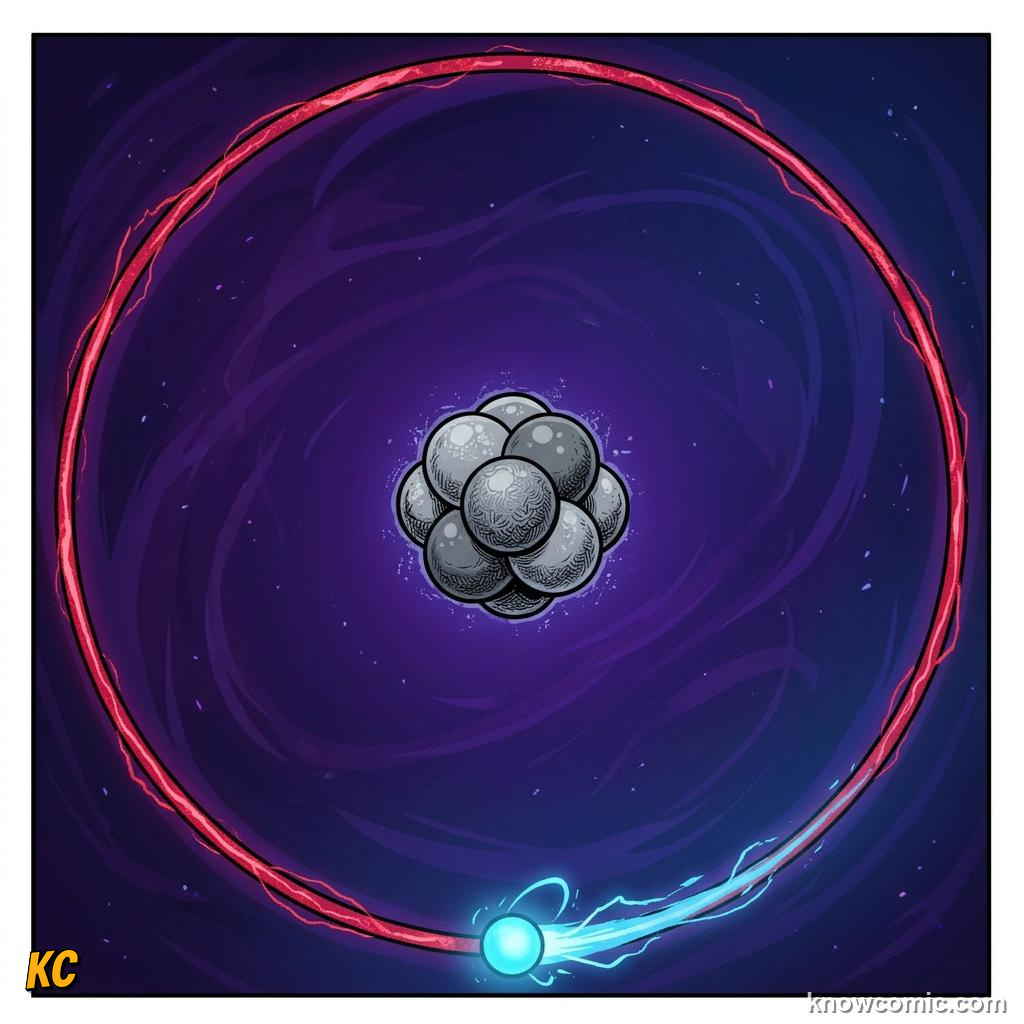
Comic panel about the bohr model: Electrons Like Tiny Planets, Nucleus, educational kids illustration
➕ Positive charge at the center
🪨 Almost all the atom's mass
📏 Tiny compared with electron orbits
ELECTRONS
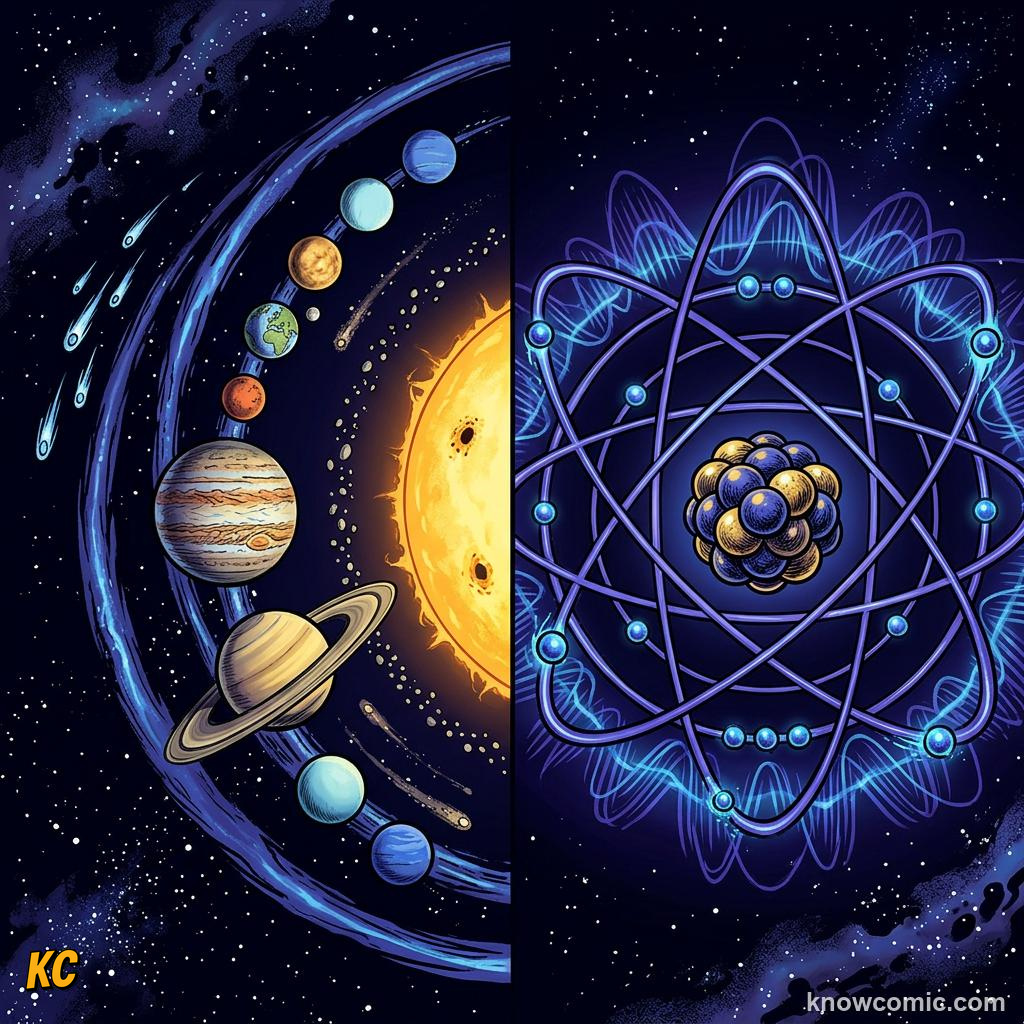
Comic panel about the bohr model: Electrons, educational kids illustration
➖ Negative charge in motion
🪐 Drawn as circular orbits
🎯 Only certain radii allowed
PAGE 2 OF 5, QUANTIZED ORBITS
NOT ANY PATH
Comic panel about the bohr model: Not Any Path, educational kids illustration
ONLY CERTAIN ORBITS ARE ALLOWED
Classical physics had a problem. An electron circling a nucleus should radiate energy continuously, spiral inward, and crash. Atoms would not last a fraction of a second. Bohr's fix was radical: electrons can occupy only special stationary orbits labeled by a quantum number n = 1, 2, 3, and so on. In those orbits they do not radiate. Angular momentum is quantized: mvr = nℏ, where ℏ is Planck's constant divided by 2π. The lowest orbit, n = 1, is the ground state. Higher n values are excited states, farther from the nucleus and higher in energy. Jumping between levels is the only way the electron gains or loses energy.
🔢 QUANTUM NUMBER n
n = 1 is closest to the nucleus and lowest in energy. Larger n means a larger orbit radius and higher energy. For hydrogen, energy levels follow E_n = −13.6 eV / n².
LEVEL!
GROUND STATE
Comic panel about the bohr model: Only Certain Orbits Are Allowed, Ground State, educational kids illustration
1️⃣ n = 1, lowest energy
🏠 Electron's normal home
🔒 Most stable arrangement
EXCITED STATES
Comic panel about the bohr model: Excited States, educational kids illustration
2️⃣ n = 2, 3, 4… higher energy
⬆️ Electron has absorbed energy
⏱️ Usually temporary, then falls back
NO SPIRAL CRASH
Comic panel about the bohr model: No Spiral Crash, educational kids illustration
✅ Stationary orbits do not radiate
❌ Continuous energy loss forbidden
⚛️ Atoms stay stable
PAGE 3 OF 5, LIGHT AND JUMPS
ABSORB
Comic panel about the bohr model: Absorb, educational kids illustration
⬆️ Electron jumps to a higher orbit
💡 Photon energy must match the gap
🎯 Wrong energy: no jump happens
EMIT
Comic panel about the bohr model: Emit, educational kids illustration
⬇️ Electron falls to a lower orbit
🌈 Photon carries away the energy difference
🎨 Color set by the size of the jump
PHOTON IN, PHOTON OUT
Comic panel about the bohr model: Photon In, Photon Out, educational kids illustration
HOW LIGHT AND MATTER INTERACT
Bohr's model finally linked atoms to light. When an electron drops from a higher level to a lower one, the atom emits a photon whose energy equals the difference: E = hf = E_high − E_low, where f is the light's frequency and h is Planck's constant. Absorbing a photon of exactly that energy can kick the electron upward. Because only certain energy gaps exist, only certain frequencies appear. That is why hydrogen's spectrum shows sharp lines, not a smooth rainbow smear. The Balmer series, visible lines from jumps that end on n = 2, matched Bohr's formula with striking accuracy and made the model famous.
⚡ DID YOU KNOW?
A larger energy jump means a higher-frequency photon. Ultraviolet lines come from bigger drops than red visible lines. The Lyman series (to n = 1) is ultraviolet; Balmer (to n = 2) is mostly visible.
JUMP!
PAGE 4 OF 5, HYDROGEN SPECTRUM
FINGERPRINT OF LIGHT
Comic panel about the bohr model: How Light And Matter Interact, Fingerprint Of Light, educational kids illustration
WHY HYDROGEN GLOWS IN LINES
Heat hydrogen gas or run an electric current through it and it emits light at precise wavelengths. Pass that light through a prism or diffraction grating and you see bright lines, not a continuous band. Each line is a specific electron jump. Bohr's formula for hydrogen wavelengths matched the known Balmer, Lyman, and Paschen series. That success earned Bohr the 1922 Nobel Prize in Physics. The model works best for hydrogen and other single-electron ions. Multi-electron atoms are more complicated because electrons interact with each other, so simple circular orbits no longer give exact answers.
🌈 SPECTRAL SERIES
Lyman: jumps to n = 1 (ultraviolet). Balmer: jumps to n = 2 (visible). Paschen: jumps to n = 3 (infrared). Each series is a family of lines from different starting levels.
LINES!
BALMER
Comic panel about the bohr model: Why Hydrogen Glows In Lines, Balmer, educational kids illustration
👁️ Visible hydrogen lines
🎯 End on n = 2
✅ Matched Bohr's formula
LYMAN
Comic panel about the bohr model: Lyman, educational kids illustration
🟣 Ultraviolet lines
🎯 End on n = 1
⚡ Largest energy gaps
LIMITS
Comic panel about the bohr model: Limits, educational kids illustration
✅ Excellent for hydrogen
⚠️ Weaker for multi-electron atoms
🔄 Later models improved the picture
PAGE 5 OF 5, BEYOND BOHR
FROM ORBITS TO CLOUDS
Comic panel about the bohr model: From Orbits To Clouds, educational kids illustration
WHY WE STILL TEACH THE MODEL
Quantum mechanics replaced planetary orbits with probability clouds called orbitals. Electrons do not travel on thin circular tracks, and you cannot pin down both position and momentum exactly. Yet Bohr's core ideas survive: energy is quantized, atoms emit and absorb photons at specific frequencies, and the ground state is stable. The Bohr model remains a powerful teaching tool because it shows, in simple pictures, how light and matter interact at the tiniest level. It was a bridge from classical physics to the quantum world, and every modern atomic theory still honors that first successful leap.
QUANTUM!
WHAT CHANGED
Comic panel about the bohr model: Why We Still Teach The Model, What Changed, educational kids illustration
☁️ Orbitals replace thin circular paths
🎲 Probability, not fixed tracks
🔬 Still quantized energy levels
REMEMBER
⚛️ KEY FACTS
Bohr (1913): electrons in quantized orbits, no radiation while in a stationary state. Energy jumps emit or absorb photons: E = hf. Explained hydrogen spectral lines. Best for hydrogen. Later quantum models use orbitals, but quantized energy and light-matter jumps remain.
✅ Only certain orbits allowed
✅ Photons match energy gaps
✅ Hydrogen spectrum explained
✅ Bridge to modern quantum theory
🧠 QUIZ TIME!
THE BOHR MODEL · 5 QUESTIONS
QUESTION 01
In the Bohr model, electrons can:
QUESTION 02
When an electron falls from a higher orbit to a lower one, the atom:
QUESTION 03
The Bohr model is most accurate for:
QUESTION 04
The Balmer series of hydrogen lines comes from electron jumps that end on:
QUESTION 05
In modern quantum theory, Bohr's thin circular orbits are replaced by:
0/5
LOADING...
← TOPIC 35 📋 ALL TOPICS TOPIC 37 →