🪶
🔨
🌙
⚛️ KNOW SECONDARY · AGES 12–18

PHYSICS

⚛️ From Newton's Apple to Quantum Weirdness!

📖 350 Topics 🆓 FREE + PRO ⏱️ 5 min per comic 🧠 Quiz included
🪶
EVERYDAY
Feather drifts, hammer drops fast
📐
GALILEO
Same acceleration for all masses
🍎
NEWTON
F = mg, so a = g for free fall
🌙
1971
Apollo 15: hammer and feather on Moon
🧪
TODAY
Vacuum tubes prove it on Earth
🪶 FREE FALL PHYSICS
TOPIC 37 · PHYSICS · VACUUM · CONSTANT · G
PAGE 1 OF 5, THE EQUAL DROP
HAMMER VS FEATHER
Comic panel about free fall physics: Hammer Vs Feather, educational kids illustration
WHAT IS FREE FALL?
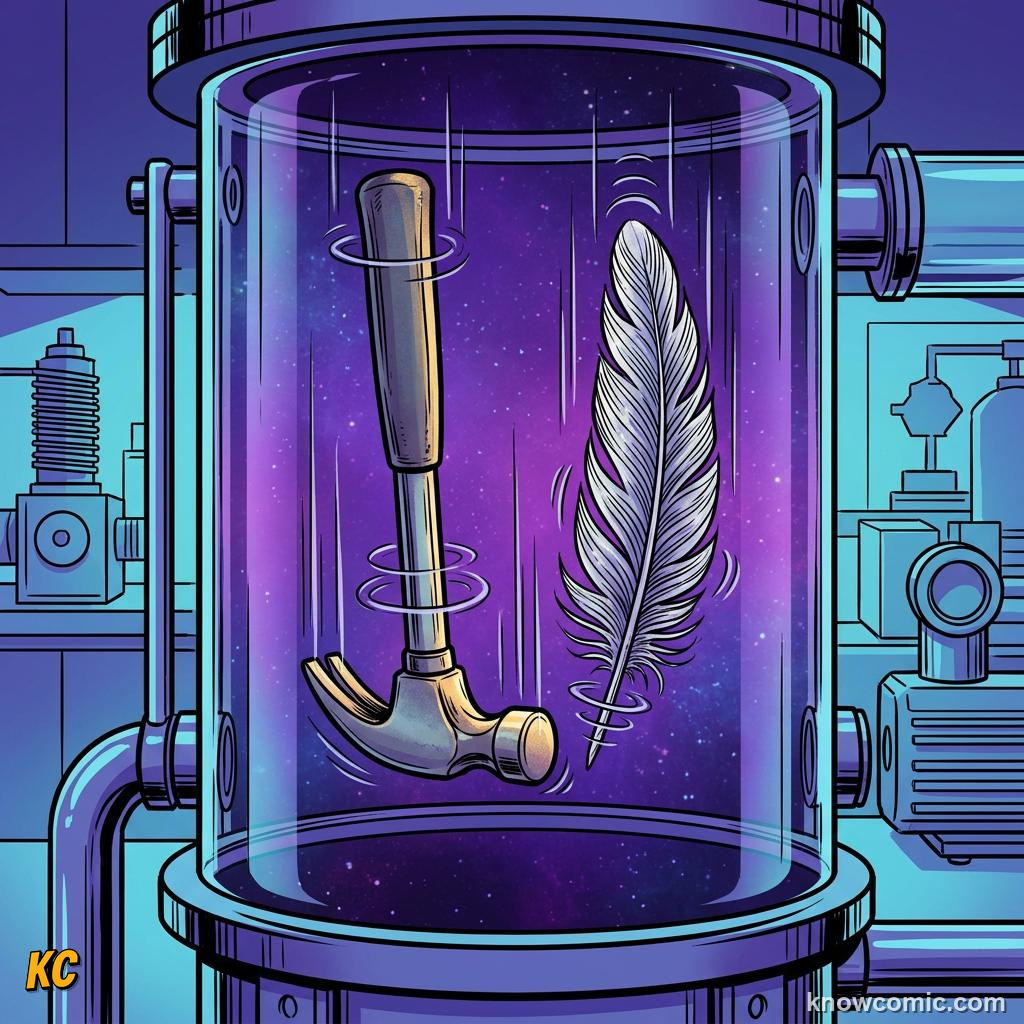
Free fall means an object is moving under gravity alone, with no other forces like air resistance or a supporting hand. On Earth, a feather drifts while a hammer smacks the ground, so it looks as if heavy things fall faster. That difference is not gravity playing favorites. Air pushes up on the feather far more than on the compact hammer. Remove the air, and both objects accelerate at the same rate. In a vacuum, mass does not decide who wins the race to the floor. Gravity pulls harder on a heavier object, but that object also has more inertia, so the extra pull and the extra resistance to motion cancel out.
🪶 FREE FALL
Free fall is motion when gravity is the only force. In a vacuum, all objects fall with the same acceleration, no matter how heavy or light they are.
DROP!
WITH AIR
Comic panel about free fall physics: What Is Free Fall?, With Air, educational kids illustration
🪶 Feather floats and drifts slowly
🔨 Hammer hits the ground first
💨 Air resistance is the real difference
NO AIR
Comic panel about free fall physics: No Air, educational kids illustration
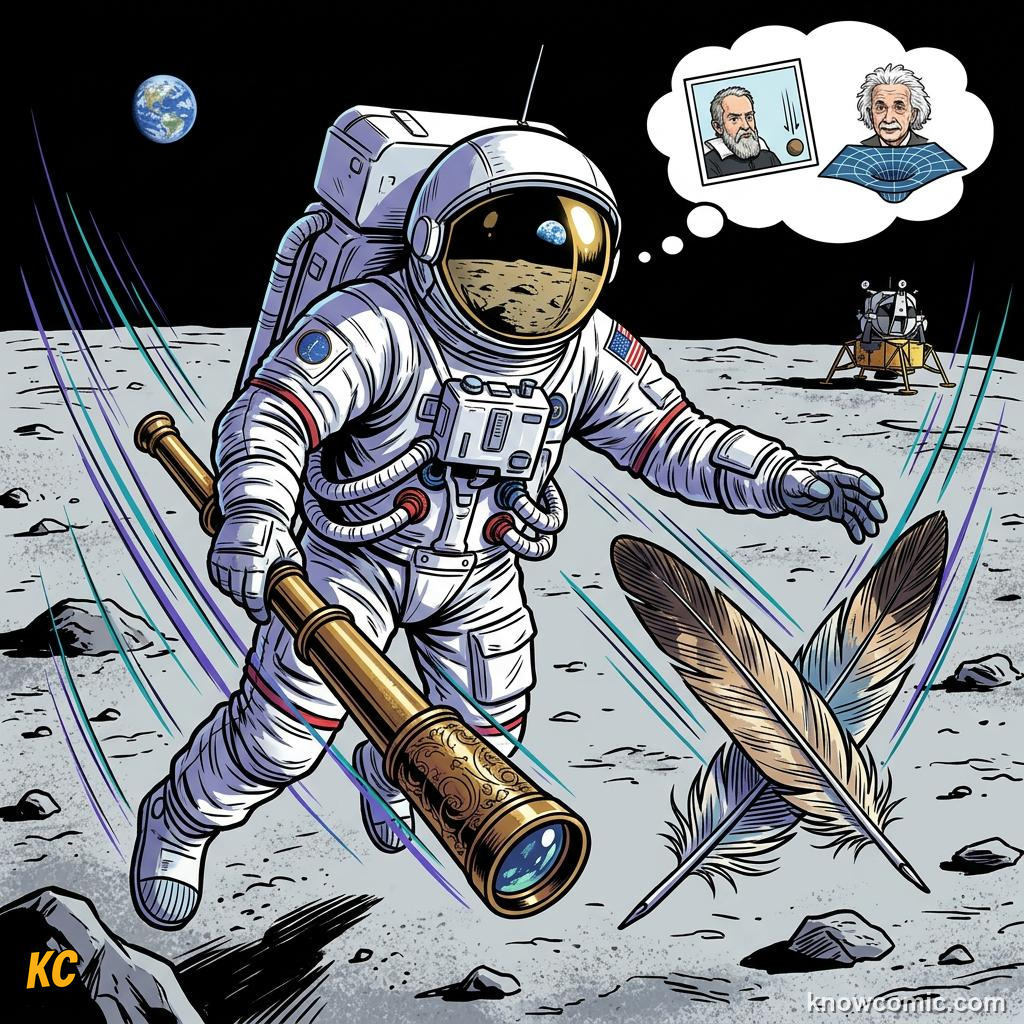
🧪 Vacuum tube: both fall together
🌙 Moon has almost no air
⚖️ Mass no longer changes the race
PAGE 2 OF 5, WHY MASS CANCELS
NEWTON'S MATH
Comic panel about free fall physics: Newton'S Math, educational kids illustration
F = MA MEETS GRAVITY
Newton's second law says net force equals mass times acceleration: F = ma. Near Earth's surface, the gravitational force on an object is F = mg, where g is the acceleration due to gravity, about 9.8 meters per second squared. Plug that into F = ma and you get mg = ma. Divide both sides by m (as long as mass is not zero) and you find a = g. The mass cancels. A bowling ball feels a stronger pull than a marble, but it also resists speeding up more, so both gain speed at the same rate when gravity is the only force. That constant acceleration is why free fall is so predictable in a vacuum.
📐 a = g
On Earth, g is about 9.8 m/s². Every second of free fall, speed increases by about 9.8 m/s if air resistance is negligible. Mass drops out of the equation.
EQUAL!
STRONGER PULL
Comic panel about free fall physics: F = Ma Meets Gravity, Stronger Pull, educational kids illustration
🏋️ Heavier mass: bigger gravitational force
🧲 Force scales with mass (F = mg)
⬇️ Pull alone would favor the heavy object
MORE INERTIA
Comic panel about free fall physics: More Inertia, educational kids illustration
🧱 Heavier mass: harder to accelerate
⚖️ Inertia also scales with mass
🎯 Extra pull and extra inertia cancel
SAME a
Comic panel about free fall physics: Same A, educational kids illustration
📉 Acceleration a equals g
🪶 Feather and hammer match in vacuum
🔬 Galileo argued this centuries ago
PAGE 3 OF 5, AIR GETS IN THE WAY
DRAG FORCE
Comic panel about free fall physics: Drag Force, educational kids illustration
💨 Air pushes upward on falling objects
🪶 Large area, low mass: drag wins early
🔨 Compact and heavy: gravity dominates
TERMINAL SPEED
Comic panel about free fall physics: Terminal Speed, educational kids illustration
🪂 Drag grows as speed increases
⚖️ Drag can balance weight
📉 Then acceleration drops to zero
WHY EARTH FOOLS YOU
Comic panel about free fall physics: Why Earth Fools You, educational kids illustration
AIR RESISTANCE HIDES THE TRUTH
Everyday free fall is almost never pure free fall. Air resistance, also called drag, opposes motion through the atmosphere. Drag depends on shape, surface area, speed, and air density. A crumpled paper ball falls faster than a flat sheet of the same paper because the sheet presents more area to the air. Skydivers reach a terminal speed when upward drag equals their weight, so they stop accelerating and fall at a steady rate. That is why classroom demos use vacuum tubes or pump the air out of a chamber: only then does the feather stop cheating with drag and match the hammer.
⚡ DID YOU KNOW?
A coin and a feather dropped in a long evacuated tube fall side by side. Pump air back in, and the feather slows while the coin still drops quickly.
DRAG!
PAGE 4 OF 5, MOON PROOF
APOLLO 15
Comic panel about free fall physics: Air Resistance Hides The Truth, Apollo 15, educational kids illustration
HAMMER AND FEATHER ON THE MOON
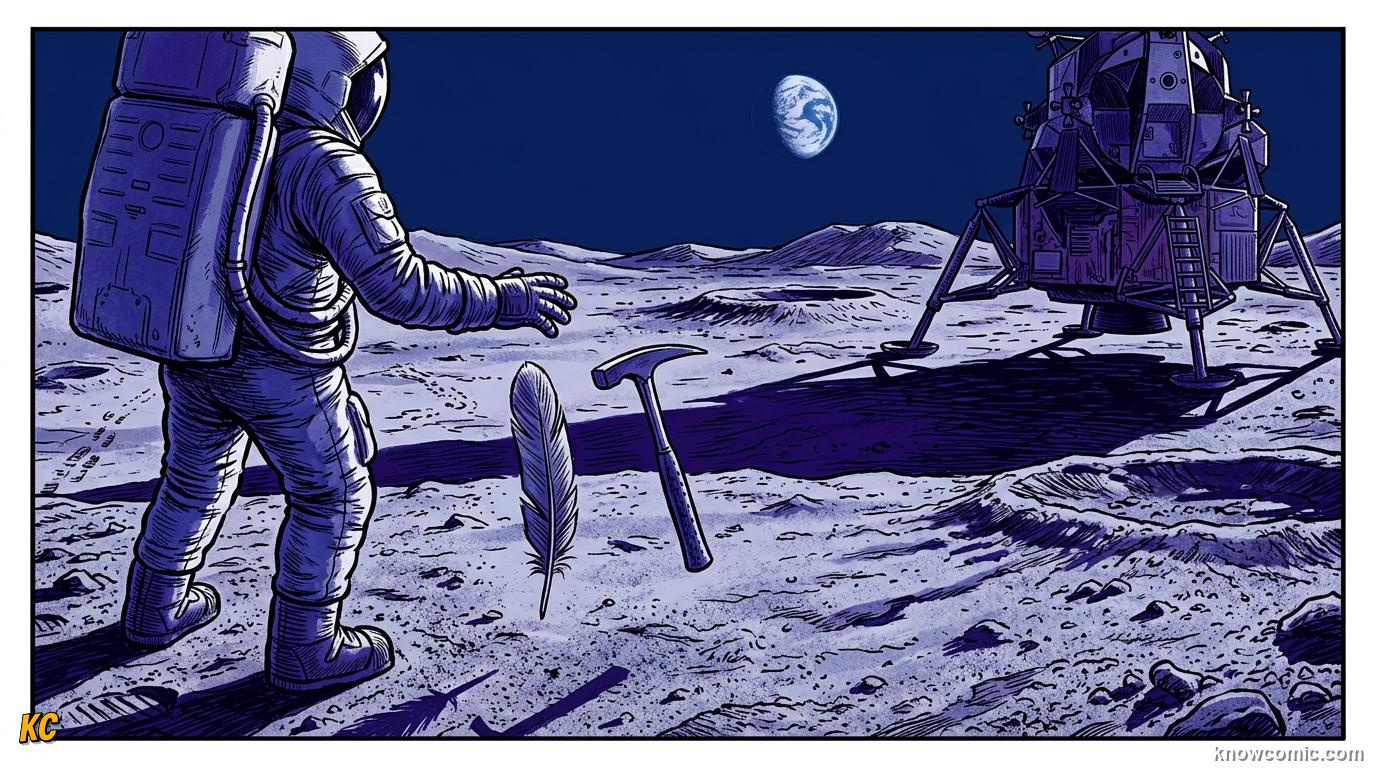
In 1971, Apollo 15 astronaut David Scott stood on the Moon and dropped a geologic hammer and a falcon feather at the same time. The Moon has almost no atmosphere, so air resistance was negligible. Both objects hit the lunar dust together, exactly as Galileo and Newton predicted. The video became one of the most famous physics demos ever filmed. Gravity on the Moon is weaker than on Earth (about one sixth of Earth's g), so both objects accelerated more slowly than they would at home. But they still accelerated at the same rate as each other. The lesson is about equality of free-fall acceleration, not about how strong gravity is.
🌙 1971
David Scott's live demo on Apollo 15 showed a hammer and feather landing together on the airless Moon. Mass did not matter.
MOON!
NO ATMOSPHERE
Comic panel about free fall physics: Hammer And Feather On The Moon, No Atmosphere, educational kids illustration
🌑 Moon: almost no air to push back
🪶 Feather cannot float or drift
✅ Pure free fall for both objects
WEAKER g
Comic panel about free fall physics: Weaker G, educational kids illustration
📉 Lunar g is about one sixth of Earth's
🐢 Both fall more slowly than on Earth
🤝 Still land at the same instant
CLASSROOM
Comic panel about free fall physics: Classroom, educational kids illustration
🧪 Vacuum tubes repeat the demo
🎥 Apollo footage is still used in class
🔬 Same physics, any planet or moon
PAGE 5 OF 5, THE BIG IDEA
THE FULL PICTURE
Comic panel about free fall physics: The Full Picture, educational kids illustration
MASS DOES NOT SET FREE-FALL SPEED
When gravity is the only force, every object at the same location accelerates at the same rate g. Mass cancels in F = ma because gravitational force and inertia both scale with mass. Air resistance breaks that simple picture on Earth, which is why feathers lose to hammers in open air. In a vacuum chamber or on the airless Moon, the race is a tie. Free fall is not about how heavy something is. It is about whether gravity alone is steering the motion. Remember that, and the famous hammer-and-feather experiment stops looking like a magic trick and starts looking like Newton's laws in action.
FALL!
EVERYDAY LINKS
Comic panel about free fall physics: Mass Does Not Set Free-Fall Speed, Everyday Links, educational kids illustration
🏀 Balls of different mass fall together
🪂 Parachutes use drag on purpose
🛰️ Orbit is continuous free fall sideways
REMEMBER
🪶 KEY FACTS
Free fall means gravity alone acts. In a vacuum, a = g for all masses because F = mg and F = ma cancel mass. Air resistance makes light, fluffy objects fall slowly on Earth. Apollo 15 proved hammer and feather land together on the Moon. g on Earth is about 9.8 m/s².
✅ Vacuum: mass does not matter
✅ Air drag explains everyday differences
✅ a = g when gravity is the only force
✅ Moon demo matches the math
🧠 QUIZ TIME!
FREE FALL PHYSICS · 5 QUESTIONS
QUESTION 01
In a vacuum, which falls faster: a hammer or a feather?
QUESTION 02
Why does a feather fall slowly in open air on Earth?
QUESTION 03
From F = ma and F = mg, free-fall acceleration is:
QUESTION 04
Who dropped a hammer and feather on the Moon in 1971?
QUESTION 05
About how large is g near Earth's surface?
0/5
LOADING...
← TOPIC 36 📋 ALL TOPICS TOPIC 38 →