🚗
⚙️
💧
⚛️ KNOW SECONDARY · AGES 12–18

PHYSICS

⚛️ From Newton's Apple to Quantum Weirdness!

📖 350 Topics 🆓 FREE + PRO ⏱️ 5 min per comic 🧠 Quiz included
💧
FLUIDS
Liquids transmit pressure evenly
📜
1600s
Pascal: pressure in a confined liquid
🏭
INDUSTRY
Hydraulic presses multiply force
🚗
CARS
Master and slave cylinders in brakes
🏗️
TODAY
Jacks, lifts, and excavators use fluid power
💧 HYDRAULIC ADVANTAGE
TOPIC 38 · PHYSICS · PASCAL · MASTER · SLAVE
PAGE 1 OF 5, SMALL PUSH, BIG LIFT
LIFT A CAR
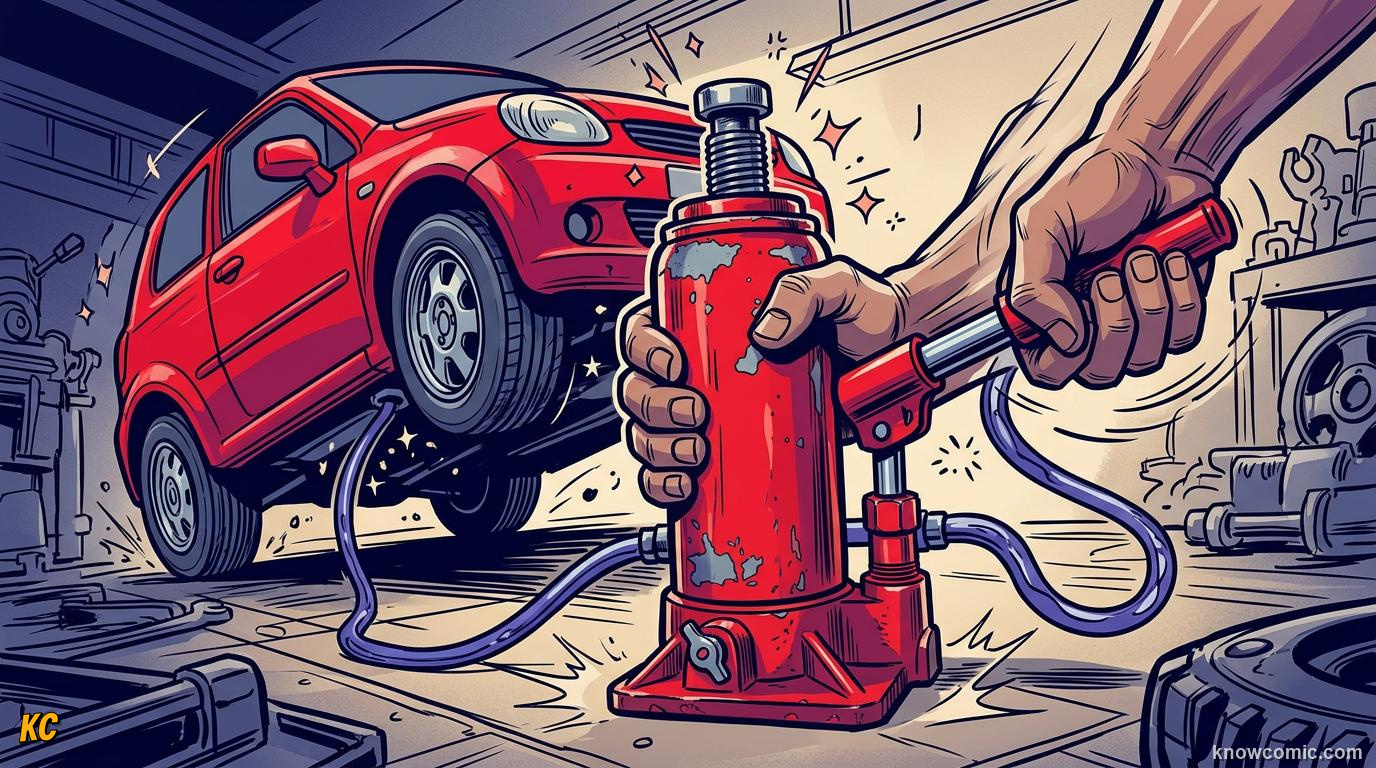
Comic panel about hydraulic advantage: Lift A Car, educational kids illustration
WHAT IS HYDRAULIC ADVANTAGE?
A hydraulic system uses liquid in sealed tubes and cylinders to move force from one place to another. Press a small piston with a modest force, and a much larger piston on the other end can lift a car. That force multiplication is hydraulic advantage. It works because liquids are nearly incompressible: you cannot squeeze their volume much, so pressure travels through the fluid almost instantly. Push on one end, and the liquid pushes back on every surface it touches. Engineers design the piston areas so a small input force becomes a huge output force. You trade distance for force: the small piston must travel farther than the large one rises.
💧 HYDRAULICS
Hydraulic advantage means a small force on a small piston can produce a large force on a large piston, because pressure in a confined liquid is the same throughout.
LIFT!
SMALL PISTON

Comic panel about hydraulic advantage: What Is Hydraulic Advantage?, Small Piston, educational kids illustration
👆 Modest force on a small area
📏 Piston travels a longer distance
🔧 Often called the master cylinder
LARGE PISTON
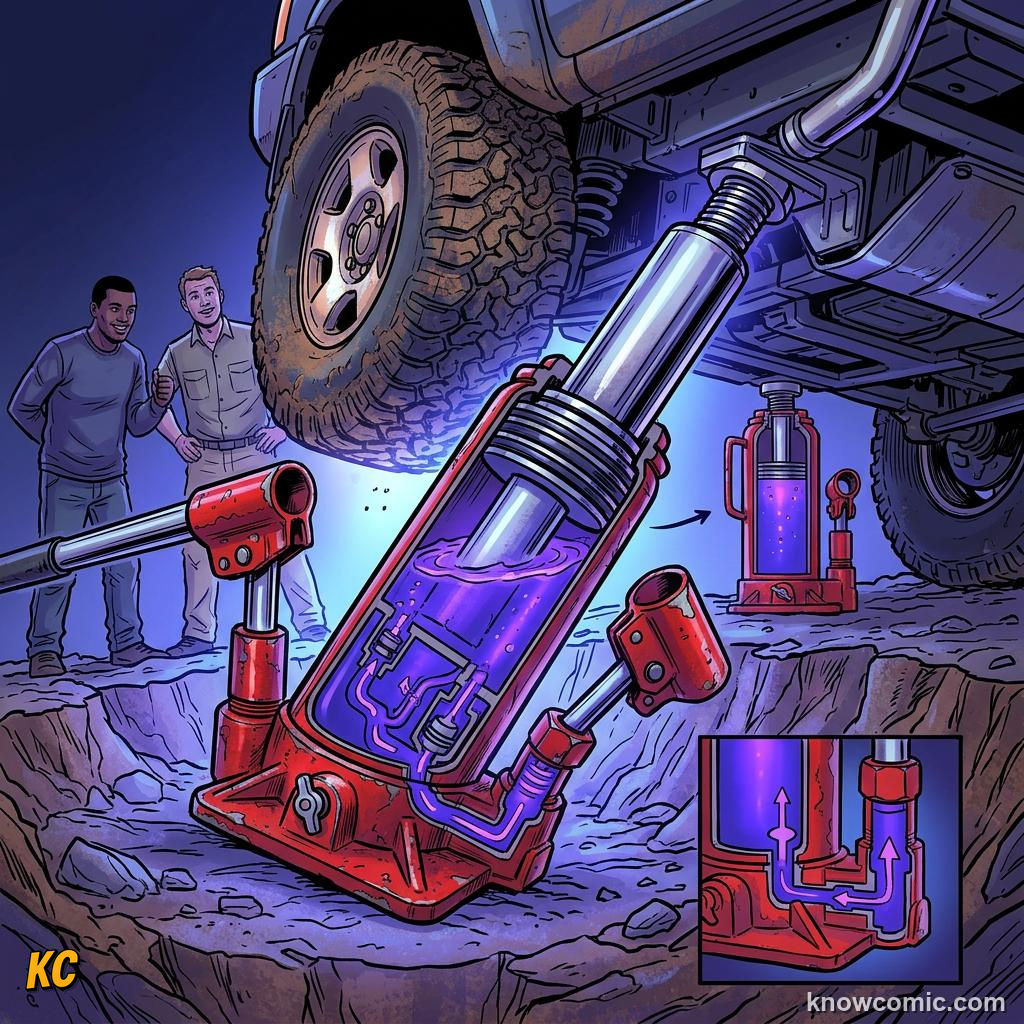
Comic panel about hydraulic advantage: Large Piston, educational kids illustration
🚗 Huge force on a large area
📐 Rises a shorter distance
🛠️ Often called the slave cylinder
PAGE 2 OF 5, PASCAL'S PRINCIPLE
PRESSURE EVERYWHERE
Comic panel about hydraulic advantage: Pressure Everywhere, educational kids illustration
PASCAL'S PRINCIPLE
Blaise Pascal, a French scientist and mathematician of the 1600s, stated a key rule of fluid statics. Pascal's principle says that a change in pressure applied to a confined fluid is transmitted undiminished to every part of the fluid and to the walls of its container. Pressure is force per unit area: P = F/A. Push with force F1 on a small piston of area A1, and you create pressure P = F1/A1. That same pressure acts on the large piston of area A2, so the output force is F2 = P × A2 = F1 × (A2/A1). If the large area is ten times the small area, the output force is ten times the input force. The liquid must be confined, or pressure would leak away instead of doing useful work.
📐 F2 / F1 = A2 / A1
Force multiplies by the ratio of piston areas. Same pressure on a bigger area means a bigger force. That is the heart of hydraulic advantage.
PRESS!
PRESSURE
Comic panel about hydraulic advantage: Pascal'S Principle, Pressure, educational kids illustration
📊 P = F / A (force over area)
🔗 Same P throughout the liquid
🚫 Leaks destroy the pressure link
AREA RATIO
Comic panel about hydraulic advantage: Area Ratio, educational kids illustration
📏 Bigger output area, bigger force
✖️ Multiply input force by A2/A1
🎯 Design areas for the job you need
CONFINED
Comic panel about hydraulic advantage: Confined, educational kids illustration
🔒 Sealed tubes and cylinders
💧 Liquid fills the space completely
⚠️ Air bubbles weaken the system
PAGE 3 OF 5, MASTER AND SLAVE
MASTER
Comic panel about hydraulic advantage: Master, educational kids illustration
🦶 Pedal or handle drives the master
🔧 Small piston creates the pressure
📡 Sends pressure through fluid lines
SLAVE
Comic panel about hydraulic advantage: Slave, educational kids illustration
🛠️ Slave piston does the heavy work
🚗 Presses brake pads or lifts a load
📐 Larger area multiplies the force
TWO CYLINDERS
Comic panel about hydraulic advantage: Two Cylinders, educational kids illustration
MASTER AND SLAVE CYLINDERS
Mechanics often call the input side the master cylinder and the output side the slave cylinder. In a car's hydraulic brakes, your foot presses the pedal, which moves a piston in the master cylinder. Brake fluid carries that pressure through rigid lines to slave cylinders at the wheels. Those pistons push the brake pads against the rotors or drums and slow the car. The areas are chosen so a human foot can generate enough force to stop a heavy vehicle. Clutch systems and many industrial machines use the same master-slave idea: one controlled push, many newtons of force where the work happens.
⚡ DID YOU KNOW?
If air enters a brake line, the pedal can feel spongy. Gas compresses, so pressure is not transmitted fully. Liquids must stay free of bubbles for hydraulics to work well.
PUSH!
PAGE 4 OF 5, THE DISTANCE TRADE
NO FREE ENERGY
Comic panel about hydraulic advantage: Master And Slave Cylinders, No Free Energy, educational kids illustration
FORCE UP, DISTANCE DOWN
Hydraulic advantage does not create energy from nothing. Work is force times distance. The liquid volume that leaves the small cylinder must equal the volume that enters the large cylinder (if the liquid is incompressible and there are no leaks). Volume equals area times distance moved, so A1 × d1 = A2 × d2. If A2 is ten times A1, then d1 must be ten times d2. You push the small piston a long way to raise the large piston a short way. Force multiplies, but distance shrinks by the same factor. Ideal work in equals ideal work out. Real systems lose a little energy to friction and fluid resistance, so efficiency is high but not perfect.
📏 A1 d1 = A2 d2
Equal volumes mean the small piston travels farther. You pay for the bigger force with a longer stroke on the input side.
TRADE!
INCOMPRESSIBLE
Comic panel about hydraulic advantage: Force Up, Distance Down, Incompressible, educational kids illustration
💧 Liquids barely change volume
📦 Volume in equals volume out
🌬️ Gases compress, so they are worse for this
WORK
Comic panel about hydraulic advantage: Work, educational kids illustration
⚡ Work = force × distance
⚖️ Ideal: work in equals work out
🔧 Real systems lose a little to friction
WHY LIQUID?
Comic panel about hydraulic advantage: Why Liquid?, educational kids illustration
🛢️ Oil and brake fluid stay nearly rigid
🎯 Pressure transmits almost instantly
❌ Air would squash instead of lift
PAGE 5 OF 5, EVERYDAY POWER
THE FULL PICTURE
Comic panel about hydraulic advantage: The Full Picture, educational kids illustration
FLUID POWER EVERYWHERE
Hydraulic advantage turns a small push into a huge force because Pascal's principle keeps pressure the same throughout a confined liquid, and force equals pressure times area. Master cylinders create the pressure. Slave cylinders deliver the force. You pay with a longer stroke on the small piston, because volume is conserved. Car jacks, garage lifts, excavator arms, and aircraft control systems all rely on this idea. Liquids work because they are nearly incompressible. Keep the system sealed and free of air, and a fingertip on a button can move a mountain of metal.
POWER!
WHERE YOU SEE IT
Comic panel about hydraulic advantage: Fluid Power Everywhere, Where You See It, educational kids illustration
🚗 Car brakes and clutch hydraulics
🏗️ Excavators and dump-truck beds
🛠️ Floor jacks and garage lifts
REMEMBER
💧 KEY FACTS
Pascal's principle: pressure in a confined liquid is transmitted equally. P = F/A, so F2/F1 = A2/A1. Master piston inputs force; slave piston outputs force. Liquids are nearly incompressible, so volume in equals volume out (A1 d1 = A2 d2). Force multiplies, distance shrinks.
✅ Same pressure, different areas
✅ Master creates, slave delivers
✅ Trade distance for force
✅ Liquid, not air, carries the load
🧠 QUIZ TIME!
HYDRAULIC ADVANTAGE · 5 QUESTIONS
QUESTION 01
Pascal's principle says pressure applied to a confined liquid is:
QUESTION 02
If the large piston has 10 times the area of the small piston, the output force is:
QUESTION 03
In a hydraulic brake system, the master cylinder:
QUESTION 04
Why are liquids used instead of air in most hydraulic systems?
QUESTION 05
When force is multiplied by a hydraulic system, what happens to distance?
0/5
LOADING...
← TOPIC 37 📋 ALL TOPICS TOPIC 39 →