🍎
⛰️
🛰️
⚛️ KNOW SECONDARY · AGES 12–18

PHYSICS

⚛️ From Newton's Apple to Quantum Weirdness!

📖 350 Topics 🆓 FREE + PRO ⏱️ 5 min per comic 🧠 Quiz included
🍎
APPLE
Gravity pulls objects down
⛰️
MOUNTAIN
Newton's cannon thought experiment
💥
FASTER
Harder shots land farther away
🌍
ORBIT
Fast enough: falls around Earth
🛰️
TODAY
Satellites are continuous free fall
🛰️ NEWTON'S CANNONBALL
TOPIC 39 · PHYSICS · LEAP · ORBIT · SPACE
PAGE 1 OF 5, THE THOUGHT EXPERIMENT
MOUNTAIN CANNON
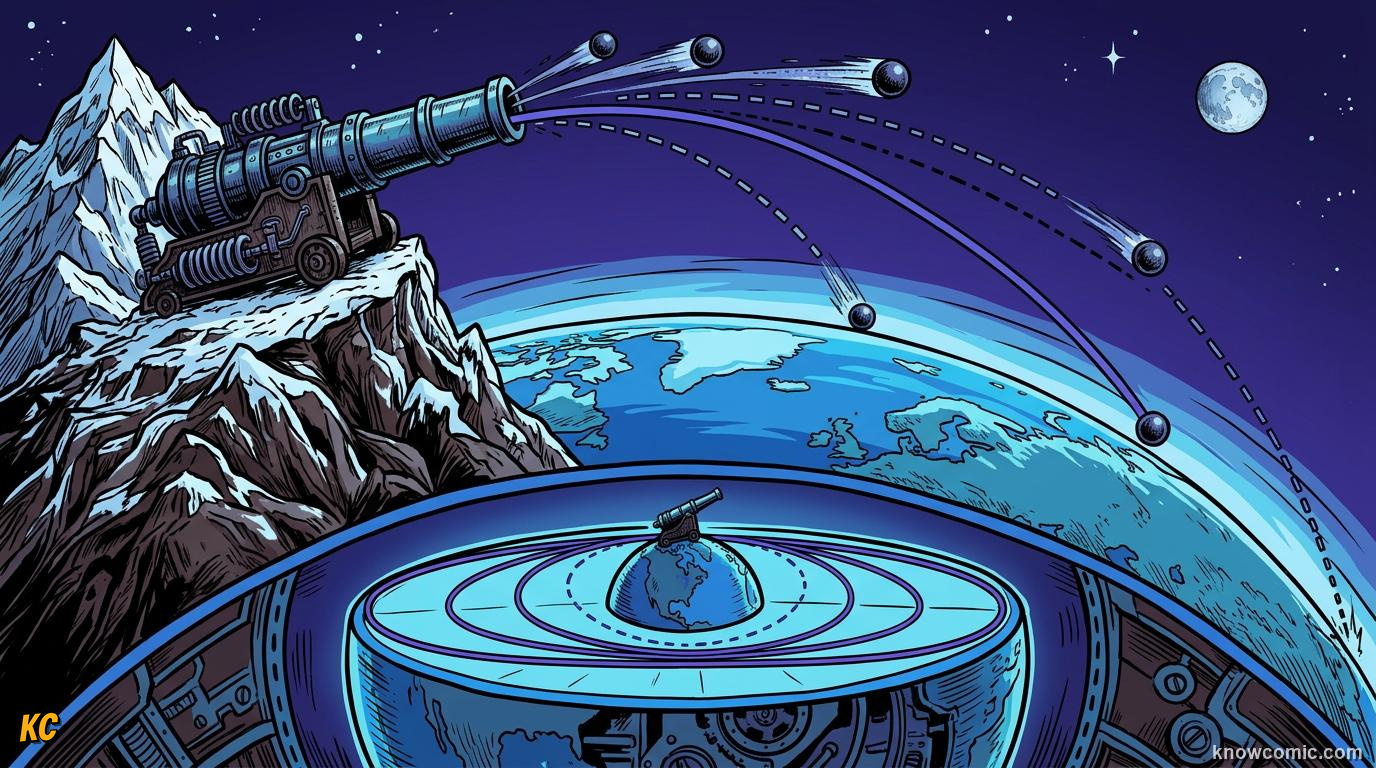
Comic panel about newton's cannonball: Mountain Cannon, educational kids illustration
WHAT IF YOU FIRED HARDER?
Isaac Newton imagined a cannon on a very tall mountain, firing cannonballs sideways. Gravity still pulls every shot toward Earth, so a slow ball arcs down and hits the ground nearby. Fire a little harder, and the ball travels farther before it lands. Newton asked a brilliant question: what if you fire so hard that the ball falls at the same rate Earth curves away beneath it? Then the ball never meets the ground. It keeps falling around the planet forever. That mental picture links everyday falling to the motion of the Moon and modern satellites.
⚡ THOUGHT EXPERIMENT
Newton never built the mountain cannon. He used the idea in his writings to show that orbit is continuous free fall sideways, not a special force that holds things up.
FIRE!
SLOW SHOT

Comic panel about newton's cannonball: What If You Fired Harder?, Slow Shot, educational kids illustration
💥 Ball arcs and hits nearby ground
⬇️ Gravity pulls it down the whole way
⛰️ Lands on the mountain's slope
FASTER SHOT
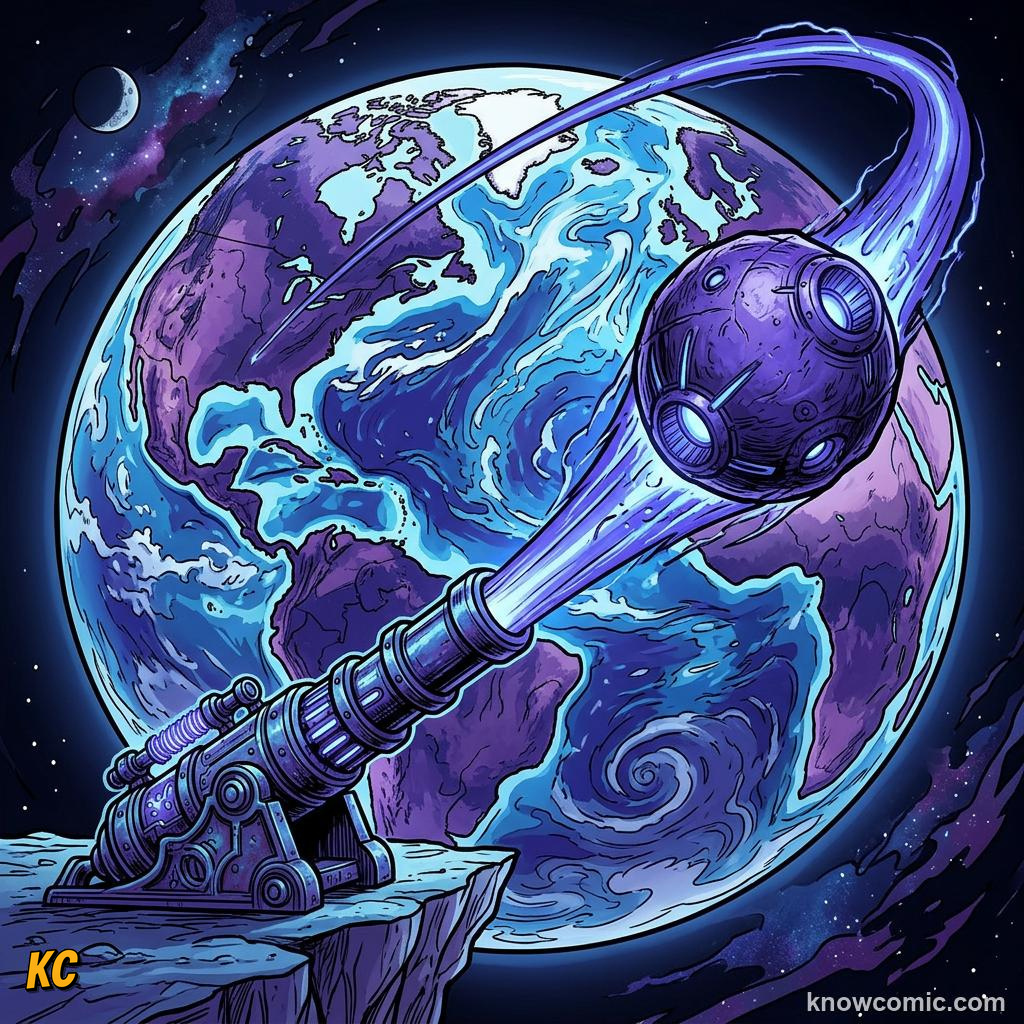
Comic panel about newton's cannonball: Faster Shot, educational kids illustration
🚀 Same gravity, more sideways speed
🌍 Lands much farther from the cannon
📐 Path still curves toward Earth
PAGE 2 OF 5, FALLING AROUND EARTH
THE ORBIT SPEED
Comic panel about newton's cannonball: The Orbit Speed, educational kids illustration
WHEN FALLING NEVER HITS
Earth is a sphere, so its surface curves away as you move sideways. A projectile always falls toward Earth's center, but if its horizontal speed is high enough, the ground drops away at the same rate the ball falls. The ball is always falling, yet it never gets closer to the surface. That closed path is an orbit. Near Earth's surface, ignoring air resistance, that orbital speed is about 8 kilometers per second, roughly 28,000 kilometers per hour. Real low-Earth satellites fly a bit higher, where air is thin, but the idea is the same: they are in continuous free fall around the planet.
🛰️ ORBIT
Orbit is not floating without gravity. Gravity is what bends the path into a closed loop. Without gravity, the cannonball would fly off in a straight line.
ORBIT!
CURVE MATCH
Comic panel about newton's cannonball: When Falling Never Hits, Curve Match, educational kids illustration
🌍 Earth curves away beneath the ball
⬇️ Ball falls toward Earth's center
🎯 Speeds match: path never meets ground
SIDEWAYS SPEED
Comic panel about newton's cannonball: Sideways Speed, educational kids illustration
⚡ Need huge horizontal velocity
📏 About 8 km/s near Earth's surface
🌬️ Air would burn a real cannonball up
STILL FALLING
Comic panel about newton's cannonball: Still Falling, educational kids illustration
🍎 Same gravity as a falling apple
🛰️ Satellites are always in free fall
🔄 Path closes into a loop
PAGE 3 OF 5, APPLES TO ORBITS
ONE GRAVITY
Comic panel about newton's cannonball: One Gravity, educational kids illustration
🍎 Apple falls straight down
🌙 Moon falls around Earth
🔗 Same force, different sideways speed
UNIVERSAL LAW
Comic panel about newton's cannonball: Universal Law, educational kids illustration
📐 Gravity acts on all masses
🌌 Links Earth, Moon, and planets
🧠 Cannonball made the link visual
THE BIG BRIDGE
Comic panel about newton's cannonball: The Big Bridge, educational kids illustration
FROM FALLING APPLES TO THE MOON
Before Newton, falling objects and the motion of the Moon seemed like different mysteries. The cannonball thought experiment showed they are the same physics. An apple has almost no sideways speed, so it hits the ground. The Moon has enormous sideways speed, so it falls around Earth instead of into it. Newton argued that the same inverse-square gravity that pulls an apple also keeps the Moon in orbit. The mountain cannon is a middle step: a projectile you can picture, fired harder and harder, until its path becomes lunar motion in miniature.
🍎 ONE FORCE
Newton's insight was unity: terrestrial gravity and celestial motion are not separate rules. One law of gravitation explains both.
LINK!
PAGE 4 OF 5, FASTER THAN ORBIT
ESCAPE PATHS
Comic panel about newton's cannonball: From Falling Apples To The Moon, Escape Paths, educational kids illustration
TOO FAST TO STAY BOUND
Newton's diagram did not stop at a perfect circle. Fire a little faster than orbital speed and the path becomes a longer ellipse that still closes around Earth. Fire even harder and the projectile can reach escape speed, about 11 kilometers per second from Earth's surface if you ignore air. Then the path opens into a hyperbola and the ball never returns. Real rockets do not fire from a mountain cannon, but they use the same idea: add enough sideways (and upward) speed so gravity cannot pull the craft back to the ground. Spaceflight is Newton's thought experiment made real with engines and careful timing.
🚀 ESCAPE
Escape speed is the speed needed to leave Earth's gravity well on a one-way trip, not the speed of a closed orbit. Orbit is slower than escape.
ESCAPE!
CIRCLE
Comic panel about newton's cannonball: Too Fast To Stay Bound, Circle, educational kids illustration
⭕ Right speed: closed circular orbit
🛰️ Height stays roughly constant
⚖️ Fall rate matches Earth's curve
ELLIPSE
Comic panel about newton's cannonball: Ellipse, educational kids illustration
🥚 Faster: stretched oval path
📈 Height rises and falls each loop
🔄 Still bound to Earth
ESCAPE
Comic panel about newton's cannonball: Escape, educational kids illustration
☄️ Fast enough: never comes back
🌌 Path opens into deep space
🚀 Rockets aim for this on missions
PAGE 5 OF 5, THE BIG IDEA
THE FULL PICTURE
Comic panel about newton's cannonball: The Full Picture, educational kids illustration
ORBIT IS FALLING THAT MISSES
Newton's cannonball is a thought experiment, not a real gun on a mountain. Its power is the picture it paints. Gravity always pulls. Sideways speed decides whether you hit the ground, circle the planet, or leave for good. Satellites look frozen in the sky only because they move so fast that their continuous free fall matches Earth's curve. The same force that drops an apple keeps the International Space Station from flying off in a straight line. Once you see orbit as falling that never lands, space stops feeling magical and starts feeling like physics.
MISS!
EVERYDAY LINKS
Comic panel about newton's cannonball: Orbit Is Falling That Misses, Everyday Links, educational kids illustration
🛰️ GPS and weather satellites orbit Earth
🏀 A thrown ball is a tiny cannon shot
🌙 The Moon is a natural satellite
REMEMBER
🛰️ KEY FACTS
Newton's mountain cannon shows orbit as continuous free fall sideways. Faster shots land farther until the path closes around Earth. Near-surface orbital speed is about 8 km/s. Escape needs even more speed. Apples and satellites obey the same gravity.
✅ Orbit is falling that misses Earth
✅ Sideways speed sets the path
✅ Same gravity as a falling apple
✅ Satellites are always in free fall
🧠 QUIZ TIME!
NEWTON'S CANNONBALL · 5 QUESTIONS
QUESTION 01
In Newton's thought experiment, what happens if the cannonball is fired fast enough?
QUESTION 02
What force keeps a satellite in orbit around Earth?
QUESTION 03
About how fast is low-Earth orbital speed near the surface (ignoring air)?
QUESTION 04
What did Newton's cannonball idea connect?
QUESTION 05
What happens if a projectile exceeds escape speed?
0/5
LOADING...
← TOPIC 38 📋 ALL TOPICS TOPIC 40 →