📦
🚀
⚛️ KNOW SECONDARY · AGES 12–18

PHYSICS

⚛️ From Newton's Apple to Quantum Weirdness!

📖 350 Topics 🆓 FREE + PRO ⏱️ 5 min per comic 🧠 Quiz included
💪
FORCE
Push or pull on an object
📏
DISPLACEMENT
Object moves through a distance
WORK
W = F d (along the motion)
🏃
ΔKE
Net work equals energy change
📒
TODAY
W = ΔKE bookkeeping rule
⚡ WORK-ENERGY THEOREM
TOPIC 42 · PHYSICS · JOULES · DISPLACEMENT · FORCE
PAGE 1 OF 5, THE ENERGY LEDGER
SPEED CHANGE
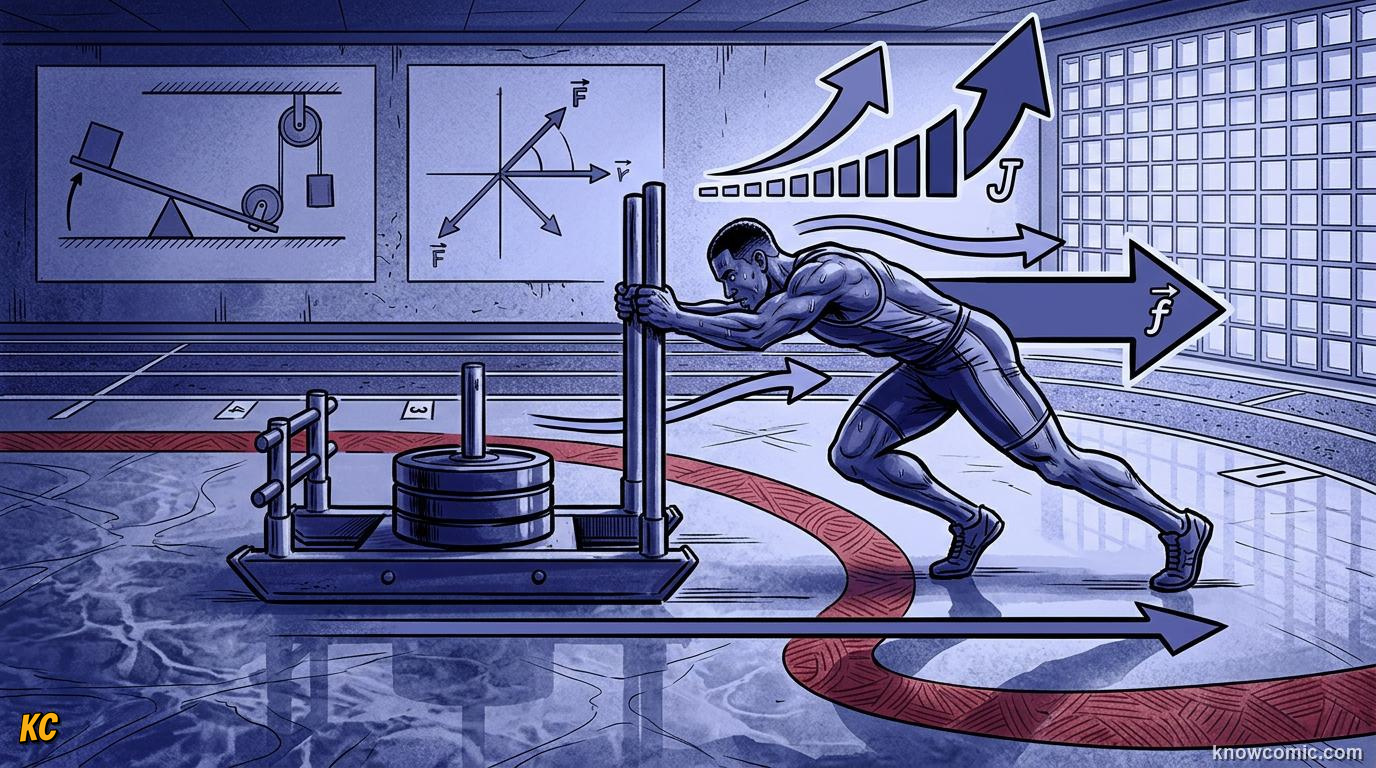
Comic panel about work-energy theorem: Speed Change, educational kids illustration
WORK CHANGES SPEED
To change an object's speed, something must do work on it. In physics, work is not "effort" or "sweat." Work is a precise transfer of energy that happens when a force acts on an object while that object moves through a displacement. Push a shopping cart and it speeds up: your force does positive work, and the cart's kinetic energy rises. Catch a rolling ball and slow it down: your force does negative work, and kinetic energy falls. The work-energy theorem is the bookkeeping rule that links those two ideas. Net work done on an object equals the change in its kinetic energy.
📒 W = ΔKE
The work-energy theorem says net work equals the change in kinetic energy: Wnet = ΔKE = KEf − KEi.
WORK!
POSITIVE WORK
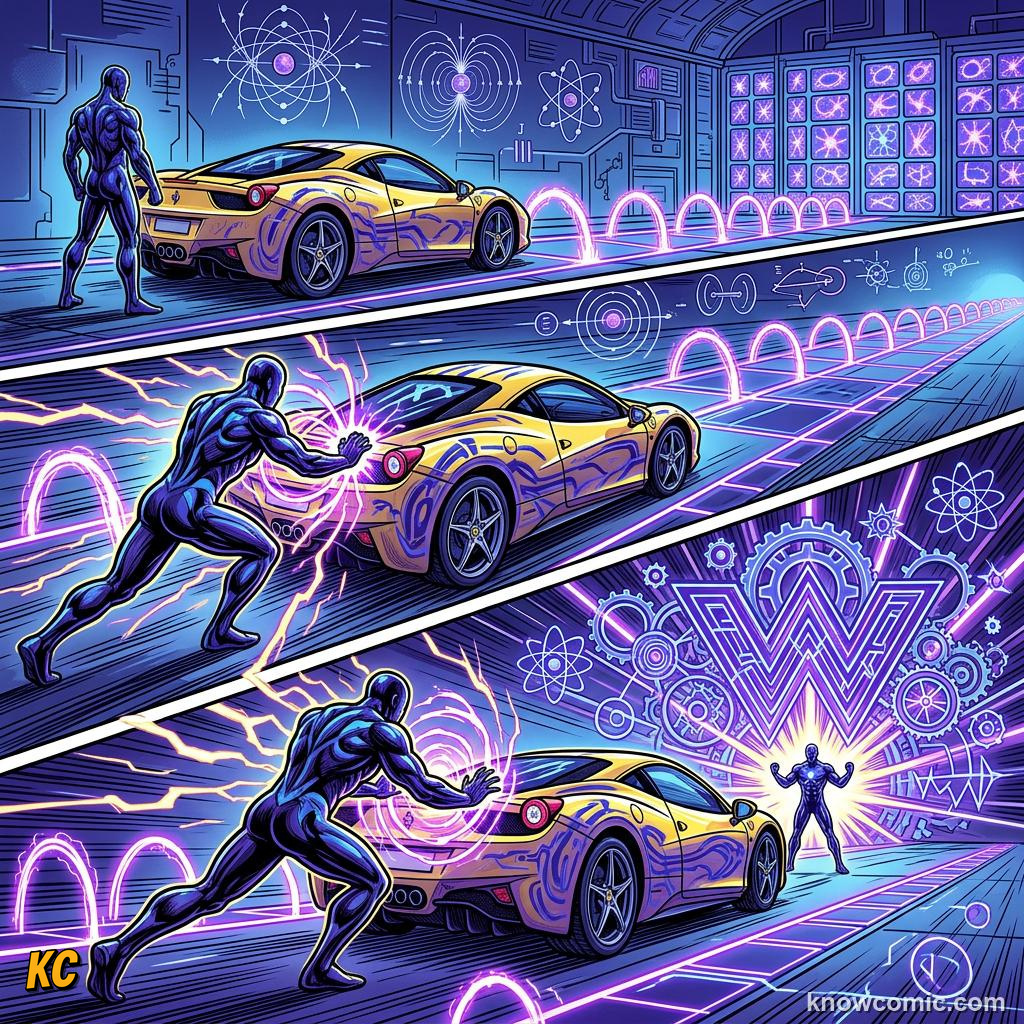
Comic panel about work-energy theorem: Work Changes Speed, Positive Work, educational kids illustration
🚀 Force points with the motion
📈 Kinetic energy increases
⚡ Object speeds up
NEGATIVE WORK
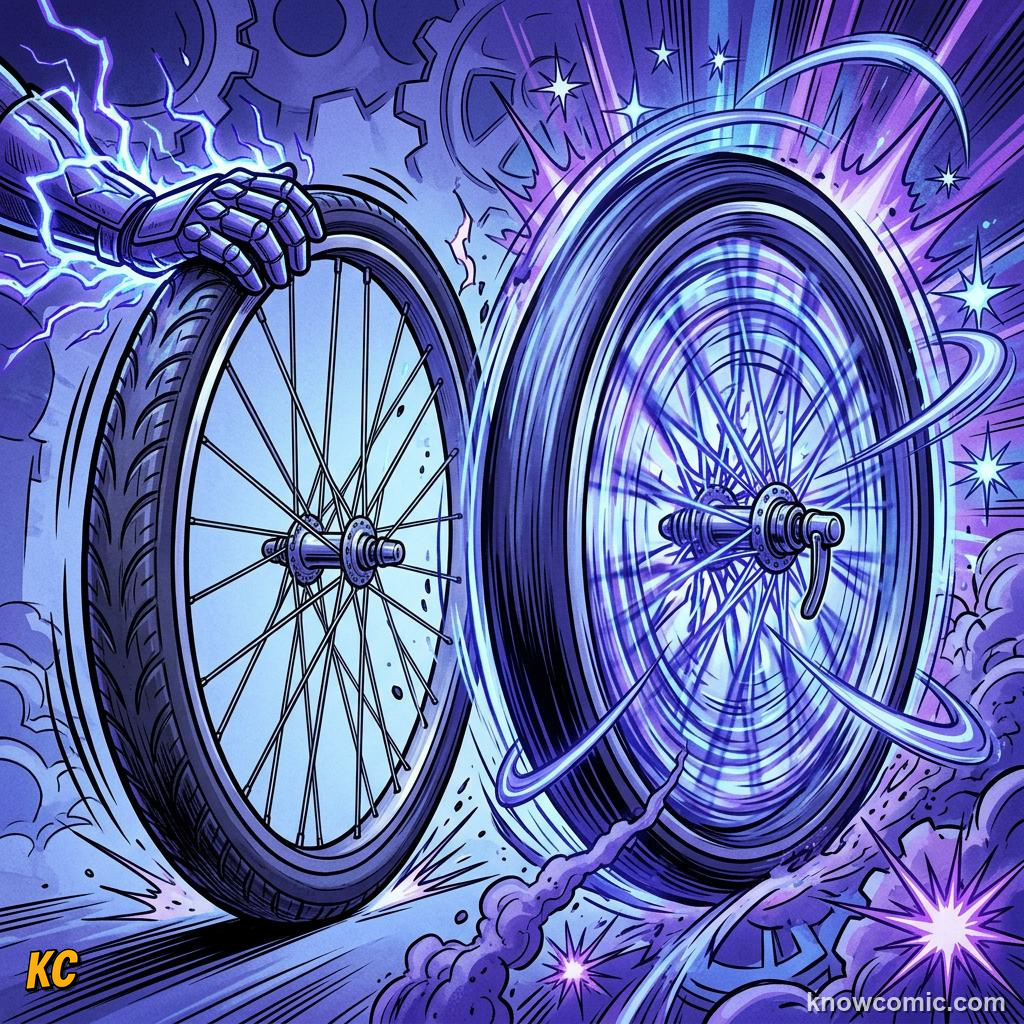
Comic panel about work-energy theorem: Negative Work, educational kids illustration
🛑 Force opposes the motion
📉 Kinetic energy decreases
🐢 Object slows down
PAGE 2 OF 5, FORCE TIMES DISTANCE
DEFINING WORK
Comic panel about work-energy theorem: Defining Work, educational kids illustration
W = F d ALONG THE PATH
When a constant force points in the same direction as the displacement, work is simply force times distance: W = F d. If the force is at an angle, only the component along the motion counts, so W = F d cos θ. Hold a heavy backpack still and you feel tired, but physics work is zero because the displacement is zero. Push a crate across a floor and work is done because both force and displacement are present. The SI unit of work is the joule (J). One joule equals one newton of force acting through one meter of displacement, so 1 J = 1 N·m.
📐 JOULE
Work and energy share the joule. 1 J = 1 N·m = 1 kg·m²/s². Kinetic energy is also measured in joules.
FORCE!
FORCE
Comic panel about work-energy theorem: W = F D Along The Path, Force, educational kids illustration
💪 Push or pull measured in newtons
➡️ Direction matters for work
🧲 Only the along-path part counts
DISPLACEMENT
Comic panel about work-energy theorem: Displacement, educational kids illustration
📏 How far the object moves
🚫 No motion means no work
📍 Path length in the force direction
UNIT
Comic panel about work-energy theorem: Unit, educational kids illustration
⚡ Work in joules (J)
🔢 1 J = 1 N·m
📒 Same unit as kinetic energy
PAGE 3 OF 5, KINETIC ENERGY
KE FORMULA
Comic panel about work-energy theorem: Ke Formula, educational kids illustration
🏃 KE = ½ m v²
📦 More mass means more KE
💨 Speed matters even more (v²)
ΔKE
Comic panel about work-energy theorem: Δke, educational kids illustration
📊 ΔKE = KEf − KEi
⬆️ Final faster: ΔKE positive
⬇️ Final slower: ΔKE negative
ENERGY OF MOTION
Comic panel about work-energy theorem: Energy Of Motion, educational kids illustration
KE = ½ m v²
Kinetic energy is the energy an object has because it is moving. For an object of mass m and speed v, KE = ½ m v². Double the speed and kinetic energy becomes four times as large, because speed is squared. That is why a car crash at higher speed is so much more destructive: the energy that must be removed is much greater. The work-energy theorem says the net work done on the object equals KEf − KEi. If you know the forces and the distance, you can predict the speed change without tracking acceleration step by step.
⚡ DID YOU KNOW?
Doubling speed multiplies kinetic energy by four. Work must supply (or remove) that full energy change.
SPEED!
PAGE 4 OF 5, NET WORK BOOKKEEPING
ALL FORCES COUNT
Comic panel about work-energy theorem: Ke = ½ M V², All Forces Count, educational kids illustration
NET WORK, NOT ONE FORCE
The theorem uses net work: the total work from every force acting on the object. Push a crate while friction opposes you, and your push does positive work while friction does negative work. The net work is the sum, and that sum equals ΔKE. If net work is zero, kinetic energy stays the same, even if individual forces are busy. A hockey puck sliding on nearly frictionless ice keeps almost constant speed because almost no net work is done. On a rough floor, friction does negative work and the puck slows. The ledger always balances: Wnet = ΔKE.
📒 LEDGER
Add work from every force. Positive and negative contributions cancel or reinforce. Only the net total equals the kinetic energy change.
NET!
PUSH
Comic panel about work-energy theorem: Net Work, Not One Force, Push, educational kids illustration
➡️ Applied force does positive work
📈 Tries to raise kinetic energy
💪 Larger F or d means more work
FRICTION
Comic panel about work-energy theorem: Friction, educational kids illustration
🛑 Friction opposes sliding
📉 Does negative work
🔥 Removes kinetic energy as heat
BALANCE
Comic panel about work-energy theorem: Balance, educational kids illustration
⚖️ Wnet = sum of all works
🎯 That sum equals ΔKE
📒 Bookkeeping never lies
PAGE 5 OF 5, THE BIG IDEA
THE FULL PICTURE
Comic panel about work-energy theorem: The Full Picture, educational kids illustration
FORCE, DISTANCE, ENERGY
The work-energy theorem is the direct link between the forces you apply and the kinetic energy an object gains or loses. Work needs both force and displacement. Kinetic energy is ½ m v², measured in joules, the same unit as work. Net work equals ΔKE, so speeding up means positive net work and slowing down means negative net work. Once you treat motion as energy bookkeeping, problems about pushes, friction, and speed changes become a single clear rule: track the work, and you know how the energy of motion changes.
ΔKE!
EVERYDAY LINKS
Comic panel about work-energy theorem: Force, Distance, Energy, Everyday Links, educational kids illustration
🚲 Pedaling does work, bike gains KE
🛑 Brakes do negative work, car slows
⚾ Bat does work, ball flies faster
REMEMBER
⚡ KEY FACTS
Wnet = ΔKE. Work needs force and displacement (W = F d along the path). Units are joules. KE = ½ m v². Positive net work speeds an object up; negative net work slows it down.
✅ Net work equals ΔKE
✅ Work and KE use joules
✅ Force alone is not enough
✅ Displacement must happen
🧠 QUIZ TIME!
WORK-ENERGY THEOREM · 5 QUESTIONS
QUESTION 01
What does the work-energy theorem state?
QUESTION 02
When a constant force points along the displacement, work is:
QUESTION 03
What is the SI unit of work and kinetic energy?
QUESTION 04
Kinetic energy of a moving object is given by:
QUESTION 05
If net work on an object is negative, what happens to its kinetic energy?
0/5
LOADING...
← TOPIC 41 📋 ALL TOPICS TOPIC 43 →