⚙️
✈️
⚛️ KNOW SECONDARY · AGES 12–18

PHYSICS

⚛️ From Newton's Apple to Quantum Weirdness!

📖 350 Topics 🆓 FREE + PRO ⏱️ 5 min per comic 🧠 Quiz included
WORK
Energy transferred by a force
⏱️
TIME
How long the transfer takes
💡
POWER
P = W / t in watts
🚂
ENGINES
Horsepower rates machines
✈️
TODAY
Jets deliver huge power fast
💡 POWER: THE RATE OF WORK
TOPIC 43 · PHYSICS · WATTS · SPEED · HORSEPOWER
PAGE 1 OF 5, HOW FAST YOU WORK
RATE MATTERS
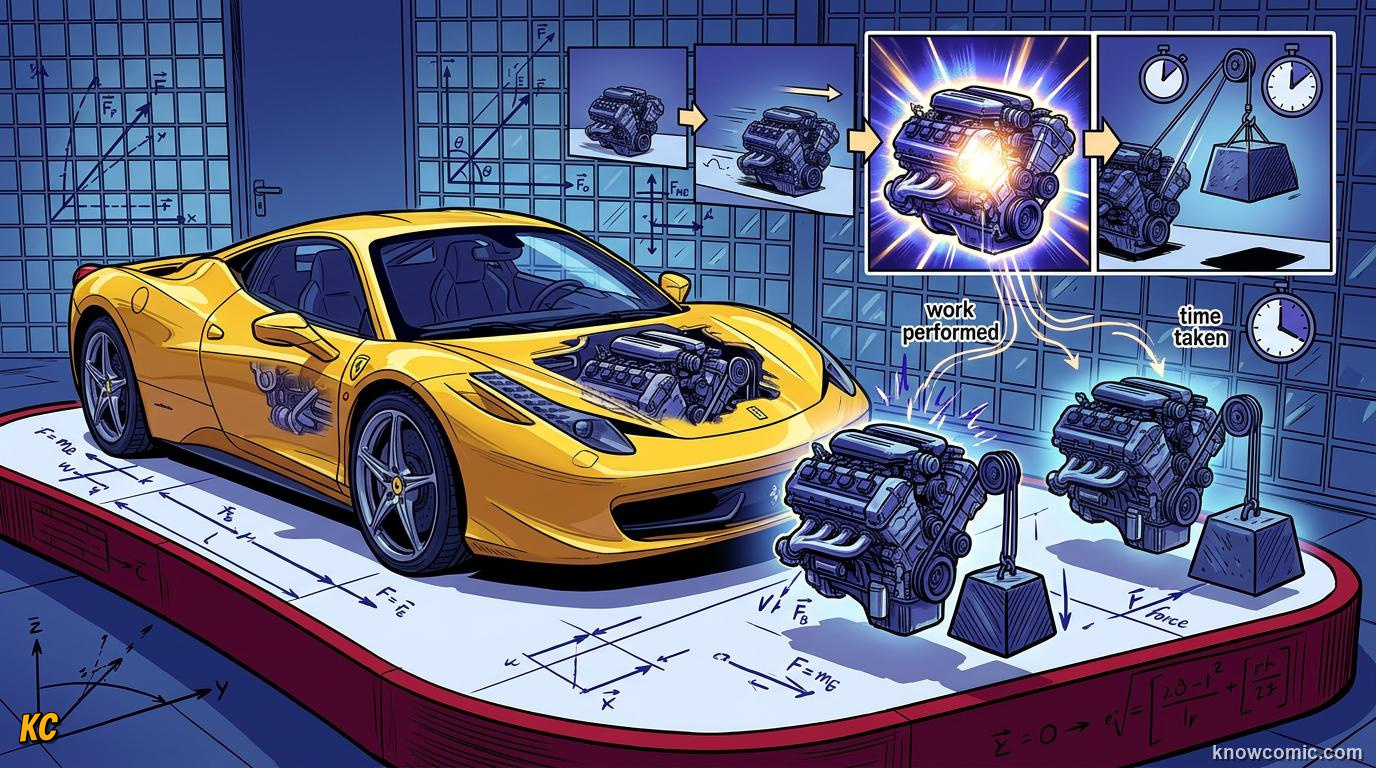
Comic panel about power: the rate of work: Rate Matters, educational kids illustration
NOT JUST WORK, HOW FAST
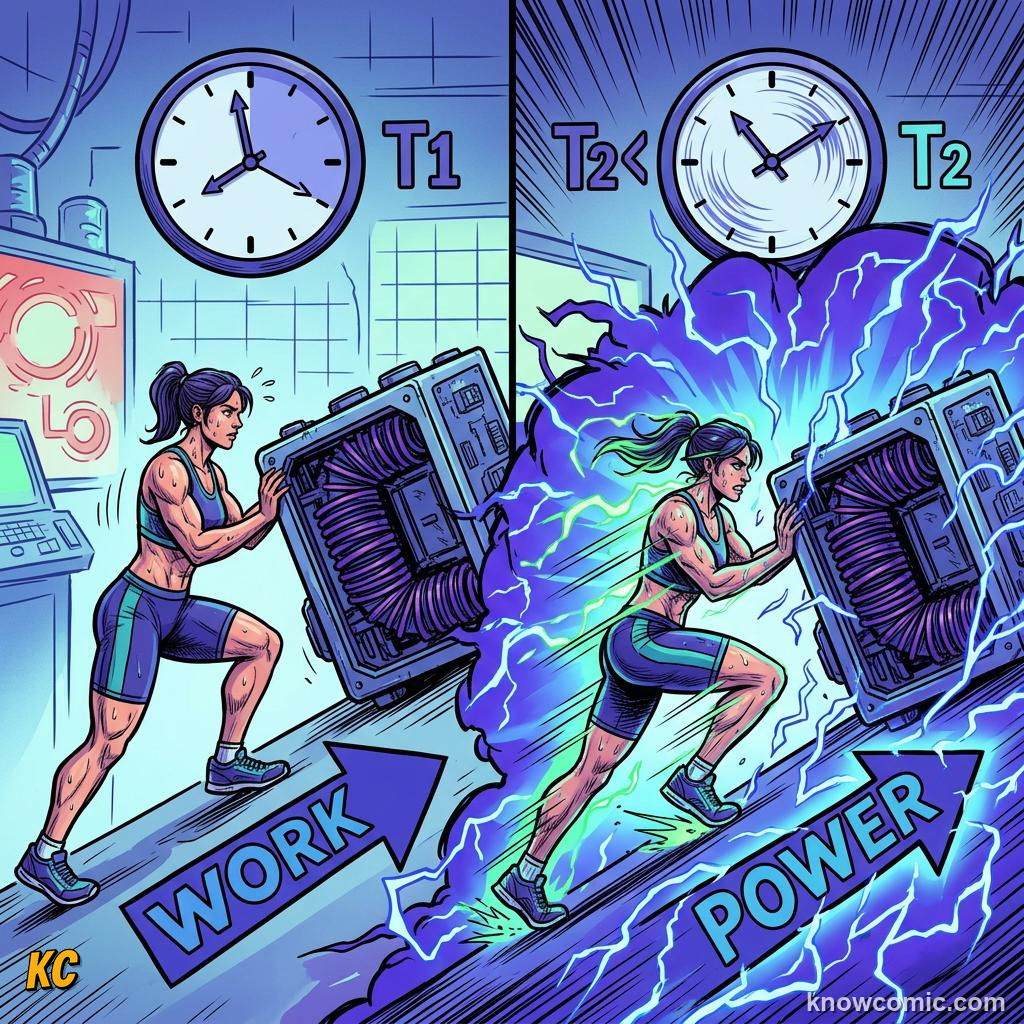
It is not just about doing the work. It is about how fast you do it. Two machines can transfer the same amount of energy, yet one finishes in seconds and the other takes minutes. Power is the rate of doing work, or the rate of transferring energy. Climb a flight of stairs slowly and you do the same gravitational work as sprinting up, but your power output is lower because the time is longer. Engines, motors, and athletes are rated by power because intensity, not only total energy, decides what technology can achieve.
💡 P = W / t
Power equals work divided by time. Same work in less time means higher power. Units: watts (W), where 1 W = 1 J/s.
POWER!
SAME WORK
Comic panel about power: the rate of work: Not Just Work, How Fast, Same Work, educational kids illustration
🪜 Same stairs, same energy change
🐢 Slow climb: low power
🏃 Fast climb: high power
INTENSITY
Comic panel about power: the rate of work: Intensity, educational kids illustration
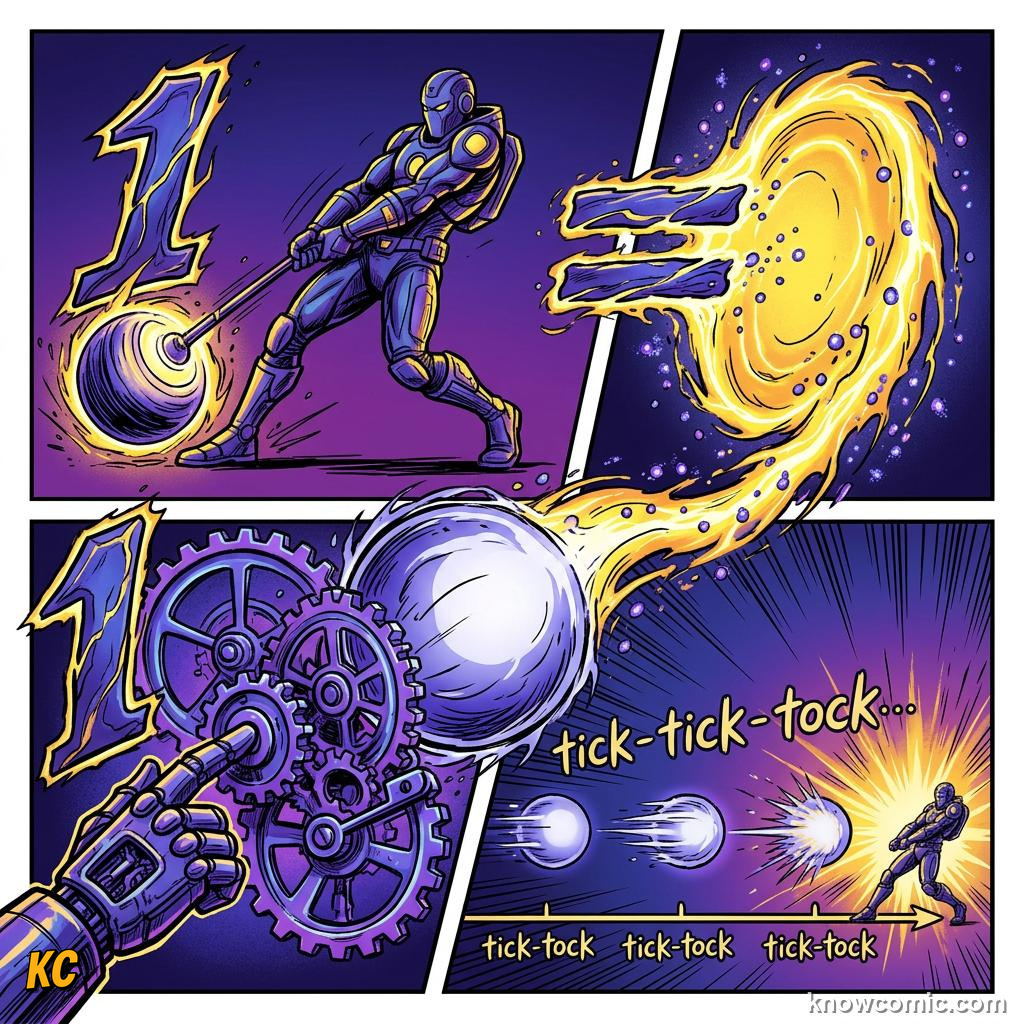
⚡ Power measures intensity
⏱️ Time is in the denominator
🚀 Faster delivery, bigger P
PAGE 2 OF 5, WATTS AND JOULES PER SECOND
THE WATT
Comic panel about power: the rate of work: The Watt, educational kids illustration
1 WATT = 1 JOULE PER SECOND
Average power is P = W / t, work divided by the time interval. Instantaneous power can also be written as P = F v when force and velocity point the same way, because work per time becomes force times speed. The SI unit of power is the watt (W), named after James Watt. One watt means one joule of energy transferred every second: 1 W = 1 J/s. A 60 W light bulb uses 60 joules of electrical energy each second. Kilowatts (kW) and megawatts (MW) scale the same idea for homes, factories, and power plants.
💡 WATT
1 W = 1 J/s. A kilowatt is 1000 W. Power is not energy; it is how quickly energy is used or delivered.
WATT!
FORMULA
Comic panel about power: the rate of work: 1 Watt = 1 Joule Per Second, Formula, educational kids illustration
📐 P = W / t
➡️ Also P = F v (aligned)
⏱️ Shorter t raises power
UNITS
Comic panel about power: the rate of work: Units, educational kids illustration
💡 Watt (W) = J/s
🏠 Kilowatt = 1000 W
🏭 Megawatt = 1,000,000 W
NOT ENERGY
Comic panel about power: the rate of work: Not Energy, educational kids illustration
⚡ Energy is joules (total)
💨 Power is joules per second
🎯 Rate, not the pile of energy
PAGE 3 OF 5, HORSEPOWER
OLD UNIT
Comic panel about power: the rate of work: Old Unit, educational kids illustration
🐴 James Watt compared engines to horses
📜 Horsepower still labels cars and motors
🔢 Mechanical hp is about 746 W
CONVERT
Comic panel about power: the rate of work: Convert, educational kids illustration
🔁 1 hp ≈ 746 W
🚗 100 hp ≈ 74,600 W
📐 Watts are the SI standard
FROM HORSES TO ENGINES
Comic panel about power: the rate of work: From Horses To Engines, educational kids illustration
1 HORSEPOWER ≈ 746 WATTS
Horsepower is an older unit of power that James Watt popularized when selling steam engines. He needed a number customers could picture, so he compared engine output to the work rate of horses. Mechanical horsepower is defined so that 1 hp is about 746 watts (exactly 745.7 W, usually rounded to 746 W). Car ads still quote horsepower, but physicists prefer watts because they connect cleanly to joules and seconds. Either way, horsepower and watts measure the same idea: how quickly work is done.
⚡ DID YOU KNOW?
One mechanical horsepower is about 746 W. A 200 hp engine delivers roughly 149,000 joules of work every second at that rating.
HP!
PAGE 4 OF 5, STEAM VS JET
INTENSITY OF TECHNOLOGY
Comic panel about power: the rate of work: 1 Horsepower ≈ 746 Watts, Intensity Of Technology, educational kids illustration
STEAM ENGINE TO JET ENGINE
Early steam engines transformed industry by delivering continuous mechanical power, often tens to a few hundred horsepower for locomotives and factories. A modern jet engine is in another league: a single large turbofan can produce tens of thousands of horsepower worth of thrust power in flight, delivering energy at a far higher rate. Both machines do work by pushing and moving mass, but the jet packs that work into a much shorter time and a much higher power output. Intensity defines modern technology. Faster energy delivery means faster travel, heavier loads, and machines that would have seemed impossible in the age of steam alone.
✈️ POWER GAP
Steam locomotives often ran on the order of hundreds of horsepower. Large jet engines deliver power equivalent to many thousands of horsepower, a huge jump in rate of work.
JET!
STEAM
Comic panel about power: the rate of work: Steam Engine To Jet Engine, educational kids illustration
🚂 Steady mechanical power
🏭 Drove factories and trains
📊 Often hundreds of hp class
JET
Comic panel about power: the rate of work: Jet, educational kids illustration
✈️ Huge thrust, high speed
🔥 Energy delivered very fast
🚀 Power in the many-thousands hp range
LESSON
Comic panel about power: the rate of work: Lesson, educational kids illustration
📈 Higher P means faster work
🌍 Technology races on power
💡 Intensity shapes what is possible
PAGE 5 OF 5, THE BIG IDEA
THE FULL PICTURE
Comic panel about power: the rate of work: The Full Picture, educational kids illustration
POWER IS WORK PER TIME
Power answers a simple question: how fast is work being done? Use P = W / t, measure it in watts, and remember that 1 W = 1 J/s. Horsepower is the same idea in an older unit, with 1 hp about 746 W. From climbing stairs to rating engines, power separates slow energy delivery from intense energy delivery. That is why a jet outruns a steam locomotive in capability: not only energy, but the rate of work. Master power, and you understand why modern machines feel so forceful.
RATE!
EVERYDAY LINKS
Comic panel about power: the rate of work: Power Is Work Per Time, Everyday Links, educational kids illustration
💡 Bulb watts rate energy use
🚗 Car hp rates engine output
🏋️ Lifting fast needs more power
REMEMBER
💡 KEY FACTS
Power is the rate of work: P = W / t. One watt equals one joule per second. Mechanical horsepower is about 746 W. Higher power means the same work is done in less time. Jets deliver far higher power than early steam engines.
✅ P = W / t
✅ 1 W = 1 J/s
✅ 1 hp ≈ 746 W
✅ Intensity defines technology
🧠 QUIZ TIME!
POWER: THE RATE OF WORK · 5 QUESTIONS
QUESTION 01
Power is defined as:
QUESTION 02
What is the SI unit of power?
QUESTION 03
One watt equals:
QUESTION 04
About how many watts equal one mechanical horsepower?
QUESTION 05
Two machines do the same work. Machine A finishes in half the time of Machine B. Machine A has:
0/5
LOADING...
← TOPIC 42 📋 ALL TOPICS TOPIC 44 →