📖 350 Topics🆓 FREE + PRO⏱️ 5 min per comic🧠 Quiz included
🏹
ANCIENT
Archers aim by instinct
→
🔭
1600s
Galileo studies falling motion
→
📐
1687
Newton unifies motion & gravity
→
⚽
1900s
Sports use ballistics math
→
🎯
TODAY
GPS tracks every kick & shot
🎯 PROJECTILE TRAJECTORIES
TOPIC 08 · PHYSICS · GRAVITY · PARABOLAS · FLIGHT
PAGE 1 OF 5, TWO MOTIONS AT ONCE
THE BIG IDEA
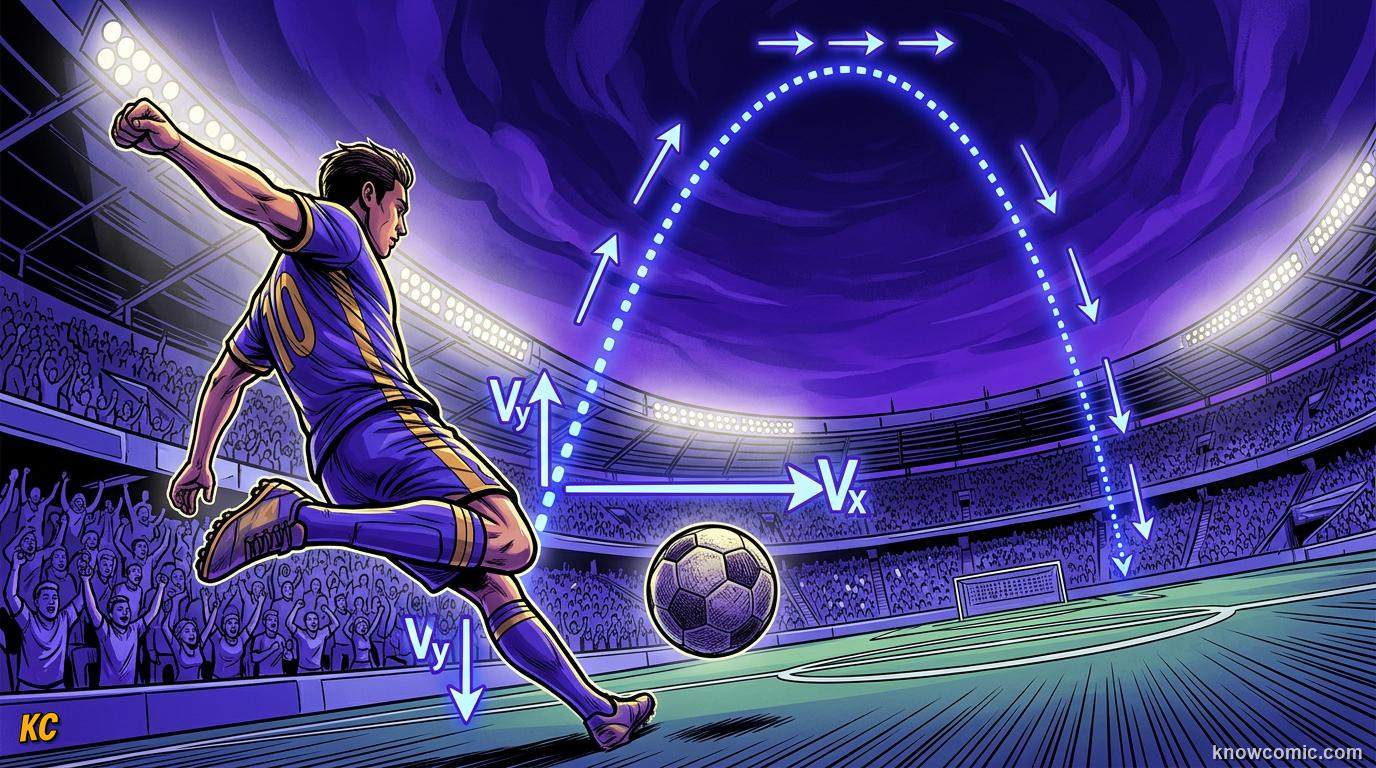
HORIZONTAL AND VERTICAL MOTION ARE INDEPENDENT
Throw a ball, kick a football, or shoot a basketball and you launch a projectile. The moment it leaves your hand or foot, two separate stories begin. Horizontally, the object keeps the speed you gave it (ignoring air). Vertically, gravity pulls it down at 9.8 m/s², the same acceleration for every object on Earth. These two motions do not interfere with each other. That independence is the secret behind every parabolic arc you see in sport and nature.
⚡ DID YOU KNOW?
A bullet fired horizontally and a bullet dropped from the same height hit the ground at the same time (in a vacuum). Horizontal speed does not slow the fall!
SPLIT!
HORIZONTAL
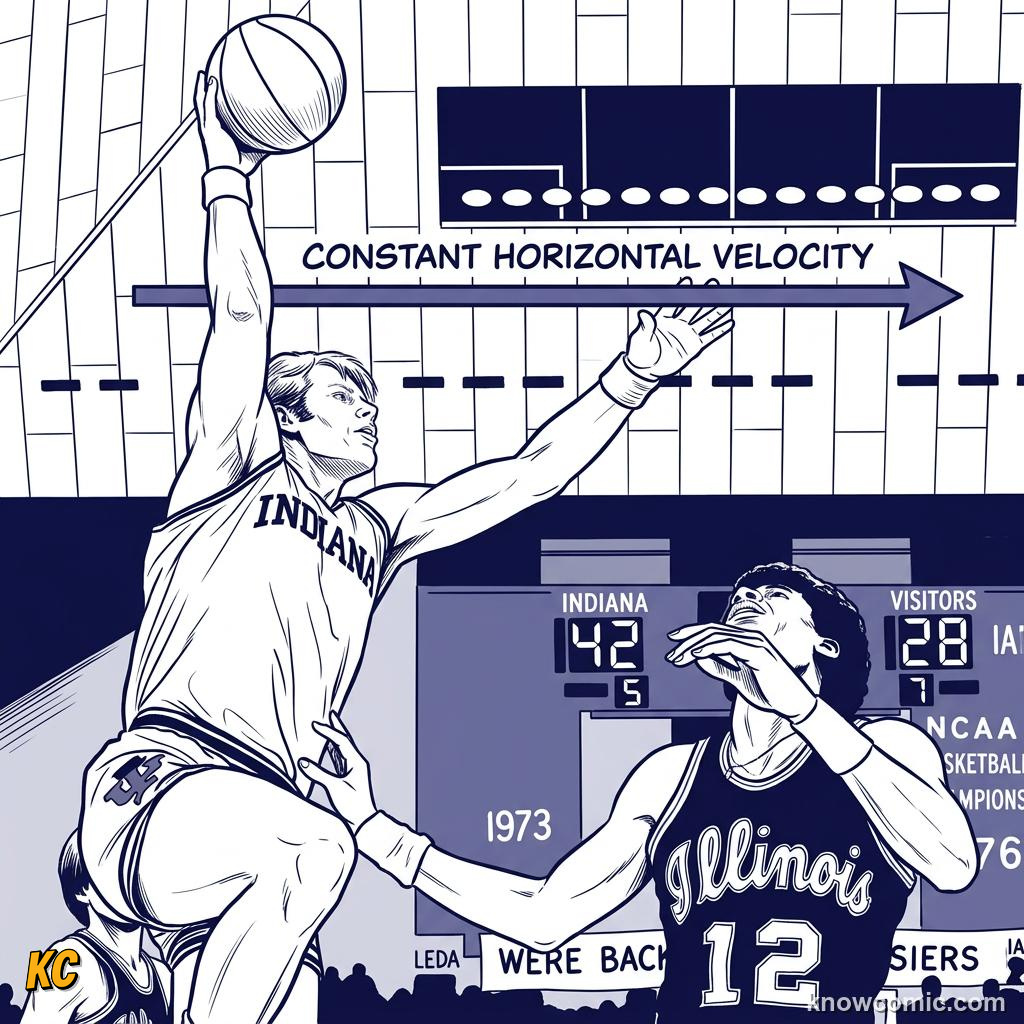
➡️ vx stays constant (no air)
→ Distance = speed × time
⚽ Kick harder = more horizontal speed
VERTICAL

⬇️ Gravity: g = 9.8 m/s² downward
⬆️ Upward speed slows, then reverses
🏀 Same g for every mass
PAGE 2 OF 5, THE PARABOLIC PATH
NATURE'S FAVOURITE CURVE
EVERY PROJECTILE TRACES A PARABOLA
Combine steady horizontal motion with constant downward acceleration and you get a parabola, a symmetric U-shaped curve. At the peak, vertical velocity is zero but horizontal velocity is unchanged. On the way down, vertical speed increases again while horizontal speed stays the same. Water from a fountain, a cricket ball in the air, and a long pass in football all follow this same mathematical shape. Galileo was among the first to recognise that projectile paths are parabolic when air resistance is small.
ARC!
📐 PEAK HEIGHT
⬆️ Higher launch angle = higher peak
→ Steeper shot climbs further
🏀 Depends on initial vertical speed
⏱️ TIME OF FLIGHT
⏱️ Upward & downward times match
→ Symmetric path (no air)
🎯 More vertical speed = longer air time
🌊 FOUNTAIN ARC
💧 Water streams = tiny projectiles
→ Each drop follows a parabola
🎆 Fireworks use the same physics
PAGE 3 OF 5, LAUNCH ANGLE & RANGE
45° ANGLE
📐 45° gives max range on flat ground
→ Equal horizontal & vertical parts
⚽ Ideal for long passes (no air drag)
STEEP vs FLAT
🎯 High angle = short range, high peak
➡️ Low angle = long skim, low peak
🏀 Shooters pick angle for the hoop
RANGE EQUATION
HOW FAR WILL IT FLY?
Range is how far a projectile travels horizontally before landing at the same height it started. On level ground with no air resistance, range depends on launch speed, launch angle, and gravity. Double the launch speed and the range quadruples. Launch at complementary angles (like 30° and 60°) from the same speed and you get the same range. Football free kicks, rugby conversions, and javelin throws all balance speed and angle to maximise distance or accuracy.
📐 RANGE (LEVEL GROUND, NO AIR)
R = v² sin(2θ) / g, where v is launch speed, θ is launch angle, and g = 9.8 m/s²
RANGE!
PAGE 4 OF 5, GRAVITY & REAL-WORLD FLIGHT
g = 9.8 m/s²
GRAVITY PULLS EVERY PROJECTILE DOWNWARD
Every second an object is in the air, gravity increases its downward speed by 9.8 metres per second. After one second of free fall, vertical speed is 9.8 m/s downward. After two seconds, 19.6 m/s, and so on. This constant acceleration is why projectiles curve so predictably. On the Moon, where g is about 1.6 m/s², a golf ball would fly six times farther for the same kick. On Jupiter's surface, g is roughly 24.8 m/s², so throws would fall much faster and land much closer.
GRAVITY!
⚽ FOOTBALL
⚽ Curved free kicks use spin + air
→ Magnus effect bends the path
🥅 Goalkeepers read the parabola
🏀 BASKETBALL
🏀 Arc shot = higher entry angle
→ Softer bounce off the rim
📐 Coaches teach optimal launch angle
💨 AIR RESISTANCE
💨 Drag slows horizontal motion
→ Real paths are not perfect parabolas
🪶 Feather vs ball: air matters hugely
PAGE 5 OF 5, MASTER THE TRAJECTORY
PREDICT THE PATH
PHYSICS BEHIND EVERY THROW
Once you understand projectile motion, the flight of any ball becomes readable. Split the motion into horizontal and vertical parts, apply g = 9.8 m/s² to the vertical side, and the full path appears. Engineers use these same equations for artillery, rocket stages, and satellite launches. Athletes use them instinctively when they adjust power and angle. The parabola is not just a maths shape. It is the signature of gravity acting on anything that flies through the air.
🎯 KEY EQUATIONS
x = vx × t, y = vyt − ½gt², g = 9.8 m/s² on Earth
FLIGHT!
🎯 SPORTS SCIENCE
📊 TrackMan & Hawk-Eye map trajectories
→ Data guides training & tactics
⚽ Optimal angles vary with air & spin
REMEMBER
🎯 KEY FACTS
Horizontal and vertical motion are independent. Combined path is a parabola. g = 9.8 m/s² on Earth. 45° gives maximum range on flat ground (no air). Range grows with the square of launch speed.
✅ Split motion into x and y
✅ Gravity only affects vertical
✅ Parabola = constant g + steady vx
✅ Air drag changes real-world paths
🧠 QUIZ TIME!
PROJECTILE TRAJECTORIES · 5 QUESTIONS
QUESTION 01
In projectile motion (ignoring air resistance), what happens to horizontal velocity after launch?
QUESTION 02
What shape does the path of a projectile follow (with no air resistance)?
QUESTION 03
What is the value of gravitational acceleration g on Earth's surface (approximately)?
QUESTION 04
On level ground with no air resistance, which launch angle gives the maximum range for a fixed speed?
QUESTION 05
At the highest point of a projectile's path, what is true about its velocity?