🎢
🌍
🔄
⚛️ KNOW SECONDARY · AGES 12–18

PHYSICS

⚛️ From Newton's Apple to Quantum Weirdness!

📖 350 Topics 🆓 FREE + PRO ⏱️ 5 min per comic 🧠 Quiz included
🪨
ANCIENT
Sling stones spin in circles
📐
1687
Newton describes circular motion
🎢
1900s
Loop-the-loop coasters built
🛰️
1957
Sputnik orbits Earth
🔄
TODAY
GPS satellites use orbital physics
🔄 CENTRIPETAL FORCE
TOPIC 09 · PHYSICS · CIRCULAR · ORBIT · ROTATION
PAGE 1 OF 5, WHAT IS CENTRIPETAL FORCE?
CENTER-SEEKING
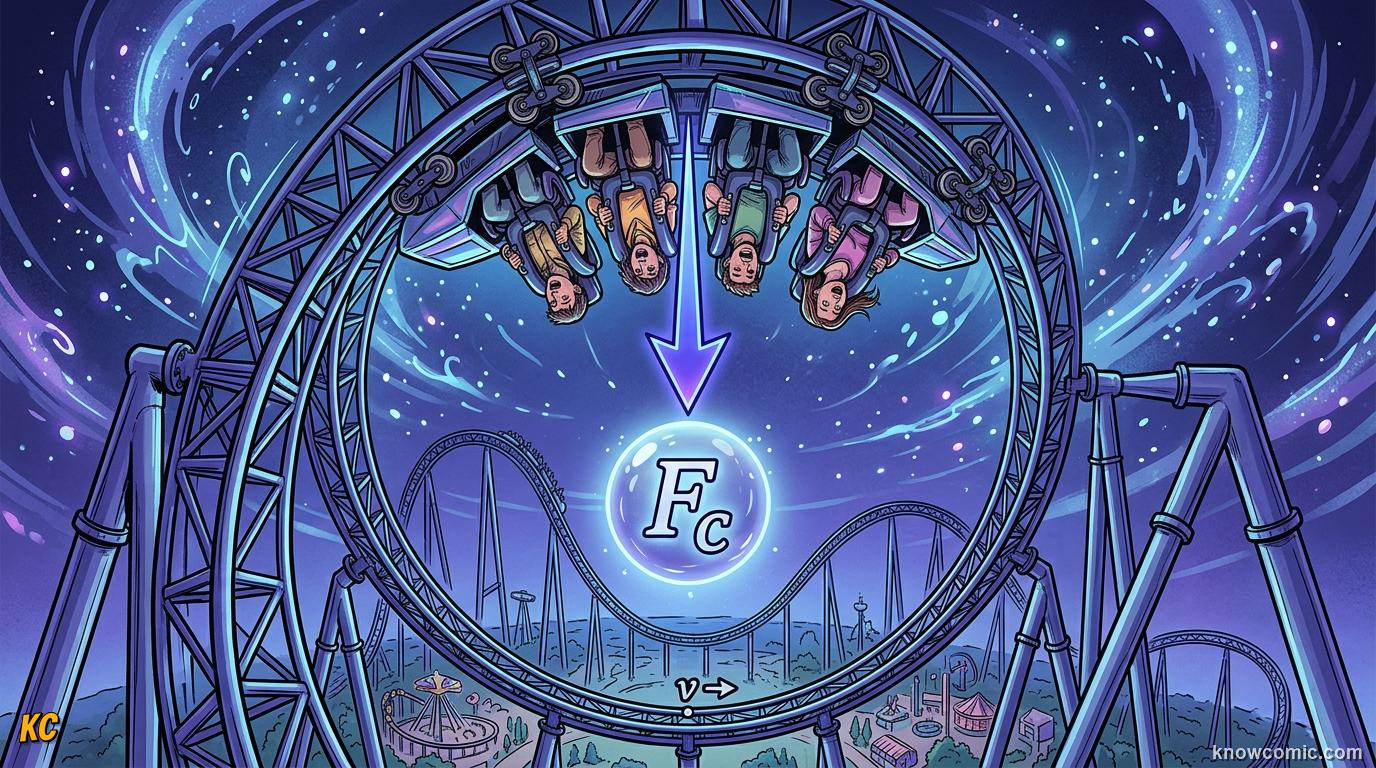
Comic illustration: CENTER-SEEKING, WHAT IS CENTRIPETAL FORCE
ANYTHING MOVING IN A CIRCLE NEEDS A CENTER-SEEKING FORCE
Imagine whirling a ball on a string. The ball wants to fly off in a straight line because of inertia, but the string pulls it inward toward your hand. That inward pull is centripetal force, from the Latin centrum (center) and petere (to seek). It is not a new kind of magic force. It is whatever real force (tension, friction, gravity) keeps an object turning instead of shooting off in a straight line. Without it, circular motion is impossible.
⚡ DID YOU KNOW?
Centripetal force always points toward the center of the circle. It is the force that changes the direction of velocity, not the speed (for uniform circular motion).
INWARD!
INERTIA WANTS STRAIGHT
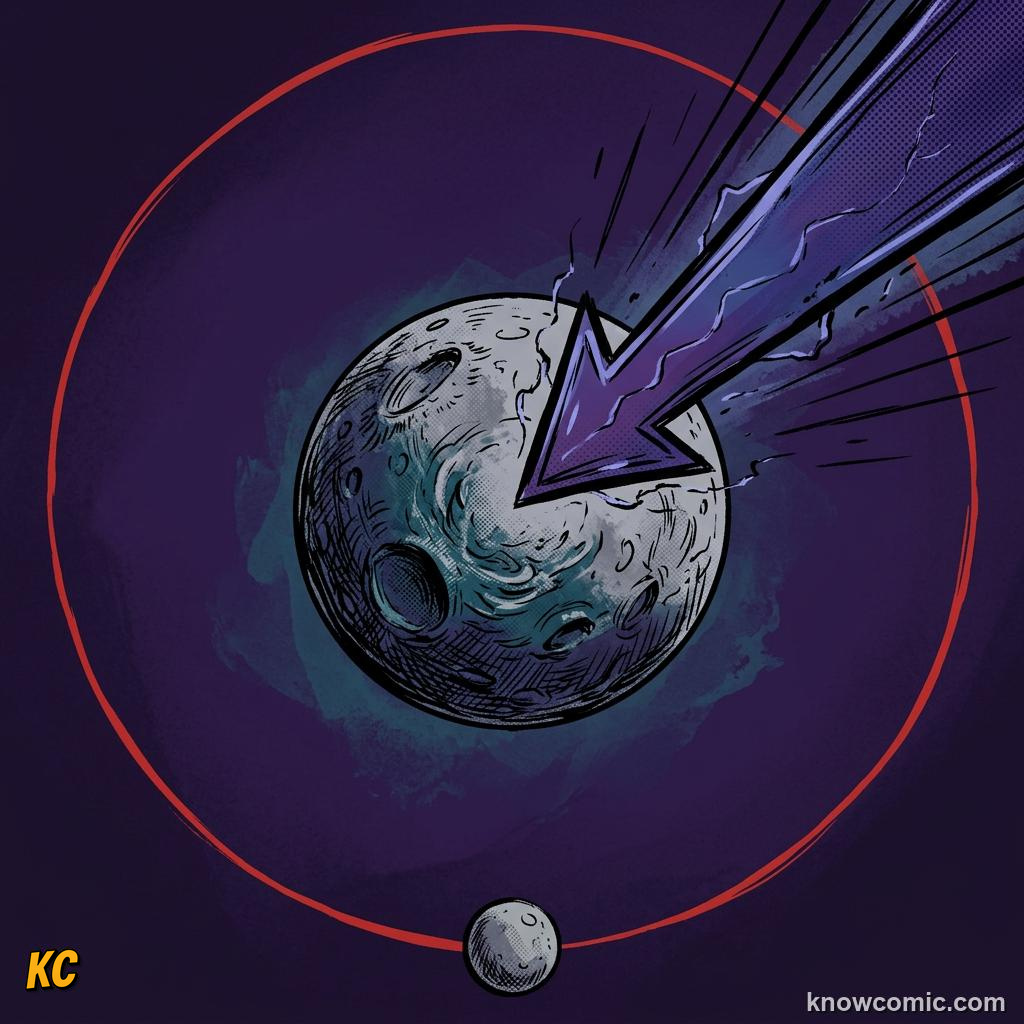
Comic illustration: ANYTHING MOVING IN A CIRCLE NEEDS A CENTER-SEEKING FORCE, INERTIA WANTS STRAIGHT
➡️ Objects resist direction changes
→ Tangent line = where it wants to go
🔄 Force bends the path into a curve
NOT CENTRIFUGAL
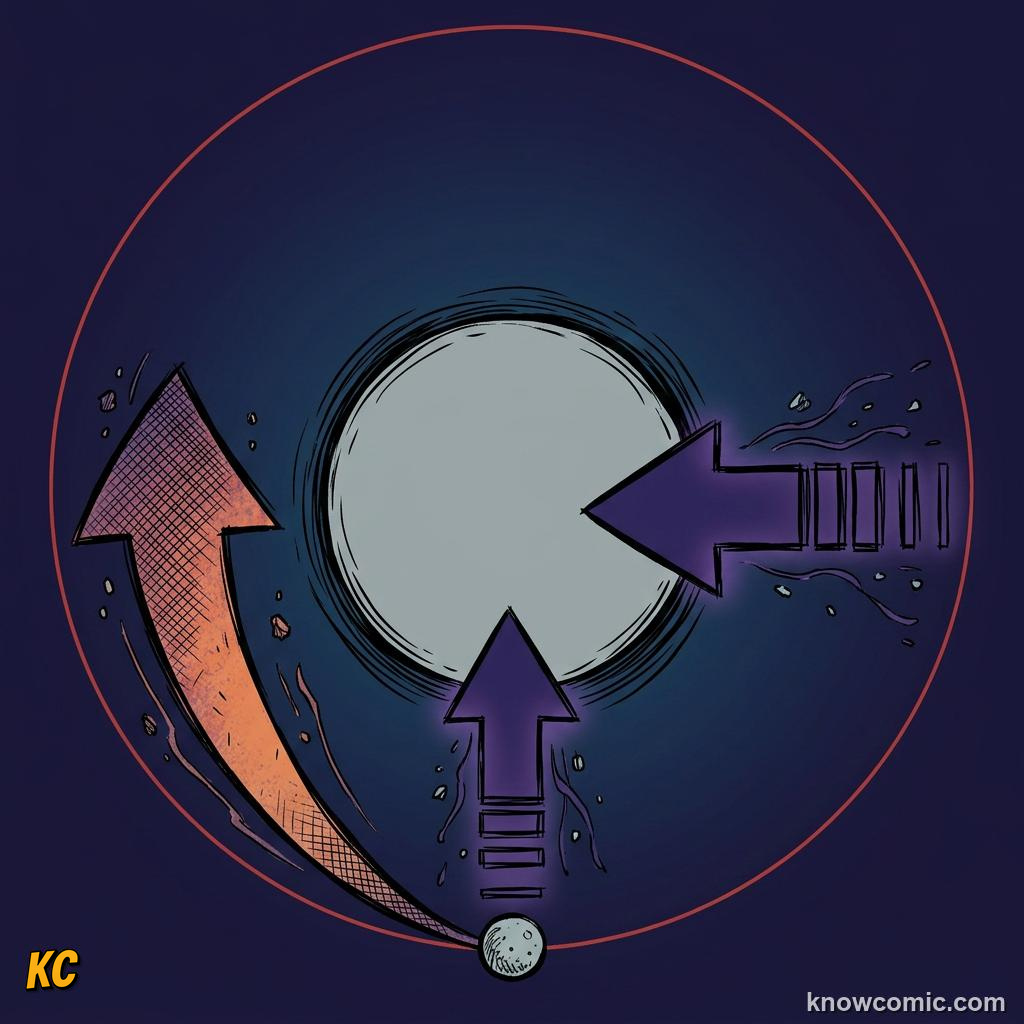
Comic illustration: ANYTHING MOVING IN A CIRCLE NEEDS A CENTER-SEEKING FORCE, NOT CENTRIFUGAL
❌ "Centrifugal" is not a real force
→ You feel pushed outward in a spin
✅ Physics: inward centripetal pulls you
PAGE 2 OF 5, THE FORMULA F = mv²/r
THE MATH OF TURNING
Comic illustration: THE FORMULA F equals mv squared over r, THE MATH OF TURNING
Fc = mv² / r
Centripetal force equals mass times speed squared, divided by the radius of the circle. Double the speed and the required force quadruples. Double the radius at the same speed and the force halves. A heavier object needs more centripetal force to turn at the same speed and radius. This formula explains why fast corners on a racetrack feel violent, why tight turns need stronger forces, and why satellites in low orbit must travel faster than those far away.
F=mv²/r!
⚡ SPEED MATTERS MOST
Comic illustration: F sub c equals mv squared over r, SPEED MATTERS MOST
🏎️ 2× speed = 4× centripetal force
→ Why speed limits exist on bends
⚠️ Too fast = lose grip & skid off
📏 RADIUS
Comic illustration: F sub c equals mv squared over r, RADIUS
🔄 Tighter circle (small r) = more force
→ Hairpin bend harder than wide curve
🎢 Loop top has smallest radius
⚖️ MASS
Comic illustration: F sub c equals mv squared over r, MASS
🚛 Heavy truck needs more force
→ Same turn, same speed as a car
🏋️ More mass = harder to redirect
PAGE 3 OF 5, ROLLER COASTER LOOP-THE-LOOP
TOP OF THE LOOP
Comic illustration: ROLLER COASTER LOOP-THE-LOOP, TOP OF THE LOOP
🎢 At top: gravity + track push down
→ Normal force adds to centripetal
😮 Riders feel lighter but stay in seat
MINIMUM SPEED
Comic illustration: ROLLER COASTER LOOP-THE-LOOP, MINIMUM SPEED
⚡ Too slow at top = lose contact
→ v must satisfy mv²/r ≥ mg at top
🔧 Engineers design safe loop radius
WHY YOU DON'T FALL OUT
Comic illustration: WHY YOU DON'T FALL OUT, ROLLER COASTER LOOP-THE-LOOP
THE TRACK PUSHES YOU INTO THE LOOP
At the top of a loop-the-loop, you are upside down, yet you stay in your seat. Your inertia wants to fly off in a straight line, but the track pushes down on the car (and on you). That normal force from the track, combined with gravity, provides the centripetal force needed to keep the car moving in a circle. As long as the coaster is fast enough, the track always pushes hard enough to keep you on the rails. You are not held in by a mysterious outward force. You are pulled and pushed inward.
🎢 LOOP PHYSICS
At the top: Fc = mg + Fnormal. The track must supply enough inward force to keep the car on its circular path.
LOOP!
PAGE 4 OF 5, ORBITS & THE MOON
GRAVITY AS CENTRIPETAL FORCE
Comic illustration: ORBITS AND THE MOON, GRAVITY AS CENTRIPETAL FORCE
THE MOON ORBITS BECAUSE EARTH PULLS IT INWARD
The Moon travels at about 1 km/s sideways around Earth. Earth's gravity constantly pulls the Moon toward our planet, bending its path into an orbit. In this case, gravity is the centripetal force. The same pattern repeats everywhere: Earth orbits the Sun because the Sun's gravity pulls inward, the ISS orbits Earth, and stars orbit the centres of galaxies. Orbits are not objects being "flung outward." They are objects falling toward a centre while moving fast enough to keep missing it.
ORBIT!
🌍 EARTH & MOON
Comic illustration: THE MOON ORBITS BECAUSE EARTH PULLS IT INWARD, EARTH AND MOON
🌕 Moon: ~384,400 km from Earth
→ Orbital period ≈ 27.3 days
🌍 Gravity provides Fc = mv²/r
🛰️ SATELLITES
Comic illustration: THE MOON ORBITS BECAUSE EARTH PULLS IT INWARD, SATELLITES
🛰️ Low orbit = faster speed needed
→ GPS satellites ~20,200 km up
📡 Orbital speed set by Fc = gravity
☀️ SOLAR SYSTEM
Comic illustration: THE MOON ORBITS BECAUSE EARTH PULLS IT INWARD, SOLAR SYSTEM
☀️ Planets orbit the Sun for same reason
→ Sun's gravity = centripetal force
🌌 Scale changes, physics stays the same
PAGE 5 OF 5, FRICTION ON FLAT TURNS
EVERYDAY CENTRIPETAL
Comic illustration: FRICTION ON FLAT TURNS, EVERYDAY CENTRIPETAL
FRICTION TURNS YOUR CAR ON A FLAT ROAD
When you steer around a flat corner, the road does not tilt inward. Instead, static friction between your tyres and the road provides the centripetal force that turns the car. Turn too fast for the available friction and the tyres skid outward (you lose the inward pull). Banked curves help because part of the normal force from the road already points inward. Cyclists lean into turns for the same reason: they angle the contact force so it has an inward component. Centripetal force is everywhere, from a spinning washing machine drum to a hammer throw at the Olympics.
🚗 FLAT TURN
Friction between tyres and road supplies Fc = mv²/r. Wet or icy roads reduce friction, so safe cornering speed drops.
TURN!
🏎️ RACING LINE
Comic illustration: FRICTION TURNS YOUR CAR ON A FLAT ROAD, RACING LINE
🏁 Wider arc = larger radius r
→ Less centripetal force needed
🎯 Drivers use physics to corner faster
REMEMBER
🔄 KEY FACTS
Centripetal force points toward the center. Fc = mv²/r. It is not a separate force type: tension, friction, gravity, or normal force can provide it. "Centrifugal" is a feeling, not a real outward force. Faster speed or tighter turns need more Fc.
✅ Always center-seeking, never outward
✅ Fc = mv²/r (speed squared!)
✅ Loops, orbits, corners: same idea
✅ Friction turns cars on flat roads
🧠 QUIZ TIME!
CENTRIPETAL FORCE · 5 QUESTIONS
QUESTION 01
What direction does centripetal force always point?
QUESTION 02
What is the formula for centripetal force?
QUESTION 03
Why don't you fall out of a roller coaster at the top of a loop-the-loop?
QUESTION 04
What provides the centripetal force that keeps the Moon in orbit around Earth?
QUESTION 05
On a flat (unbanked) road corner, what force provides the centripetal force to turn a car?
0/5
LOADING...
← TOPIC 08 📋 ALL TOPICS TOPIC 10 →