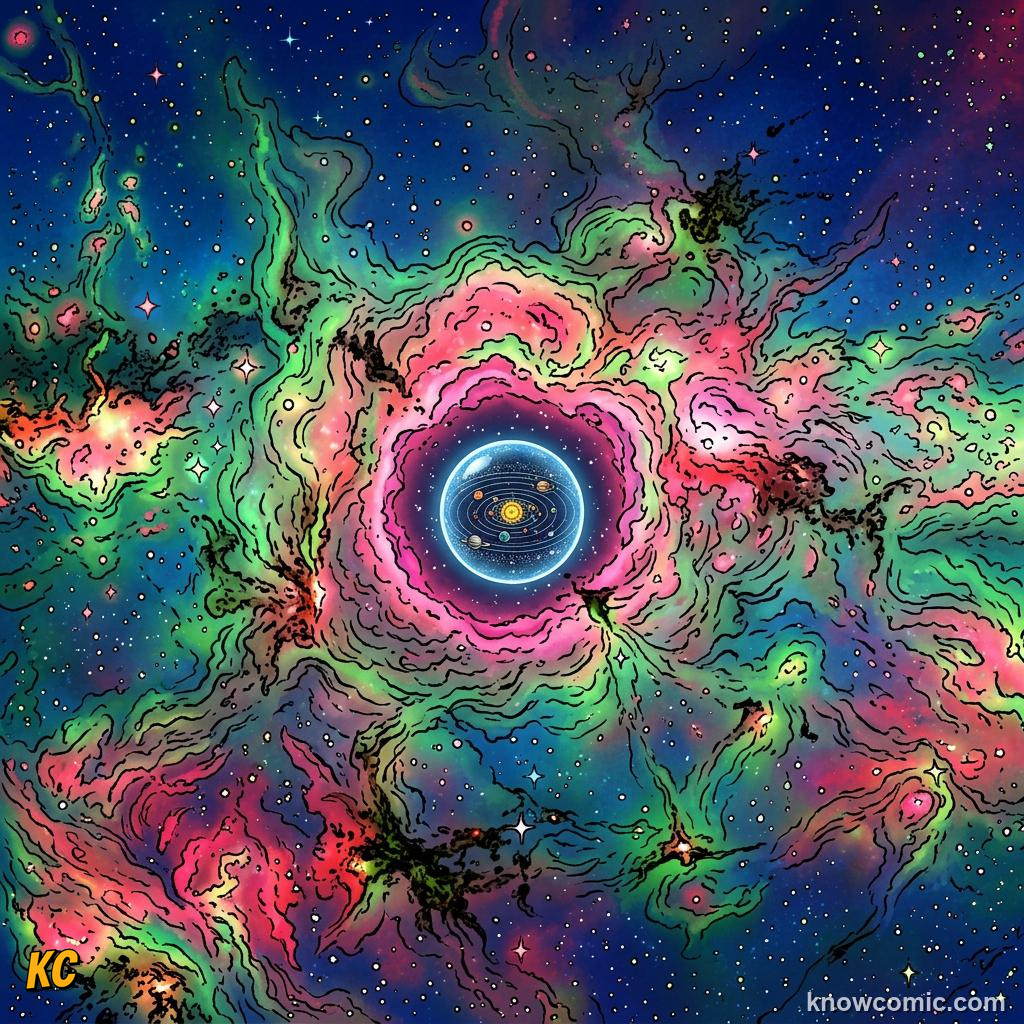
❄️ The Solar System's Freezer at the Edge of Space!
📖 200 Topics🆓 FREE + PRO⏱️ 5 min per comic🧠 Quiz included
🌐
SHELL
Spherical icy cloud
→
☀️
FAR OUT
Weak Sun gravity
→
☄️
COMETS
Long-period visitors
→
🔭
HALE-BOPP
Famous 1997 comet
→
✨
TODAY
Edge still uncertain
❄️ THE OORT CLOUD
TOPIC 10 · PLANETS & ASTRONOMY · THE SOLAR SYSTEM
PAGE 1 OF 5 — THE OUTER SHELL
FAR EDGE
A CLOUD WE CANNOT SEE
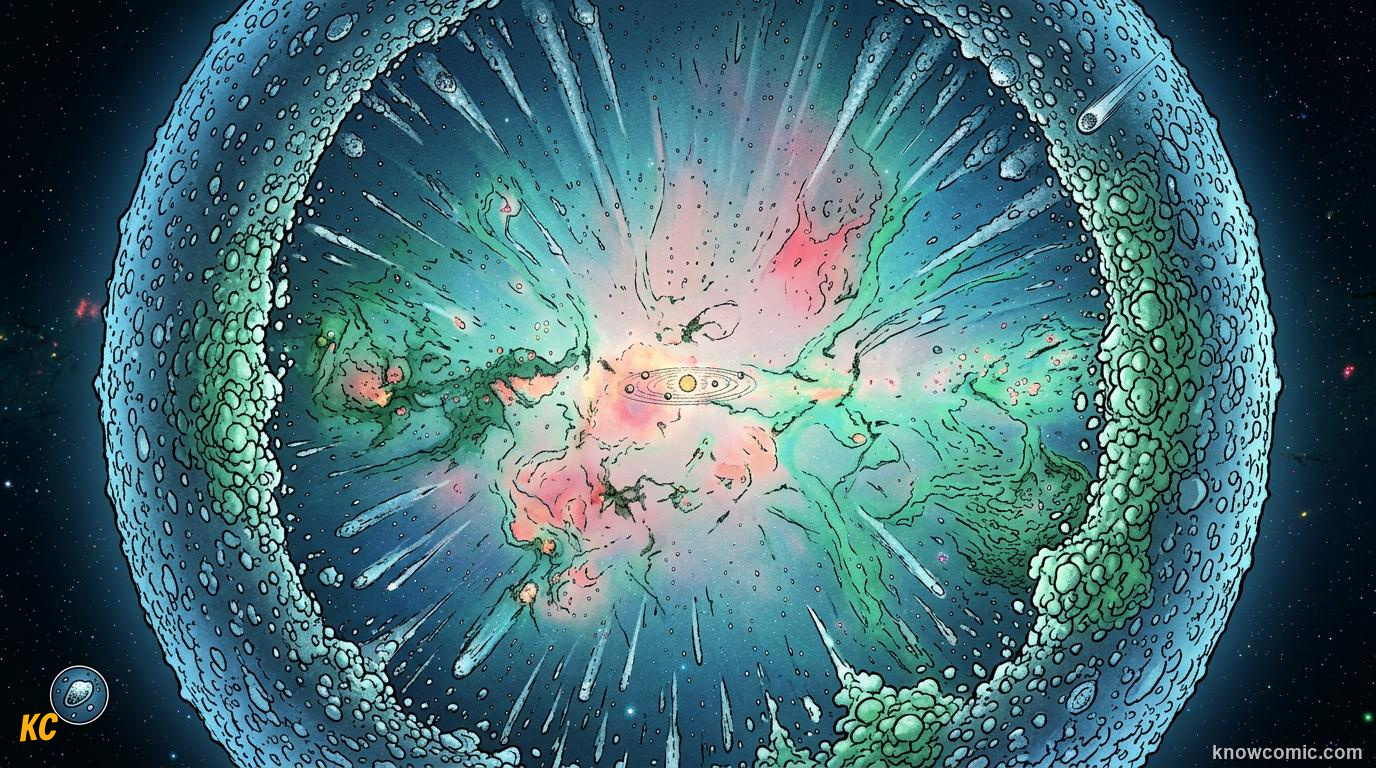
Far beyond the planets and the Kuiper Belt, astronomers think another zone wraps the solar system in a giant sphere. It is called the Oort Cloud, named after Dutch astronomer Jan Oort. No telescope has photographed it directly. Instead, scientists infer it exists because of comets with extremely long orbits. These icy wanderers arrive from all directions, hinting at a huge shell of objects very far from the Sun.
🔭 HIDDEN
The Oort Cloud is too faint and far to image directly. Its existence is inferred from comet paths.
SHELL!
SPHERE
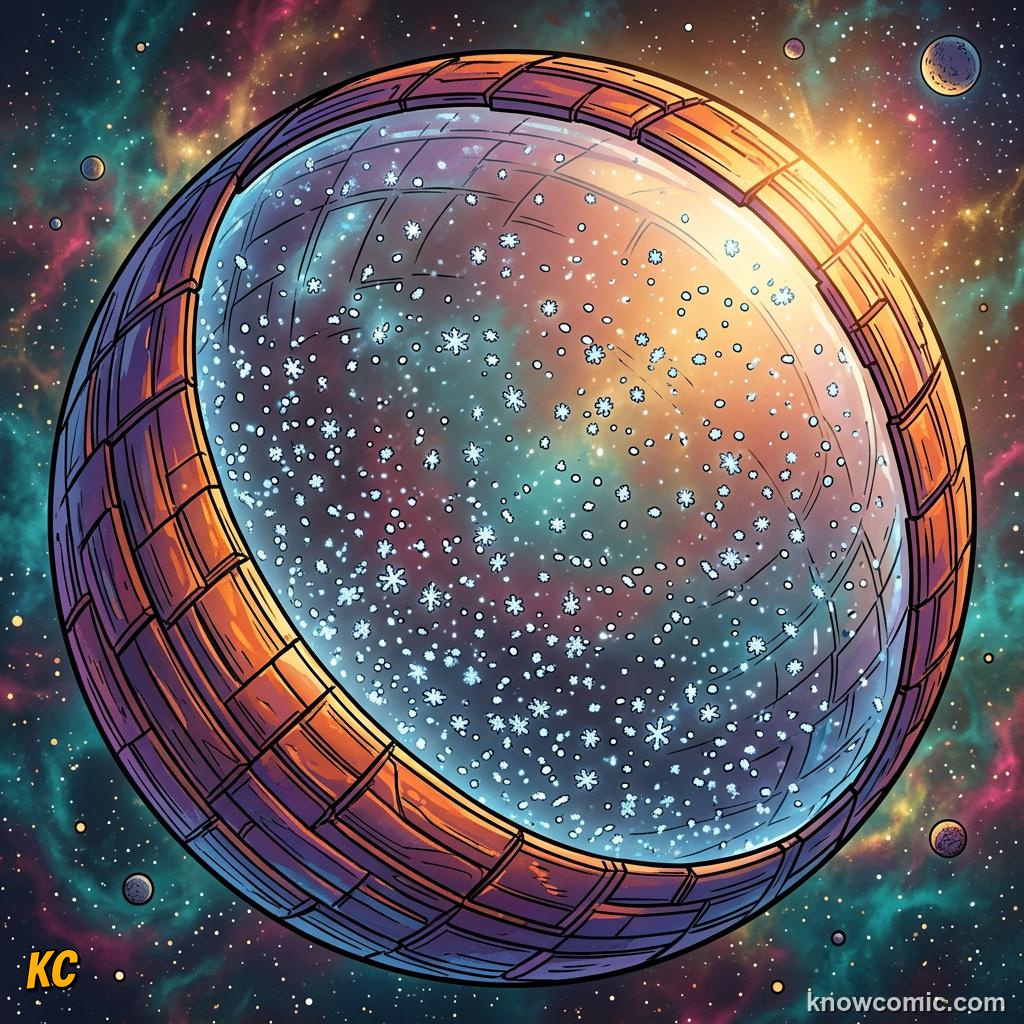
🌐 Icy bodies all around ☀️ Sun's gravity still reaches
NAMED
📜 Jan Oort studied comets 🧊 Coldest zone we know of
PAGE 2 OF 5 — HOW FAR OUT?
DEEP SPACE
DISTANCE IS HARD TO PIN DOWN
The inner edge of the Oort Cloud may begin around a few thousand times Earth's distance from the Sun. The outer edge is even harder to measure. Some estimates suggest it could stretch outward to roughly two light-years or so, though scientists are still debating the exact numbers. That is almost halfway to the nearest star. At those distances, the Sun looks like just another bright star in a black sky.
📏 UNCERTAIN
Exact Oort Cloud distances are uncertain. Astronomers use careful ranges rather than one fixed number.
FAR!
LIGHT-YEAR
💫 About six trillion miles each ⭐ Nearest star is over four away
WEAK SUN
🌑 Sunlight is extremely faint 🧊 Objects stay frozen for eons
DEBATE
📊 Models give different edges 🔬 Science keeps refining estimates
PAGE 3 OF 5 — LONG-PERIOD COMETS
TAILS
💨 Gas and dust stream away ☀️ Sunlight makes them shine
LONG TRIP
⏳ Orbits can take millennia 🎯 Sun gravity captures them
RARE VISITORS
COMETS FROM THE DEEP
When gravity from passing stars or the galaxy nudges an Oort Cloud object inward, it can become a long-period comet. These comets may take thousands or even millions of years to orbit once. Comet Hale-Bopp, bright in 1997, was a spectacular long-period visitor. As it neared the Sun, ice turned to gas and dust, creating a huge glowing coma and twin tails visible from Earth.
☄️ HALE-BOPP
Comet Hale-Bopp was discovered in 1995 and became one of the brightest comets of the twentieth century.
GLOW!
PAGE 4 OF 5 — TRILLIONS OF ICES
COLD STORAGE
THE SOLAR SYSTEM'S DEEP FREEZER
Models suggest the Oort Cloud could contain many trillions of icy bodies, mostly small chunks a few kilometres across or less. They are leftovers scattered outward during the solar system's early chaos. Some may have been thrown far out by Jupiter and the other giant planets. Out there, time moves slowly. Objects can stay almost unchanged for billions of years until a tiny gravity tug sends one falling toward the Sun.
🧊 TRILLIONS
Most Oort Cloud objects are tiny, but together they may number in the trillions across the huge shell.
DEEP!
SCATTERED
♃ Giants may have flung ice outward 🌌 Gravity tug starts comet trips
TINY
🪨 Many are kilometre-sized ❄️ Frozen for billions of years
SLOW
⏳ Barely change until nudged ☄️ Then become dazzling comets
PAGE 5 OF 5 — SOLAR EDGE
BIG PICTURE
WHERE OUR SYSTEM FADES
The Oort Cloud is the solar system's distant icy shell. We have not seen it directly, but long-period comets like Hale-Bopp point to its existence. It may extend very far, perhaps on the order of about two light-years, though exact distances remain uncertain. Out there, our Sun is just a bright dot, and icy leftovers wait in the dark until gravity sends them on a long journey inward.
EDGE!
WONDER
🌌 Our system fades into interstellar space ☄️ Comets are messengers from far out
REMEMBER
🪐 KEY FACTS
The Oort Cloud is a distant spherical shell of icy bodies. Long-period comets hint it exists. It may stretch very far, roughly up to about two light-years, but exact edges are uncertain.
🌐 Spherical cloud far beyond the planets ☄️ Long-period comets like Hale-Bopp 📏 Distance estimates are still debated
🧠 QUIZ TIME!
THE OORT CLOUD · 5 QUESTIONS
QUESTION 01
What shape is the Oort Cloud thought to be?
QUESTION 02
How do we know the Oort Cloud probably exists?
QUESTION 03
Which comet was a famous long-period visitor in 1997?
QUESTION 04
About how far might the Oort Cloud extend?
QUESTION 05
Why have we not photographed the Oort Cloud directly?