🪐 Planets Speed Up, Slow Down, and Trace Oval Paths!
📖 200 Topics🆓 FREE + PRO⏱️ 5 min per comic🧠 Quiz included
1609
KEPLER
Laws published
→
⭕
ELLIPSE
Not perfect circles
→
🏃
SWEEP
Faster near Sun
→
📏
PERIOD
Farther takes longer
→
✨
TODAY
Still used in spaceflight
🪐 KEPLER'S LAWS
TOPIC 12 · PLANETS & ASTRONOMY · THE SOLAR SYSTEM
PAGE 1 OF 5 — OVAL ORBITS
NOT CIRCLES
PLANETS TRACE ELLIPSES
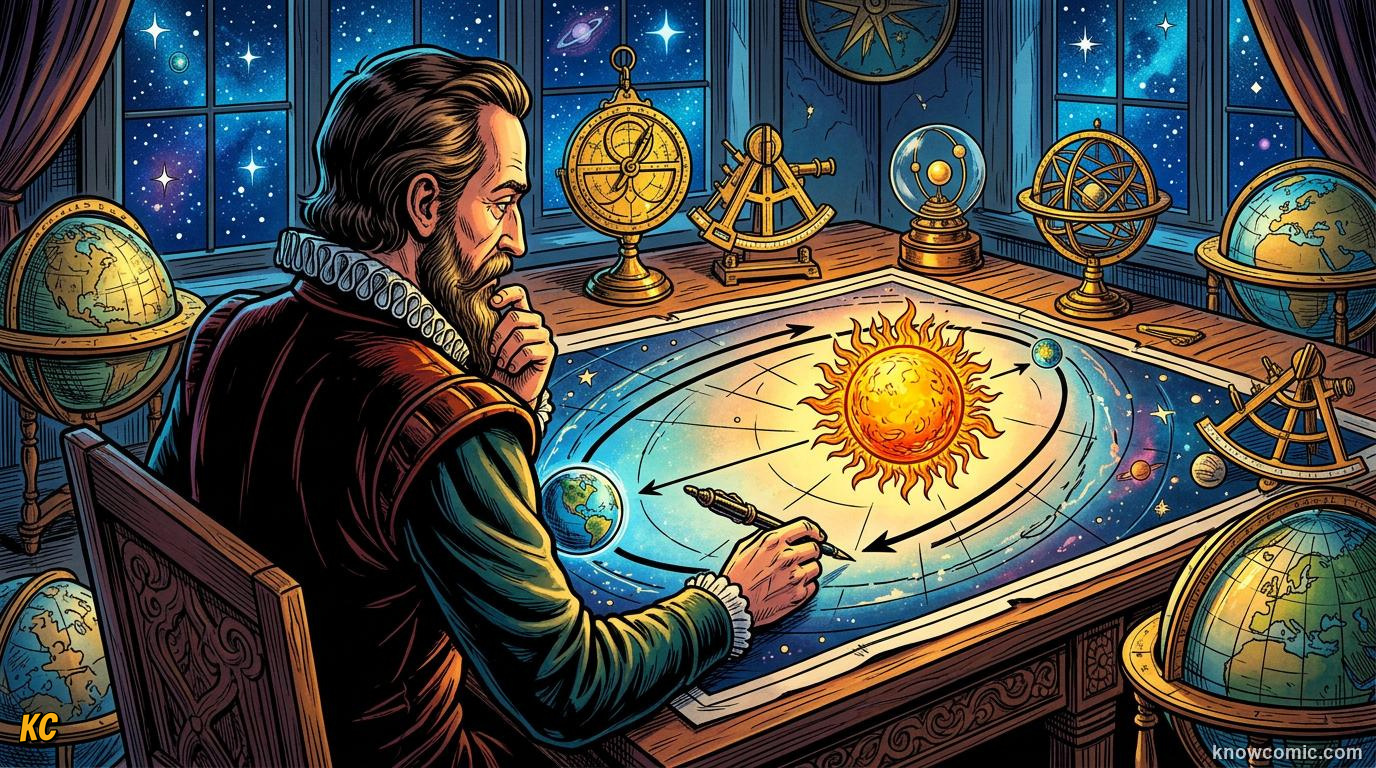
For centuries, many people thought planets moved in perfect circles. Johannes Kepler studied precise observations from Tycho Brahe and discovered something different. Planets orbit in ellipses, stretched-out ovals with the Sun at one focus. Sometimes a planet is closer to the Sun. Sometimes farther. The path is smooth and repeating, but it is not a simple circle. Kepler published this first law in 1609 in his book Astronomia Nova.
⭕ OVAL
An ellipse has two focal points. The Sun sits at one focus of each planetary orbit.
ELLIPSE!
1609
📜 Astronomia Nova published 🔭 Based on Tycho's data
FOCUS
☀️ Sun at one focal point 🪐 Planet traces oval path
PAGE 2 OF 5 — EQUAL AREAS
SWEEPING
FASTER NEAR THE SUN
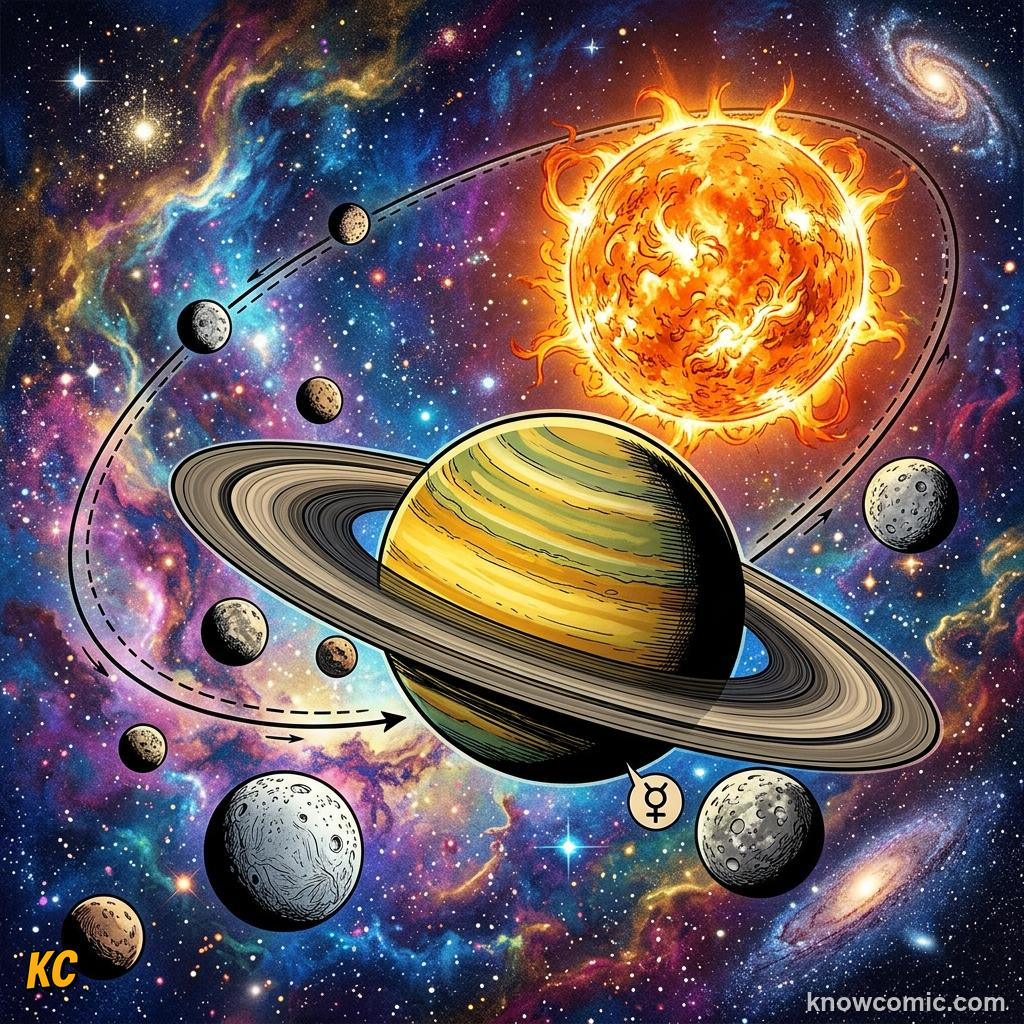
Kepler's second law says a line from the Sun to a planet sweeps equal areas in equal times. In plain words: when a planet is closer to the Sun, it moves faster. When it is farther away, it moves slower. Imagine a pizza slice shaped region traced in one month. That slice is wider near the Sun and narrower far out, but the area is the same. Gravity explains why, but Kepler found the pattern first.
🏃 SWEEP
Planets speed up at perihelion, their closest approach to the Sun, and slow down at aphelion, the farthest point.
SWIFT!
CLOSE
☀️ Near Sun means faster 🚀 Gravity has sped it up
FAR
🐢 Far from Sun means slower 📐 Equal areas in equal time
PATTERN
📊 Same rule for every planet 🔭 Seen in all orbits
PAGE 3 OF 5 — LONGER TRIPS
MARS
🔴 Year about 687 Earth days 🪐 Farther than Earth
JUPITER
♃ Year about 12 Earth years 📈 Distance drives period
THIRD LAW
DISTANCE AND PERIOD LINKED
Kepler's third law connects how long a planet takes to orbit with how far it is from the Sun. Planets farther out have longer years. Mars takes about 687 Earth days. Jupiter takes about 12 Earth years. The math is precise: the square of the orbital period is proportional to the cube of the average distance. For kids, the simple version is enough: farther from the Sun means a longer trip around it.
📏 CUBE
Kepler's third law uses period squared and distance cubed. Farther planets take much longer to complete one orbit.
YEARS!
PAGE 4 OF 5 — BEFORE NEWTON
PATTERN FIRST
WHY CAME LATER
Kepler published his laws in 1609 and 1619, about 70 years before Newton explained gravity. Kepler knew how planets moved, not why. He described beautiful patterns in the sky. Newton later showed that gravity causes those patterns. Today spacecraft use Kepler's laws to plan missions. Knowing the shape and timing of orbits helps engineers send probes to Mars, Jupiter, and beyond.
⏳ TIMELINE
Kepler found the rules of motion. Newton later explained that gravity makes those rules work.
FIRST!
1609
📜 Kepler publishes ellipses 🔭 Decades before Newton
WHY LATER
🍎 Newton explains with gravity 🛰️ Both still used today
SPACE
🚀 Orbit math guides missions 🪐 Patterns power spaceflight
PAGE 5 OF 5 — KEPLER'S LEGACY
THREE LAWS
HOW PLANETS REALLY MOVE
Kepler changed astronomy forever. Planets move in ellipses with the Sun at one focus. They speed up near the Sun and slow down farther out. Farther planets take longer to complete each orbit. He figured this out from careful measurements, not from guessing perfect circles. Newton later explained why. Together, their work lets us explore the solar system with confidence.
KEPLER!
LAWS
⭕ Ellipses, not circles 🏃 Faster when closer
REMEMBER
🪐 KEY FACTS
Kepler's three laws: elliptical orbits, equal areas in equal times, and longer periods for farther planets. He published in 1609, before Newton explained gravity.
⭕ Orbits are ellipses around the Sun 🏃 Planets move faster when closer 📏 Farther planets have longer years
🧠 QUIZ TIME!
KEPLER'S LAWS · 5 QUESTIONS
QUESTION 01
What shape are planetary orbits according to Kepler?
QUESTION 02
When does a planet move fastest in its orbit?
QUESTION 03
What does Kepler's third law tell us?
QUESTION 04
When did Kepler publish his first two laws?
QUESTION 05
Did Kepler explain why gravity causes these motions?