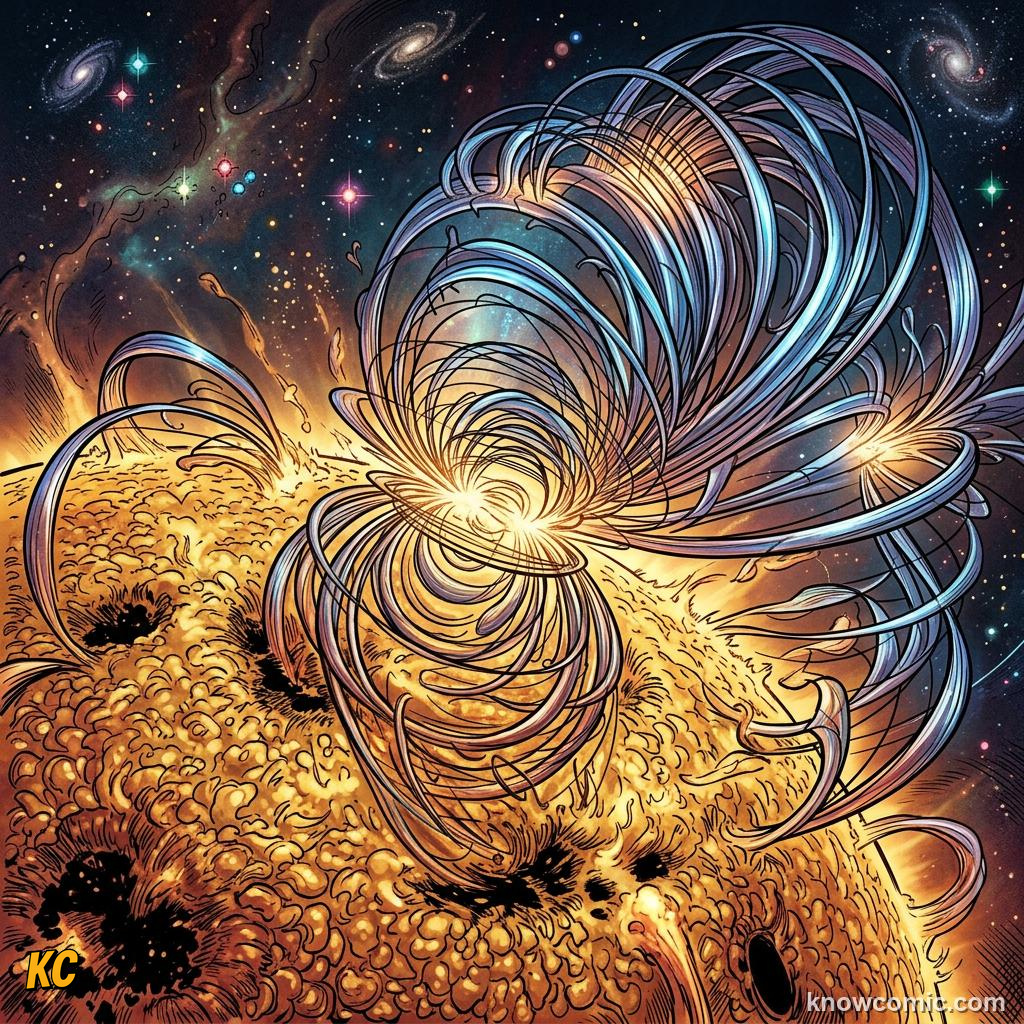
📖 200 Topics🆓 FREE + PRO⏱️ 5 min per comic🧠 Quiz included
💥
FLARE
Sudden Sun burst
→
🌊
CME
Plasma cloud launched
→
🧲
STORM
Magnetic field shakes
→
⚡
1989
Quebec blackout
→
✨
TODAY
Forecasters watch the Sun
☀️ SOLAR FLARES & SPACE WEATHER
TOPIC 14 · PLANETS & ASTRONOMY · THE SOLAR SYSTEM
PAGE 1 OF 5 — SUN OUTBURSTS
EXPLOSIONS
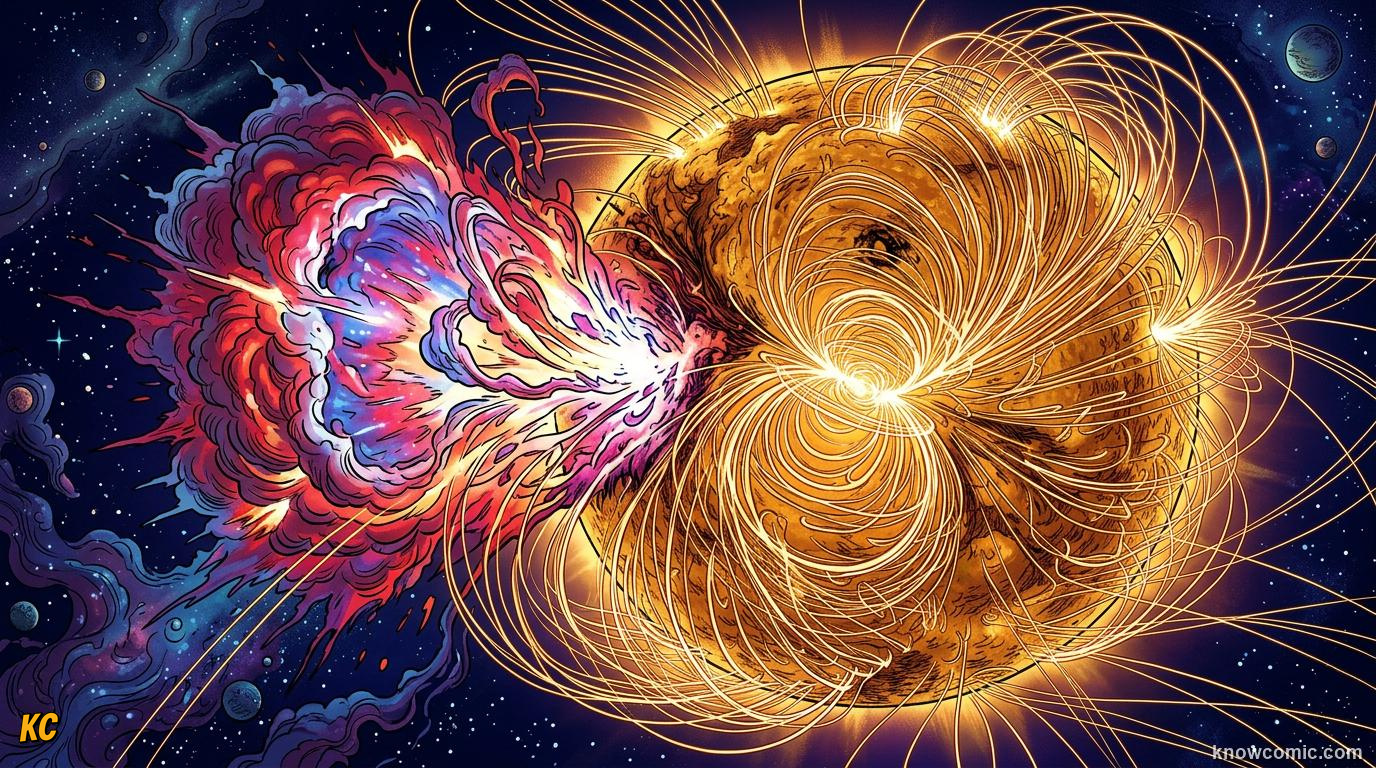
SOLAR FLARES ERUPT
The Sun is usually calm, but it can erupt with sudden bursts of energy called solar flares. These are among the most powerful explosions in the solar system. In minutes, a flare can release as much energy as millions of nuclear bombs. Flares shine brightly in X-rays and ultraviolet light. They often happen near sunspots, dark patches where the Sun's magnetic field is twisted and tangled.
💥 POWER
Solar flares are sudden releases of magnetic energy on the Sun, heating plasma to extreme temperatures.
FLARE!
SUNSPOTS
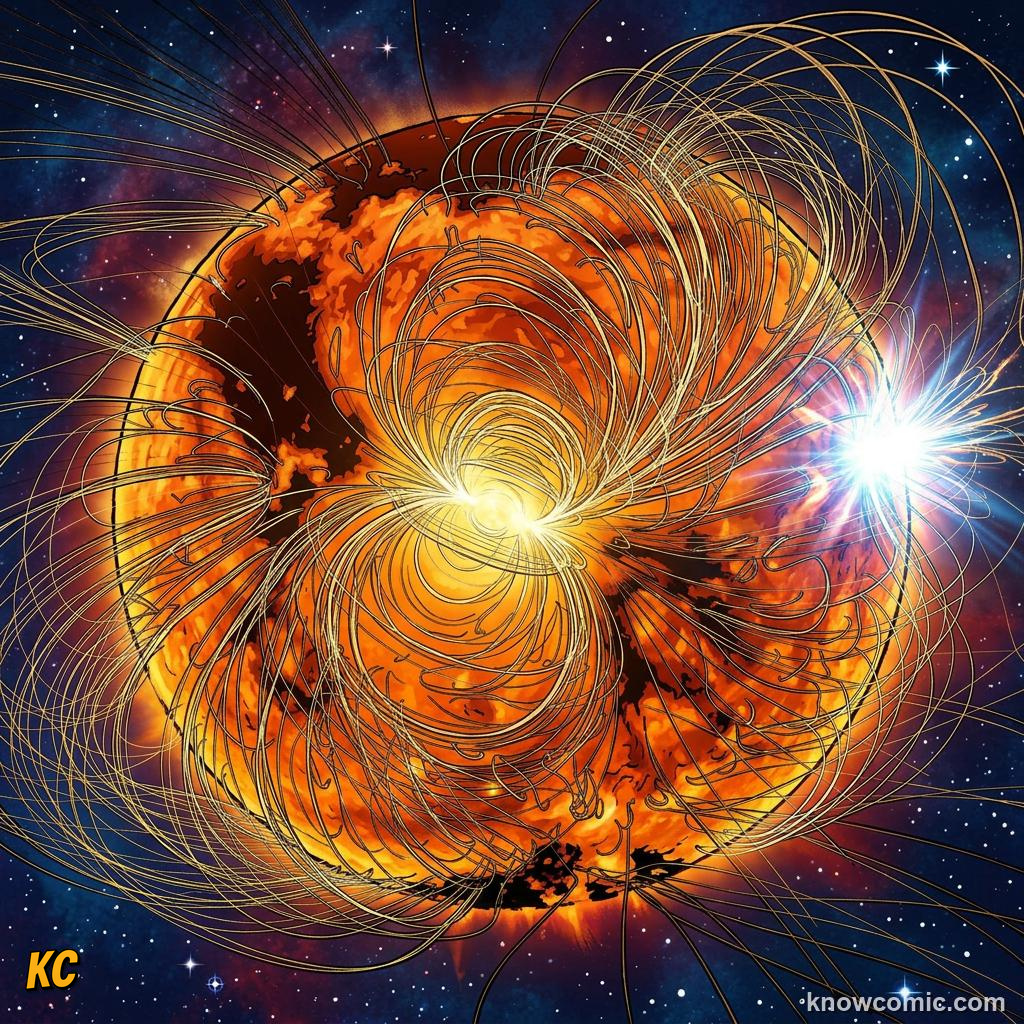
🌑 Dark magnetic patches 🌀 Twisted fields snap loose
ENERGY
⚡ Huge burst in minutes 📡 Detected by space telescopes
PAGE 2 OF 5 — MASS EJECTIONS
PLASMA CLOUDS
CORONAL MASS EJECTIONS
Sometimes the Sun also hurls a giant cloud of plasma into space. This is called a coronal mass ejection, or CME. A CME can contain billions of tons of charged particles. If it is aimed at Earth, the cloud may arrive in one to three days. When it hits our magnetosphere, it can compress and shake Earth's magnetic field. That shaking is called a geomagnetic storm.
🌊 CME
A coronal mass ejection is a huge bubble of plasma threaded with magnetic field lines, launched from the Sun.
⚖️ Billions of tons of plasma 🧭 Magnetic field inside cloud
PAGE 3 OF 5 — EARTH FEELS IT
SATELLITES
🛰️ Electronics can glitch 📡 Radio signals may fade
GRID
⚡ Currents in power lines 👨🚀 Astronauts need extra shielding
IMPACTS
SATELLITES AND POWER GRIDS
Space weather is not just a sky show. Strong geomagnetic storms can disrupt radio signals and GPS. Satellites may need to be placed in safe mode. Astronauts on the space station take shelter from extra radiation. On the ground, changing magnetic fields can induce electric currents in long power lines. Engineers design grids to handle storms, but very strong events can still cause serious problems.
🛰️ RISK
Space weather can affect satellites, communications, navigation, and power systems on Earth.
STORM!
PAGE 4 OF 5 — MARCH 1989
BLACKOUT
QUEBEC GOES DARK
On March 13, 1989, a powerful geomagnetic storm struck Earth after a major solar eruption. Electric currents surged through Quebec's power grid in Canada. Circuit breakers tripped to prevent damage. About six million people lost electricity for roughly nine hours. It was one of the most famous space weather events in modern history. The storm also made auroras visible much farther south than usual, even near the equator in some places.
⚡ 1989
The March 1989 geomagnetic storm caused a major blackout in Quebec, Canada, lasting about nine hours.
DARK!
QUEBEC
🇨🇦 Six million without power ⏱️ Roughly nine hours of blackout
AURORA
🌌 Lights seen far from poles 📜 A warning for power companies
LESSON
⚡ Grids now plan for storms 🔭 Forecasting improved since
PAGE 5 OF 5 — FORECASTING
WATCH THE SUN
SPACE WEATHER SCIENCE
Solar flares and coronal mass ejections are part of space weather. They can endanger satellites, astronauts, and power grids. The March 1989 storm blacked out Quebec for about nine hours. Today, observatories watch the Sun around the clock. Forecasters warn engineers and airlines when a storm may arrive. Understanding space weather helps keep our connected world safer.
FORECAST!
ALERT
☀️ Satellites watch the Sun 24/7 📢 Warnings go out before impact
REMEMBER
🪐 KEY FACTS
Solar flares and CMEs can cause geomagnetic storms. The 1989 storm blacked out Quebec for about nine hours. Space weather forecasters help protect technology on Earth.
💥 Flares and CMEs burst from the Sun ⚡ Strong storms can affect power grids 🔭 Scientists forecast space weather today