🪐
📏
☀️
🪐 KNOW PRIMARY · AGES 6–11

PLANETS &
ASTRONOMY

📏 From Tiny Mercury to the Mighty Sun!

📖 200 Topics 🆓 FREE + PRO ⏱️ 5 min per comic 🧠 Quiz included
🪐
MERCURY
Smallest planet
🌍
EARTH
Our blue home
🟠
JUPITER
Largest planet
☀️
SUN
Star dwarfs all
TODAY
Scale still amazes
📏 PLANET SIZES
TOPIC 18 · PLANETS & ASTRONOMY · THE SOLAR SYSTEM
PAGE 1 OF 5 — COSMIC SCALE
SIZE LINEUP
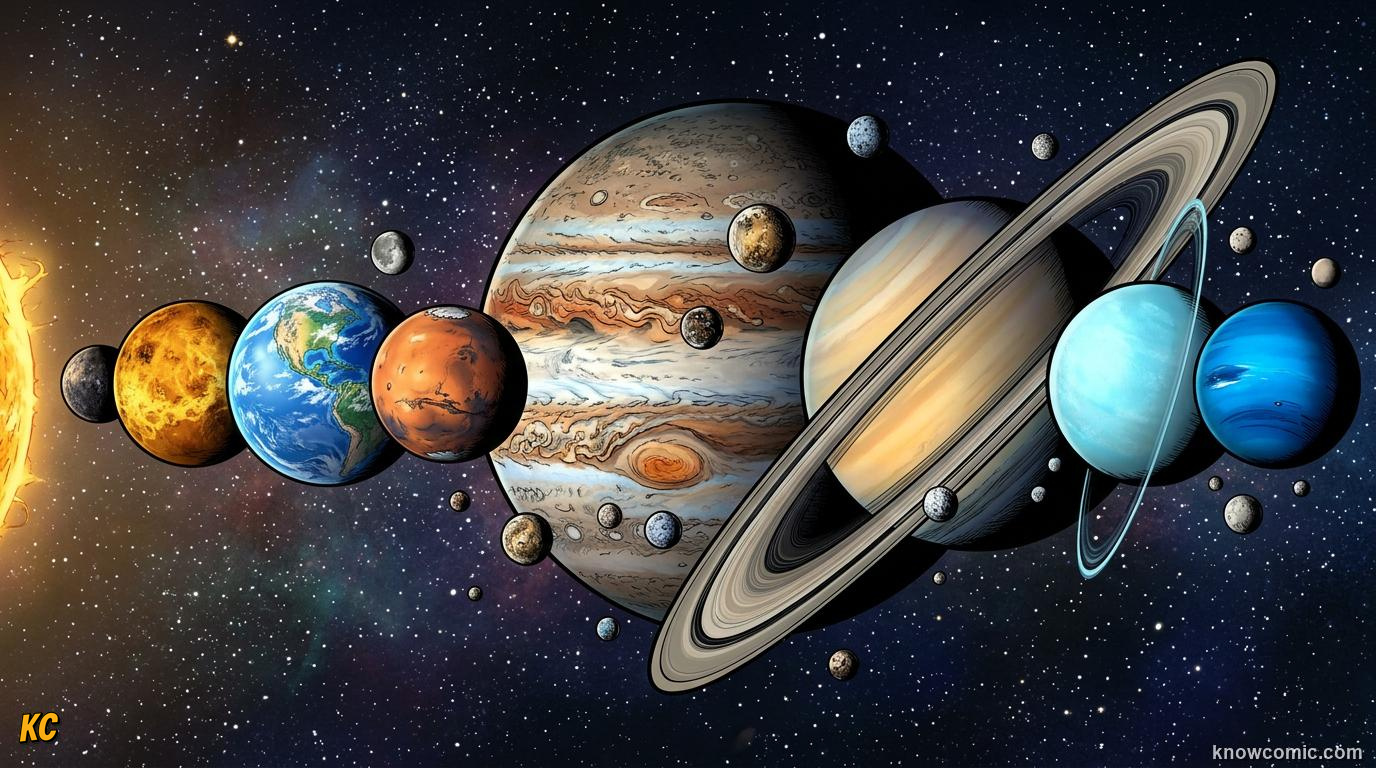
Comic panel about planet sizes compared: Size Lineup, educational kids illustration
PLANETS ARE NOT EQUAL
If you lined up worlds from the Sun, you would see a huge range of sizes. Mercury is only a little bigger than Earth's Moon. Earth is cozy compared with the giants. Jupiter is the largest planet, more than 11 times wider than Earth. Saturn is a close second. Uranus and Neptune are smaller ice giants, but still far bigger than any rocky world. Size tells you a lot about how a planet formed and what it is made of.
📏 WIDTH
Jupiter's diameter is about 139,800 km, roughly 11 times Earth's width of about 12,700 km.
SCALE!
SMALL
Comic panel about planet sizes compared: Planets Are Not Equal, Small, educational kids illustration
☿️ Mercury is tiniest major planet
🌙 Moon-sized compared with giants
GIANT
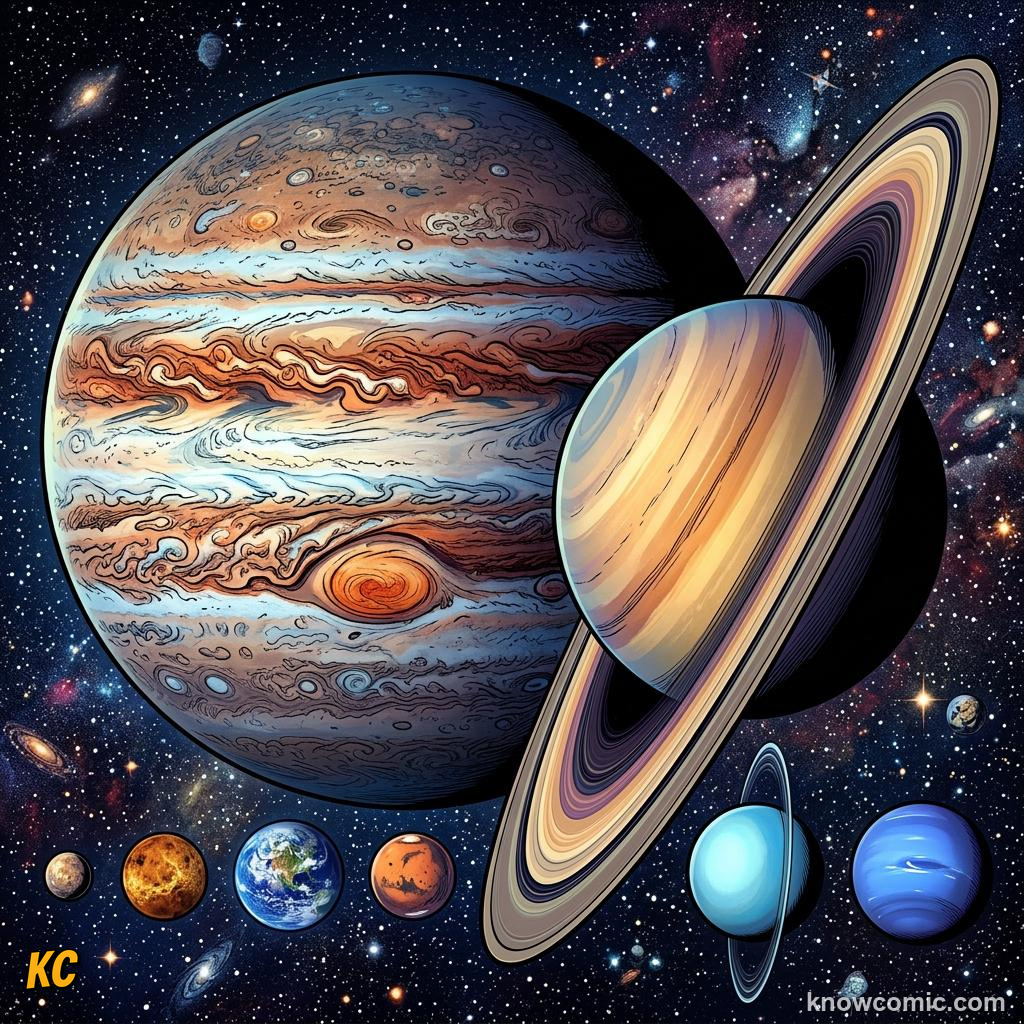
Comic panel about planet sizes compared: Giant, educational kids illustration
🟠 Jupiter rules the planets
💫 Saturn nearly as wide
PAGE 2 OF 5 — VOLUME MATTERS
INSIDE SPACE
Comic panel about planet sizes compared: Inside Space, educational kids illustration
HOW MANY EARTHS FIT?
Width is only one way to compare worlds. Volume measures how much space something takes up in three dimensions. Because volume grows with the cube of radius, a planet only a few times wider can hold thousands of times more space inside. About 1,300 Earths could fit inside Jupiter if you packed them in. Saturn could hold about 760 Earths. Even the smaller ice giants Uranus and Neptune could each swallow dozens of Earths whole.
🧮 VOLUME
Volume scales fast: double the radius and you get eight times the volume inside a sphere.
VOLUME!
JUPITER
Comic panel about planet sizes compared: How Many Earths Fit?, Jupiter, educational kids illustration
🟠 ~1,300 Earths inside
📦 Biggest bucket in the system
SATURN
Comic panel about planet sizes compared: How Many Earths Fit?, Saturn, educational kids illustration
💍 ~760 Earths by volume
🧊 Ice giants still huge
ICE GIANTS
Comic panel about planet sizes compared: Ice Giants, educational kids illustration
🧊 Dozens of Earths each
📐 Volume beats width
PAGE 3 OF 5 — THE SUN WINS
MASS
Comic panel about planet sizes compared: Mass, educational kids illustration
☀️ Sun holds almost everything
🪐 Planets are leftover bits
FIT
Comic panel about planet sizes compared: Fit, educational kids illustration
🟠 ~1,000 Jupiters in the Sun
📉 Planets shrink on true-scale maps
STAR SCALE
Comic panel about planet sizes compared: Star Scale, educational kids illustration
EVEN JUPITER LOOKS TINY
Planets are small next to the Sun. Our star is about 109 times wider than Earth and contains more than 99 percent of all mass in the solar system. Roughly 1,000 Jupiters could fit inside the Sun by volume. That is why the Sun shines so brightly and holds the planets in orbit with its powerful gravity. When artists draw the solar system to scale, the Sun is often too big to fit on the page unless planets are just dots.
☀️ STAR
The Sun contains about 99.8 percent of the solar system's total mass. Planets share the tiny leftover.
SUN!
PAGE 4 OF 5 — ALL PLANETS IN JUPITER
MIND-BLOWING
Comic panel about planet sizes compared: Even Jupiter Looks Tiny, Mind-Blowing, educational kids illustration
ONE PLANET SWALLOWS THE REST
Here is a famous comparison: if you added up the volumes of Mercury, Venus, Earth, Mars, Saturn, Uranus, and Neptune, the total is still less than Jupiter's volume. In other words, every other planet could fit inside Jupiter with room to spare. Of course this is a math thought experiment, not something that could really happen. But it shows how wildly different sizes can be in one family of worlds orbiting the same star.
🤯 MATH
All seven other planets combined still take up less space than Jupiter alone.
WOW!
COMBINED
Comic panel about planet sizes compared: One Planet Swallows The Rest, Combined, educational kids illustration
🪐 Seven planets still smaller
🟠 Jupiter is the volume king
IDEA
Comic panel about planet sizes compared: One Planet Swallows The Rest, Idea, educational kids illustration
🧮 Compare volumes, not just width
🌌 Scale tricks our brains
MODEL
Comic panel about planet sizes compared: Model, educational kids illustration
🎨 True-scale art uses tiny dots
👀 Hard to picture in one image
PAGE 5 OF 5 — SIZE FACTS
WRAP UP
Comic panel about planet sizes compared: Wrap Up, educational kids illustration
REMEMBER THE SCALE
Planet size spans an enormous range. Jupiter holds about 1,300 Earths by volume, and the Sun could hold about 1,000 Jupiters. Width alone can fool you: a planet a little bigger across can be vastly bigger inside. Understanding scale helps you picture orbits, gravity, and why the outer giants shaped the solar system. Never trust a cartoon where all planets look the same size!
SCALE!
TRUE
Comic panel about planet sizes compared: Remember The Scale, True, educational kids illustration
📏 Width and volume tell different stories
☀️ The Sun dwarfs every planet
REMEMBER
🪐 KEY FACTS
Jupiter holds about 1,300 Earths by volume. The Sun holds about 1,000 Jupiters. All other planets combined are smaller than Jupiter. True-scale pictures make planets look like dots.
🪐 Rocky worlds are much smaller than giants
🟠 Jupiter is the largest planet
☀️ The Sun contains almost all the mass
🧠 QUIZ TIME!
📏 PLANET SIZES · 5 QUESTIONS
QUESTION 01
About how many Earths could fit inside Jupiter by volume?
QUESTION 02
Which object is largest in our solar system?
QUESTION 03
Roughly how many Jupiters could fit inside the Sun?
QUESTION 04
What happens if you compare volume instead of width?
QUESTION 05
Could all other planets fit inside Jupiter by volume?
0/5
LOADING...
💬 REACTIONS & COMMENTS
No comments yet, be the first!
← TOPIC 17 📋 ALL TOPICS TOPIC 19 →