📖 200 Topics🆓 FREE + PRO⏱️ 5 min per comic🧠 Quiz included
🪨
INNER
Mercury to Mars
→
💨
OUTER
Jupiter to Neptune
→
🔥
HOT ZONE
Rocky worlds form
→
❄️
COLD ZONE
Gas and ice gather
→
✨
TODAY
Eight very different worlds
🪨 ROCKY VS GAS
TOPIC 19 · PLANETS & ASTRONOMY · THE SOLAR SYSTEM
PAGE 1 OF 5 — TWO FAMILIES
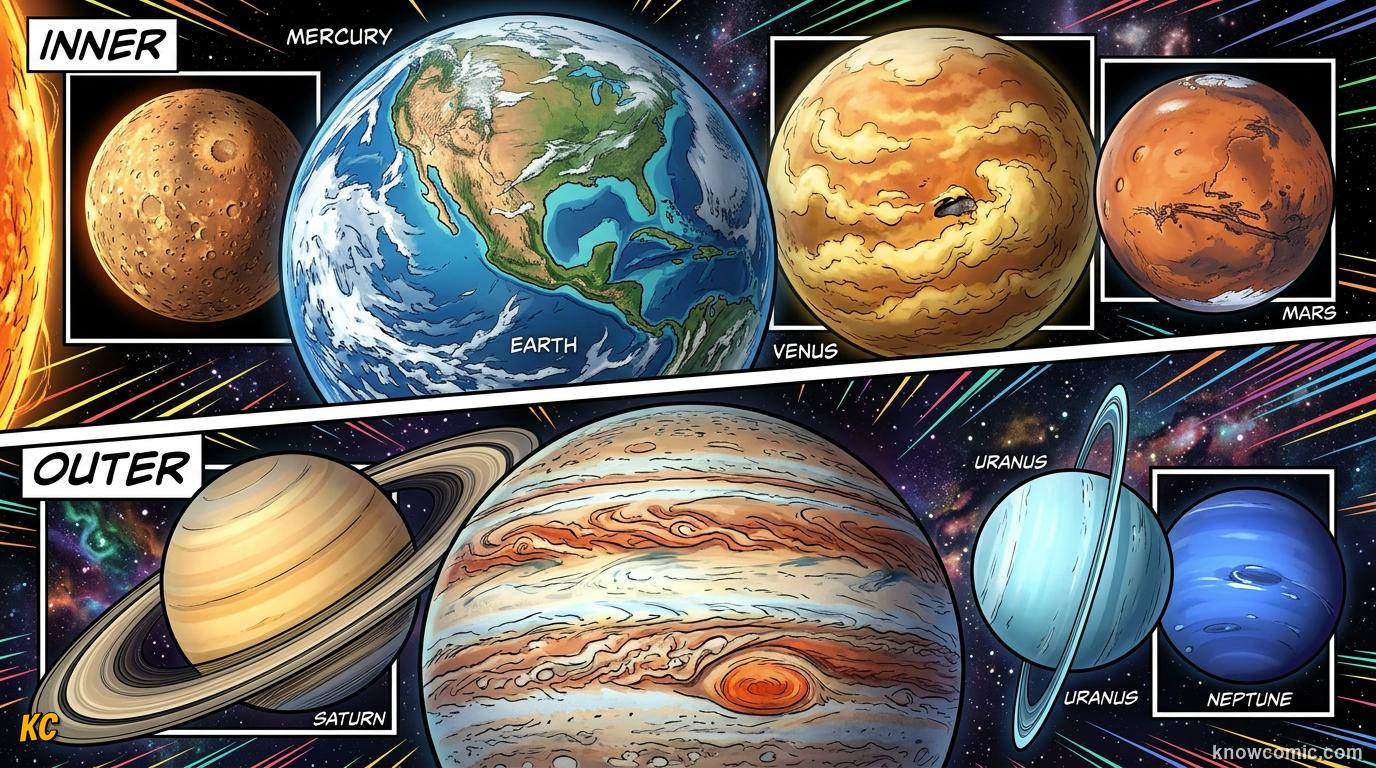
INNER VS OUTER
EIGHT PLANETS, TWO STYLES
Our solar system has eight major planets in two groups. The inner four, Mercury, Venus, Earth, and Mars, are rocky terrestrial planets. They have dense metal cores and solid crusts made of rock. The outer four, Jupiter, Saturn, Uranus, and Neptune, are giant planets with thick atmospheres and no solid surface to walk on. A spacecraft diving into Jupiter would never hit ground, only denser and denser gas.
🪨 ROCKY
Terrestrial planets have solid surfaces and are relatively small and dense compared with the giants.
SPLIT!
INNER
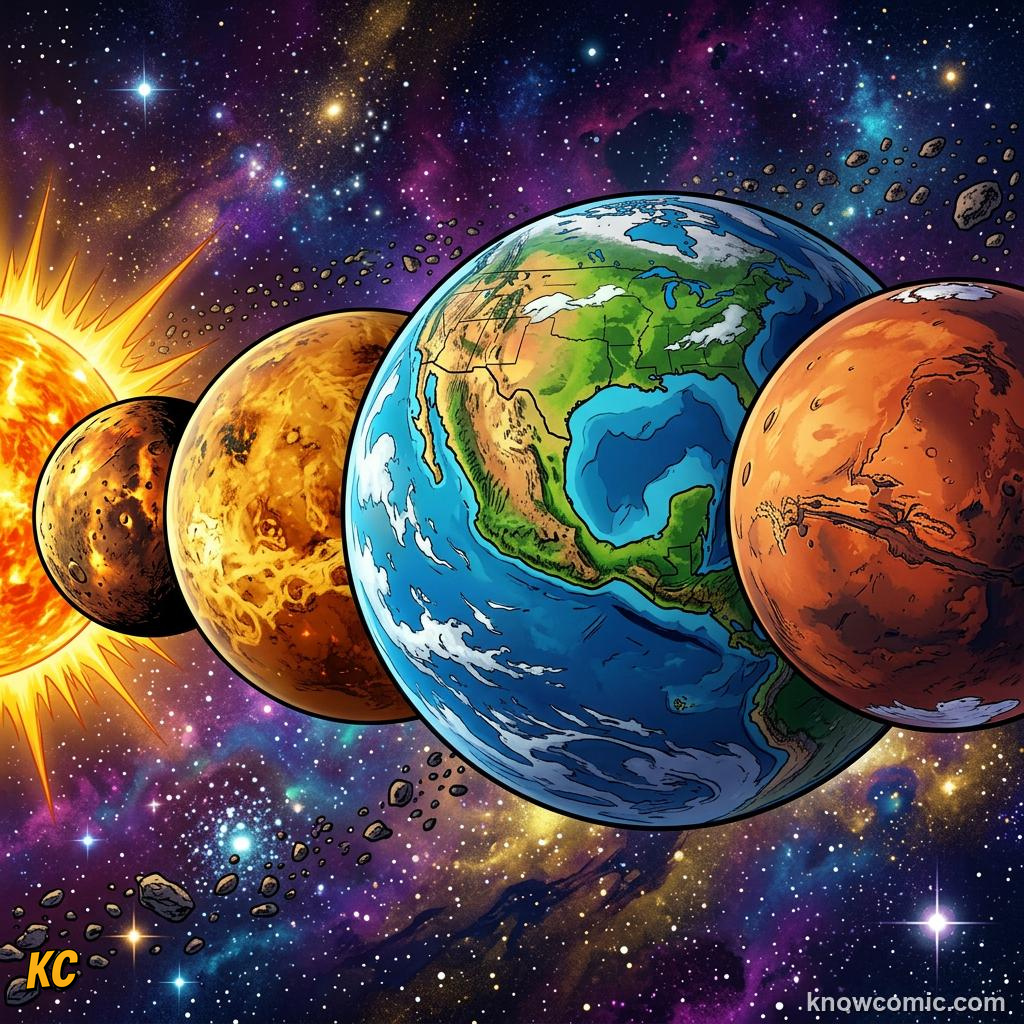
☿️🌍🔴 Mercury, Venus, Earth, Mars 🪨 Rock and metal cores
OUTER
🟠💍🧊🔵 Jupiter through Neptune 💨 Thick atmospheres dominate
PAGE 2 OF 5 — ROCKY WORLDS
SOLID GROUND
WHAT TERRESTRIAL PLANETS ARE LIKE
Rocky planets formed close to the young Sun where it was too hot for light gases to condense easily. Dust and rock stuck together, building planetesimals that collided and merged. Their surfaces can be cratered, volcanic, or wrapped in atmosphere, but below the clouds there is real ground. Earth is special because liquid water and life thrive on its rocky surface. Mars once had rivers; Venus is wrapped in a crushing carbon dioxide atmosphere.
🌍 EARTH
Earth is the largest rocky planet and the only one known to have stable liquid water on its surface today.
ROCK!
MERCURY
☿️ Smallest, heavily cratered 🌡️ Extreme day and night heat
VENUS
♨️ Thick toxic atmosphere 🔴 Mars: cold desert world
EARTH
💧 Liquid water on the surface 🌱 Only known life so far
PAGE 3 OF 5 — GAS GIANTS
BANDS
🌈 Cloud belts and zones 🌀 Storms bigger than Earth
CORE
🪨 Rocky core may hide deep ⬇️ Pressure crushes any probe
NO FLOOR
JUPITER AND SATURN
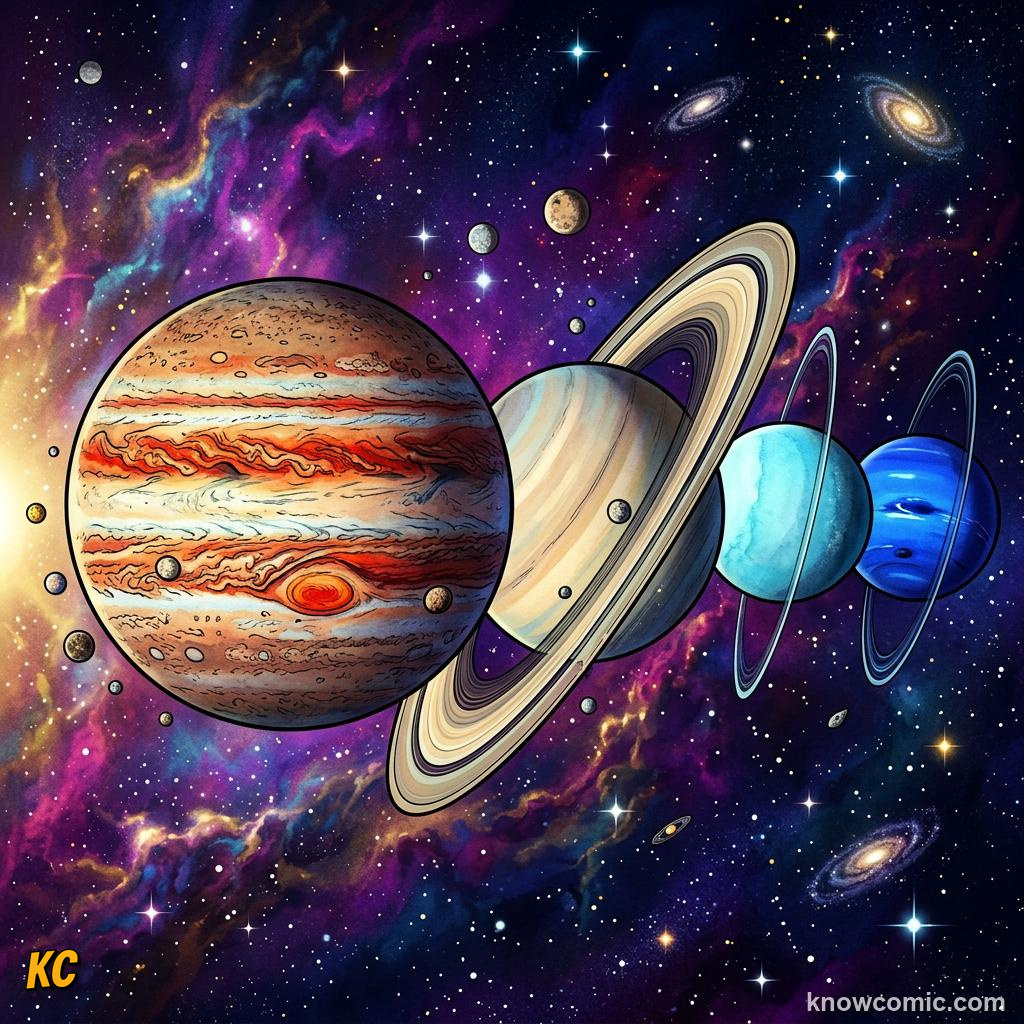
Farther from the Sun, it was cold enough for hydrogen and helium to join the mix. Jupiter and Saturn grew huge by pulling in gas from the solar nebula. They are mostly hydrogen and helium, like the Sun, with possible rocky cores deep inside. Their colorful cloud bands are storms and weather in thick atmospheres. You could not land on them because pressure and temperature increase forever downward until hydrogen acts like a metal.
🟠 JUPITER
Jupiter and Saturn are gas giants with no solid surface. Their weather includes storms larger than Earth.
GAS!
PAGE 4 OF 5 — ICE GIANTS
COLD BLUE WORLDS
URANUS AND NEPTUNE
Uranus and Neptune are sometimes called ice giants because they contain more water, ammonia, and methane ices than Jupiter and Saturn. They are still enormous, with thick atmospheres and no solid surface. Methane gas helps give Neptune its deep blue color. Both have faint ring systems and many moons. They formed in the coldest outer zone where only plentiful ice-rich material could build such large cores before grabbing gas.
🧊 ICE
Ice giants have more water and methane ices in their interiors than the gas giants Jupiter and Saturn.
ICE!
URANUS
🔄 Spins on its side 💍 Thin dusty rings
NEPTUNE
💨 Fastest winds in the system 🌙 Moon Triton orbits backward
COMPARE
🧊 More ices than Jupiter ❄️ Still no solid ground
PAGE 5 OF 5 — WHY THE SPLIT
WRAP UP
DISTANCE SHAPED THE PLANETS
Rocky planets formed hot and close, built from metal and stone. Gas and ice giants formed farther out where cold allowed huge atmospheres to gather. Jupiter and Saturn are mostly hydrogen and helium. Uranus and Neptune add more ices. No giant has a surface to stand on. Knowing the two families helps you predict what each world is like before you visit.
TWO!
ZONE
🔥 Inner heat favored rock ❄️ Outer cold favored gas and ice
REMEMBER
🪐 KEY FACTS
Inner planets are rocky with solid surfaces. Outer planets are giants of gas and ice with deep atmospheres. Distance from the Sun helped decide what each world became.
🪨 Mercury, Venus, Earth, Mars are rocky 💨 Jupiter and Saturn are gas giants 🧊 Uranus and Neptune are ice giants