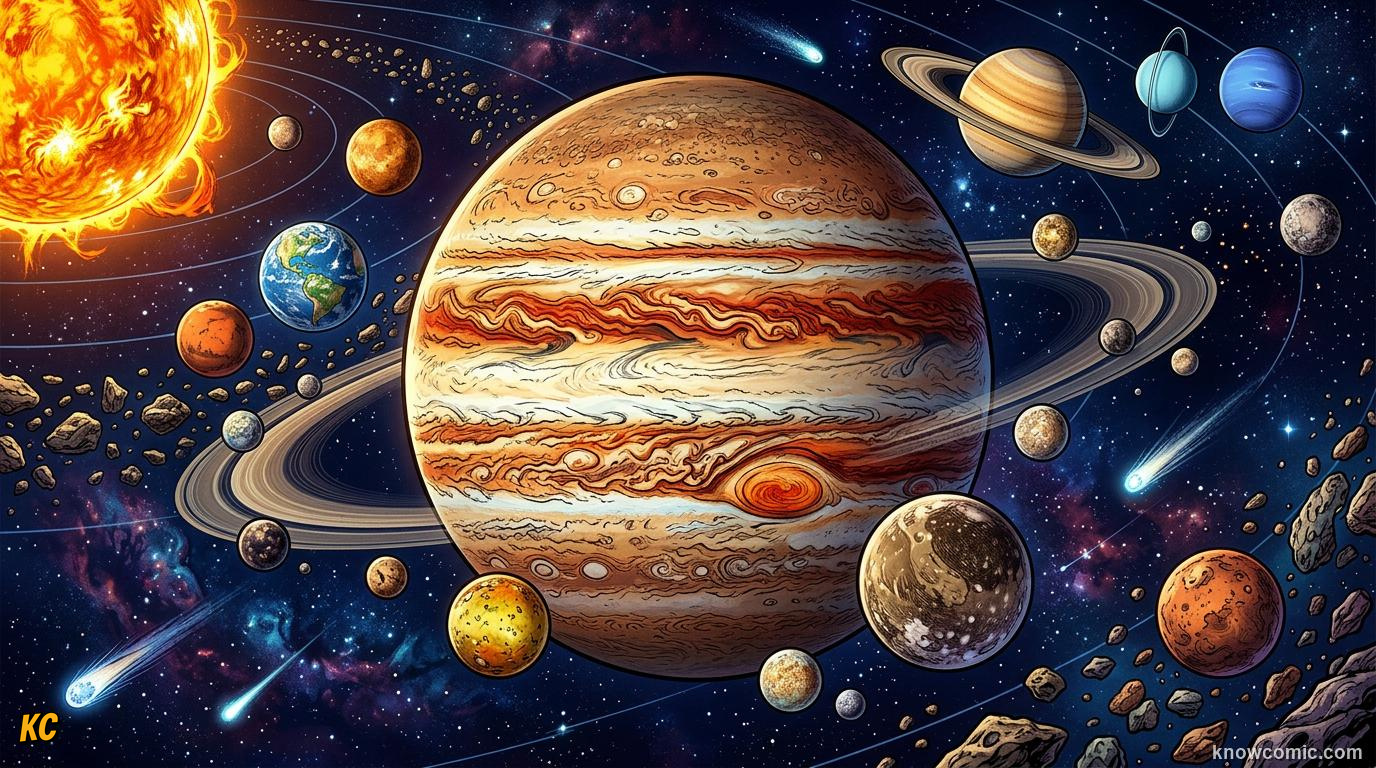
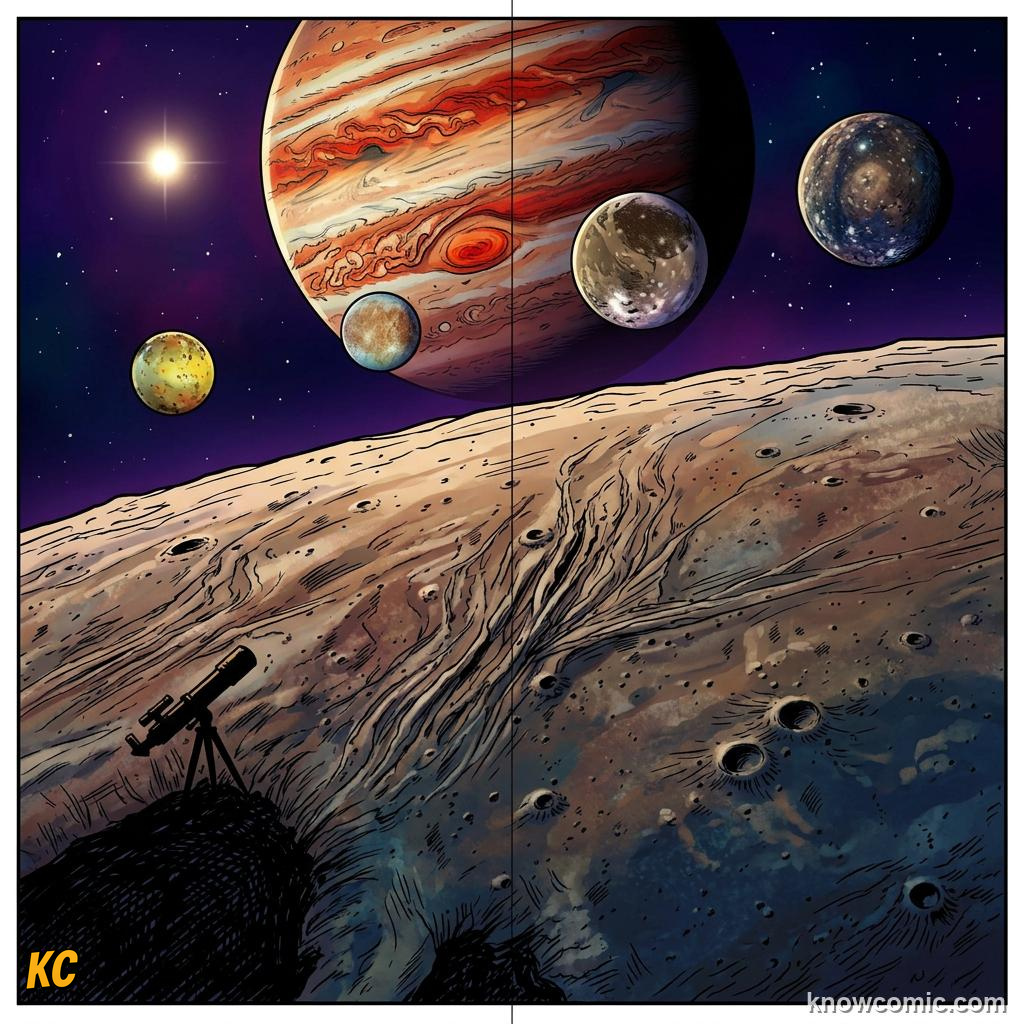
Jupiter is the fifth planet from the Sun and by far the largest. Its mass is more than twice that of all other planets put together. If you could stack worlds inside it, about 1,300 Earths would fit by volume. Jupiter is a gas giant with no solid surface. Its fast spin stretches clouds into bands of color. Four big moons, Io, Europa, Ganymede, and Callisto, were discovered by Galileo in 1610 and changed how we see the cosmos.
🟠 MASS
Jupiter contains more than twice the mass of all other planets in the solar system combined.
KING!
SIZE
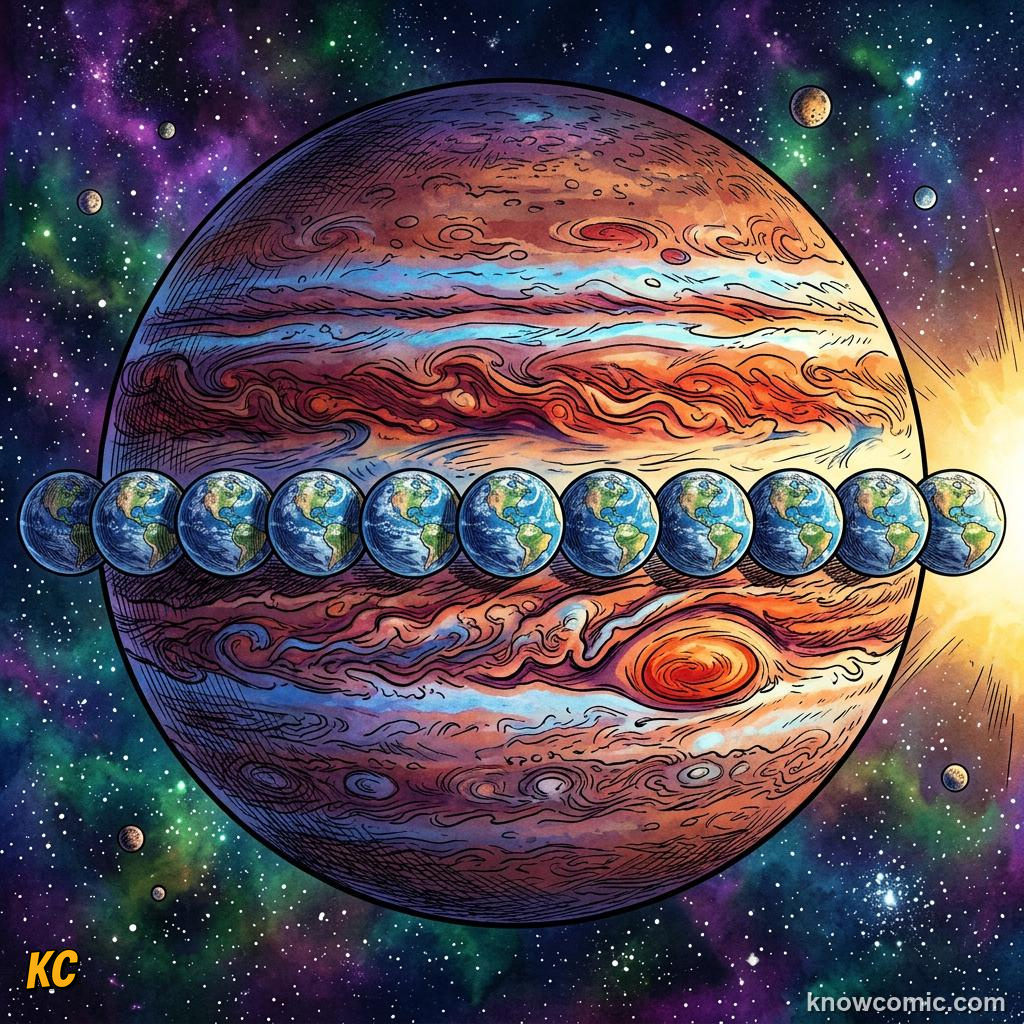
📏 Wider than 11 Earths across ⚖️ Heaviest planet by far
GALILEO
🌙 Four large moons spotted in 1610 🔭 Proof not everything orbits Earth
PAGE 2 OF 5 — MADE OF GAS
NO GROUND
INSIDE THE CLOUD KING
Jupiter is mostly hydrogen and helium, similar to the Sun but not massive enough to shine by fusion. Colorful zones and belts are clouds of ammonia and water ice at different heights. The famous Great Red Spot is a giant storm wider than Earth that has raged for hundreds of years. Deep inside, pressure squeezes hydrogen until it acts like liquid metal, generating a huge magnetic field. Any probe would be crushed long before reaching a small rocky core.
💨 HYDROGEN
Jupiter's atmosphere is mostly hydrogen and helium with clouds of ammonia ice and water ice.
GAS!
BANDS
🌈 Zones and belts circle the planet 🌀 Storms can last centuries
DEEP
⚡ Metallic hydrogen deep inside 🧲 Strong magnetic field
CORE
🪨 Small rocky core may hide deep ⬇️ No surface to land on
PAGE 3 OF 5 — MOON CITY
IO
🌋 Most volcanic body known 🔥 Tidal heating from Jupiter
EUROPA
🧊 Ice shell over hidden ocean 🦠 Scientists ask if life could exist
MANY MOONS
A MINI SOLAR SYSTEM
Jupiter hosts a huge family of moons. The four Galilean moons are the largest, but astronomers have found more than 90 confirmed moons and keep discovering tiny ones. Ganymede is the biggest moon in the solar system, even larger than Mercury. Io is covered in active volcanoes. Europa hides a salty ocean under ice that might harbor life. Each moon is a world with its own geology, heated by Jupiter's powerful gravity squeezing and flexing them.
🌙 MOONS
Jupiter has more than 90 known moons, from giant Ganymede to small captured asteroids.
MOONS!
PAGE 4 OF 5 — COSMIC VACUUM
GUARDIAN
JUPITER TAKES THE HIT
Jupiter's enormous gravity pulls in comets and asteroids. In 1994, pieces of Comet Shoemaker-Levy 9 slammed into Jupiter while telescopes watched. Some scientists think Jupiter shields Earth by flinging dangerous objects away or swallowing them. Others note it can also send objects inward. Still, life on Earth may have benefited from Jupiter catching some ancient impactors. NASA's Juno spacecraft has orbited Jupiter since 2016, studying its clouds, magnetic field, and deep interior.
🛡️ SHIELD
Jupiter's gravity strongly influences asteroids and comets, sometimes protecting inner planets and sometimes redirecting them.
HIT!
COMET
☄️ Shoemaker-Levy 9 crashed in 1994 🔭 Telescopes watched live
JUNO
🛰️ Orbiter maps interior since 2016 📡 Still sending new data
GRAVITY
🛡️ Can shield or redirect rocks 🪐 Shapes asteroid paths
PAGE 5 OF 5 — JUPITER FACTS
WRAP UP
THE SYSTEM'S GIANT
Jupiter is the largest planet, with more mass than all others combined and room for about 1,300 Earths inside. It is a stormy gas giant with more than 90 moons, including volcanic Io and icy Europa. Its gravity shapes the solar system, catching or deflecting many small bodies. Understanding Jupiter helps explain how planetary systems form and stay stable.
GIANT!
LEGACY
🟠 Dominates outer solar system 🌙 Moons are worlds of their own
REMEMBER
🪐 KEY FACTS
Jupiter has more mass than all other planets combined. About 1,300 Earths fit inside it. It has more than 90 moons and strong gravity that affects comets and asteroids.
🟠 Largest planet, mostly hydrogen and helium 🌙 Io, Europa, Ganymede, Callisto are the big four 🛡️ Gravity influences impactors near Earth
🧠 QUIZ TIME!
🟠 JUPITER · 5 QUESTIONS
QUESTION 01
Which planet has the most mass in the solar system?
QUESTION 02
About how many Earths could fit inside Jupiter?
QUESTION 03
Which moons did Galileo discover around Jupiter in 1610?