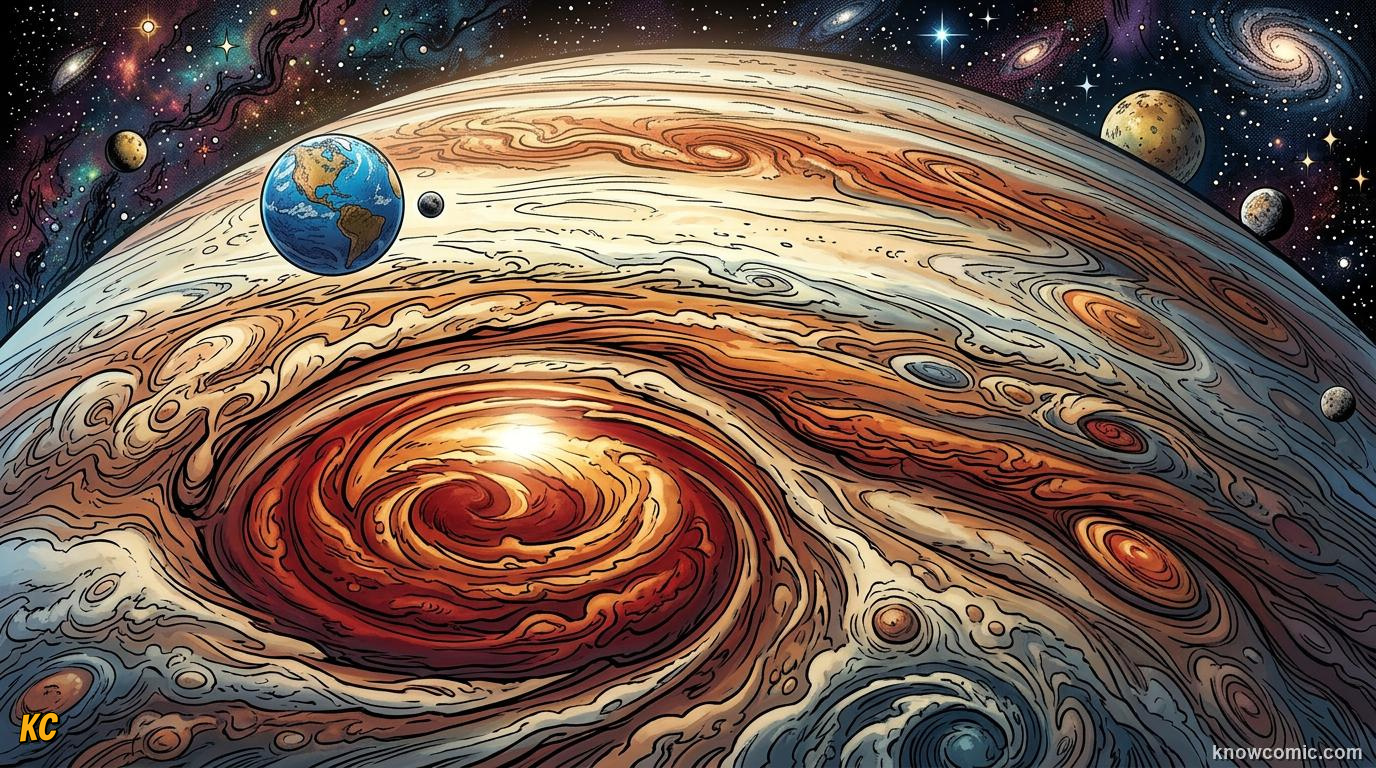
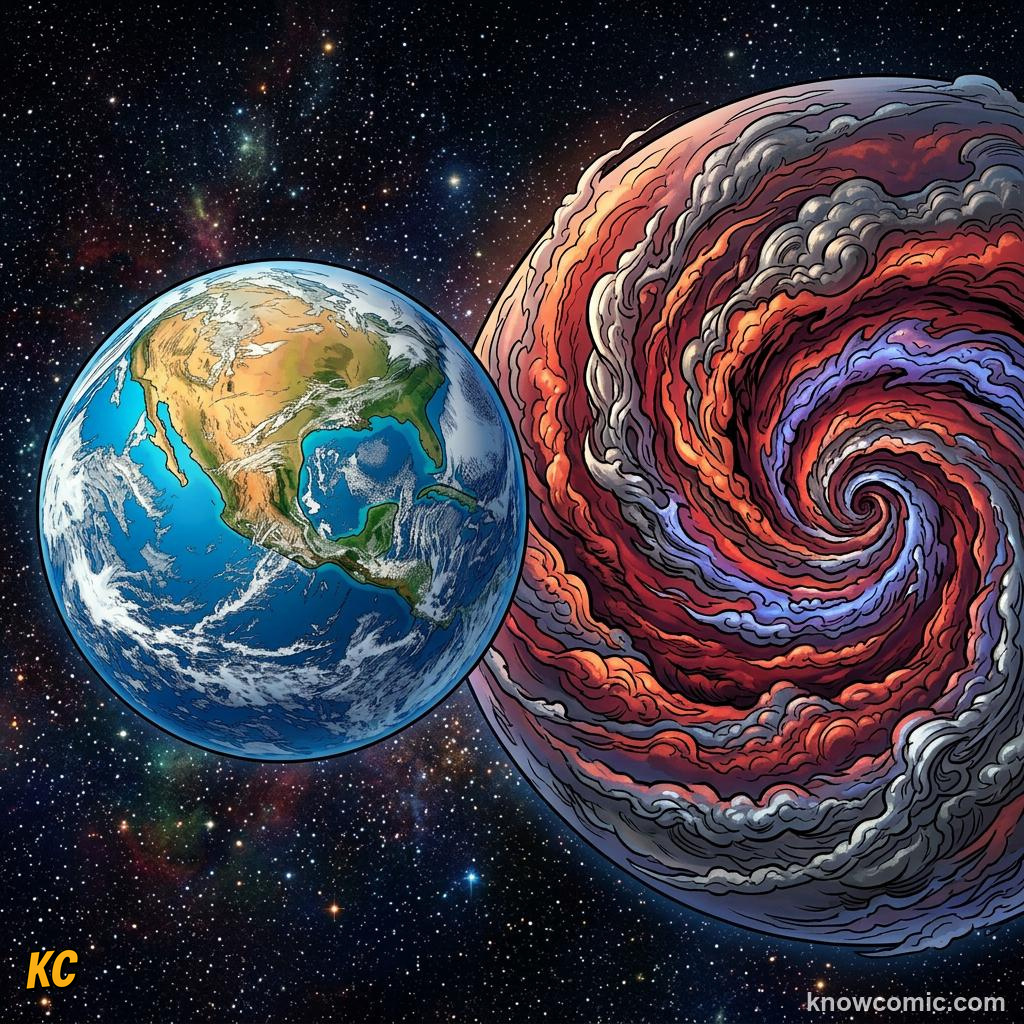
Look at a picture of Jupiter and one feature jumps out: a huge reddish oval called the Great Red Spot. It is a storm, a swirling anticyclone in the planet's southern hemisphere. Winds can reach hundreds of kilometres per hour around its edges. The spot is wider than Earth, yet it is just one weather system floating in Jupiter's cloud tops. No storm on Earth comes close to its size or lifetime.
🔴 SPOT
The Great Red Spot is a long-lived anticyclonic storm in Jupiter's atmosphere, wider than Earth.
STORM!
SWIRL

🌀 High-pressure cyclone turns 💨 Fierce winds around edges
SIZE
🌍 Wider than our whole planet 👁️ Visible in small telescopes
PAGE 2 OF 5 — CENTURIES OLD
LONG LIFE
HUNDREDS OF YEARS OF FURY
Astronomers have tracked the Great Red Spot for hundreds of years. Early sketches from the 1600s may show a similar feature, though records are debated. Continuous telescopic observations since the 1800s prove the storm has lasted far longer than any Earth hurricane. Hurricanes on our planet die in days or weeks when they hit land or lose heat. Jupiter has no solid surface and plenty of heat from inside, so storms can keep spinning.
⏳ TIME
The Great Red Spot has been observed for hundreds of years, far longer than any Earth storm.
ANCIENT!
LOGS
📜 Drawings date back centuries 🔭 Never stopped watching
EARTH
🌪️ Our storms end quickly 🪐 Jupiter storms can endure
RECORD
⏳ Longest storm we track 📖 Sketch books span eras
PAGE 3 OF 5 — WHY RED
CLOUDS
☁️ Ammonia and water ice layers ⚡ Chemistry colors the storm
BANDS
↔️ Winds shear around the spot 🌀 Spin keeps it alive
COLORS
CHEMISTRY IN THE CLOUDS
Scientists still debate exactly why the spot looks red-orange. Jupiter's clouds contain ammonia, water ice, and chemicals that change color when sunlight and lightning alter them. Deeper red compounds may be pulled upward in the storm. The spot sits between bands of clouds moving in opposite directions, which feeds its spin. Smaller white ovals and brown barges also drift through Jupiter's atmosphere, but none are as famous.
🎨 COLOR
Sunlight and chemistry in ammonia clouds may create the reddish hues of the Great Red Spot.
RED!
PAGE 4 OF 5 — SHRINKING
CHANGING
THE SPOT IS GETTING SMALLER
Since regular measurements began, the Great Red Spot has been shrinking. In the late 1800s its longest axis spanned about 39,000 km, big enough to swallow three Earths side by side. By the time Voyager flew past in 1979 it was smaller. Recent Hubble images show it is now only a little wider than Earth and becoming more circular. Astronomers do not know if it will stabilize or fade away in coming decades.
📉 SHRINK
The Great Red Spot has shrunk for more than a century and is now only a little wider than Earth.
SMALLER!
DATA
📏 Long axis measured yearly 🔭 Hubble tracks the change
SHAPE
⭕ Oval turning more round ❓ Future still uncertain
SIZE
📉 Once held three Earth widths 🌍 Now near one Earth wide
PAGE 5 OF 5 — SPOT FACTS
WRAP UP
JUPITER'S LEGENDARY STORM
The Great Red Spot is a giant anticyclone wider than Earth for most of recorded history. It has raged for hundreds of years because Jupiter has no land to stop it and plenty of heat below. Its red color comes from complex cloud chemistry. It has been shrinking for over a century, and scientists watch it closely. The spot reminds us that gas giants are living worlds of weather, not quiet balls of gas.
SPOT!
WATCH
🛰️ Spacecraft and Hubble monitor it 🌀 Storm may change or fade
REMEMBER
🪐 KEY FACTS
The Great Red Spot is a huge long-lived storm on Jupiter, once wider than several Earths but shrinking for over a century. It spins between Jupiter's cloud bands with fierce winds.
🌀 Anticyclone storm in Jupiter's clouds 📏 Once much larger than Earth 📉 Shrinking for more than a century
🧠 QUIZ TIME!
🌀 GREAT RED SPOT · 5 QUESTIONS
QUESTION 01
What is the Great Red Spot?
QUESTION 02
How does the Great Red Spot compare to Earth?
QUESTION 03
Why can the spot last so much longer than Earth hurricanes?