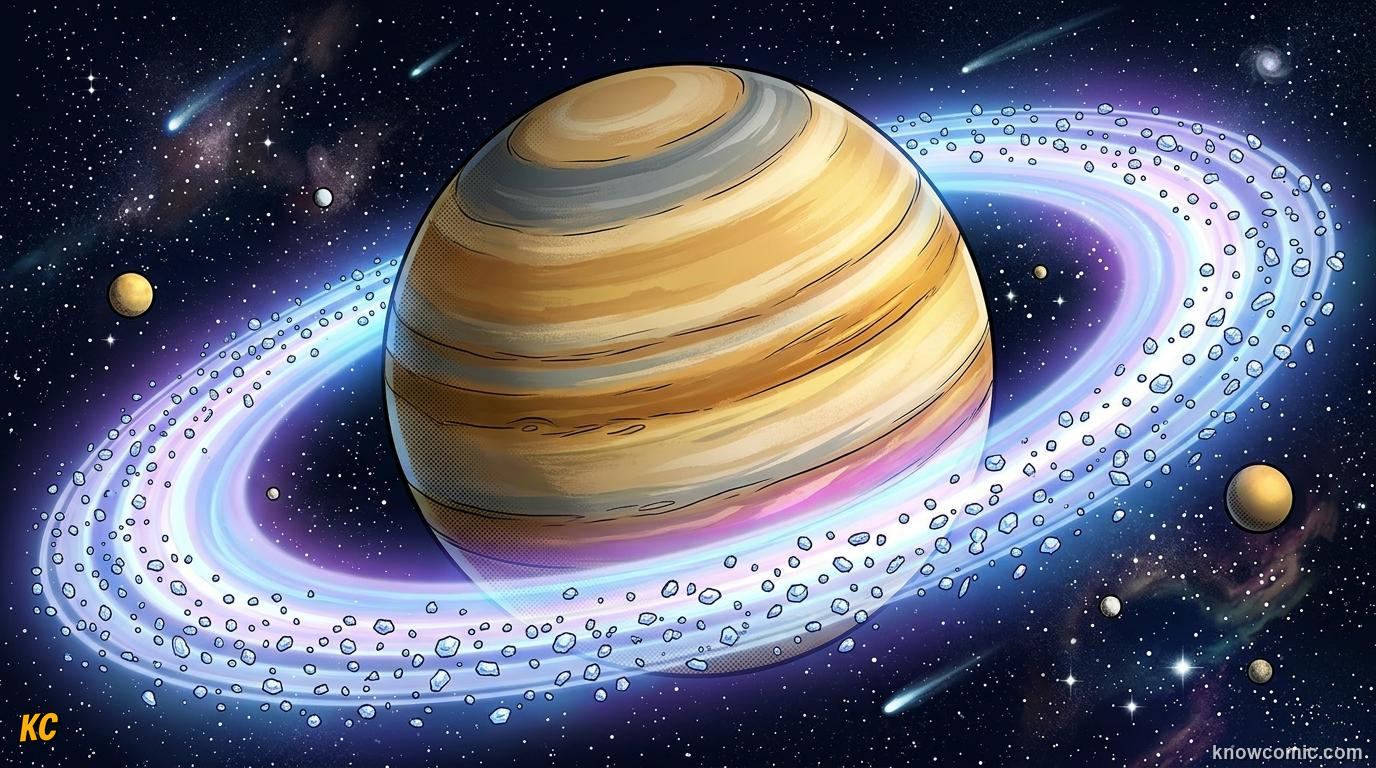
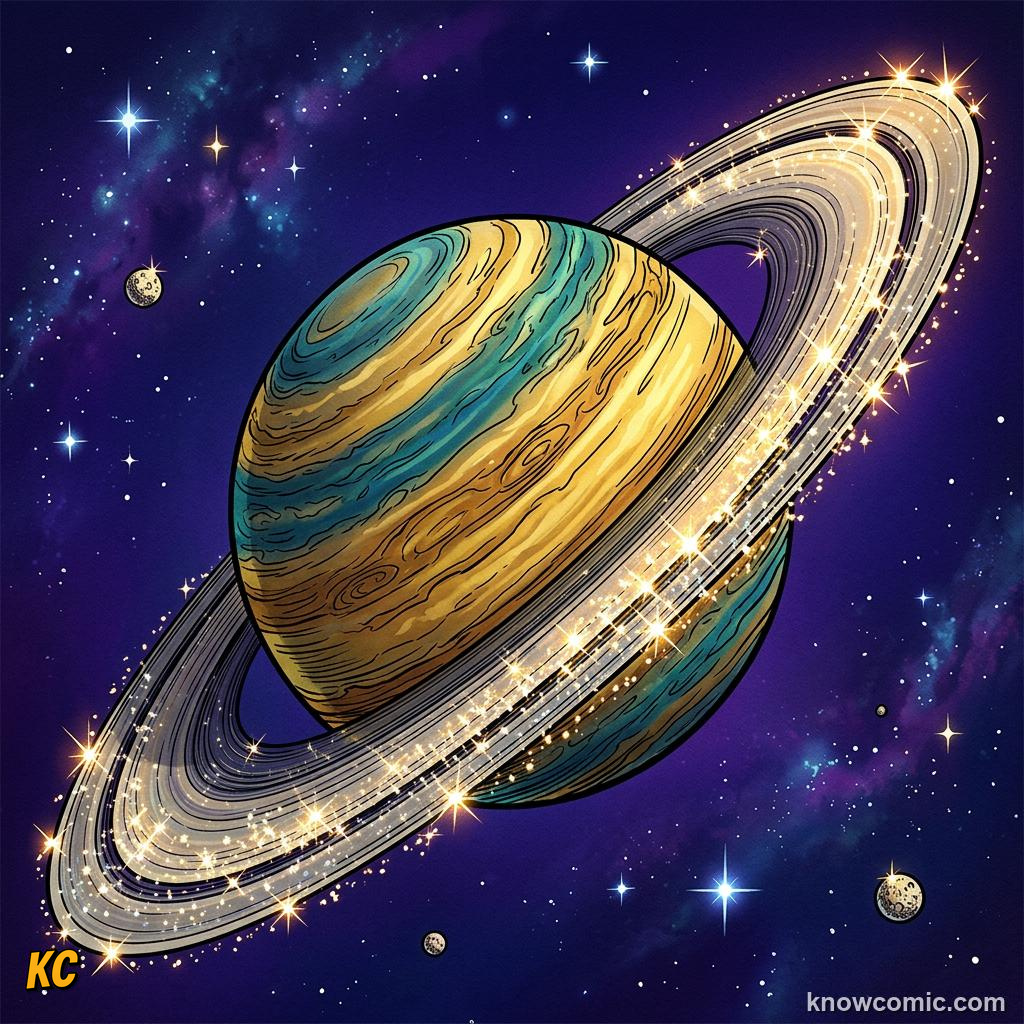
Saturn is famous for its rings. Through a small telescope they look like a flat halo around the planet. The rings are not solid sheets. They are made of billions of separate particles, mostly water ice, from dust-sized grains to chunks as big as houses. Each piece orbits Saturn like a tiny moon. Sunlight glints off the ice and makes Saturn the most beautiful planet in the sky.
💍 DISK
Saturn's ring system spans about 282,000 km from side to side, yet is only meters thick in many places.
JEWEL!
ICE
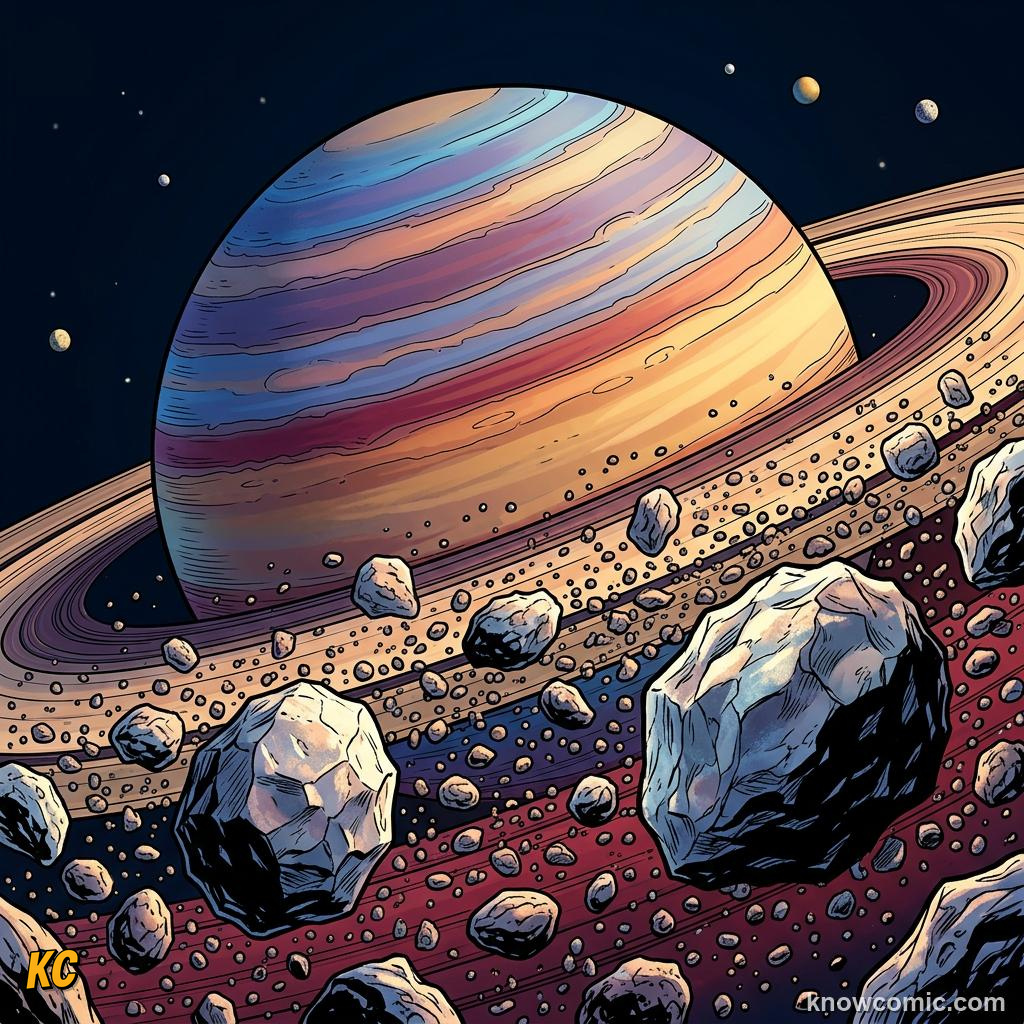
🧊 Mostly water ice particles ✨ Sunlight makes them shine
ORBITS
🔄 Each chunk has its own path 🪐 Gravity keeps them circling
PAGE 2 OF 5 — THIN BUT WIDE
PAPER THIN
SIZE THAT FOOLS THE EYE
If you built a scale model, Saturn's rings would be incredibly wide yet paper thin. They stretch more than seven times the planet's diameter, but their vertical thickness is often just a few meters to tens of meters in many regions. That is why they can almost disappear when we see them edge-on from Earth. The rings are so flat that from the side they reflect very little light toward us.
📏 THIN
Despite spanning about 282,000 km, much of the ring disk is only meters to tens of meters thick.
FLAT!
WIDE
↔️ Hundreds of thousands of km across 📐 Yet only meters tall
EDGE
👁️ Edge-on view hides them 🔭 Telescopes need good angle
SCALE
🪐 Wider than seven Saturn diameters 📏 Thickness like paper
PAGE 3 OF 5 — HOW THEY FORMED
IDEAS
💥 Broken moon theory 🌫️ Leftover ice and rock theory
GAPS
🌙 Moons sculpt ring lanes 📛 Names like A ring and B ring
ORIGIN
SHATTERED MOONS OR LEFT OVERS
Scientists debate exactly how Saturn's rings formed. One idea is that a moon wandered too close and was torn apart by Saturn's gravity. Another is that the rings are leftover material from the early solar system that never made a moon. What is clear is that different ring bands, named A, B, and C among others, have gaps carved by small moons. Shepherd moons herd particles with their gravity like border collies with sheep.
🌙 SHEPHERD
Tiny moons like Pan and Daphnis clear gaps and keep ring edges sharp with their gravity.
BIRTH!
PAGE 4 OF 5 — DISAPPEARING?
TWO STORIES
ILLUSION AND SLOW RAIN
Sometimes headlines say Saturn's rings are disappearing. One reason is an optical illusion: about every 13 to 15 years we see the rings nearly edge-on from Earth, so they seem to vanish even though they are still there. Separately, NASA data show icy ring material slowly falling into Saturn as ring rain. That process may empty the rings over hundreds of millions of years, but they are not gone tomorrow.
👁️ ILLUSION
Ring plane crossings make the rings look invisible from Earth for a while, then they return to view.
RAIN!
EDGE ON
🌍 We see rings thin every ~15 years 🔭 They come back as Saturn tilts
FUTURE
🌧️ Ring rain feeds Saturn slowly ⏳ Hundreds of millions of years
HEADLINES
📰 Edge-on is not permanent loss 🔬 Cassini measured real ring rain
PAGE 5 OF 5 — RING FACTS
WRAP UP
SATURN'S ICY HALO
Saturn's rings are a disk of ice and rock particles about 282,000 km wide but only meters thick in many places. They are not solid and they change how we see Saturn from Earth. Edge-on views hide them temporarily. Over geologic time, ring rain may slowly drain them. Spacecraft like Cassini taught us they are dynamic and beautiful.
RINGS!
SEE THEM
🔭 Best views when rings are open 🛰️ Cassini mapped them in detail
REMEMBER
🪐 KEY FACTS
Saturn's rings are billions of ice and rock particles spanning about 282,000 km but only meters thick in many places. They can seem to vanish edge-on from Earth. Ring rain may slowly remove them over hundreds of millions of years.
💍 Particles orbit individually, not as a solid sheet 📏 Wide but incredibly thin 👁️ Edge-on views hide them temporarily
🧠 QUIZ TIME!
💍 SATURN'S RINGS · 5 QUESTIONS
QUESTION 01
What are Saturn's rings mostly made of?
QUESTION 02
About how wide is Saturn's ring system?
QUESTION 03
Why can Saturn's rings seem to disappear from Earth?