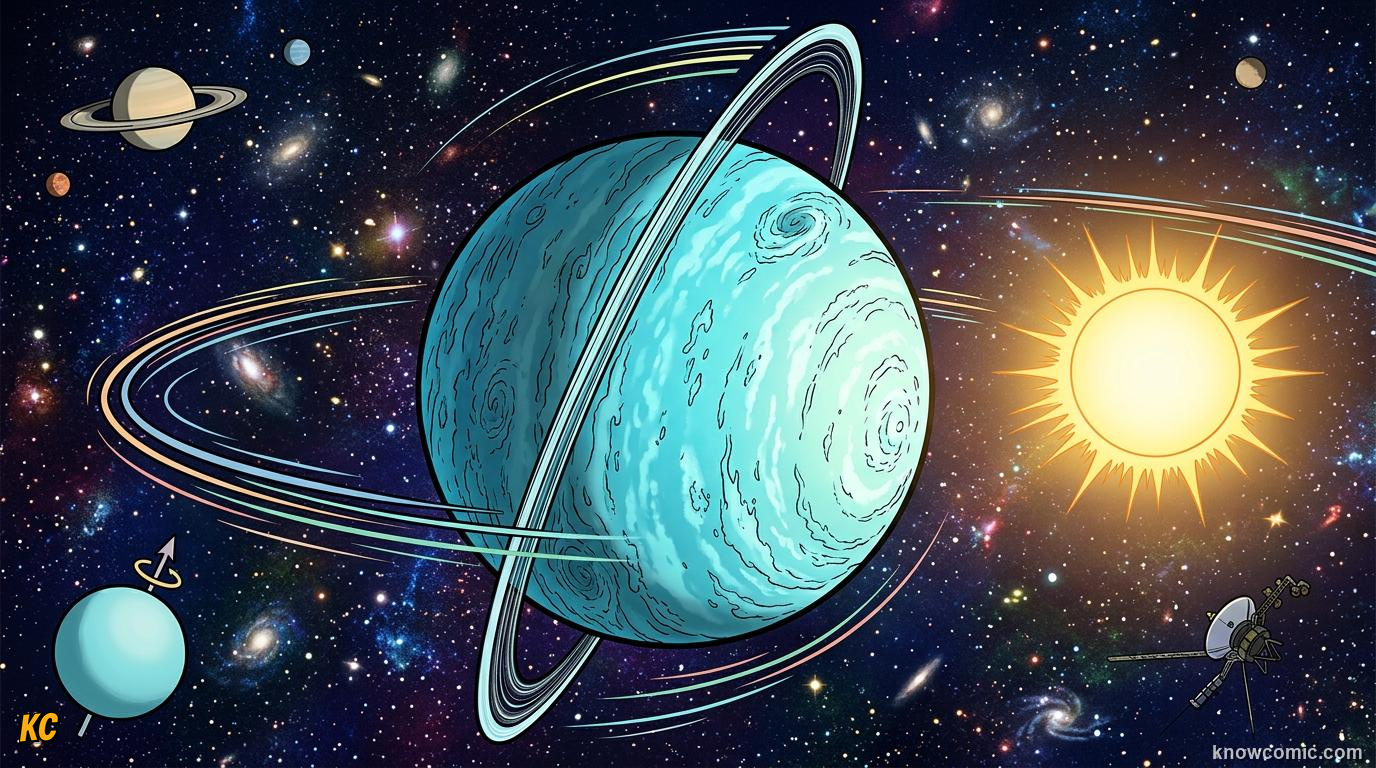
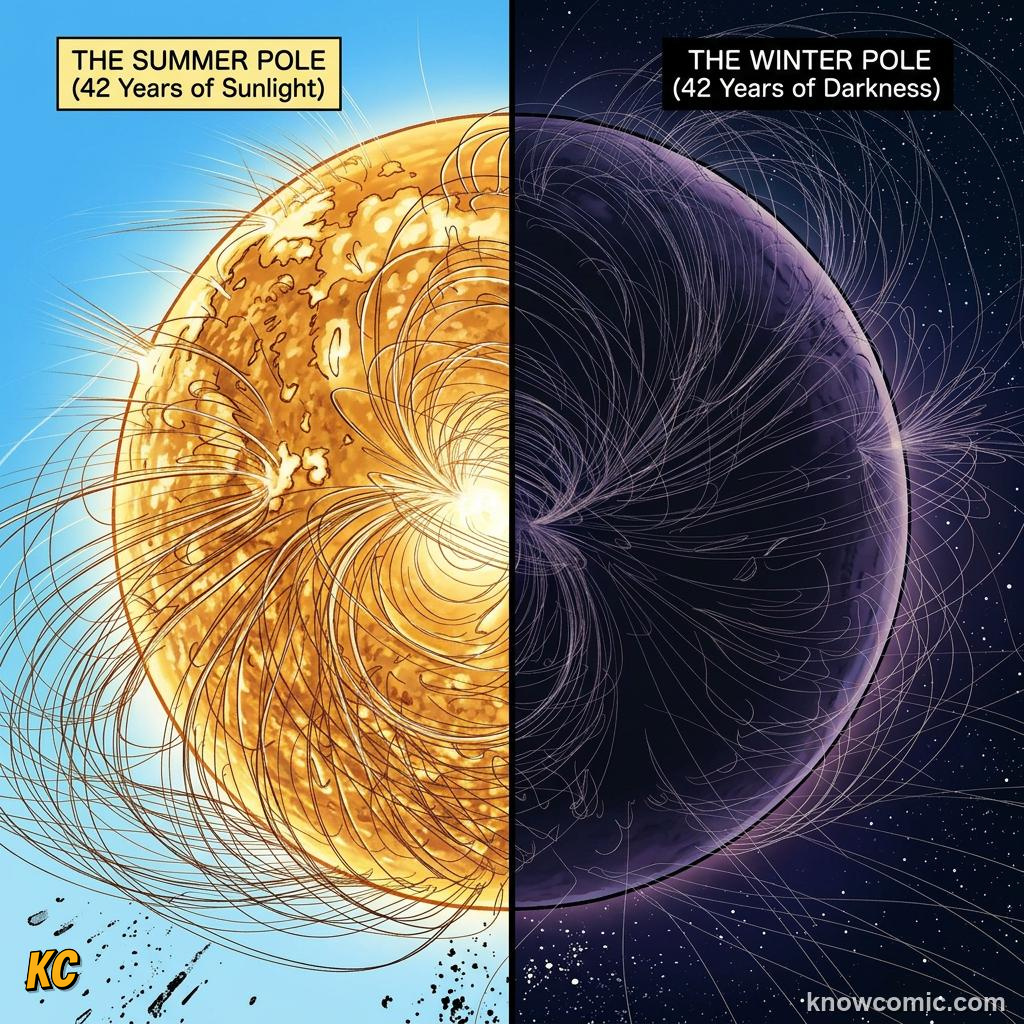
Most planets spin like tops with their poles slightly tilted. Uranus is different. Its rotation axis is tilted about 98 degrees compared with its orbit, so the planet rolls around the Sun on its side. If Earth worked this way, the Arctic might point toward the Sun for months of blazing daylight, then away for months of darkness. Uranus takes about 84 years to orbit once, so each pole can get roughly 42 years of continuous sunlight followed by 42 years of darkness.
🔄 TILT
Uranus's axis is tilted about 98 degrees, the most extreme tilt of any major planet.
ROLL!
AXIS
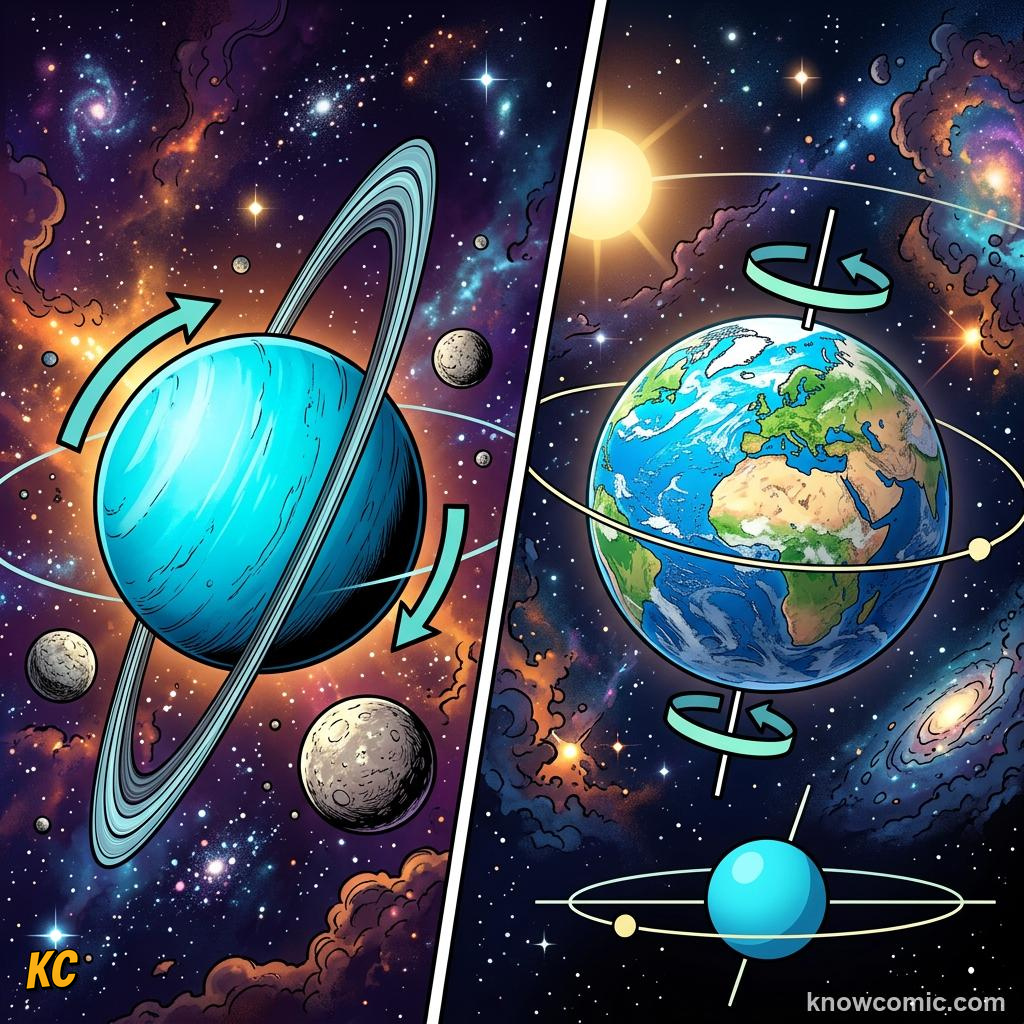
↔️ Planet rolls on its side 🌓 Poles take turns facing Sun
YEARS
⏱️ ~42 years light per pole 🌑 Then ~42 years dark
PAGE 2 OF 5 — ICE GIANT
BLUE WORLD
NOT A GAS GIANT LIKE JUPITER
Uranus is an ice giant, not a Jupiter-style gas giant. Its interior holds water, ammonia, and methane ices under huge pressure, wrapped in a hydrogen and helium atmosphere. Methane gas absorbs red light and reflects blue-green, giving Uranus its calm pastel color. Do not let the quiet look fool you. Winds still blow and clouds still move, but the planet appears smoother than Jupiter or Saturn.
🧊 ICE
Ice giants contain more water, ammonia, and methane ices than Jupiter and Saturn.
BLUE!
METHANE
💙 Methane colors the clouds 🌫️ Pale calm appearance
INSIDE
💧 Water and ammonia ices deep 🪐 No solid surface to stand on
CALM
🌬️ Still has winds and clouds 🔭 Looks smooth from far away
PAGE 3 OF 5 — RINGS AND MOONS
SHAKESPEARE
📚 Moons named from plays 🌙 Titania and Oberon are largest
MIRANDA
🧩 Bizarre mixed-up surface 🔭 Rings are hard to see
FAINT HALO
URANUS HAS RINGS TOO
Saturn steals the spotlight, but Uranus has thin, dark rings discovered in 1977 when they briefly blocked a star's light. The planet also hosts more than two dozen known moons. The largest are Miranda, Ariel, Umbriel, Titania, and Oberon, named for characters in Shakespeare plays. Miranda shows jumbled terrain that looks like a moon torn apart and reassembled.
💍 RINGS
Uranus has faint rings of dark dust and rock, discovered when they occulted a distant star.
MOONS!
PAGE 4 OF 5 — MYSTERY TILT
WHAT HAPPENED?
A GIANT CRASH MAYBE
Nobody knows for sure why Uranus tilts so far. A leading guess is that a Mars-sized object smashed into young Uranus long ago, knocking it on its side. Another idea involves several smaller hits or gravitational tugs from moons over time. Whatever happened, the tilt shapes extreme seasons. Near the equator during solstice, the Sun can crawl in tiny circles in the sky instead of rising and setting normally.
💥 IMPACT
A giant collision early in history is a popular explanation for Uranus's extreme axial tilt.
WHY?
CRASH
💥 Big impact hypothesis 🌙 Or slow gravitational nudges
SKY
☀️ Sun moves oddly at equator ❓ Still an open mystery
SEASONS
🌓 Extreme pole lighting 🔄 Tilt shapes whole year
PAGE 5 OF 5 — URANUS FACTS
WRAP UP
THE ROLLING ICE GIANT
Uranus rolls on its side with a tilt near 98 degrees. Each pole can face the Sun for about 42 years. It is an ice giant colored blue-green by methane, with faint rings and many moons. Voyager 2 is the only spacecraft to visit, flying past in 1986. Uranus remains one of the least explored major planets.
ROLL!
VISIT
🛰️ Voyager 2 in 1986 only 🔭 Telescopes still watch seasons
REMEMBER
🪐 KEY FACTS
Uranus is tilted about 98 degrees and rolls on its side. Each pole gets about 42 years of sunlight then darkness. It is an ice giant with methane blue color, faint rings, and many moons.
🔄 Most extreme tilt of any major planet 🧊 Ice giant with water and methane ices 💍 Thin dark rings and Shakespeare moons
🧠 QUIZ TIME!
🔄 URANUS TILT · 5 QUESTIONS
QUESTION 01
About how much is Uranus's axis tilted?
QUESTION 02
How long can one pole on Uranus face the Sun continuously?