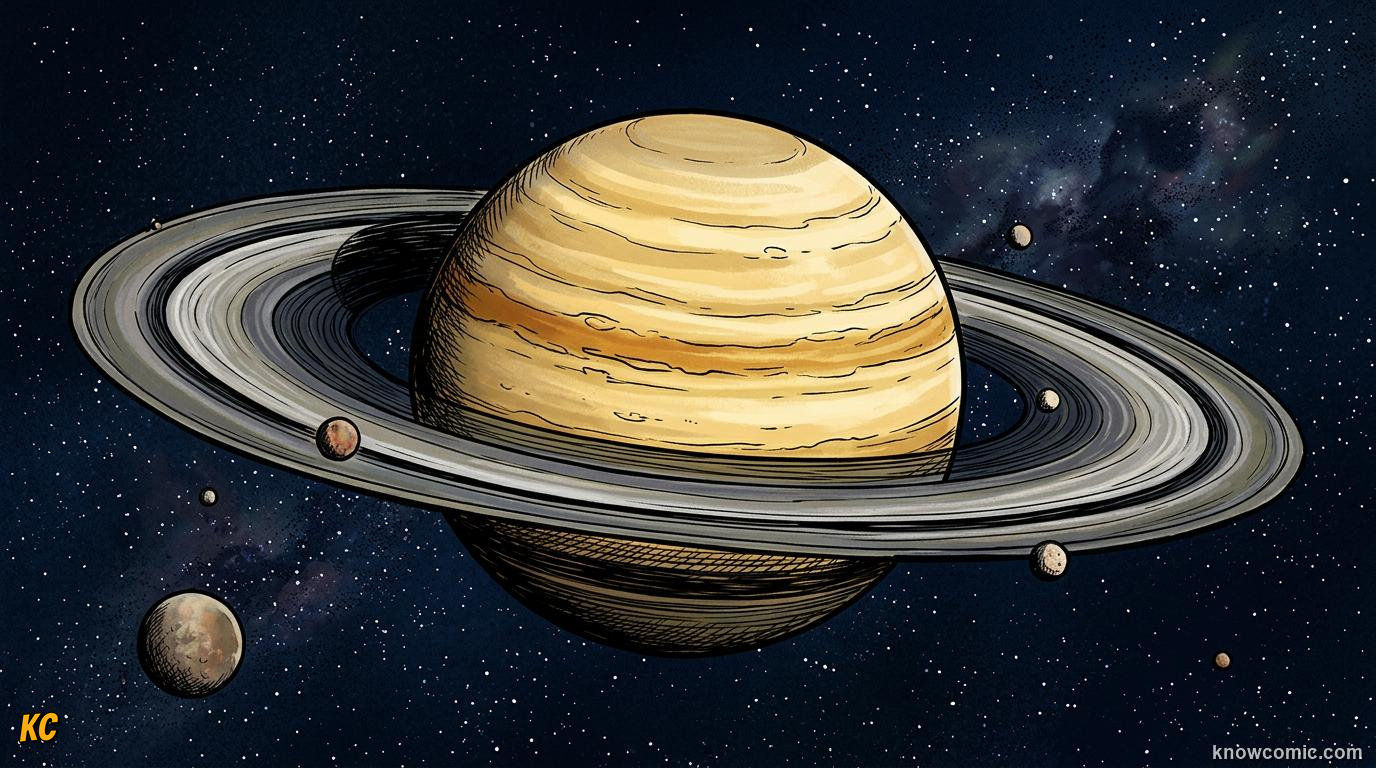
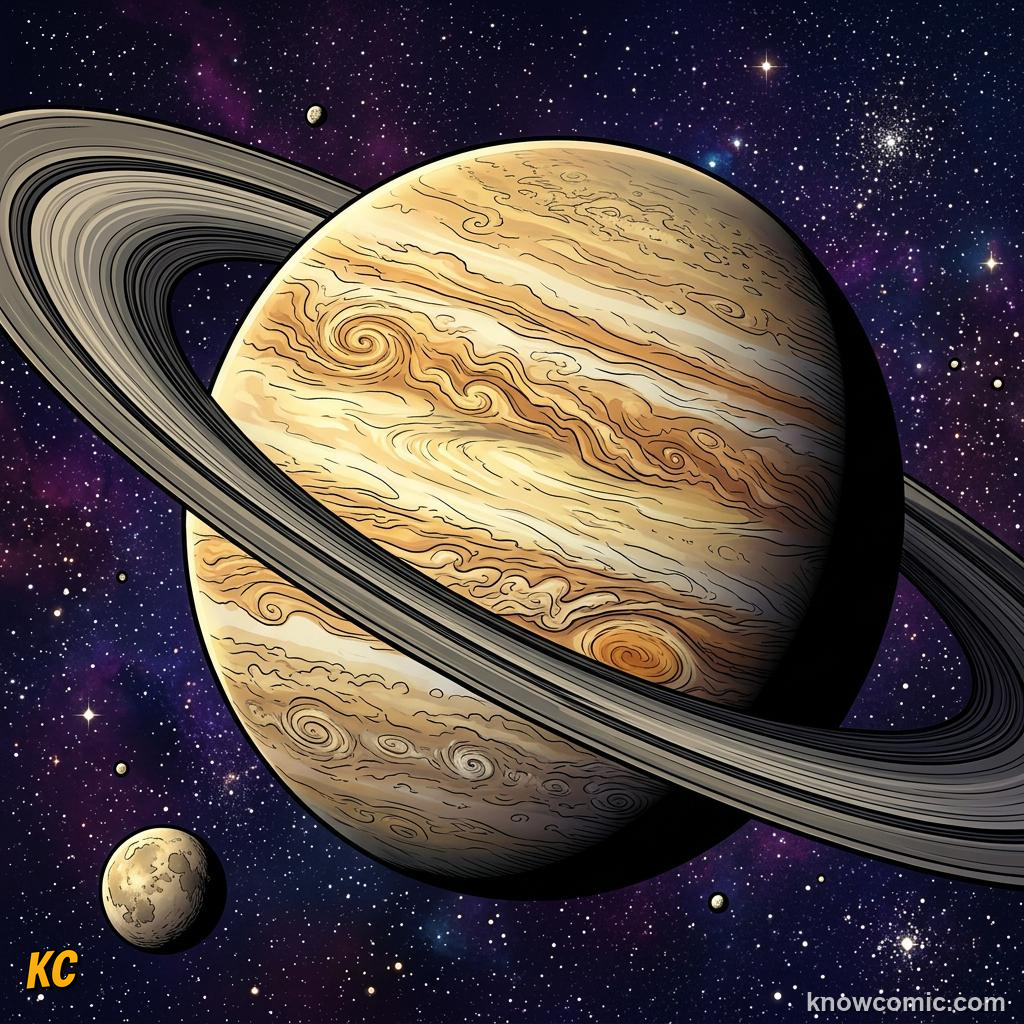
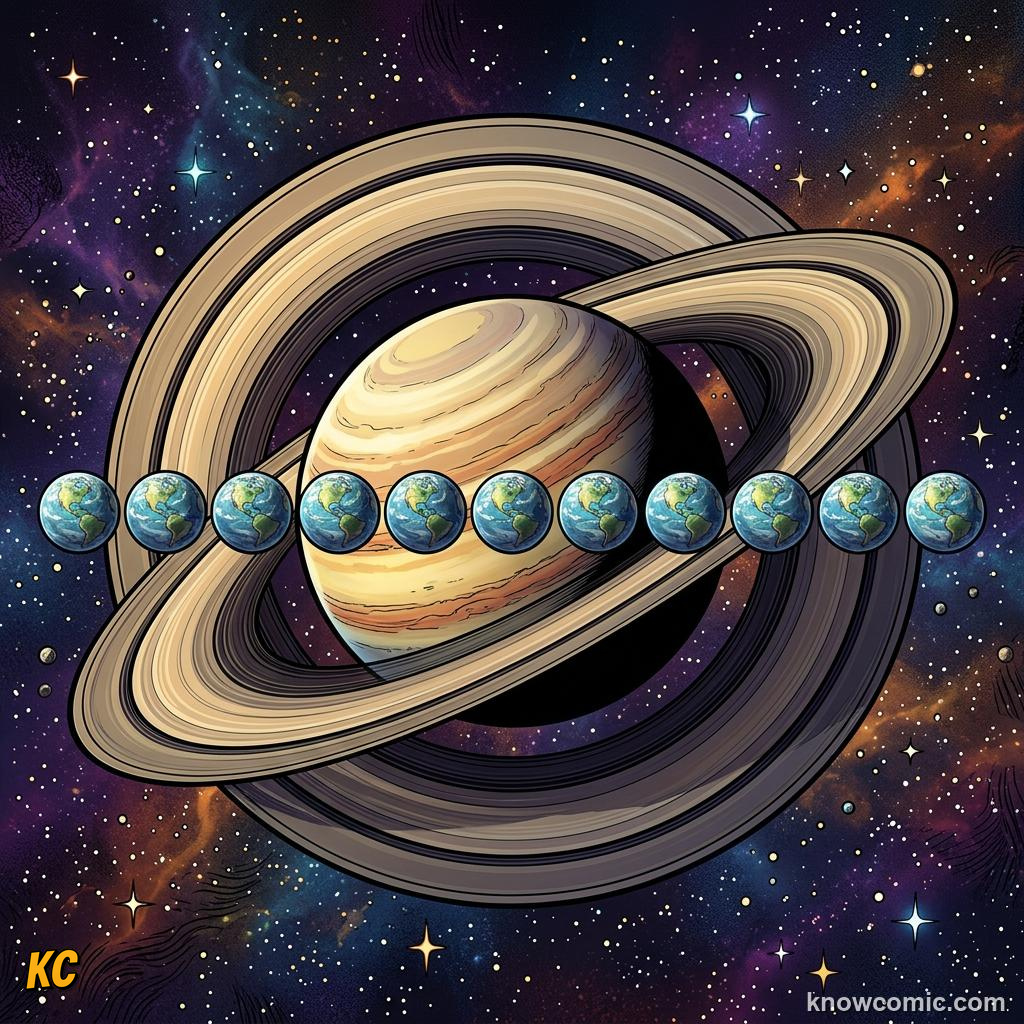
Saturn is the sixth planet from the Sun and the second largest after Jupiter. It is a gas giant about nine times wider than Earth, made mostly of hydrogen and helium with a possible rocky core deep inside. Its pale gold color comes from ammonia crystals in the upper clouds. While rings grab attention, Saturn itself is a world of deep winds, layered clouds, and strange polar weather unlike anywhere else.
🪐 SIZE
Saturn is about nine times Earth's diameter and is the second largest planet in the solar system.
GOLD!
GAS
💨 Hydrogen and helium bulk ☁️ Ammonia haze colors clouds
CORE
🪨 Rocky core may hide deep 🌬️ Winds race in atmosphere
PAGE 2 OF 5 — WOULD IT FLOAT?
LOW DENSITY
SATURN IS SURPRISINGLY LIGHT
Here is a famous science fact: Saturn's average density is less than liquid water. If you could find a bathtub big enough, Saturn would float, leaving most of the planet above the waterline. That does not mean Saturn is hollow. The planet is huge, but its gases are spread out over a vast volume. A piece of Saturn's atmosphere would still be heavier than the same size cup of water.
💧 FLOAT
Saturn is the only planet with average density lower than water, so it would float in a huge pool.
LIGHT!
DENSITY
📉 Less dense than water on average 🛁 Famous bathtub thought experiment
GAS
💨 Mostly light hydrogen 📦 Huge volume spreads mass
FACT
🌍 Only planet less dense than water ⚖️ Average density, not every bit
PAGE 3 OF 5 — MOON FAMILY
LAKES
🌊 Methane seas on Titan 🌫️ Thick nitrogen air
ENCELADUS
💦 Ice geysers from south pole 🔬 Possible hidden ocean
MANY MOONS
TITAN STANDS OUT
Saturn has well over 100 known moons and keeps discovering more. Titan is the largest, bigger than Mercury, with a thick nitrogen atmosphere and lakes of liquid methane and ethane. Enceladus shoots geysers of water ice from cracks near its south pole, hinting at a subsurface ocean. Small shepherd moons shape the rings. Each moon tells part of Saturn's story.
🌙 MOONS
Saturn has well over 100 confirmed moons, more than any other planet in the solar system.
TITAN!
PAGE 4 OF 5 — NORTH POLE HEXAGON
SIX SIDES
A STORM LIKE NO OTHER
At Saturn's north pole sits a huge hexagon-shaped jet stream, each side longer than Earth's diameter. The whole pattern is more than twice as wide as Earth. Voyager spotted it in the 1980s and Cassini watched it for years. Winds race around the hexagon while a central hurricane swirls at the pole. Scientists test spinning water tanks on Earth to mimic how such a shape can form.
⬡ HEX
Saturn's north polar hexagon spans about 20,000 to 30,000 km, far wider than Earth.
SIX!
JET
💨 Winds hundreds of km per hour 🌀 Central polar hurricane
UNIQUE
🌍 Nothing like it on Earth 🔬 Lab tanks mimic shape
NASA
🛰️ Cassini filmed hexagon for years ⬡ Each side longer than Earth
PAGE 5 OF 5 — SATURN FACTS
WRAP UP
RINGS ARE ONLY THE START
Saturn is a gas giant about nine times wider than Earth, with well over 100 moons including Titan and Enceladus. Its average density is lower than water, so it would float in a giant pool. The north polar hexagon is a unique six-sided storm. NASA's Dragonfly mission plans to explore Titan in the 2030s. Saturn is more than its rings.
SATURN!
FUTURE
🚁 Dragonfly mission to Titan 🛰️ Cassini legacy lives on
REMEMBER
🪐 KEY FACTS
Saturn is the second largest planet, about nine times Earth's width. It has well over 100 moons, density lower than water, and a unique north polar hexagon wider than Earth.
💧 Would float in water by average density 🌙 Titan has lakes and thick atmosphere ⬡ Hexagon jet at the north pole