📖 200 Topics🆓 FREE + PRO⏱️ 5 min per comic🧠 Quiz included
🔵
NEPTUNE
Last giant planet
→
🍩
BELT
Donut-shaped icy zone
→
🪐
PLUTO
Famous dwarf planet
→
☄️
COMETS
Short-period visitors
→
✨
TODAY
Thousands of icy worlds
🧊 THE KUIPER BELT
TOPIC 09 · PLANETS & ASTRONOMY · THE SOLAR SYSTEM
PAGE 1 OF 5 — BEYOND NEPTUNE
OUTER RING
THE KUIPER BELT BEGINS
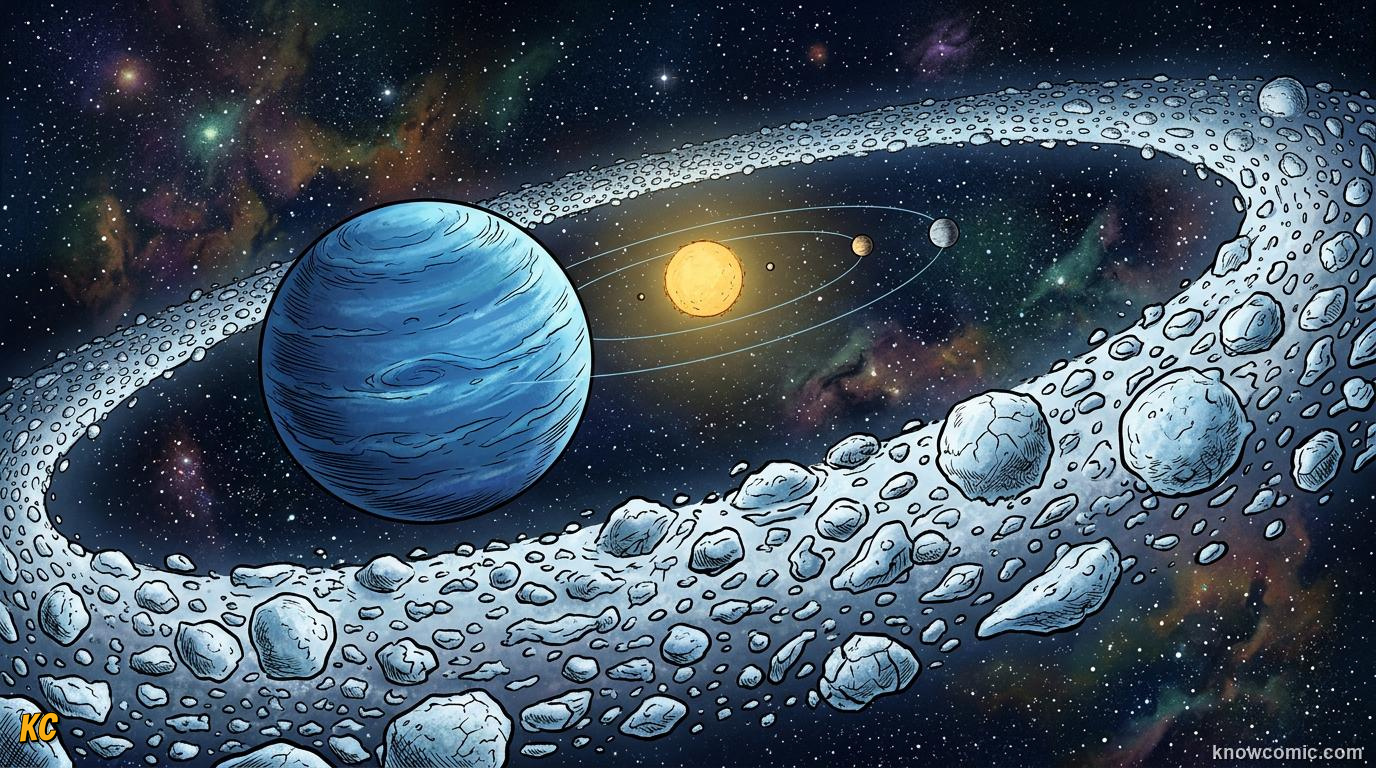
Past Neptune, the solar system is not empty. A broad, flat zone called the Kuiper Belt wraps around the Sun like a cosmic donut. It holds thousands of icy bodies left over from planet formation. Most are small, dark, and frozen. This region is far colder than anywhere on Earth. Sunlight there is dim and weak. Yet these distant worlds tell a huge story about how our solar neighborhood was built.
🍩 SHAPE
The Kuiper Belt is a wide ring, not a solid wall. Icy objects orbit in a flat disk beyond Neptune.
FROZEN!
DISTANCE
🔵 Starts beyond Neptune ❄️ Far colder than Earth
DONUT
🍩 Flat ring around the Sun 🌑 Dim sunlight out there
PAGE 2 OF 5 — ICY LEFTOVERS
COLD BUILDERS
ROCK AND ICE TOGETHER
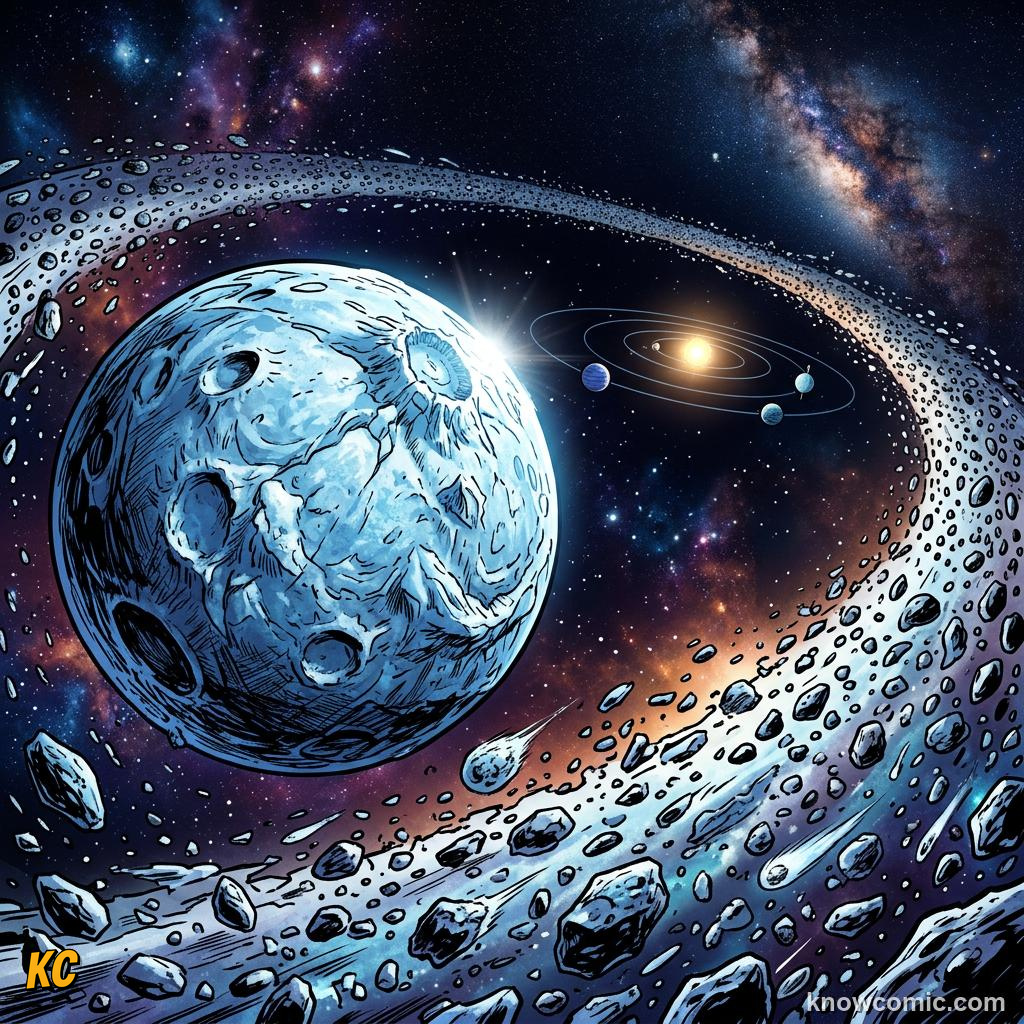
Kuiper Belt objects are mixtures of rock and frozen materials like water ice, methane, and nitrogen. They never grew into full planets. Neptune and the other giants formed closer in, leaving this outer material scattered in a chilly storage zone. Some chunks are tiny. Others, like Pluto and Eris, are big enough to be round dwarf planets. Every object is a frozen fossil from the solar system's youth.
🧊 ICE
Many Kuiper Belt bodies are rich in water ice and other frozen gases that vaporize easily if warmed.
ICEBALLS!
MIX
🪨 Rock plus frozen ices ❄️ Kept cold for billions of years
FOSSILS
📦 Leftover planetesimals 🔭 Hard to see from Earth
COUNT
📊 Thousands known so far 🔎 More await discovery
PAGE 3 OF 5 — PLUTO AND FRIENDS
ERIS
🪐 Nearly Pluto's size 🏷️ Both are dwarf planets
NEW HORIZONS
📸 Close photos of Pluto 🌫️ Nitrogen ice and haze
FAMOUS WORLDS
DWARF PLANETS OF THE BELT
Pluto was once called the ninth planet, but in 2006 astronomers created the dwarf planet category. Pluto shares the Kuiper Belt with Eris, Makemake, Haumea, and many others. Eris is similar in size to Pluto and helped scientists rethink what counts as a planet. These worlds have moons, mountains, and nitrogen ice plains. NASA's New Horizons flew past Pluto in 2015 and sent back stunning close-up images.
🛰️ FLYBY
New Horizons revealed Pluto's heart-shaped glacier and hazy blue atmosphere during its 2015 flyby.
PLUTO!
PAGE 4 OF 5 — COMET FACTORY
INWARD VISITORS
SHORT-PERIOD COMETS
Many comets that return every few years or decades started in the Kuiper Belt. Jupiter's gravity can nudge an icy body inward, where the Sun warms it. Ice vaporizes into gas and dust, forming a glowing coma and tail. Halley's Comet is a famous example of a short-period comet linked to this region. Studying comets is like studying Kuiper Belt material delivered to the inner solar system.
☄️ TAILS
When a Kuiper Belt object falls inward, solar heat releases gas and dust that stream into a tail.
COMETS!
JUPITER
♃ Can redirect icy bodies ☀️ Sun heat makes them glow
RETURN
🔄 Some orbit back repeatedly 📅 Short periods of years
CLUES
🧪 Comet dust holds ice history 🔬 Same stuff as belt objects
PAGE 5 OF 5 — OUTER EDGE
KUIPER ZONE
THE COLD STORAGE RING
The Kuiper Belt is a donut-shaped icy region beyond Neptune. Pluto, Eris, and thousands of smaller bodies orbit there. Many short-period comets begin as Kuiper Belt objects nudged inward. Spacecraft like New Horizons have only begun to explore this frontier. The belt marks where the familiar planets end and the deep outer solar system truly begins.
KUIPER!
NEXT
🛰️ Future probes may visit more 🔭 Telescopes find new bodies
REMEMBER
🪐 KEY FACTS
The Kuiper Belt lies beyond Neptune. It holds icy dwarf planets like Pluto and Eris. Jupiter can send belt objects inward as short-period comets. It is a frozen archive of the outer solar system.
🍩 Donut-shaped icy ring past Neptune 🪐 Pluto and Eris are dwarf planets there ☄️ Source of many short-period comets
🧠 QUIZ TIME!
THE KUIPER BELT · 5 QUESTIONS
QUESTION 01
Where is the Kuiper Belt?
QUESTION 02
What are Kuiper Belt objects mostly made of?
QUESTION 03
Which famous world orbits in the Kuiper Belt?
QUESTION 04
What kind of comets often start in the Kuiper Belt?