📖 100 Topics🆓 ALL FREE⏱️ 5 min per comic🧠 Quiz included
🔄
SPIN
Ball Rotates
→
🌬️
AIR
Pressure Shifts
→
↪️
CURVE
Ball Bends
→
🥅
GOAL
Top Corner
→
🏆
WORLD CUP 2026
Banana Kicks
🌀 THE MAGNUS EFFECT
TOPIC 47 · WORLD CUP 2026 · LEVEL 4 · SCIENCE & TECH
PAGE 1 OF 5 · THE BANANA KICK MYSTERY
PHYSICS MAGIC
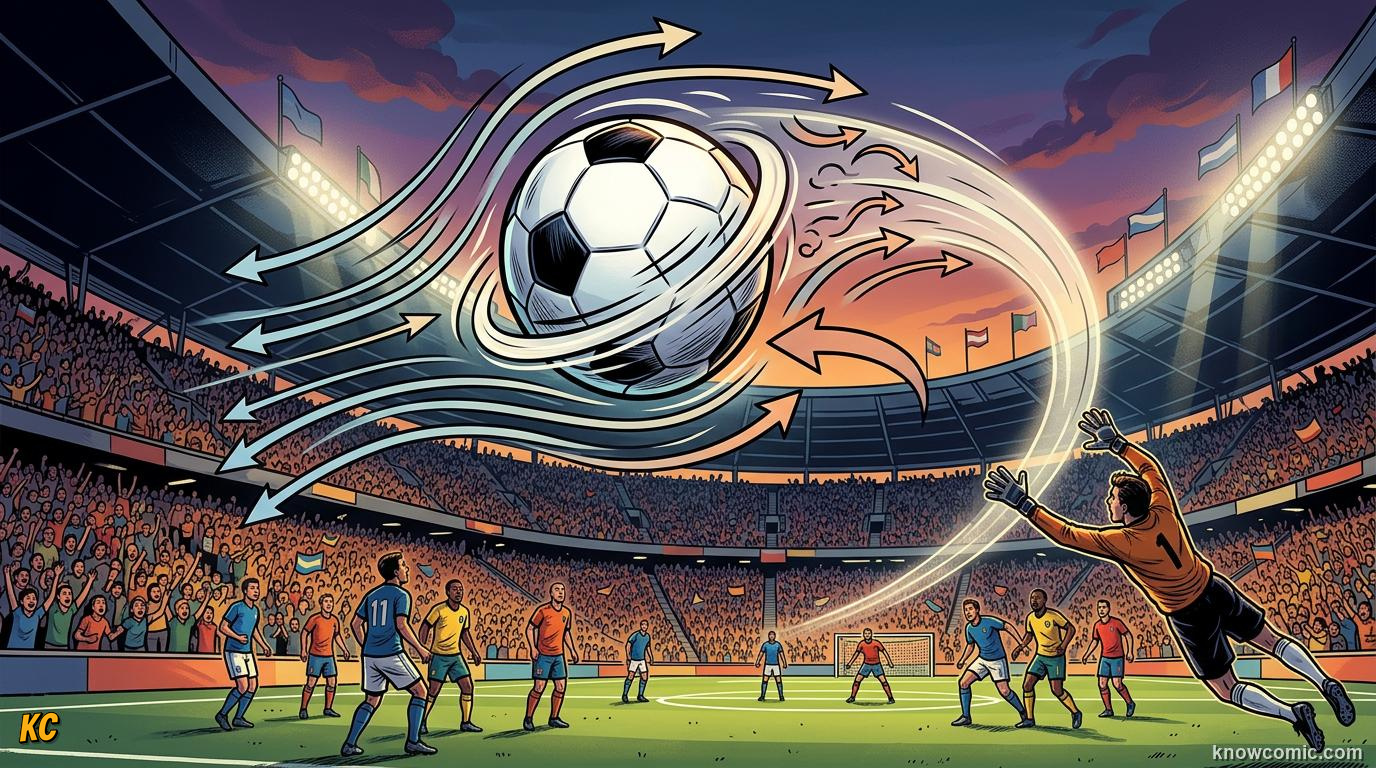
WHY BALLS BEND IN MID-AIR
You have seen it a hundred times. A free kick sails wide of the wall, then suddenly hooks into the top corner like it was pulled by a string. Fans call it a banana kick. Scientists call it the Magnus effect. Named after German physicist Heinrich Magnus, it explains how a spinning object moving through air gets pushed sideways. No magnets. No trickery. Just spin, speed, and air pressure doing their job. Every World Cup produces moments where the ball curves impossibly past a diving keeper. Roberto Carlos against France in 1997. Beckham from impossible angles. Modern stars like Messi and Ward-Prowse bend balls on demand. The Magnus effect is the hidden hand behind football's most beautiful goals. Once you understand it, you will never watch a set piece the same way again.
⚡ DID YOU KNOW?
The Magnus effect also explains why tennis balls dip, baseballs curve, and golf balls hook or slice through the air.
BEND!
FAMOUS
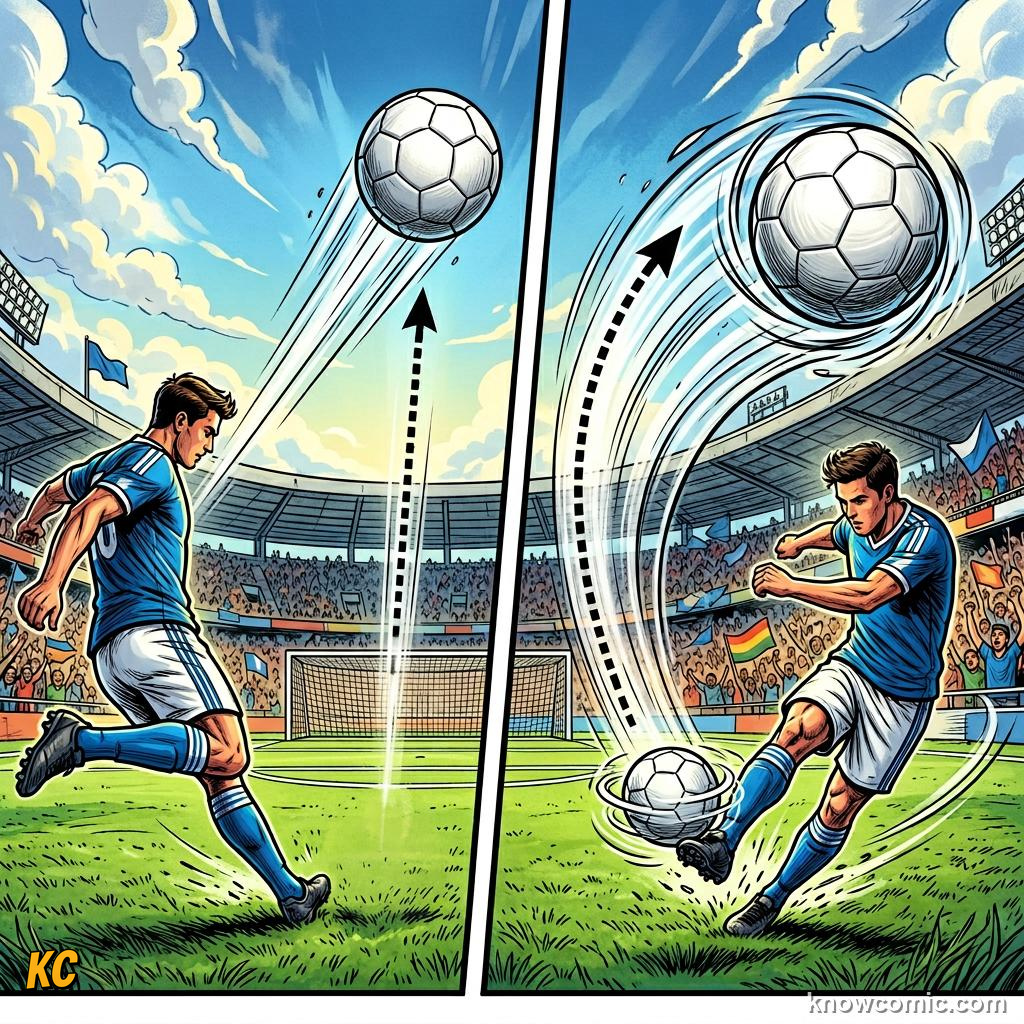
🍌 Banana free kicks stun goalkeepers
⭐ Stars train the skill for years
PHYSICS
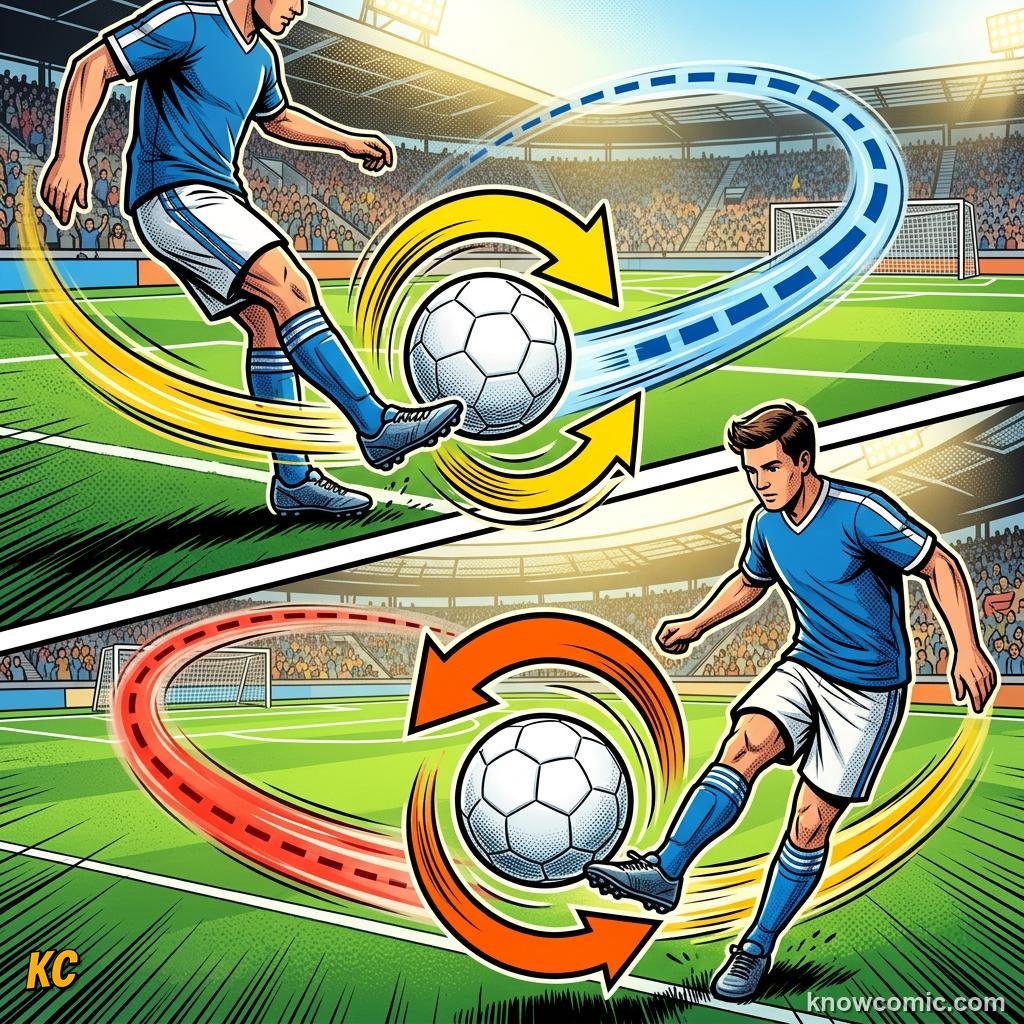
🌀 Spin plus speed equals curve
🌬️ Air pressure does the pushing
PAGE 2 OF 5 · PUTTING SPIN ON THE BALL
THE KICK
HOW PLAYERS CREATE SPIN
Spin starts at the boot. When a player strikes the ball off-centre, the foot brushes around the side and sets the ball rotating. Hit the right side with the instep and the ball spins counter-clockwise from above. Strike the left side and it spins the other way. More brush means more spin. A knuckleball uses almost no spin at all, letting the ball flutter unpredictably. Topspin makes the ball dip sharply, perfect for long shots that drop under the bar. Sidespin creates the sideways curve of a banana kick. Professionals practise thousands of free kicks to find the sweet spot where power and rotation balance perfectly. Too little spin and the ball flies straight. Too much and it curves too early, missing the target. The best set-piece takers can read the wall, pick their spin, and bend the ball around it like a guided missile.
⚡ SPIN RATE
A curling free kick can spin at 8 to 10 revolutions per second. That rotation is what creates the sideways force through the Magnus effect.
SPIN!
INSTEP
👟 Off-centre contact brushes the ball
🔄 Rotation starts at the kick
TOPSPIN
📉 Ball dips sharply toward goal
🎯 Great for long-range shots
SIDESPIN
🍌 Curves around the defensive wall
↪️ Bends toward the far corner
PAGE 3 OF 5 · AIR PRESSURE AT WORK
FAST SIDE
💨 Air rushes with the spinning side
📉 Lower pressure on that side
SLOW SIDE
🐢 Air fights against the spin
📈 Higher pressure pushes the ball
PRESSURE GAP
THE SCIENCE STEP BY STEP
Imagine a ball spinning clockwise as it flies forward. On one side, the ball's surface moves in the same direction as the airflow. Air speeds up and pressure drops. On the opposite side, the surface spins against the airflow. Air slows down and pressure rises. High pressure always pushes toward low pressure. The ball gets shoved sideways toward the low-pressure side. That sideways push is the Magnus force. Stronger spin means a bigger pressure difference and a sharper curve. Faster flight also increases the effect. This is the same principle that gives aircraft wings lift, just applied to a football. The ball is literally being sucked and pushed through the air by pressure. Goalkeepers set their wall to block the straight path, but the Magnus effect lets the ball arc around them. Physics turns an impossible angle into a world-class goal.
⚡ PRESSURE
Fast-moving air creates low pressure. Slow-moving air creates high pressure. The ball always curves toward the low-pressure side.
PUSH!
PAGE 4 OF 5 · CURVE IN ACTION
FREE KICK SCIENCE
FROM WALL TO TOP CORNER
Watch a free kick in slow motion and the curve is beautiful. The ball leaves the boot heading wide. Spin grabs the air within metres. The path bends like a boomerang finding its target. The goalkeeper dives the wrong way because human reflexes expect straight lines. The Magnus effect cheats physics in the best possible way. Crosses use the same trick. An in-swinging corner curves toward goal, tempting keepers to punch it into their own net. Out-swinging crosses drift away from defenders. Even passes on the ground use subtle spin to bend around opponents' legs. At World Cup level, set-piece coaches map the Magnus effect on whiteboards. They study wind direction, ball speed, and spin rate. A headwind slows the ball and increases curve. A tailwind does the opposite. The best players adjust instinctively. Science meets art on every dead ball.
⚡ GOALKEEPER TRAP
Keepers train to read spin from the kicker's run-up and the ball's rotation in flight. A late curve is the hardest shot to save.
CURVE!
WALL
🧱 Wall blocks the straight shot
🍌 Curve goes around the edge
CROSSES
↪️ In-swing and out-swing deliveries
🎯 Spin guides ball to strikers
WIND
🌬️ Wind changes curve amount
🧠 Pros adjust spin and power
PAGE 5 OF 5 · MAGNUS AT WORLD CUP 2026
THE STAGE
PHYSICS ON THE BIGGEST STAGE
World Cup 2026 will deliver more set-piece drama than ever. Expanded teams mean more free kicks, more corners, and more chances to see the Magnus effect live. Stadiums at altitude in Mexico City have thinner air, which actually reduces drag and can make balls fly faster and curve differently. Coastal venues add humidity that slightly changes flight. Set-piece specialists from every continent will bend balls in front of billions of viewers. You now know the secret. Spin creates a pressure gap. Air pushes the ball sideways. Skill controls the amount. The Magnus effect does not care about fame or flags. It obeys physics every single time. Next time you see a ball hook into the net, you can explain it to your friends. A spinning ball, uneven air pressure, and a sideways shove. Football's most magical moments are really science wearing boots.
⚡ WORLD CUP 2026
Different stadium altitudes and climates across North America will change how much balls curve. Players must adapt the Magnus effect to each venue.
GOAL!
RECIPE
🔄 Spin plus speed equals curve
📉 Topspin makes the ball dip
REMEMBER
🌀 KEY FACTS
Spinning balls create different air pressure on each side. The ball curves toward low pressure. Sidespin bends around walls. Topspin makes shots dip. This is the Magnus effect.
🔄 Spin starts at the boot
🌬️ Air pressure pushes sideways
🏆 Physics powers World Cup 2026
🧠 QUIZ TIME!
THE MAGNUS EFFECT · 5 QUESTIONS
QUESTION 01
What is the Magnus effect?
QUESTION 02
How does a player create spin on a free kick?
QUESTION 03
Which side does the ball curve toward?
QUESTION 04
What does topspin do to a football in flight?
QUESTION 05
What makes a banana free kick curve around the wall?