🌌
✦ ASTRONOMY ✦

ASTRO
NOMY!

🔭 From the Big Bang to Black Holes — The Universe Explained!

📖 150 Topics ⏱️ 5 min per comic 🧠 Quiz included
FORMATION
Star is born
💥
SUPERNOVA
Star explodes
COLLAPSE
Core implodes
🐧
EVENT HORIZON
No escape
📷
2019
First photo!
⬛ BLACK HOLES
TOPIC 02 · ASTRONOMY · THE UNIVERSE'S GREATEST MYSTERY
PAGE 1 OF 5 — WHAT IS A BLACK HOLE?
THE VOID
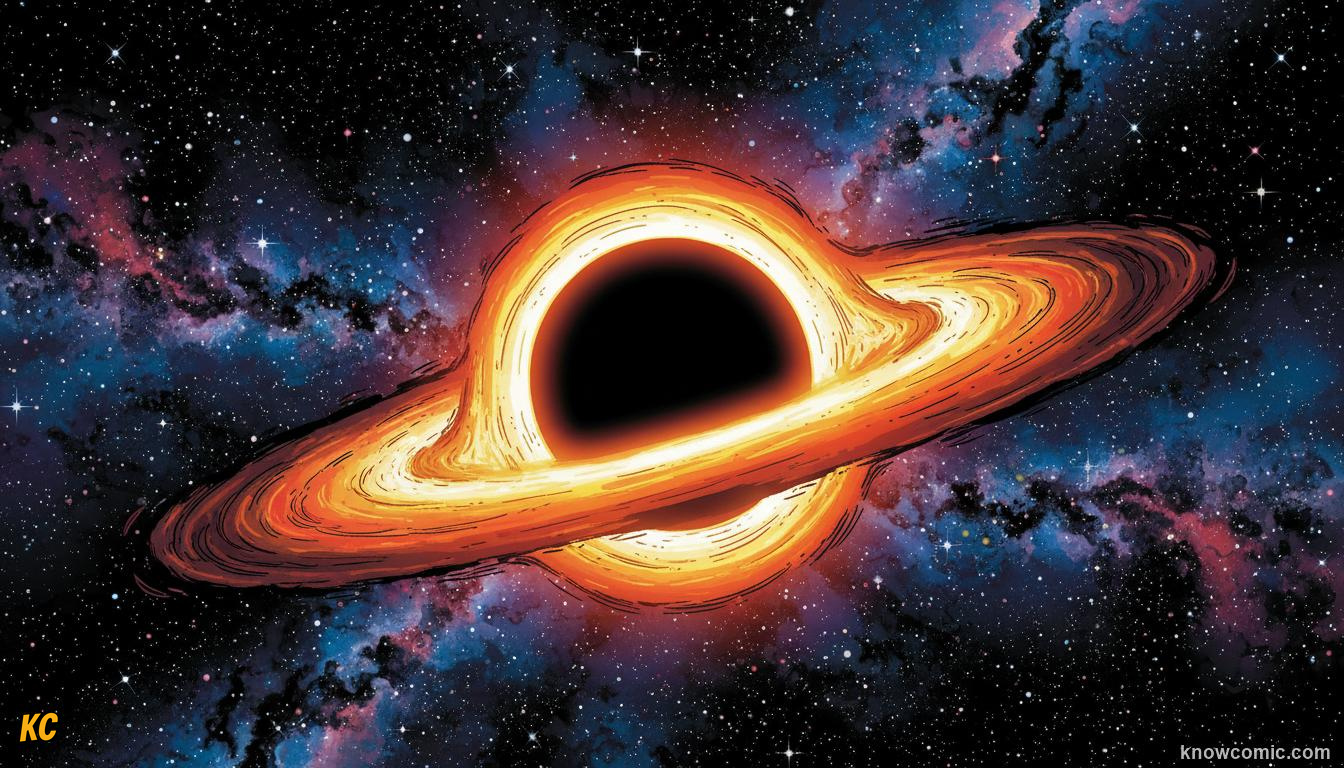
Comic illustration of a black hole event horizon, the boundary beyond which nothing can escape
WHERE GRAVITY WINS EVERYTHING
A black hole is a region of space where gravity is so unimaginably strong that nothing can escape once it crosses the boundary called the event horizon. Not matter. Not light. Not information. Not anything. It is not a hole in space. It is a real object of almost infinite density, born from the collapsed core of a massive dead star.
🤔 MYTH BUSTER
Black holes are not cosmic vacuum cleaners. They do not suck things in from a distance. If you replaced the Sun with a black hole of the same mass, Earth would continue orbiting exactly as it does today.
INESCAPABLE!
EVENT HORIZON
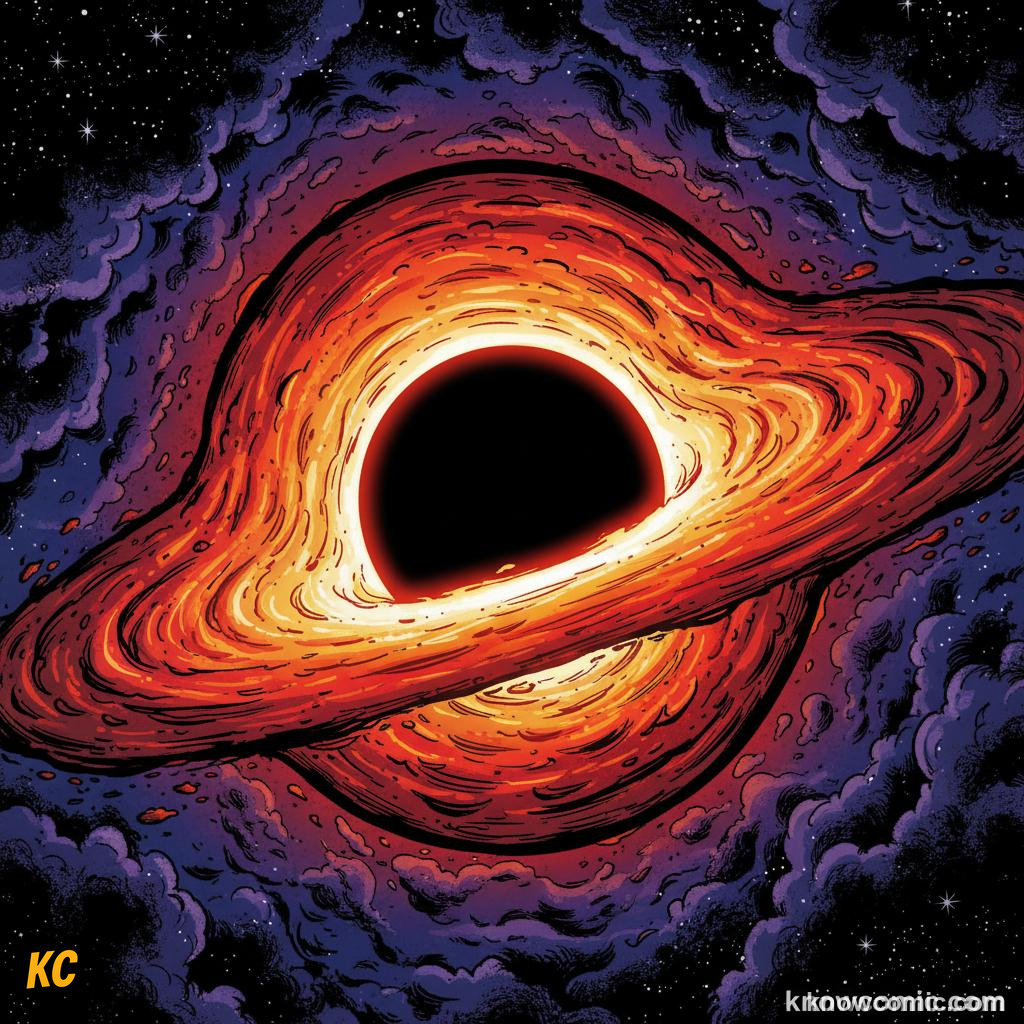
Diagram of the event horizon where escape velocity exceeds the speed of light
⬛ The point of no return: escape velocity exceeds light speed
⚡ Cross it and you can never come back
🐧 Invisible itself: only the shadow and ring of light betrays it
SINGULARITY
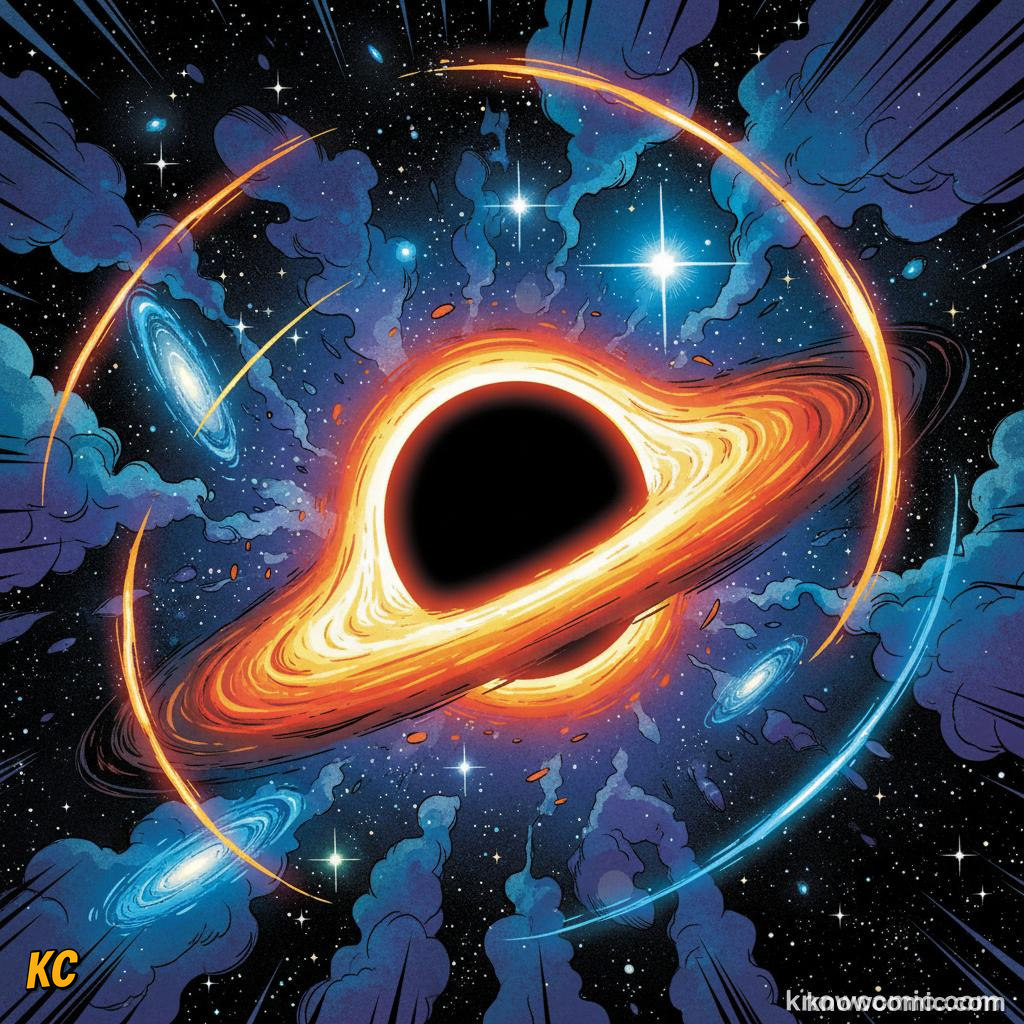
The singularity at the centre of a black hole, infinite density at a mathematical point
🔮 At the center: infinite density, zero volume
📏 Mass of a mountain compressed to zero size
⚛️ Spacetime curvature becomes infinite at the singularity
PAGE 2 OF 5 — THREE TYPES OF BLACK HOLES
CLASSIFICATION
Supermassive black hole at the centre of a galaxy surrounded by a glowing accretion disk and jets
NOT ALL BLACK HOLES ARE EQUAL
Scientists have identified three main types of black holes, spanning an enormous range of sizes. The smallest are formed from individual dead stars. The largest lurk at the centres of galaxies and contain the mass of billions of suns. Every type has the same basic property: nothing inside the event horizon can ever escape.
MASSIVE!
STELLAR
Types of black holes compared in size from stellar to supermassive black holes
💥 Born from massive stars (20+ solar masses) exploding as supernovae
📏 Size: 5 to 100 times the mass of our Sun
🌟 Thousands exist in our Milky Way galaxy
INTERMEDIATE
Swirling gas and dust forming a bright accretion disk around a spinning black hole
🔗 The missing link: 100 to 100,000 solar masses
🔮 May form when multiple stellar black holes merge
🔍 Only recently confirmed to exist
SUPERMASSIVE
Gravitational lensing bending and warping light from stars around a massive black hole
🌌 Found at the centre of almost every large galaxy
📊 Sagittarius A* at the Milky Way centre: 4 million solar masses
📈 Largest known: TON 618, 66 billion solar masses
PAGE 3 OF 5 — EXTREME PHYSICS
SPAGHETTIFICATION
Time dilation near a black hole showing clocks running extremely slowly in intense gravity
🤌 Tidal forces stretch matter into long thin strands
📏 Gravity on your feet vastly stronger than on your head
❓ Scientists actually call this process spaghettification
TIME DILATION
Spaghettification showing matter stretched into long strands by tidal forces near a black hole
⏱️ Time slows near a black hole: proven by Einstein's relativity
📷 A clock near the event horizon ticks slower than one far away
⭐ At the event horizon itself, time appears to stop completely
THE SINGULARITY
Journey toward the singularity as space compresses to infinite density at the black hole core
SPACETIME BREAKS DOWN COMPLETELY
At the very centre of a black hole lies the singularity: a point of infinite density where the known laws of physics simply stop working. Einstein's general relativity and quantum mechanics both break down at this point. Understanding the singularity is one of the greatest unsolved problems in all of physics. It is the universe's best-kept secret.
🌟 ACCRETION DISK
The glowing ring seen in images is an accretion disk: gas and dust spiralling into the black hole at near light speed, heated to billions of degrees, releasing enormous energy as X-rays and visible light.
INFINITE!
PAGE 4 OF 5 — HAWKING RADIATION & THE FIRST PHOTO
STEPHEN HAWKING · 1974
Hawking radiation escaping a black hole as virtual particle pairs split at the event horizon
BLACK HOLES ARE NOT FOREVER
In 1974, Stephen Hawking made an astonishing prediction: black holes slowly evaporate. Near the event horizon, quantum effects cause pairs of particles to spontaneously appear. One particle falls in, one escapes as radiation. The black hole slowly loses mass. A stellar black hole would take 10 to the power of 67 years to fully evaporate. This discovery connected quantum mechanics and gravity for the first time in history.
EVAPORATE!
APRIL 10, 2019
Stephen Hawking explaining black hole radiation combining quantum mechanics and general relativity
📡 Event Horizon Telescope linked 8 radio telescopes worldwide
🌏 Created a virtual Earth-sized telescope
📷 First direct image of a black hole shadow captured
M87*
Virtual particle pair forming at the event horizon with one particle escaping as Hawking radiation
📷 M87*: 6.5 billion solar masses, 55 million light-years away
🆀 The orange ring is superheated gas at billions of degrees
🥇 Dr. Katie Bouman led the algorithm that created the image
SGR A* · 2022
Black hole slowly evaporating over billions of years through Hawking radiation emission
🏠 Our own galaxy's black hole: Sagittarius A*, just 26,000 light-years away
⚖️ 4 million solar masses, diameter of ~44 million kilometres
📷 Photographed in 2022 by the same EHT collaboration
PAGE 5 OF 5 — THE LEGACY
THE LEGACY
First photograph of a black hole, M87 captured by the Event Horizon Telescope in 2019
WINDOWS INTO THE UNIVERSE'S DEEPEST SECRETS
Black holes are not just objects of destruction. They are laboratories where the laws of physics are pushed to their absolute limits. By studying them, scientists test Einstein's theories, probe the nature of spacetime, and inch closer to a theory of everything unifying quantum mechanics and gravity. Every black hole that jets out plasma or warps nearby stars is teaching us something new about the universe itself.
📉 GRAVITATIONAL WAVES
When two black holes merge, they send ripples through spacetime called gravitational waves. First detected in 2015 by LIGO, these waves confirmed Einstein's 100-year-old prediction and opened an entirely new way to observe the universe.
DISCOVERY!
GRAVITATIONAL WAVES
Gravitational waves detected by LIGO from two black holes merging billions of light-years away
🌝 Two merging black holes stretch and squeeze spacetime itself
📡 LIGO detected them in 2015, confirming Einstein's 1916 prediction
🌌 New field of gravitational wave astronomy now open
REMEMBER THIS
📌 KEY FACTS
⬛ Event horizon: the point of no return

💥 Born from massive stars that collapse

⚡ Spaghettification: tidal forces stretch all matter

🌝 Hawking radiation: black holes slowly evaporate

📷 First photo: M87*, April 10, 2019
🧠 BLACK HOLE QUIZ
TEST YOUR KNOWLEDGE  ·  5 QUESTIONS
QUESTION 01
What is the "event horizon" of a black hole?
QUESTION 02
What is spaghettification?
QUESTION 03
Who proposed that black holes slowly evaporate over time?
QUESTION 04
What is the name of the supermassive black hole at the centre of our Milky Way?
QUESTION 05
When was the first photograph of a black hole taken?
0/5
LOADING...
← TOPIC 01 📋 ALL TOPICS TOPIC 03 →