🔭 From the Big Bang to Black Holes — The Universe Explained!
📖 150 Topics⏱️ 5 min per comic🧠 Quiz included
💥
BIG BANG
Universe born
→
🔭
1929
Hubble: expansion
→
💥
1998
Acceleration found!
→
❓
TODAY
Still unknown
→
🌞
FAR FUTURE
Universe fate?
⚡ DARK ENERGY: THE FORCE STRETCHING SPACE
TOPIC 06 · ASTRONOMY · 68% OF THE UNIVERSE
PAGE 1 OF 5 — THE FORCE THAT RULES THE UNIVERSE
68% OF EVERYTHING
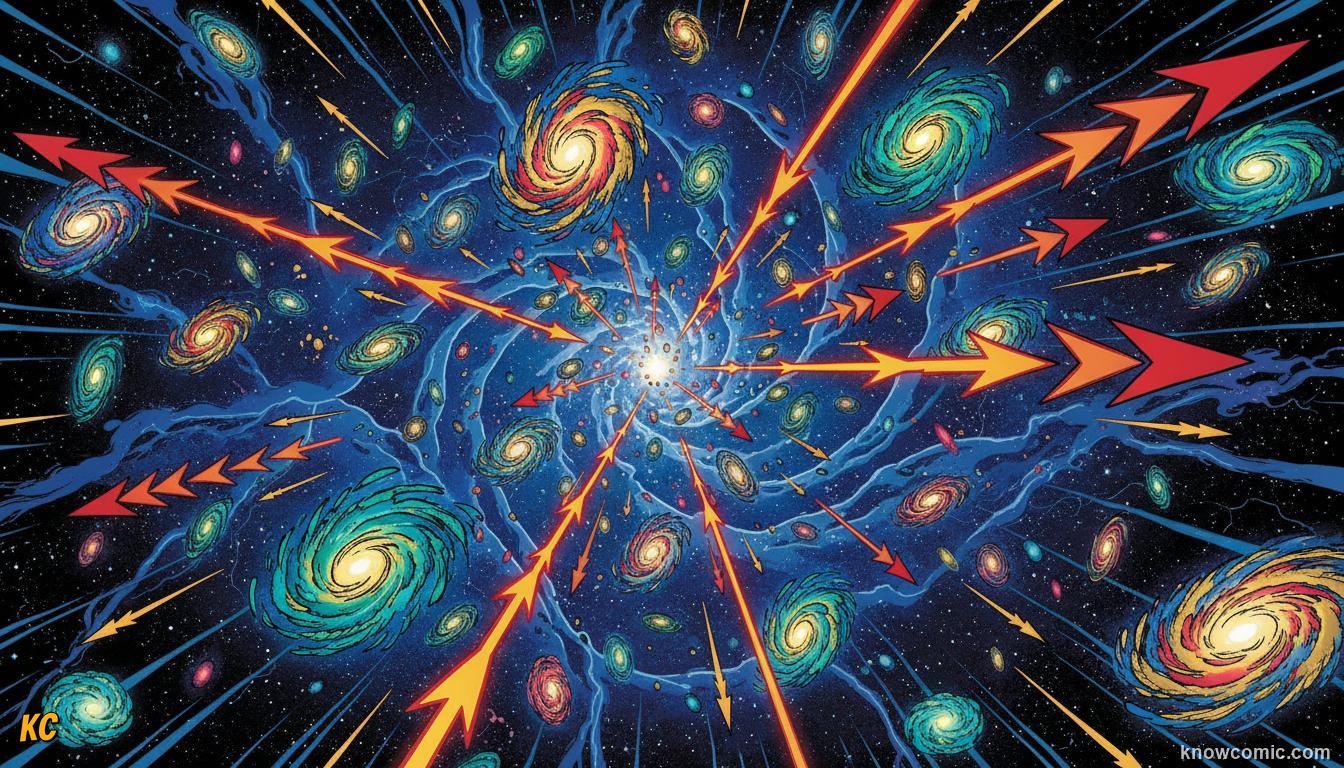
SPACE ITSELF IS BEING STRETCHED APART
The universe is not just expanding. It is expanding faster and faster every second. Something is pushing space itself outward with increasing force, overcoming the gravity of all the matter in the cosmos. We call this force dark energy. It makes up 68 percent of the entire universe. It is the dominant component of everything that exists. Yet we have absolutely no idea what it is.
⚡ THE DOMINANT FORCE
Dark energy (68%) + dark matter (27%) = 95% of the universe. Everything you have ever seen, every star, planet, gas cloud, and black hole, makes up just 5%. The universe is almost entirely made of things we cannot see or understand.
ACCELERATING!
EXPANDING SPACE
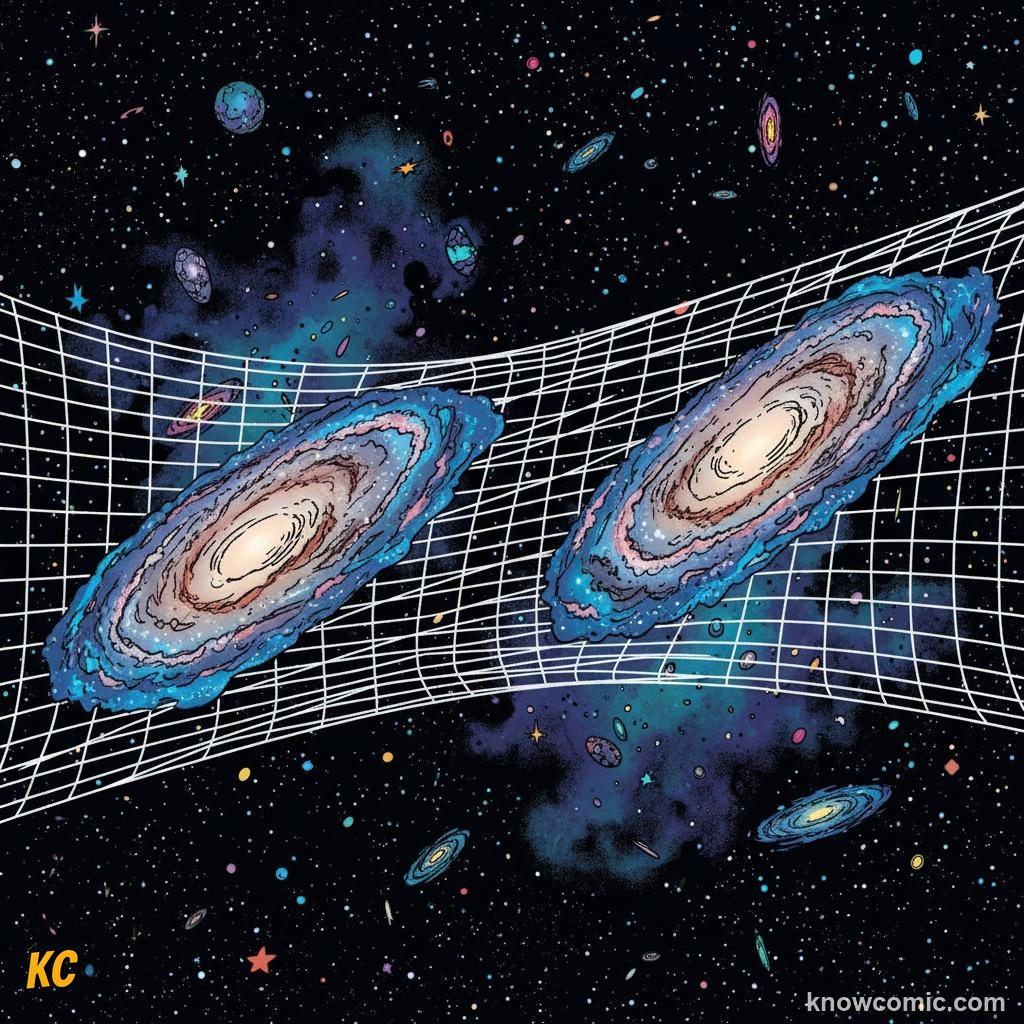
→ Galaxies are not moving through space: space itself expands
🌌 The further away a galaxy is, the faster it recedes
💥 In 1929, Hubble proved all galaxies are moving away from us
ACCELERATING
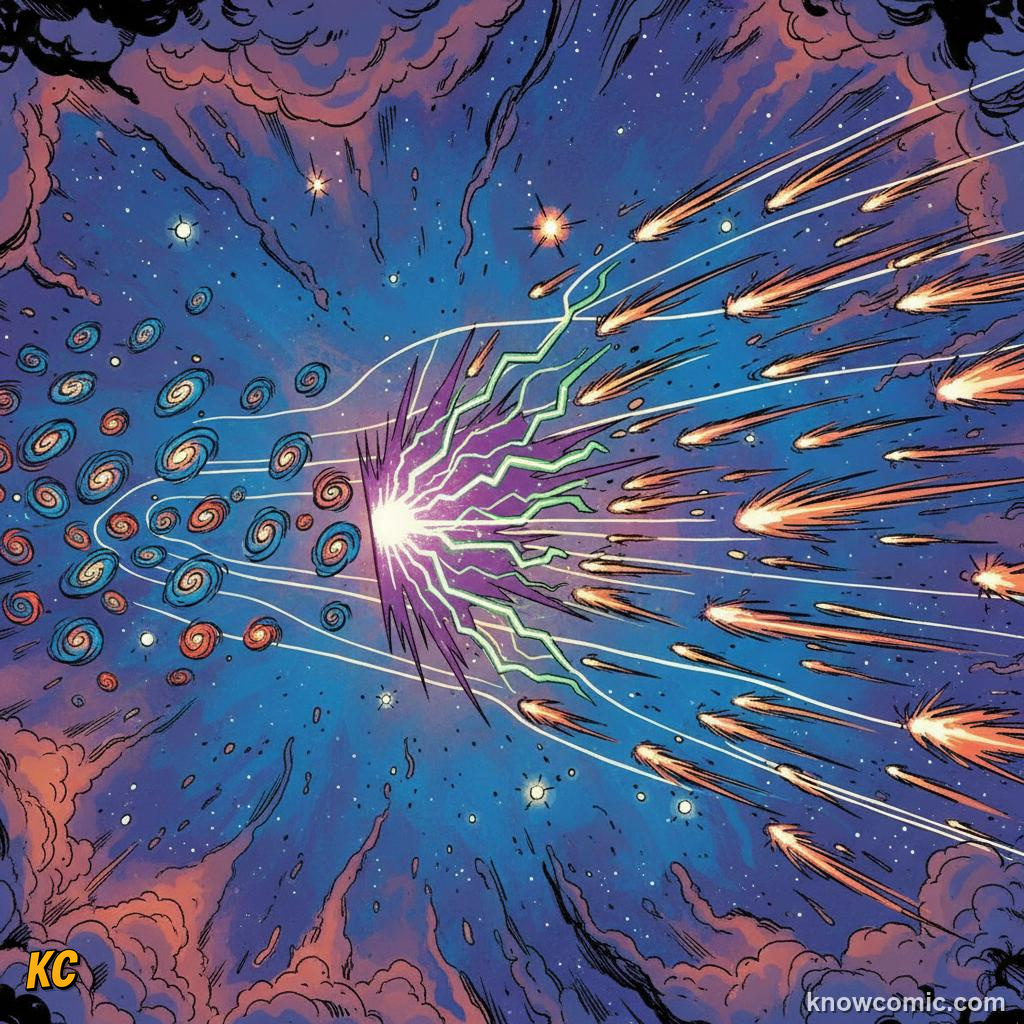
⚡ In 1998, astronomers found expansion is speeding up
🤔 Gravity should be slowing it down: something is fighting back
❓ That something is dark energy: the universe's biggest mystery
PAGE 2 OF 5 — THE SHOCKING DISCOVERY OF 1998
TYPE Ia SUPERNOVAE
DISTANT SUPERNOVAE WERE DIMMER THAN EXPECTED
Two independent teams raced to measure the expansion of the universe using Type Ia supernovae as standard candles. These supernovae always explode with the same brightness, making them perfect distance markers. When they measured how far away ancient supernovae were, both teams got the same shocking result: the supernovae were further away than expected. The universe's expansion had been speeding up, not slowing down. Both teams won the Nobel Prize in 2011.
🍶 NOBEL PRIZE 2011
Saul Perlmutter, Brian Schmidt, and Adam Riess shared the Nobel Prize in Physics for their discovery of the accelerating expansion. Riess was only 29 years old when his team made the discovery. He called it the most shocking result of his career.
SHOCKING!
STANDARD CANDLES
💥 Type Ia supernovae always reach the same peak brightness
🔭 Like a standard light bulb: dimmer means further away
📊 The further they were, the more the expansion had accelerated
THE RESULT
⚡ Ancient supernovae 10 to 15 percent dimmer than expected
🔭 Meaning they were further away than a steady expansion would predict
▲ The expansion must be speeding up: something is accelerating it
CONFIRMED BY CMB
🌈 The Planck CMB map independently confirmed dark energy
📊 CMB shows the universe is flat: requires dark energy to make the geometry work
✨ Large-scale structure surveys also confirm the 68% dark energy fraction
PAGE 3 OF 5 — WHAT COULD IT BE?
COSMOLOGICAL CONSTANT
🔮 Einstein added a constant to his equations to make the universe static
⚡ He later called it his biggest blunder: but it may describe dark energy
🐦 Empty space may have an intrinsic energy density that pushes outward
QUINTESSENCE
✨ A dynamic field (like dark matter) filling all of space
🔮 Its energy density can change over time and space
🔍 If quintessence, the acceleration may speed up or slow down in future
THE VACUUM ENERGY PROBLEM
THE WORST PREDICTION IN THE HISTORY OF PHYSICS
Quantum mechanics predicts that empty space should be seething with virtual particles constantly popping in and out of existence. This should give the vacuum enormous energy. But when physicists calculate how much, the answer is 10 to the power of 120 times larger than the dark energy we actually observe. This is the worst disagreement between theory and observation in all of science, and solving it may require entirely new physics.
🤔 THE FINE-TUNING PROBLEM
Dark energy's value appears precisely tuned to allow galaxies to form. If it were slightly larger, the universe would have expanded too fast for any structure to form. If slightly smaller, it would have collapsed. Why is it just right? Nobody knows.
MYSTERY!
PAGE 4 OF 5 — THE FATE OF THE UNIVERSE
FAR FUTURE SCENARIOS
DARK ENERGY WILL DETERMINE HOW THE UNIVERSE ENDS
The ultimate fate of the universe depends on whether dark energy stays constant, grows stronger, or fades. If it grows stronger without limit, it could eventually rip apart galaxies, then stars, then planets, then atoms themselves in what cosmologists call the Big Rip. If it stays constant, the universe will expand forever into cold darkness, all stars burning out: the Big Freeze. If it weakens, gravity could eventually reverse the expansion in the Big Crunch.
FOREVER!
THE BIG RIP
💥 If dark energy grows stronger: accelerated tearing of spacetime
🌌 Galaxies separate first, then solar systems, then atoms
⏱️ The Big Rip could occur in about 20 billion years
THE BIG FREEZE
⛄️ If dark energy stays constant: expansion continues forever
⭐ All stars burn out over trillions of years
✏️ Universe ends as cold, dark, empty, near-zero temperature void
THE BIG CRUNCH
💥 If dark energy fades and gravity wins: expansion reverses
🔥 Universe collapses back into an infinitely hot, dense singularity
❓ Current evidence suggests this is the least likely outcome
PAGE 5 OF 5 — MEASURING THE UNKNOWN
THE LEGACY
THE EUCLID MISSION AND BEYOND
To understand dark energy, we need to map the universe's expansion history in unprecedented detail. ESA's Euclid space telescope launched in 2023 and will map two billion galaxies over ten years, measuring how dark energy's strength has changed through cosmic time. The Nancy Grace Roman Space Telescope will add even more data. Together, they aim to answer whether dark energy is a constant property of space or a dynamic field that can change.
🛰 EUCLID (2023)
Euclid will map the 3D distribution of 2 billion galaxies across 10 billion years of cosmic history. By measuring how galaxy clustering changed over time, it will tell us exactly how dark energy's strength has evolved since the Big Bang.
DISCOVERY!
HUBBLE TENSION
🔭 Two methods of measuring expansion give different answers
❓ CMB gives 67.4 km/s/Mpc; local measurements give 73.2 km/s/Mpc
🤔 This 5-sigma tension may hint at physics beyond our current model
REMEMBER THIS
📌 KEY FACTS
⚡ Dark energy: 68% of the universe, still completely unknown
💥 Discovered in 1998 via Type Ia supernova dimness
→ It causes the universe to expand faster every second
🍶 Perlmutter, Schmidt, and Riess won the 2011 Nobel Prize
🌞 Fate of the universe depends on dark energy's future behaviour
🧠 DARK ENERGY QUIZ
TEST YOUR KNOWLEDGE · 5 QUESTIONS
QUESTION 01
What does dark energy cause the universe to do?
QUESTION 02
What astronomical objects were used to discover the accelerating expansion in 1998?
QUESTION 03
What fraction of the universe is made of dark energy?
QUESTION 04
What do scientists call the simplest candidate explanation for dark energy?
QUESTION 05
If dark energy grows stronger without limit, what could eventually happen?