🌍 THE INTERNAL STRUCTURE OF EARTH
PAGE 1 OF 5 — LOOKING INSIDE THE PLANET
BELOW YOUR FEET
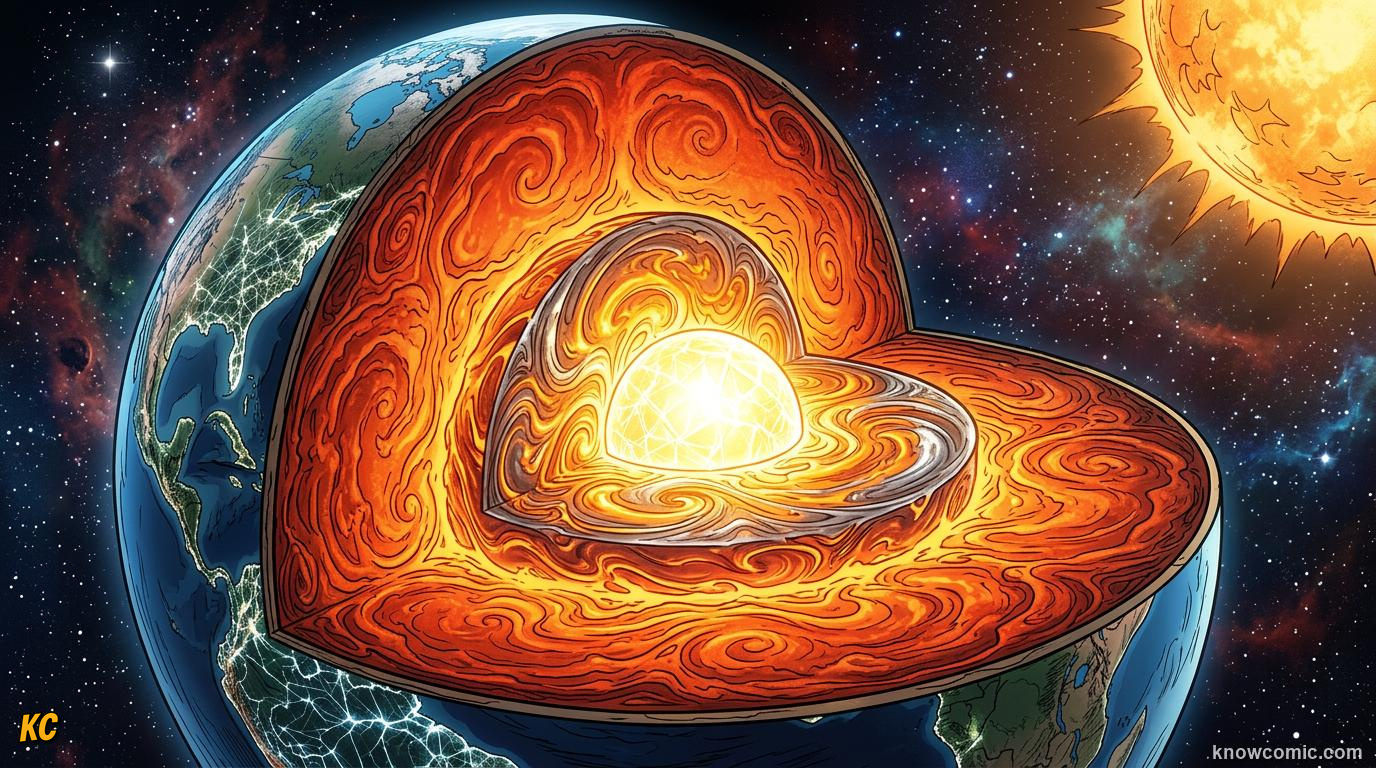
EARTH IS NOT A SOLID MARBLE
From space, Earth looks like a calm blue sphere. Below the surface it is layered like an onion. Geologists divide the planet by chemical composition into crust, mantle, and core. They also describe physical behaviour: rigid shells, soft rock, and liquid metal. No drill has ever reached the mantle. The deepest borehole, the Kola Superdeep Borehole, stopped near 12 km depth, still inside the crust. Almost everything we know about deeper layers comes from seismic waves recorded during earthquakes. Those waves travel, bend, reflect, and sometimes disappear, revealing hidden structure. Understanding Earth's interior is the foundation for plate tectonics, volcanoes, and the magnetic field that shields life.
📏 SCALE
Earth's mean radius is about 6,371 km. The crust is thinner than the skin on an apple compared with the whole planet.
LAYERS!
CRUST TYPES
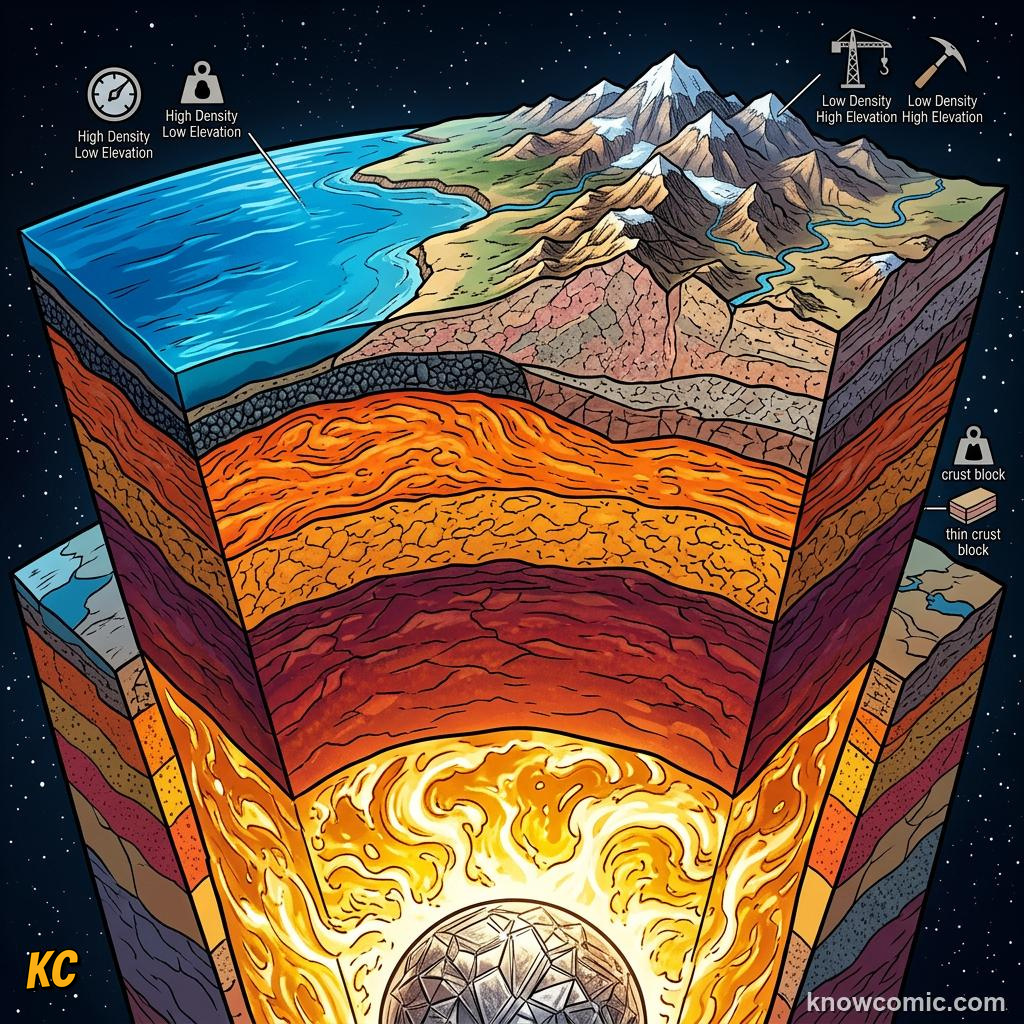
- Continental crust is thicker (up to ~70 km under mountains) and less dense, rich in silica and aluminium.
- Oceanic crust is thinner (~5–10 km) and denser, made mainly of basalt and iron-rich minerals.
- Both crust types float on the denser mantle below, like wood on water.
DEPTH CLUES
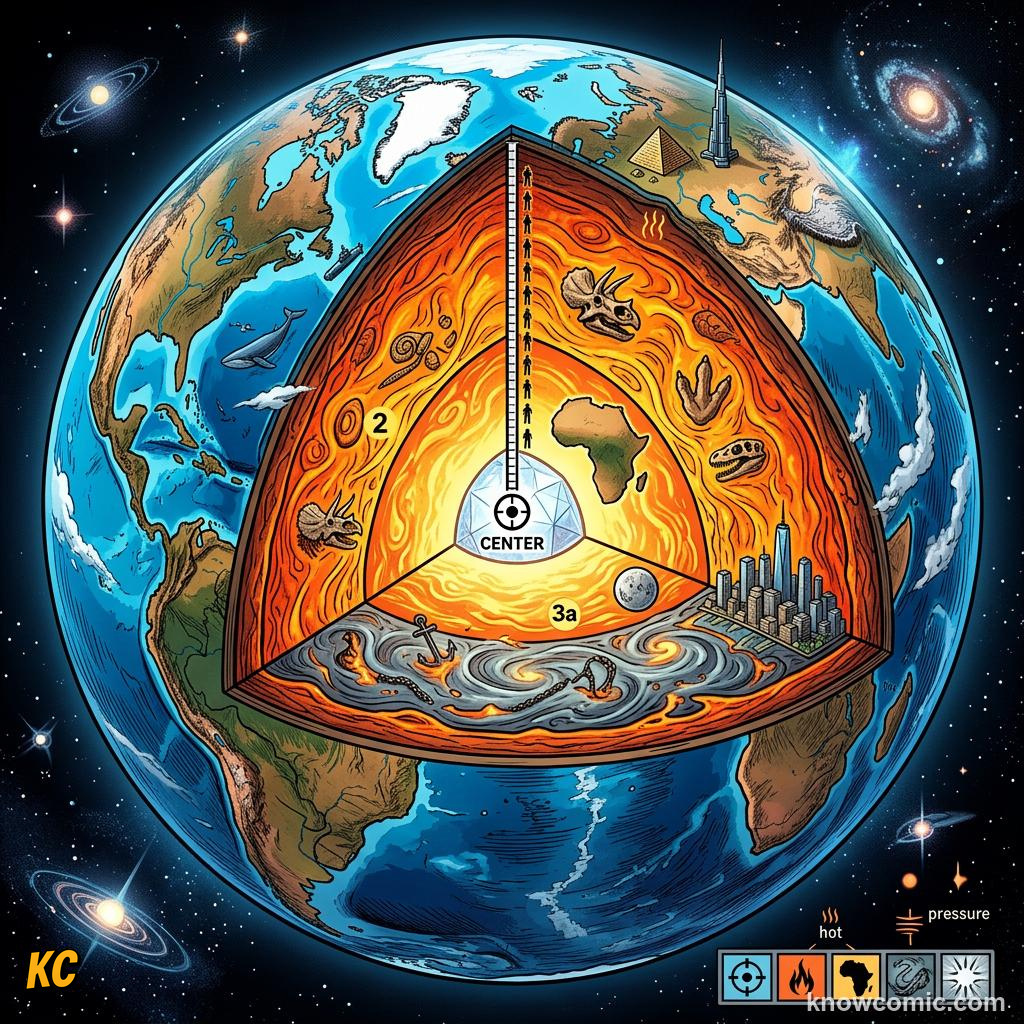
- Humans have sampled only the top few kilometres of crust directly.
- Meteorites and lab experiments help geologists model deeper chemistry.
- Seismology remains the main tool for mapping the full interior.
PAGE 2 OF 5 — CHEMICAL AND PHYSICAL LAYERS
THREE MAIN SHELLS
CRUST, MANTLE, AND CORE
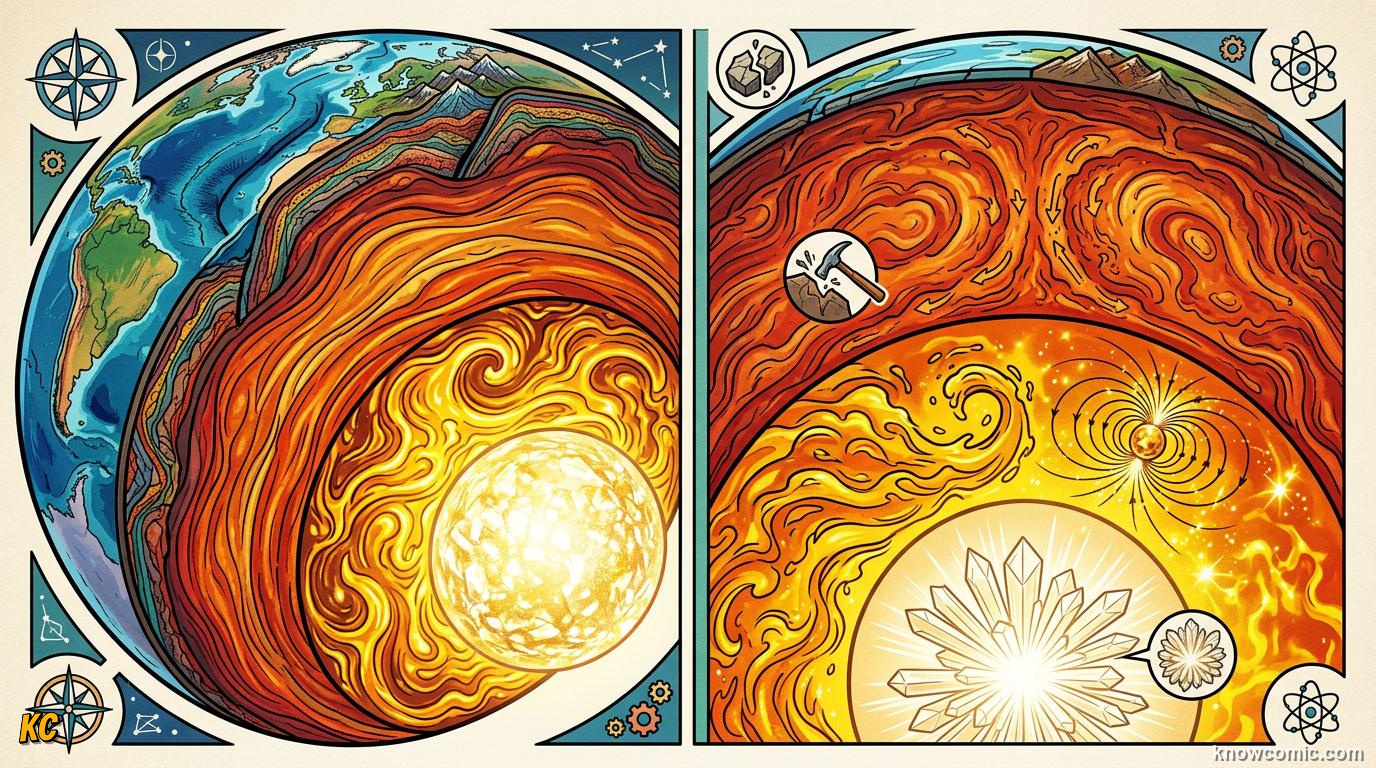
By chemical composition, Earth has three major parts. The crust is the outer rocky skin. The mantle is a thick shell of hot silicate rock extending to about 2,900 km depth. Below that lies the core, mostly iron and nickel. The core makes up roughly one third of Earth's mass. Physically, the mantle is mostly solid rock, but it can flow very slowly over millions of years, like stiff tar. The outer core is liquid. The inner core is solid because extreme pressure keeps iron frozen even at temperatures near 5,000°C to 6,000°C. These two ways of dividing Earth, chemical and physical, overlap but answer different questions about how the planet behaves.
SHELLS!
LITHOSPHERE
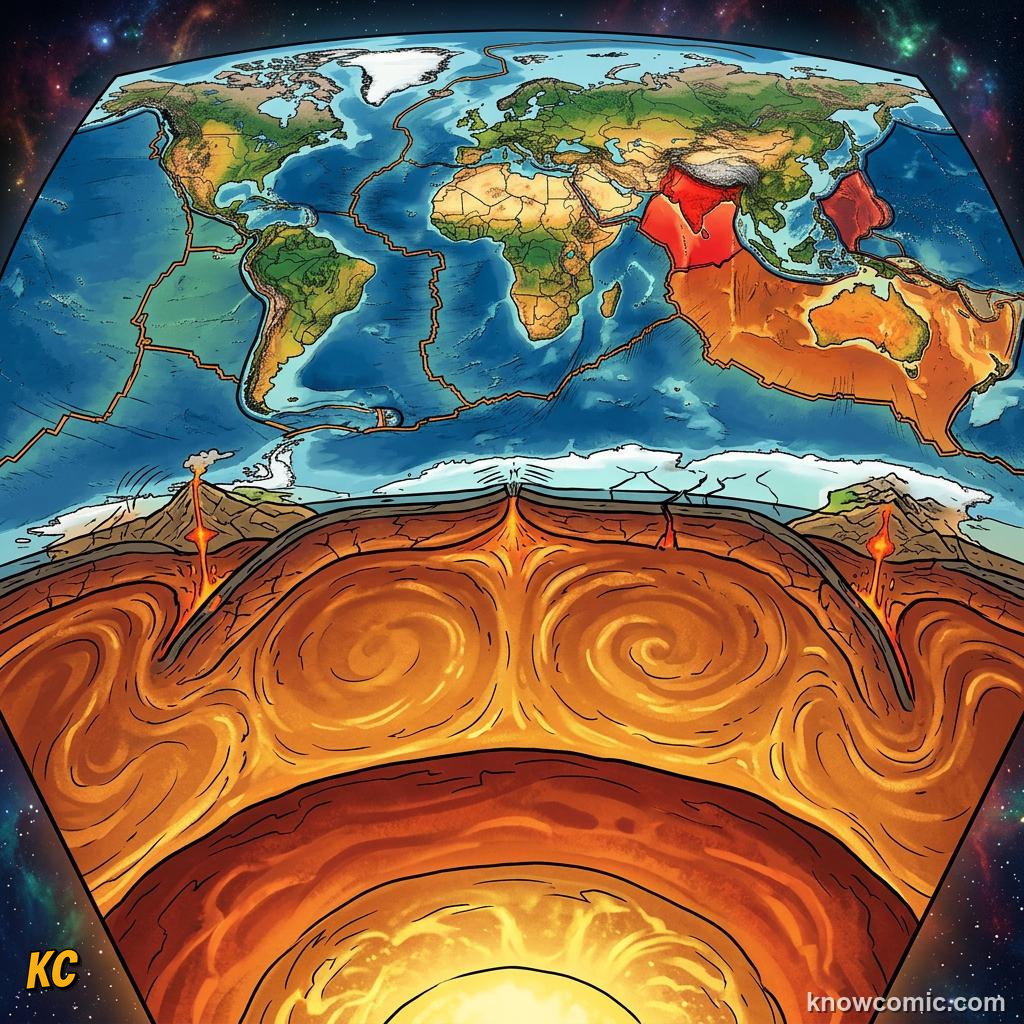
- The lithosphere includes crust plus the rigid uppermost mantle.
- It breaks into tectonic plates that move a few centimetres per year.
- Plate boundaries are where earthquakes, volcanoes, and mountains concentrate.
ASTHENOSPHERE
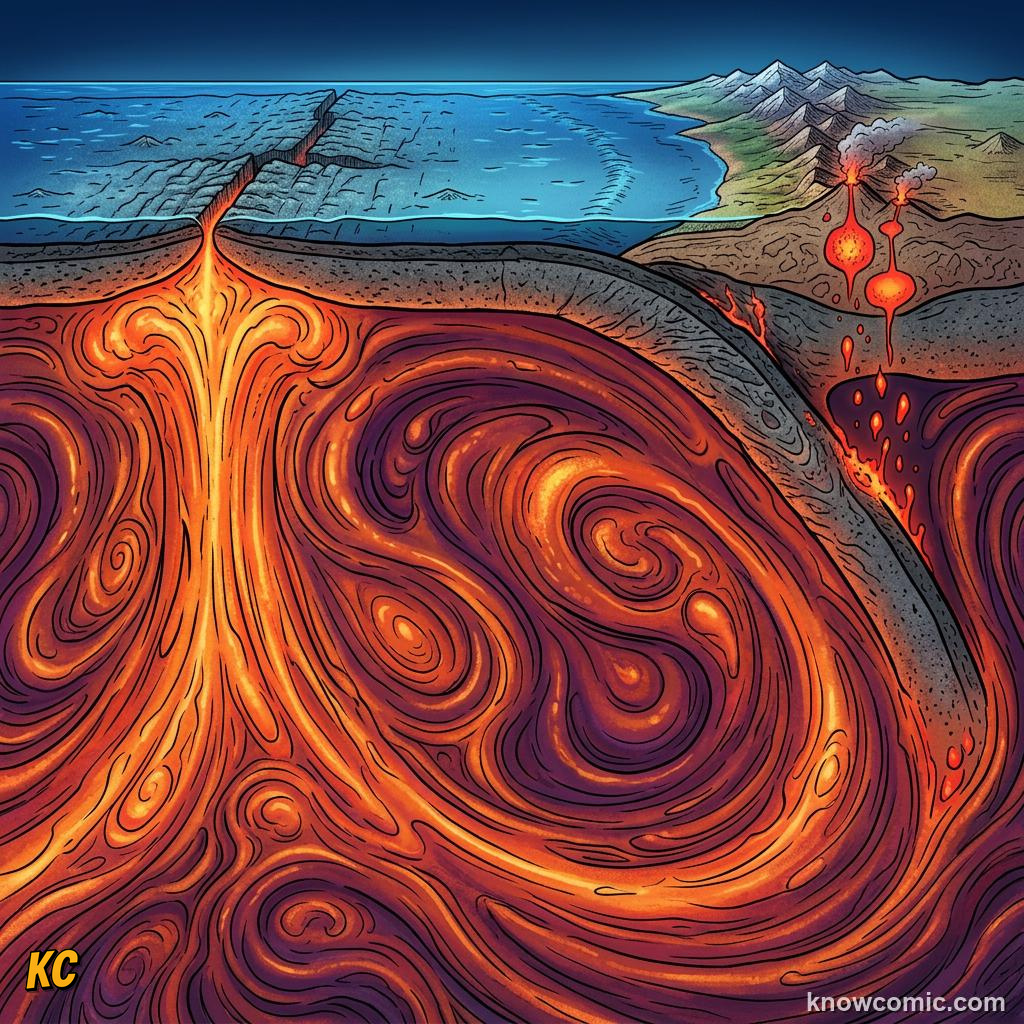
- The asthenosphere lies directly below the lithosphere.
- It is weak and plastic, allowing plates to slide and sink.
- Its softness is key to how continents drift without snapping the whole planet.
LOWER MANTLE
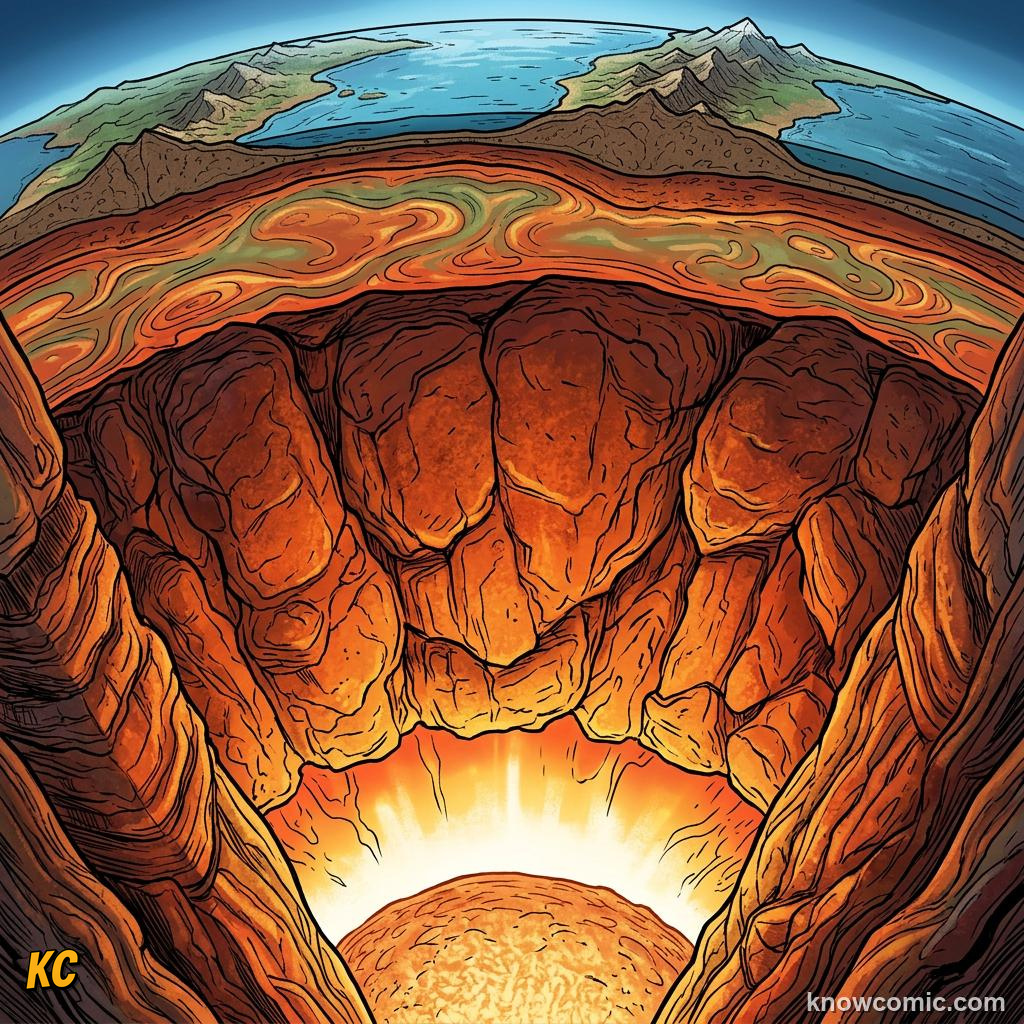
- The lower mantle (sometimes called the mesosphere) is dense and hot.
- It extends down to the core-mantle boundary near 2,900 km depth.
- Convection here connects surface plate motion to deep Earth heat.
PAGE 3 OF 5 — THE IRON HEART
OUTER CORE
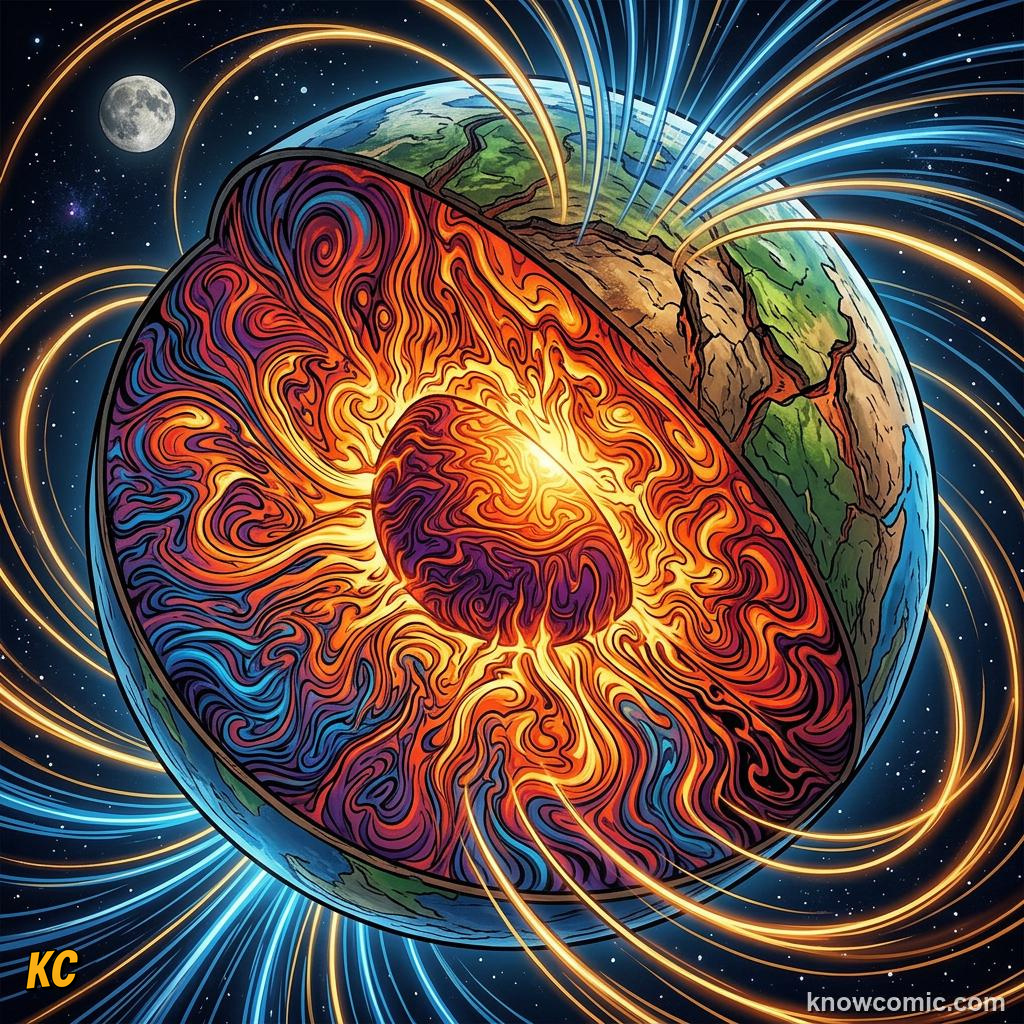
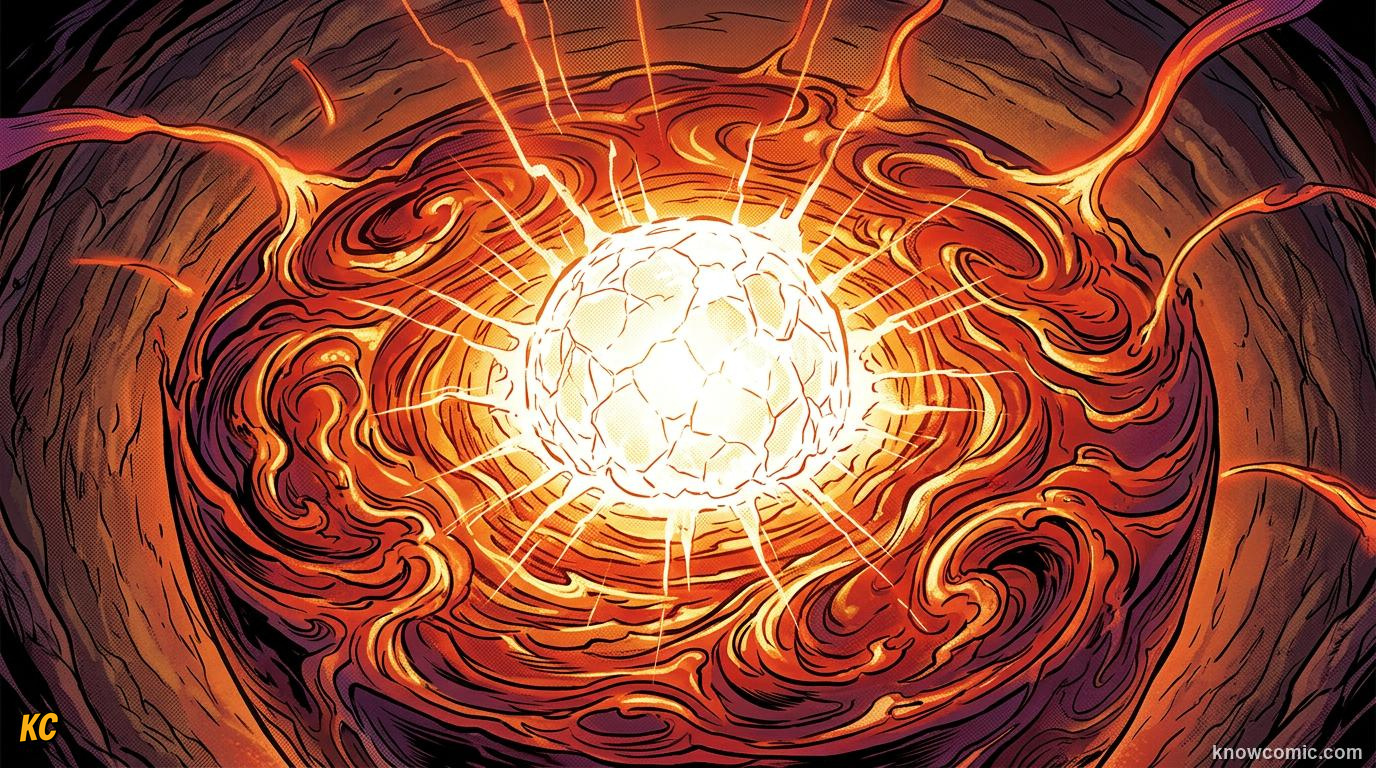
- The outer core is liquid iron-nickel about 2,260 km thick.
- Its motion powers the geodynamo that creates Earth's magnetic field.
- That field deflects harmful solar radiation and makes compass needles point north.
INNER CORE
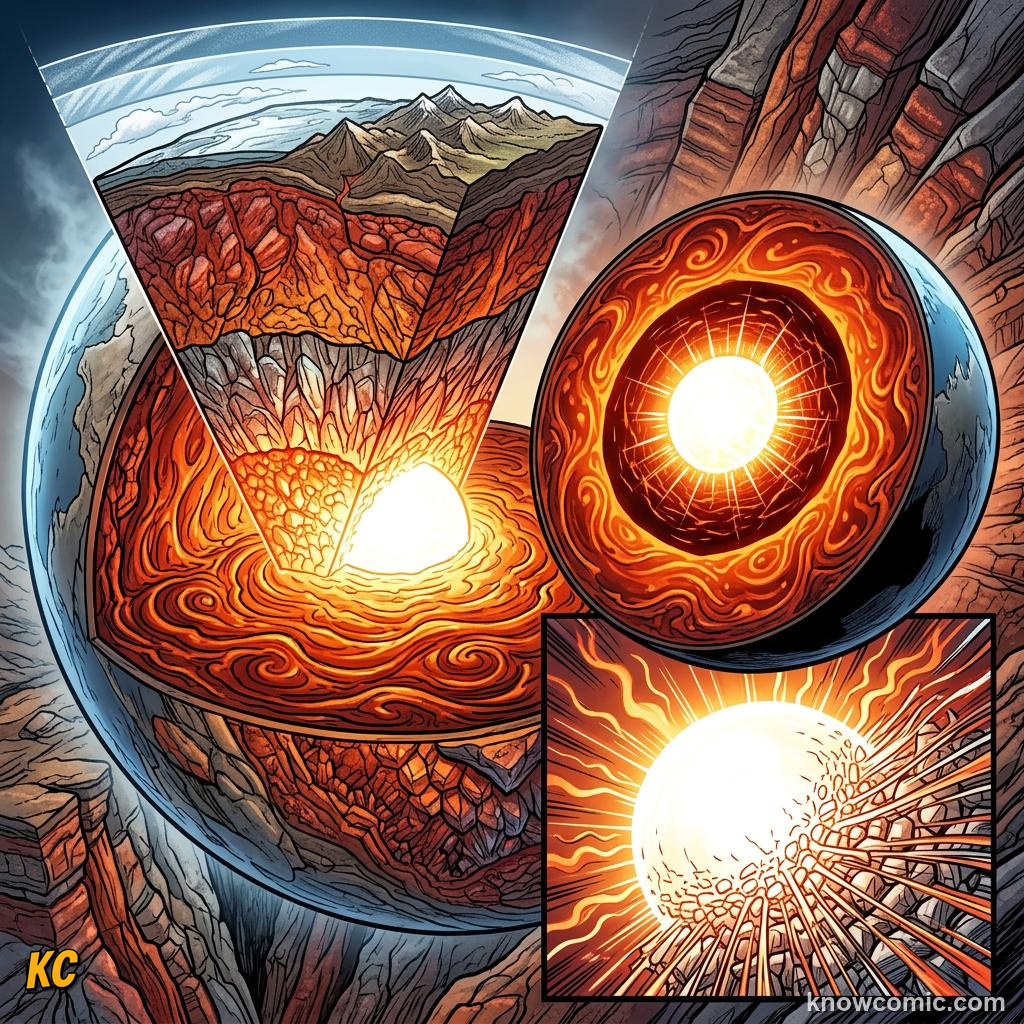
- The inner core is a solid sphere about 1,220 km in radius.
- Pressure at the centre exceeds 3.6 million atmospheres, locking iron solid.
- Temperatures reach roughly 5,000°C to 6,000°C, nearly as hot as the Sun's surface.
CORE FACTS
LIQUID OUTSIDE, SOLID INSIDE
Earth's core formed early in planetary history when dense iron sank toward the centre. The outer core stays liquid because temperature wins over pressure at that depth. Deeper still, pressure dominates and the inner core freezes solid despite fierce heat. Seismic studies show the inner core may rotate slightly faster than the rest of the planet. Without the liquid outer core churning, Earth would lose most of its magnetic protection. Evidence from ancient rocks shows the field has weakened and flipped direction many times over geologic time. The core is remote, but its behaviour shapes climate, navigation, and even auroras in the sky.
🧲 MAGNETIC SHIELD
The geodynamo converts kinetic energy in the liquid core into a magnetic field that extends far into space.
CORE!
PAGE 4 OF 5 — MANTLE HEAT ENGINE
CONVECTION DRIVES THE SURFACE
THE MANTLE IS EARTH'S ENGINE ROOM
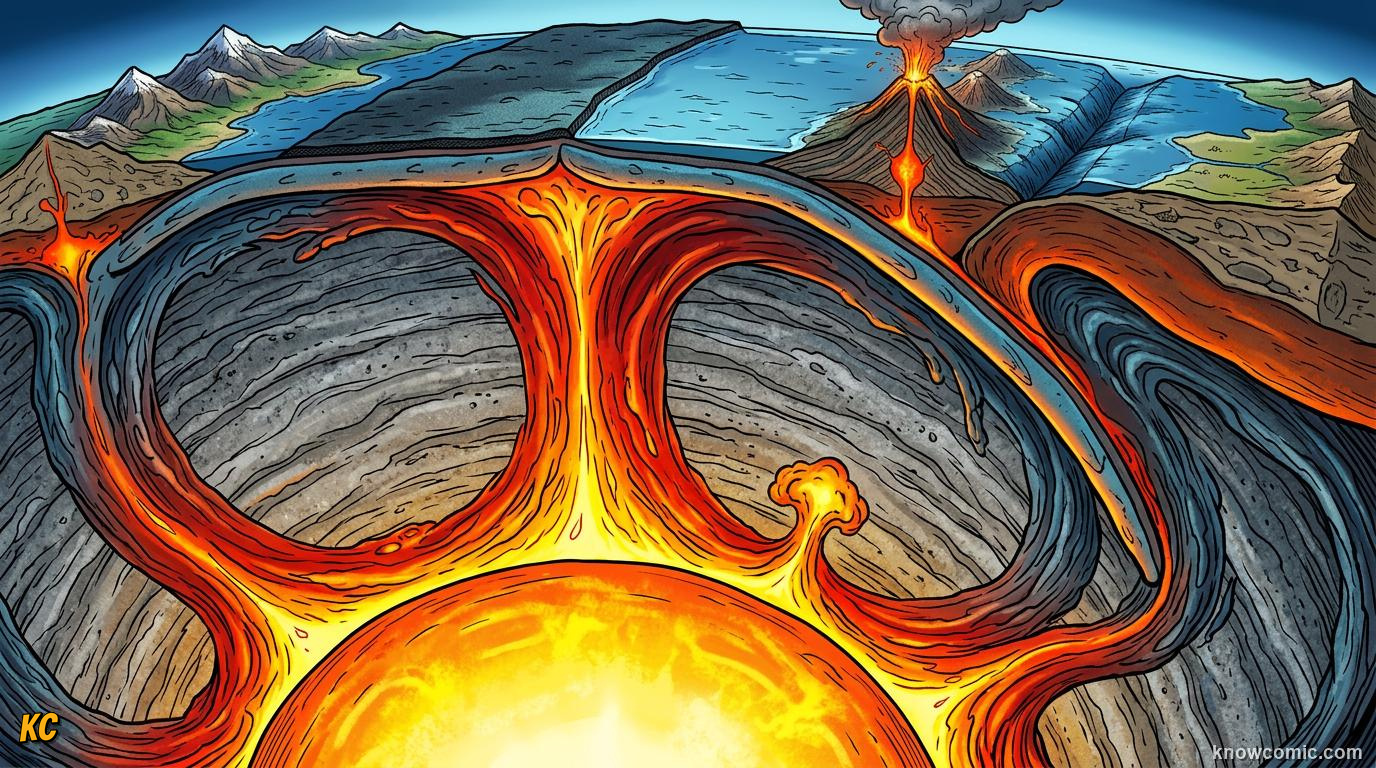
Earth still carries heat left from its formation 4.5 billion years ago. Radioactive decay of uranium, thorium, and potassium in the mantle adds more energy continuously. Hot rock near the core-mantle boundary becomes slightly less dense and rises. Cooler rock near the surface sinks. These slow convection cells drag tectonic plates above them. Heat moves by conduction through rigid rock, by convection in the flowing mantle, and by radiation from the surface to space. Mid-ocean ridges mark rising limbs where new crust forms. Subduction zones mark sinking limbs where old ocean plate dives back into the mantle. This heat engine explains why Earth is geologically alive while smaller worlds like Mars cooled faster.
HEAT!
CONVECTION
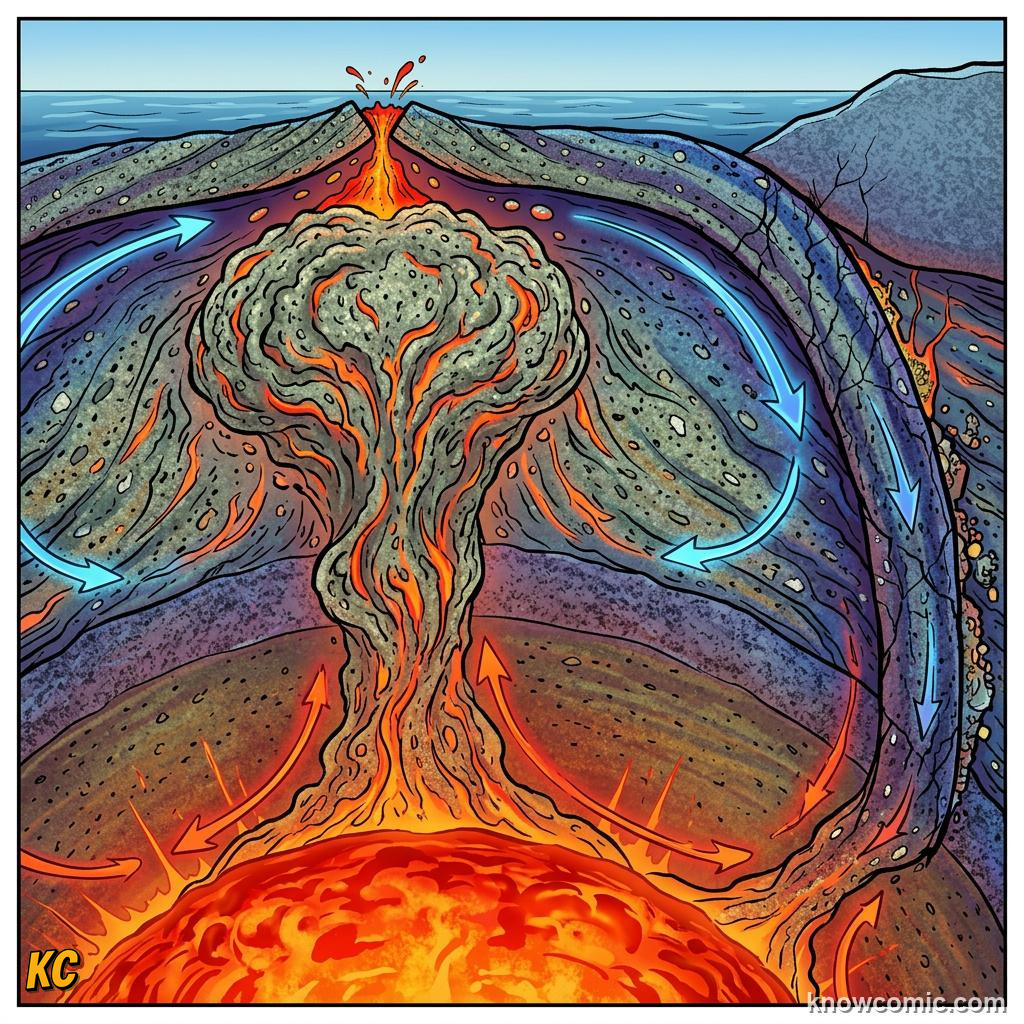
- Convection moves heat faster than conduction alone in a planet this size.
- Whole-mantle models show large cells linking ridges and subduction zones.
- Plumes from deep mantle can create hotspot volcanoes like Hawaii.
RADIOACTIVE HEAT
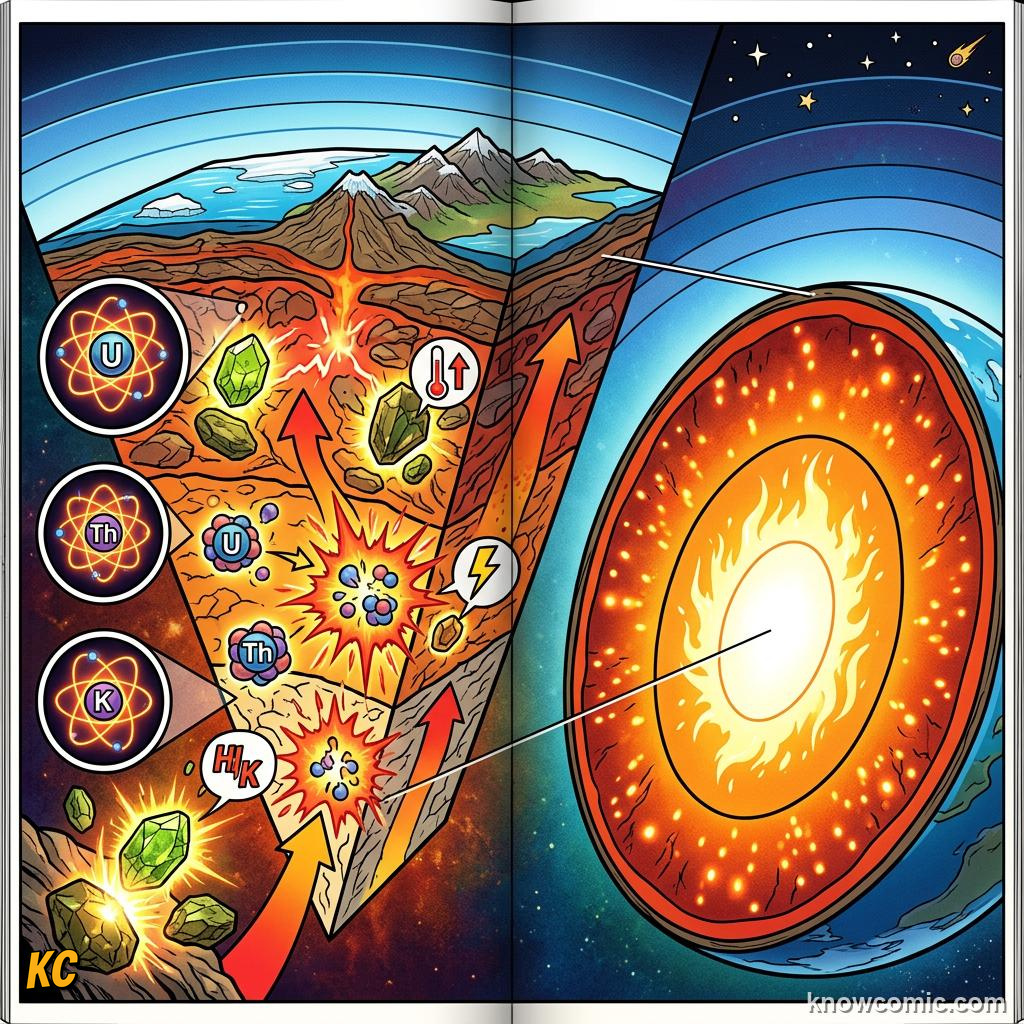
- Radioactive isotopes decay and release energy inside crust and mantle rocks.
- This internal heating keeps convection running long after formation heat faded.
- Without it, plate tectonics would slow dramatically over time.
HEAT TRANSFER
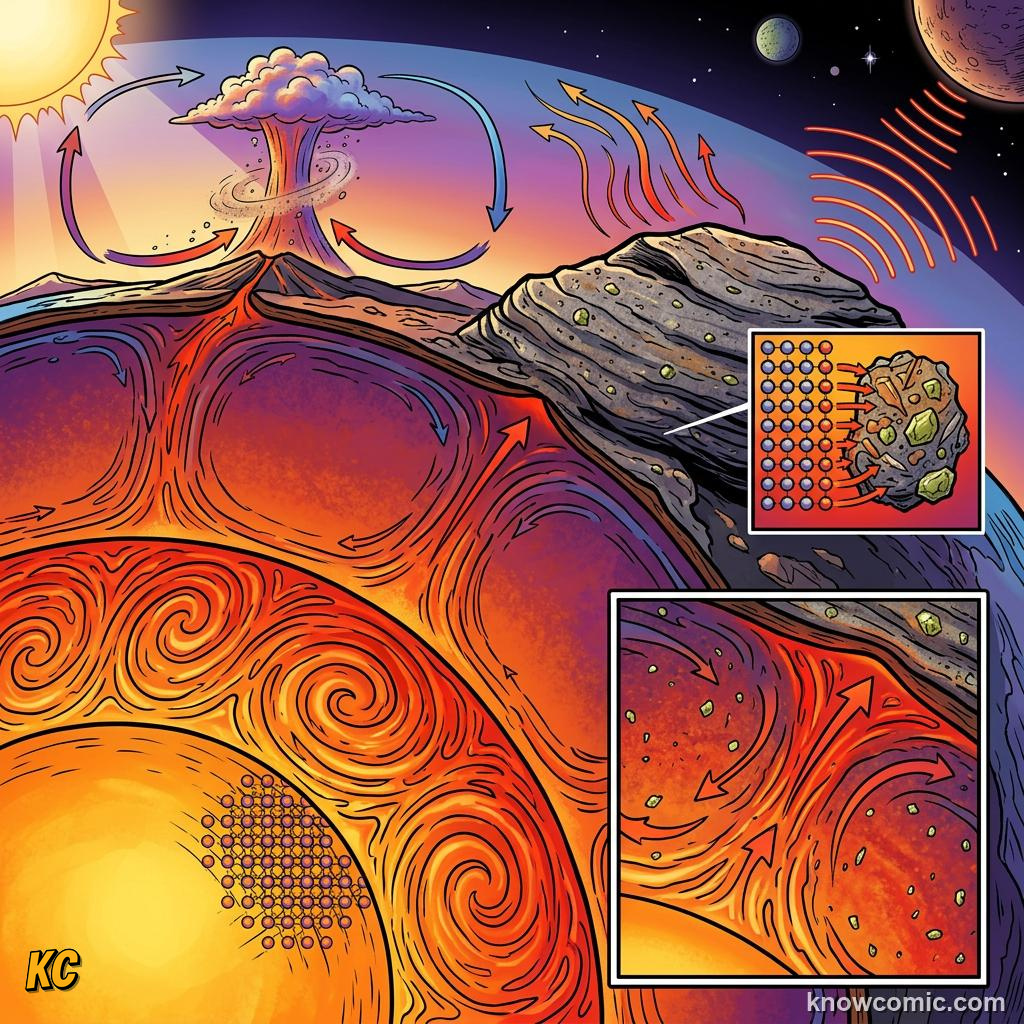
- Conduction passes heat through touching rock grains.
- Convection carries heat in moving mantle currents.
- Radiation sends energy from the surface out to space as infrared light.
PAGE 5 OF 5 — SEISMIC CLUES AND SURFACE LINKS
REMEMBER EARTH'S INTERIOR
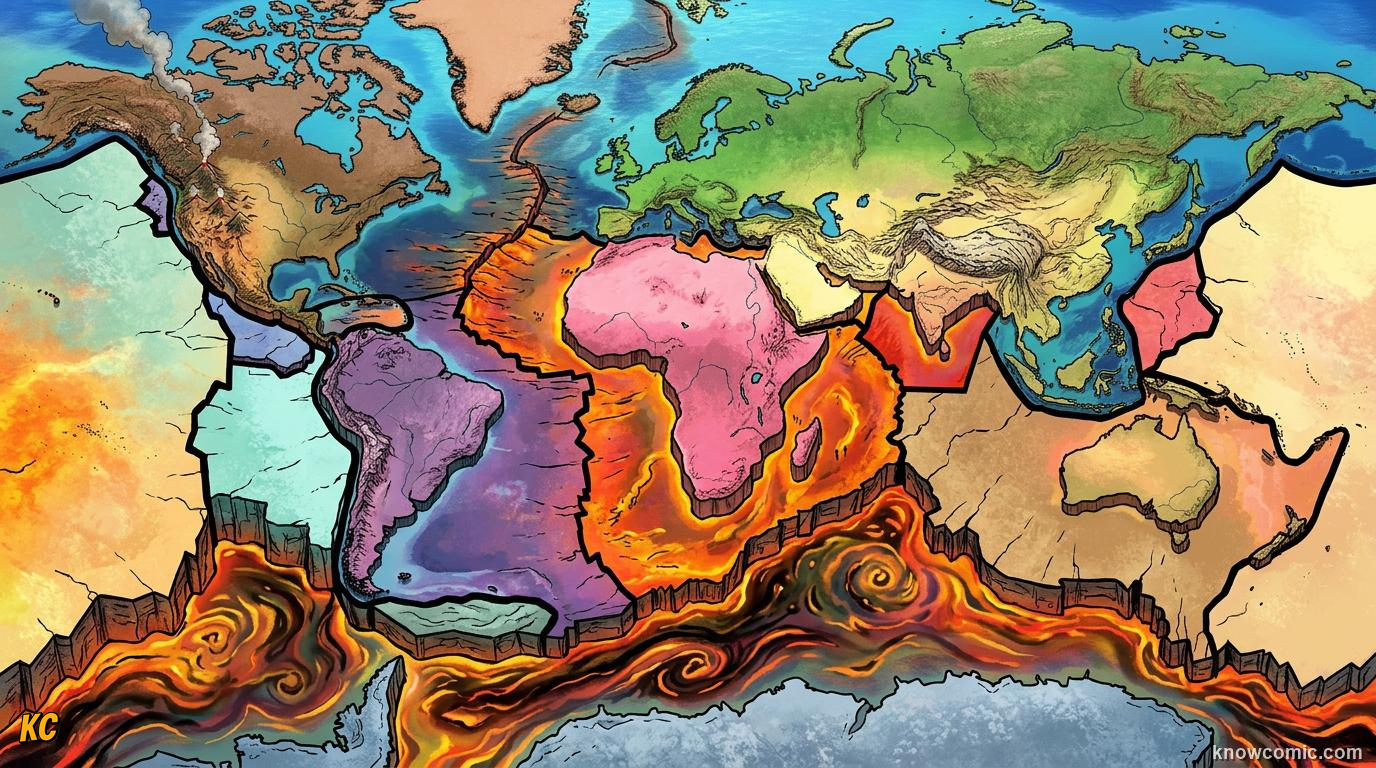
FROM CORE TO CONTINENTS
For exams, connect the layers to processes you can see on maps. The rigid lithosphere breaks into plates. The soft asthenosphere lets them move. Mantle convection and radioactive heat supply the energy. The liquid outer core creates the magnetic field. The solid inner core grows slowly as Earth cools. Seismic waves prove the structure: P-waves travel through solids and liquids but bend at boundaries. S-waves pass only through solids, so they stop at the liquid outer core and create a large shadow zone on the opposite side of the planet. Topic 2 builds on this foundation with full plate tectonics theory.
🧠 REMEMBER
Crust + upper mantle = lithosphere → asthenosphere below → mantle convection + radioactivity → liquid outer core → solid inner core ~5,000°C → S-wave shadow zone.
PLANET!
S-WAVE SHADOW
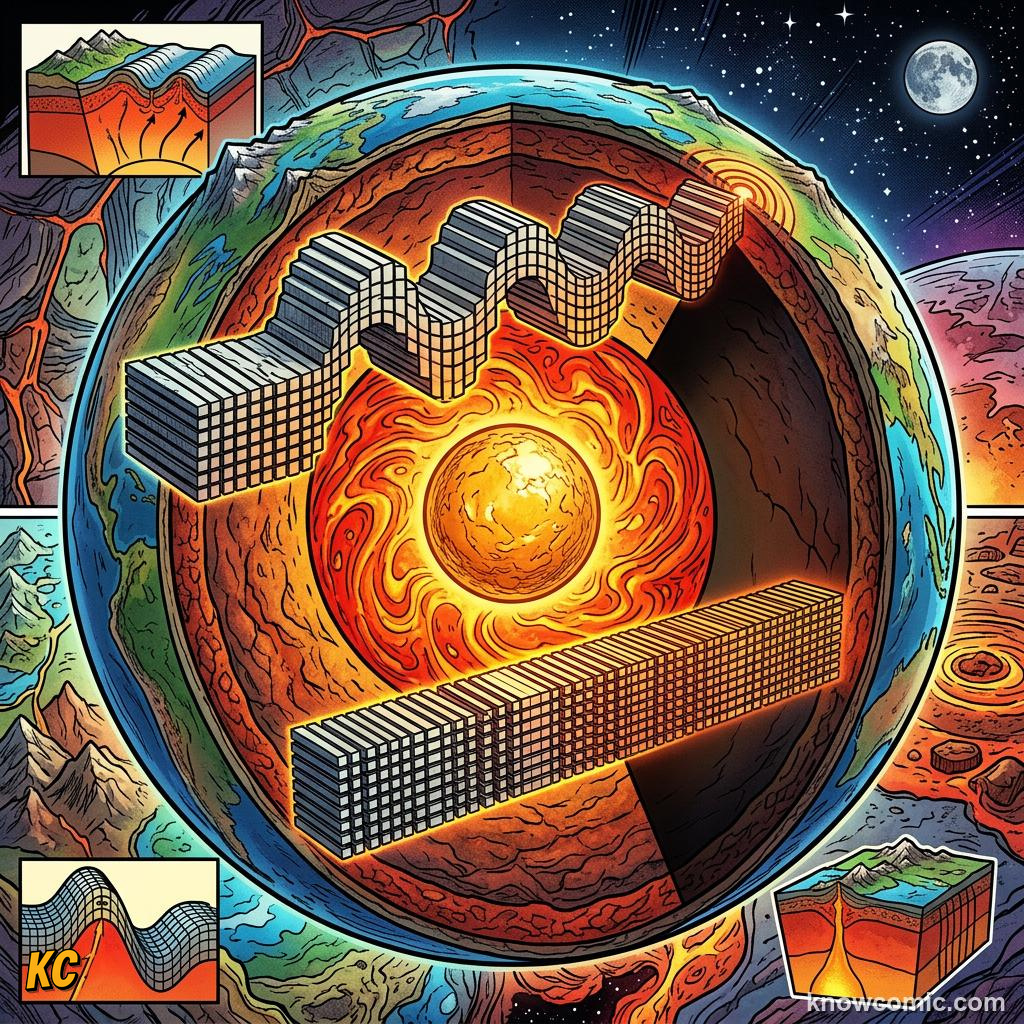
- S-waves cannot travel through liquid, so they vanish in the outer core.
- Seismometers more than about 103° from an earthquake miss direct S-waves.
- That shadow zone was key evidence for a liquid core early in the 1900s.
KEY FACTS
📌 KEY FACTS
Chemical layers: crust, mantle, core. Physical layers: lithosphere, asthenosphere, mesosphere, outer core, inner core. Heat from formation + radioactivity drives mantle convection and plate motion.
🧠 QUIZ TIME!
EARTH'S INTERNAL STRUCTURE · 5 QUESTIONS
QUESTION 01
Why do S-waves from an earthquake not arrive at seismometers on the far side of Earth?
QUESTION 02
The temperature of Earth's solid inner core is approximately:
QUESTION 03
The lithosphere is best defined as:
QUESTION 04
A major source of heat keeping mantle convection active today is:
QUESTION 05
The asthenosphere is important because it:
0/5
LOADING...
No comments yet. Be the first!