🌊
🏛️
📜
🏛️ HISTORY UNIVERSE · AGES 8–14

MESO-
POTAMIA

🌊 Two Rivers · First Cities · The Birth of Civilisation!

📖 200 Topics 🆓 FREE + PRO ⏱️ 5 min read 🧠 Quiz included
🌾
4000 BCE
First Sumerian city of Uruk
📜
3200 BCE
Cuneiform writing invented
👑
2334 BCE
Sargon builds first empire
⚖️
1754 BCE
Hammurabi's law code
🏜️
TODAY
Ancient ruins across Iraq
🏛️ MESOPOTAMIA: FIRST CITIES
TOPIC 02 · HISTORY · ANCIENT WORLD · 4000 BCE, 539 BCE
PAGE 1 OF 5, THE LAND BETWEEN TWO RIVERS
WHERE CIVILISATION WAS BORN
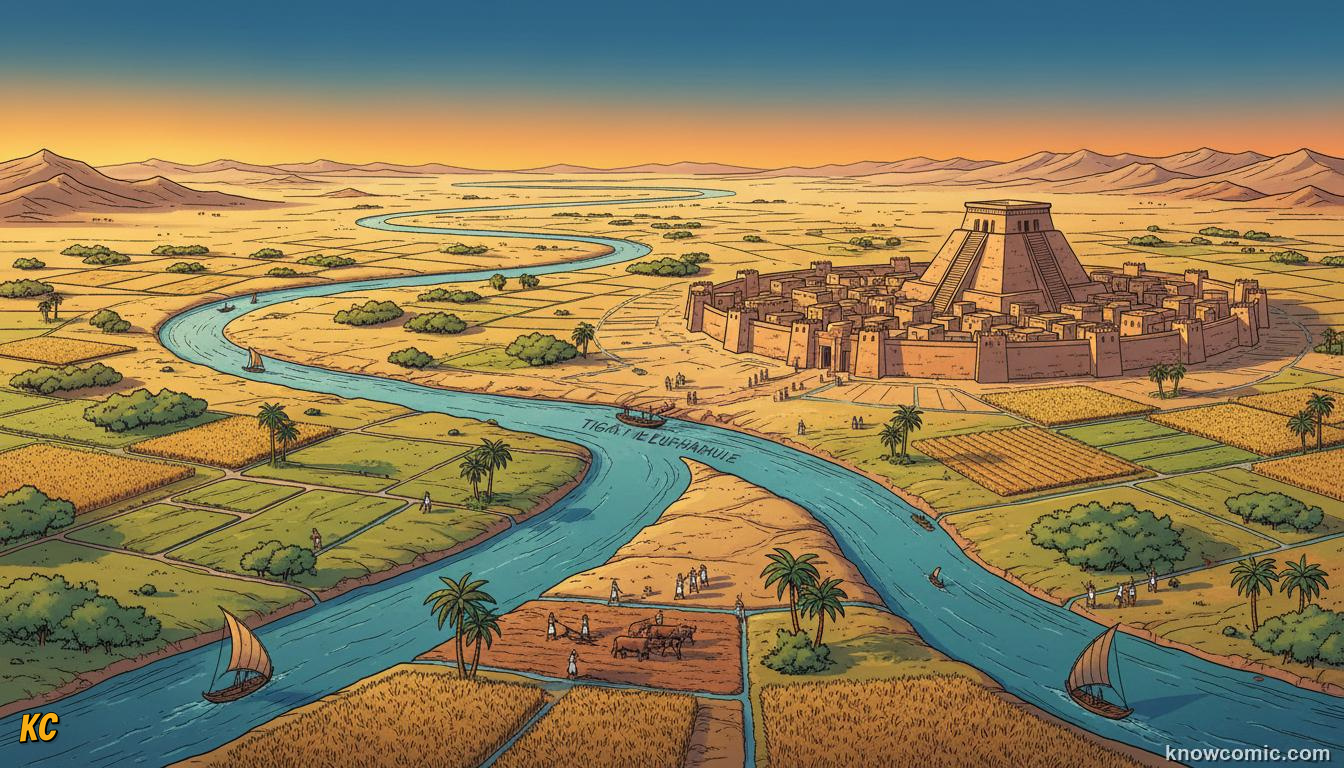
Ancient Mesopotamia with Tigris and Euphrates rivers flowing through fertile farmland
TIGRIS & EUPHRATES, THE FERTILE CRESCENT
The word Mesopotamia is ancient Greek for "the land between the rivers", the two great rivers being the Tigris and the Euphrates, which flow through what is today Iraq, eastern Syria and south-east Turkey. Around 10,000 years ago, people here stopped wandering and settled down. They noticed something amazing: if you dug channels from the river into the dry plain, the desert burst into wheat, barley, dates and flax. For the first time in history humans produced so much food that not everyone had to be a farmer. Some became potters, weavers, priests, traders and rulers. Small farming villages swelled into towns, and towns became walled cities. Historians call the wider region "the Fertile Crescent" and Mesopotamia is its beating heart, the very first place on Earth where human civilisation truly began.
⚡ DID YOU KNOW?
The word "Iraq" and the region's ancient name come from the city of Uruk, founded around 4000 BCE. Uruk may have been the largest city on Earth in 3200 BCE, home to around 40,000 people, bigger than London would be 4,000 years later!
CRADLE!
URUK · 4000 BCE
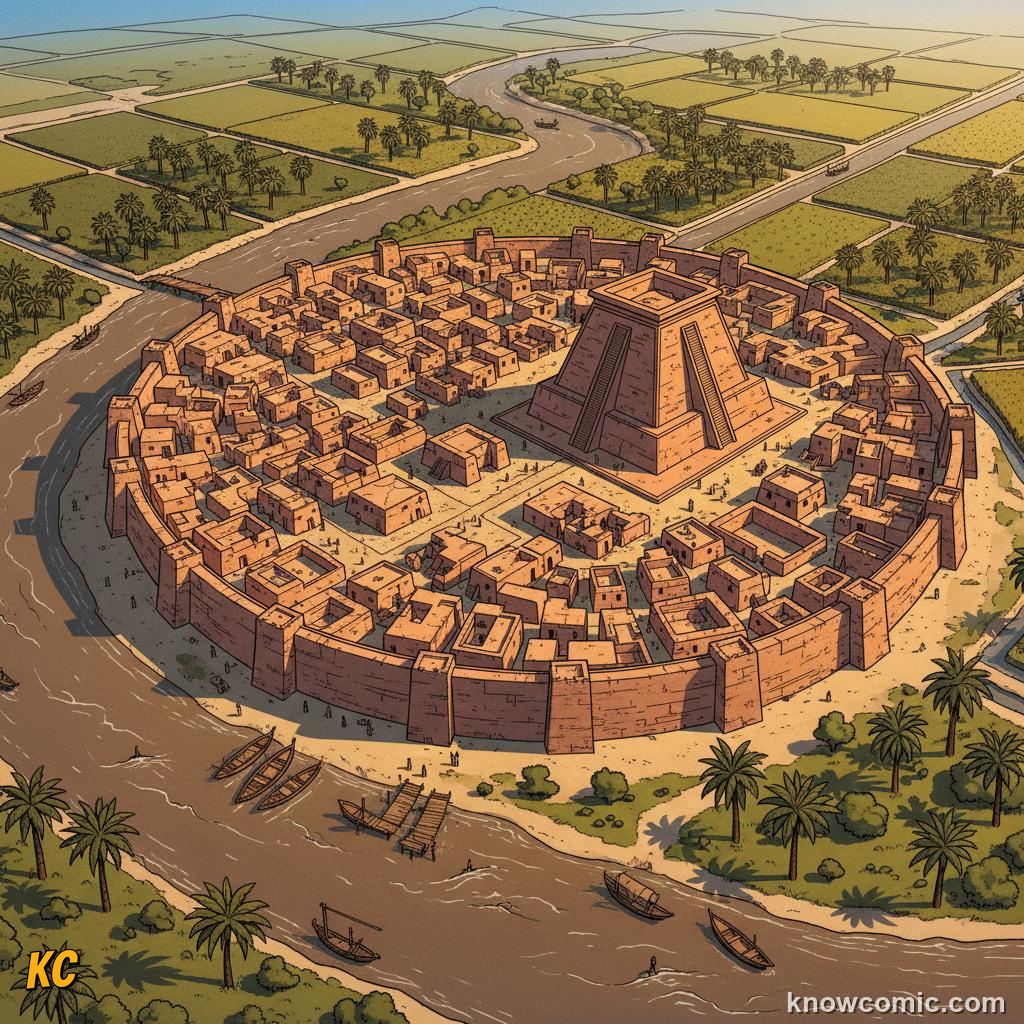
Ancient city of Uruk with sun-dried mud brick walls and early Sumerian architecture
🏙️ World's first true city
🧱 Built of sun-dried mud bricks
🛕 Surrounded by thick walls
ZIGGURATS
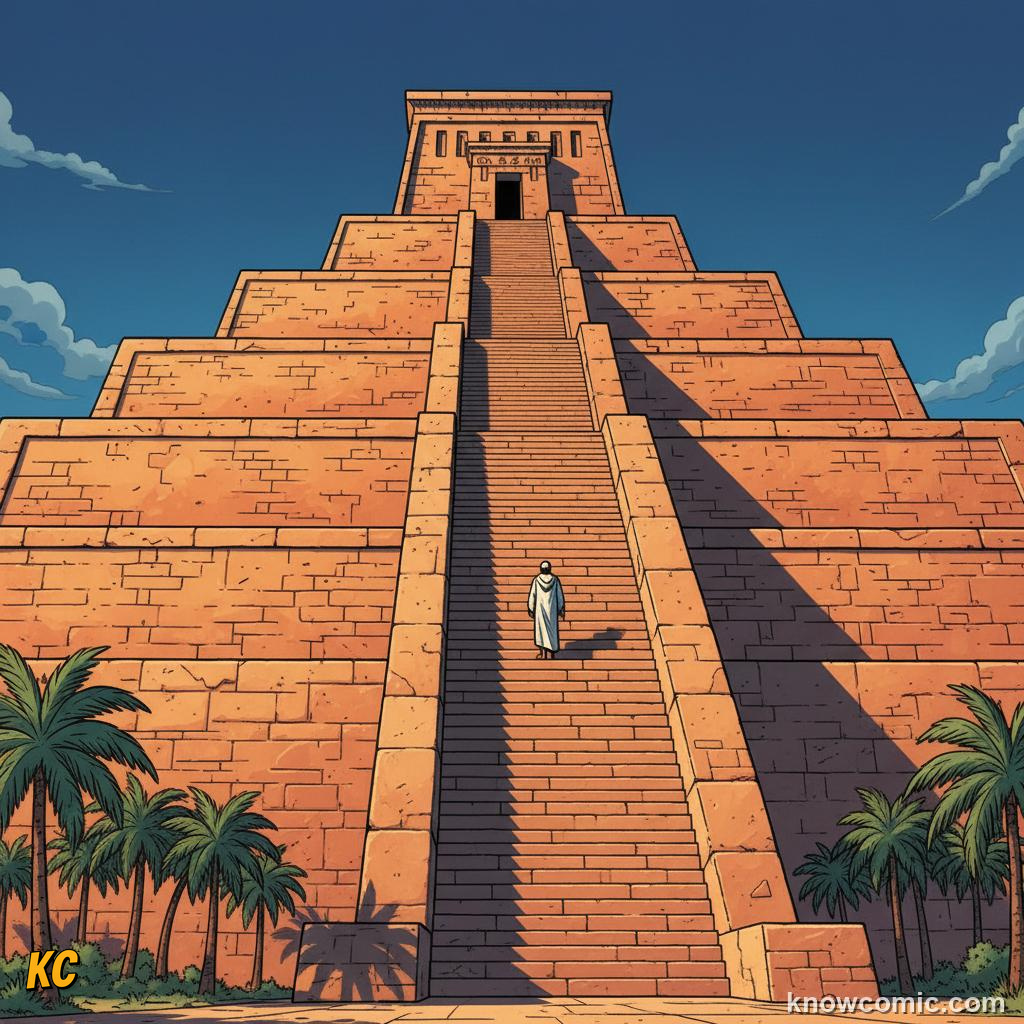
A stepped ziggurat temple tower rising above the flat Mesopotamian plains
🛕 Stepped pyramid-temples
🙏 Homes of the city gods
🏞️ Rose above the flat plains
PAGE 2 OF 5, THE INVENTION OF WRITING
C. 3200 BCE · SUMER
Sumerian scribe pressing a reed stylus into a wet clay tablet creating cuneiform writing
CUNEIFORM, THE WORLD'S FIRST WRITING
Imagine running a city of 40,000 people with no paper, no books and no way to record who owes what. That was Uruk's problem around 3200 BCE. To solve it, Sumerian priests invented the first writing system on Earth. They took wet clay from the river, shaped it into small flat tablets, and pressed the end of a cut reed into the clay. Each press left a tiny wedge-shaped mark, and we call this script cuneiform, from the Latin word for "wedge". At first they only wrote numbers and lists, 5 sheep, 12 jars of beer, 3 bags of barley. But soon the symbols grew into a full language of hundreds of signs that could record laws, letters, stories and even poems. When each tablet dried or was baked in the sun it became almost indestructible, which is why archaeologists today can still read the shopping lists, love letters and school homework of people who lived 5,000 years ago.
📜 FIRST WORDS
The oldest known author in history is a Sumerian priestess called Enheduanna, who lived around 2300 BCE. She wrote religious poems that were signed with her name, making her the first named writer we know of anywhere in the world.
WRITE!
CLAY TABLETS
Ancient clay tablets covered in wedge-shaped cuneiform script baked hard by the sun
🧱 Wet clay pressed by a reed
☀️ Baked hard by the sun
🗄️ Lasts for thousands of years
REED STYLUS
A cut reed stylus used by Sumerian scribes to press wedge marks into soft clay
🌾 A cut marsh reed
✏️ Triangular tip makes wedges
🔣 Hundreds of different signs
SCRIBE SCHOOL
Sumerian scribe school with boys learning to write cuneiform on clay tablets
📚 Called the "edubba", tablet house
🧒 Boys trained for many years
✍️ Became priests, lawyers, clerks
PAGE 3 OF 5, WHEELS, PLOUGHS & ZIGGURATS
THE WHEEL
Early Mesopotamian wooden wheel attached to an ox-cart crossing the plains
⚙️ First used on the potter's wheel
🐂 Fitted to ox-carts around 3500 BCE
⚔️ Later transformed warfare
IRRIGATION
Ancient irrigation canal channeling water from the Euphrates river to dry farmland
💧 Canals fed desert fields
🌾 Three harvests a year became possible
🧑‍🌾 Surplus food freed up workers
THE ZIGGURAT OF UR
The Great Ziggurat of Ur, a massive stepped mud-brick temple towering above the city
STEPPED TEMPLES THAT TOUCHED THE SKY
Every Mesopotamian city had a patron god, and every god needed a home. The Sumerians built those homes from millions of sun-dried mud bricks, stacked into huge stepped platforms called ziggurats. At the top of each ziggurat sat a small shrine room where only priests were allowed. From the flat floodplain, a ziggurat could be seen for miles, a man-made mountain in a land without mountains. The most famous surviving one is the Great Ziggurat of Ur, built around 2100 BCE by King Ur-Nammu, and partly rebuilt by the Iraqi government in the 1980s. Similar towers inspired the Bible story of the Tower of Babel, set in the city of Babylon. Ziggurats were not tombs like the pyramids, they were cosmic stairways, a way for the city to climb closer to heaven and meet its god.
🛕 STAIRWAY TO HEAVEN
A large ziggurat could use up to 30 million mud bricks. The outside was baked hard, but the inside was just sun-dried, which is why most ziggurats have melted into huge mounds over the centuries.
ZIGGURAT!
PAGE 4 OF 5, KINGS, EMPIRES & THE FIRST LAW CODE
1754 BCE · BABYLON
King Hammurabi of Babylon presenting 282 laws carved on a tall black stone stele
HAMMURABI, THE KING WHO WROTE DOWN THE LAW
For centuries, whether you were punished or rewarded depended on the mood of your local king. Around 1754 BCE, a Babylonian ruler called Hammurabi decided that was unfair. He had his scribes carve 282 written laws onto a huge black stone pillar taller than a grown man, called a stele, and put it up in the centre of Babylon so every citizen could see them. The laws covered theft, trade, marriage, slavery, contracts, and doctors' fees. Many were harsh, "an eye for an eye, a tooth for a tooth" comes straight from his code. But the key idea was new: the law applied to everyone, rich or poor, and it had to be written down. Before Hammurabi, the king was the law. After Hammurabi, the law was above the king. That idea still shapes courts and constitutions all over the world today.
⚖️ STILL STANDING
The original Hammurabi stele, more than 2.25 metres tall, was discovered in 1901 and is now displayed in the Louvre Museum in Paris. You can still read all 282 laws carved into it, 3,700 years later.
LAW!
SARGON OF AKKAD
Sargon of Akkad, the warrior king who built the world first empire in 2334 BCE
👑 Built the world's first empire
🗡️ Ruled from around 2334 BCE
🌍 United the Sumerian city-states
HAMMURABI
Hammurabi standing beside his law stele representing justice and written order
⚖️ 282 laws carved in stone
🏛️ Ruled Babylon 1792–1750 BCE
👁️ "An eye for an eye"
EPIC OF GILGAMESH
Ancient clay tablet depicting scenes from the Epic of Gilgamesh, the world oldest story
📖 World's oldest known story
🐂 Hero-king battles monsters
🌊 Includes a great flood tale
PAGE 5 OF 5, WHAT MESOPOTAMIA GAVE US
5,000 YEARS LATER · WE STILL USE THEIR INVENTIONS
Visual collage of Mesopotamian inventions including the wheel, writing, and the plough
THE INVENTIONS THAT BUILT THE MODERN WORLD
Mesopotamia's cities eventually fell, Babylon was conquered by the Persians in 539 BCE and later by Alexander the Great, but their ideas never died. We owe Mesopotamia the very concept of a city, along with writing, schools, arithmetic, lawyers, postal systems, the 60-minute hour, the 360-degree circle, the 12-month calendar, the wheel, sailboats, bronze tools, the plough, and the first libraries. Babylonian astronomers watched the night sky so carefully that they predicted eclipses long before the Greeks did, and they gave the planets the names we still use in modern languages. Every time you tell the time, buy something, sign a contract, sit in a classroom, or read a book, you are standing on the shoulders of Sumerian scribes from 5,000 years ago. Mesopotamia didn't just build the first cities, it built the blueprint for all civilisation that followed.
🌍 GIFTS TO THE WORLD
writing · schools · laws · city-states · the wheel · irrigation · bronze tools · the plough · the 60-minute hour · the 360-degree circle · astronomy · the first libraries · epic literature.
LEGACY!
🔭 REDISCOVERY
Archaeologists excavating ancient Mesopotamian ruins and discovering cuneiform tablets
1849 Nineveh library found
1901 Hammurabi stele unearthed
1922 Ziggurat of Ur excavated
TODAY Digs continue across Iraq
REMEMBER
🏛️ KEY FACTS
Mesopotamia = "land between the rivers". Two rivers: Tigris & Euphrates. Sumerians invented cuneiform writing around 3200 BCE. Sargon built the first empire in 2334 BCE. Hammurabi wrote the first major law code around 1754 BCE.
✅ 4000 BCE, City of Uruk
✅ 3200 BCE, Cuneiform writing
✅ 2334 BCE, Sargon's empire
✅ 1754 BCE, Hammurabi's code
🧠 QUIZ TIME!
MESOPOTAMIA · FIRST CITIES · 5 QUESTIONS
QUESTION 01
The word "Mesopotamia" means "the land between the rivers". Which two rivers?
QUESTION 02
What is the name of the world's first known writing system, invented by the Sumerians?
QUESTION 03
What is a ziggurat?
QUESTION 04
Which Babylonian king is famous for carving 282 laws onto a giant stone pillar around 1754 BCE?
QUESTION 05
Which of these everyday things was NOT invented in Mesopotamia?
0/5
LOADING...
← TOPIC 01 📋 HISTORY HUB TOPIC 03 →