THE LANGUAGE OF PROOF
PAGE 1 OF 5, BEYOND SOLVING: WHAT IS A PROOF?
SOLVE VS PROVE
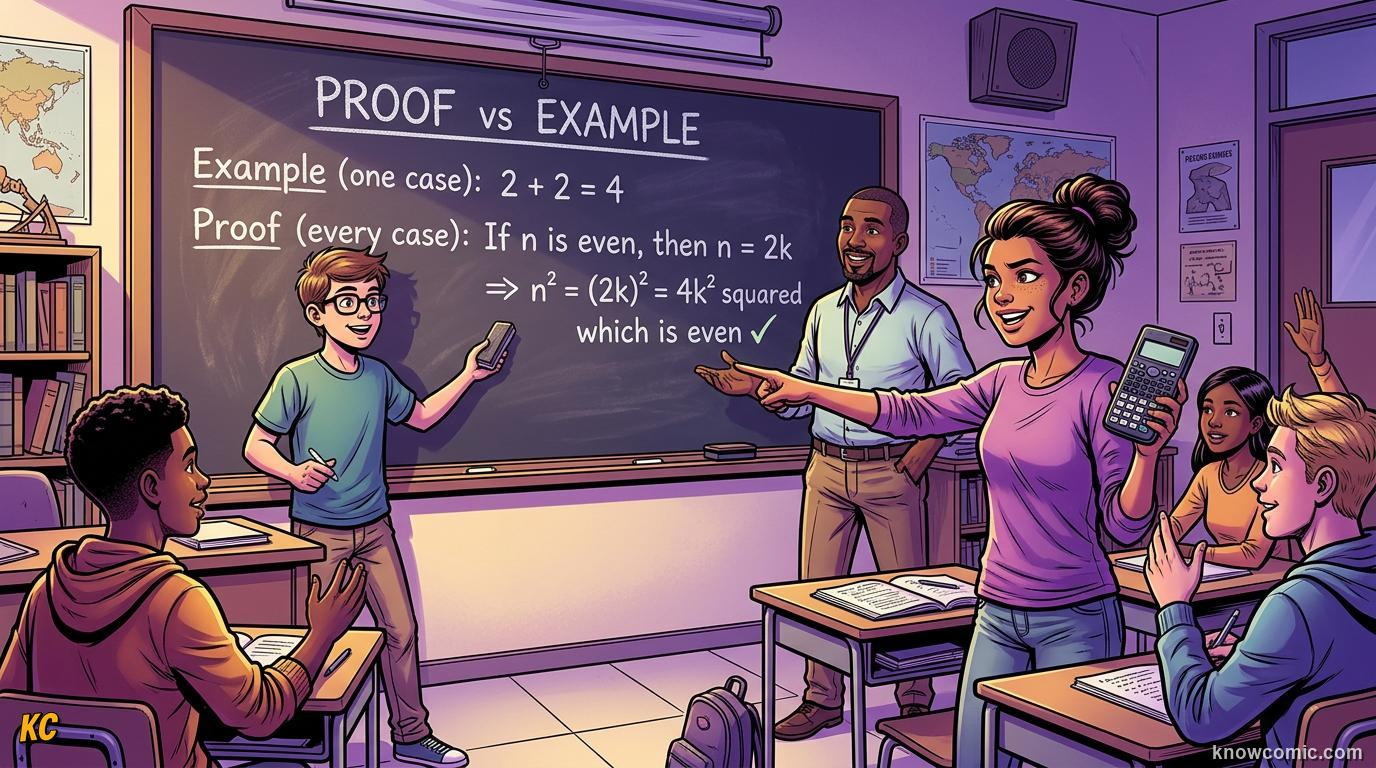
MORE THAN FINDING AN ANSWER
In school you often solve problems: plug numbers in, simplify, get one answer. Advanced maths asks you to prove statements: show that a claim is true for every allowed case, not just one lucky example. Checking that 2 + 2 = 4 once is an example. Proving that adding zero never changes a number works for all numbers you could ever write. That shift from "it worked this time" to "it must always work" is the heart of proof. Scientists test the world with experiments; mathematicians test ideas with logic that cannot be overturned by a counterexample.
⚡ DID YOU KNOW?
One counterexample destroys a general claim! If someone says "every even number bigger than 2 is a sum of two primes" (a famous claim called Goldbach's conjecture that nobody has proved yet), finding a single even number that breaks the rule would disprove that statement forever.
PROVE!
EXAMPLE
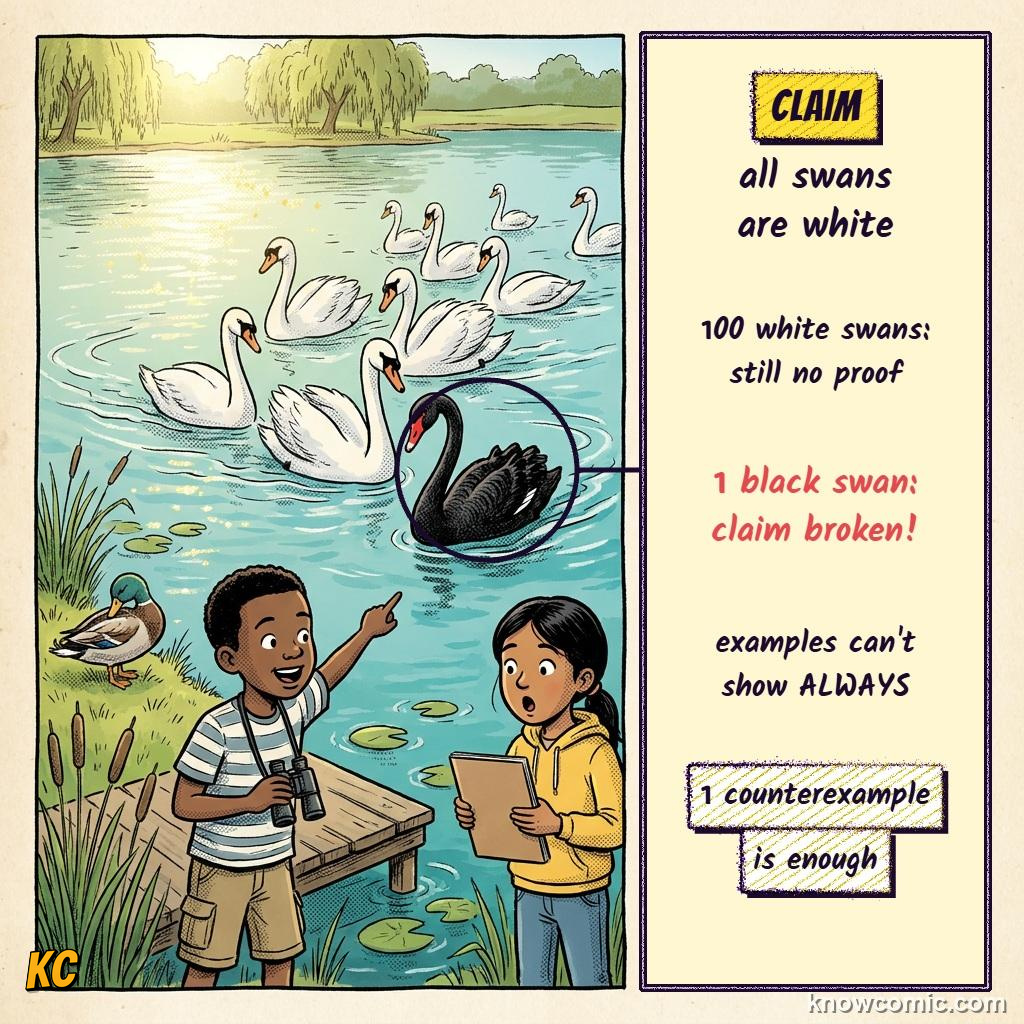
🦢 Seeing 100 white swans still does not prove that all swans are white.
⚫ One black swan shows the claim is wrong, so trying examples can never prove "always".
⚫ One black swan shows the claim is wrong, so trying examples can never prove "always".
PROOF
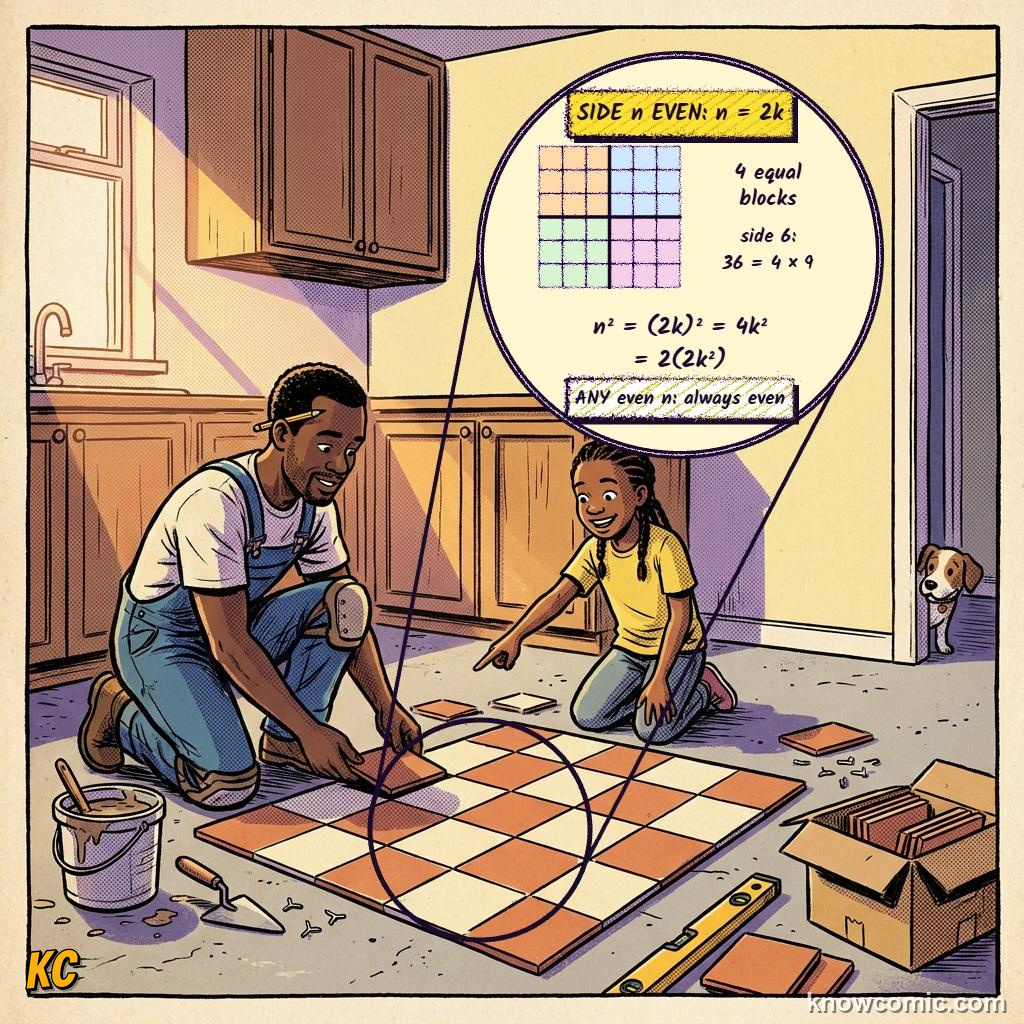
🧩 A proof checks every possible case, not just the few you tried.
🔗 Each step follows from the one before, so once something is proved, it stays true forever.
🔗 Each step follows from the one before, so once something is proved, it stays true forever.
PAGE 2 OF 5, THE ARCHITECTURE OF LOGICAL STEPS
STEP BY STEP
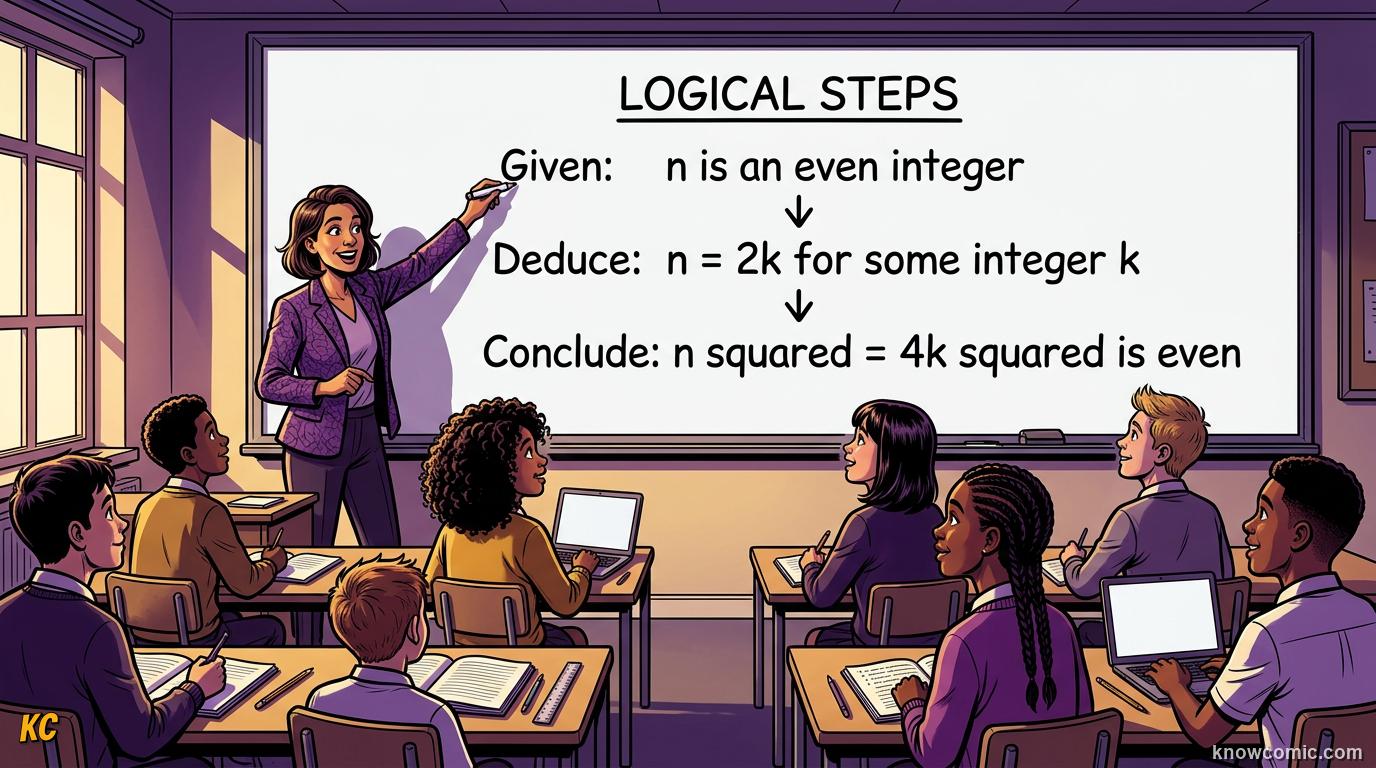
EVERY LINE NEEDS A REASON
A proof reads like a chain. You start from facts everyone accepts: definitions, axioms, or results already proved. Each new line must follow from earlier lines using valid rules (adding the same thing to both sides, substituting equal quantities, applying a theorem). In exams you often write "Given," then "Therefore," and name the rule you used. If a step jumps without justification, the proof has a gap, like a bridge missing a plank. Good proof writing is not about being clever once; it is about being so clear that another mathematician cannot find a hole in your reasoning.
🔗 PROOF PHRASES
"Suppose that…" sets up an assumption. "Therefore" and "Hence" mark conclusions. "By definition" and "By induction" tell the reader which tool you are using.
LOGIC!
GIVEN
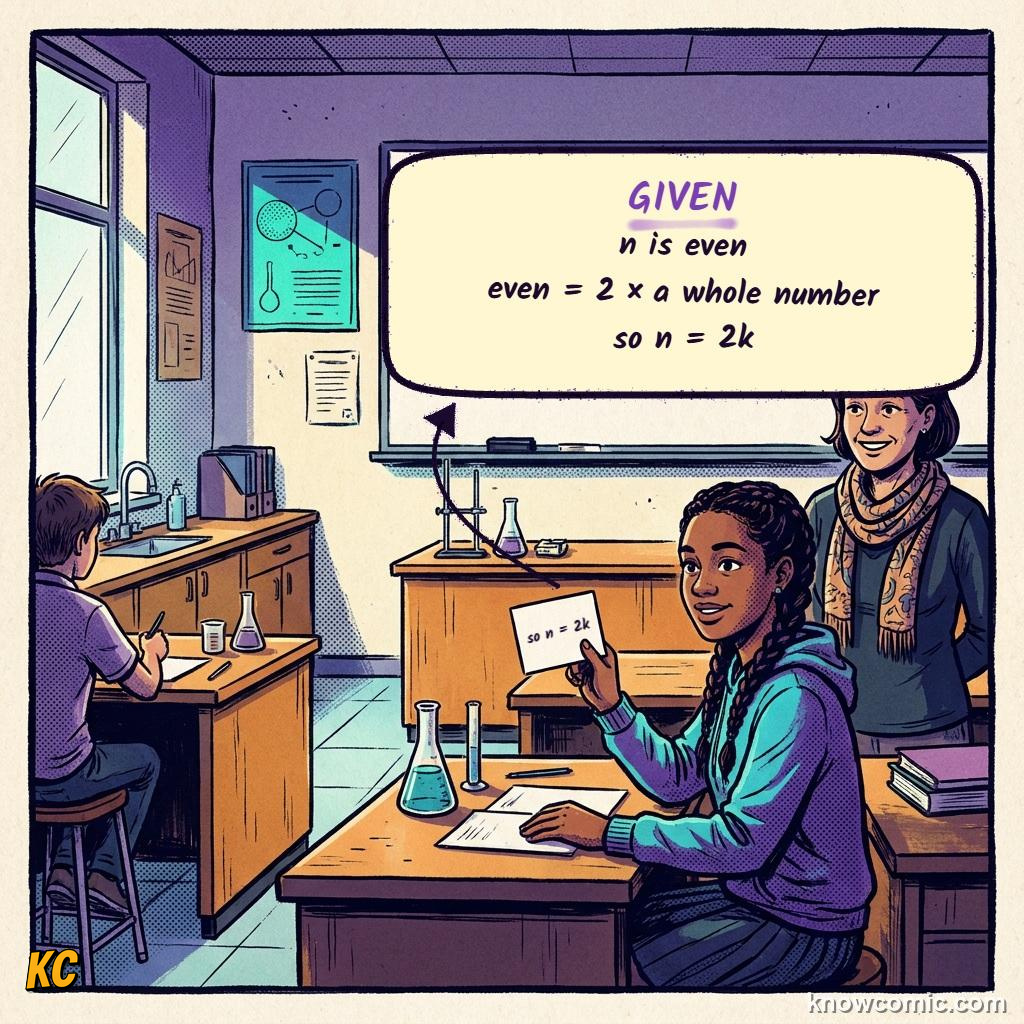
📋 A proof starts by writing down what you already know and what each word means.
🎯 Then you write exactly what you need to show, so you know where you are going.
🎯 Then you write exactly what you need to show, so you know where you are going.
DEDUCE
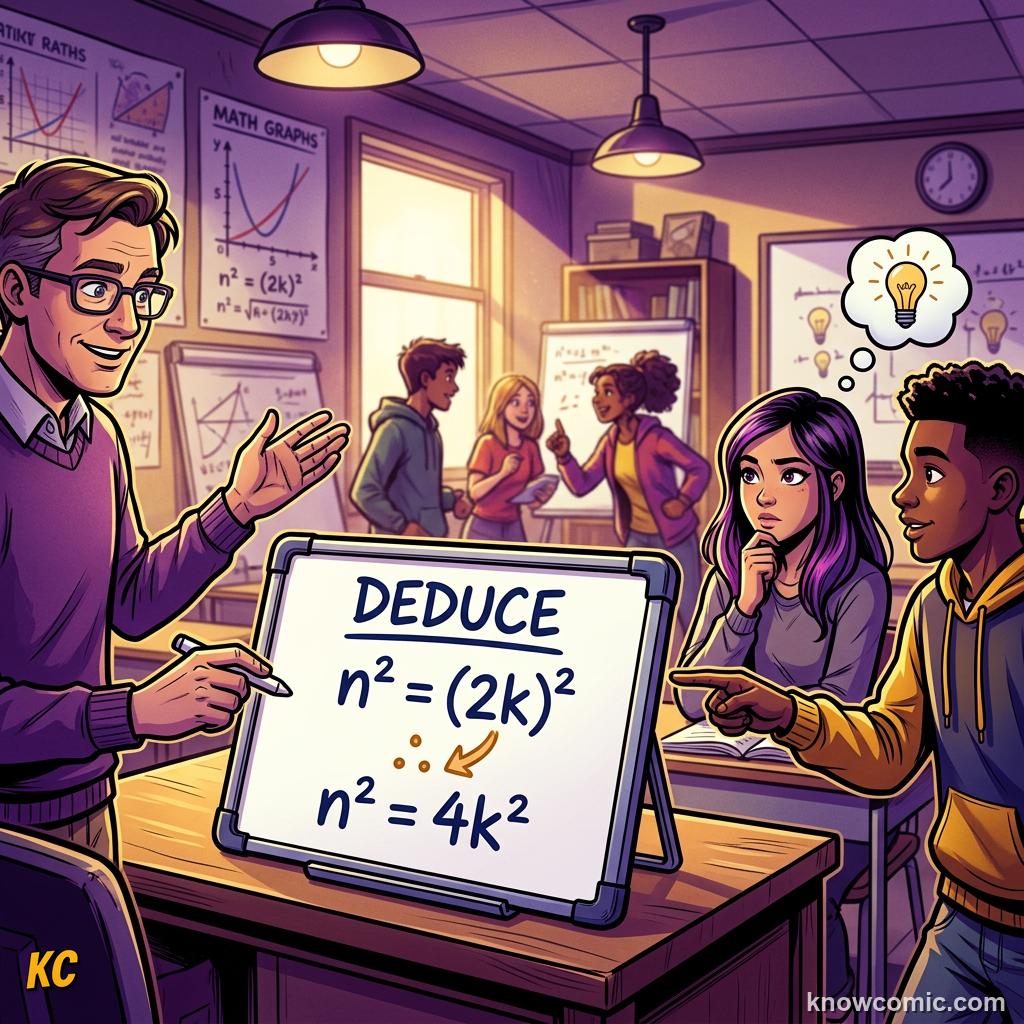
➡️ In the middle of a proof, you move forward one small step at a time.
✏️ Beside each step you write the rule that allows it, so nothing is skipped.
✏️ Beside each step you write the rule that allows it, so nothing is skipped.
CONCLUDE
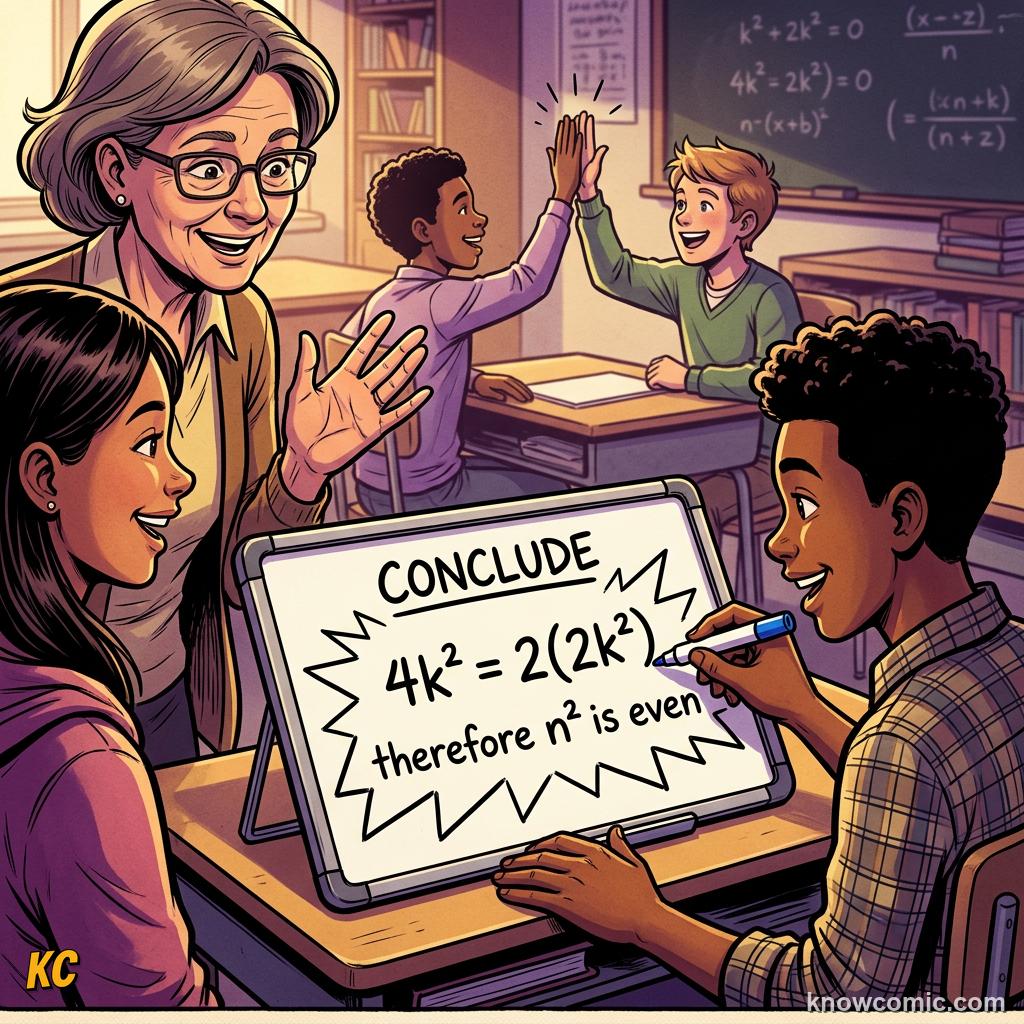
🎯 A proof ends when you reach the exact statement you set out to show.
∎ Many mathematicians draw a small box at the end to show they are done.
∎ Many mathematicians draw a small box at the end to show they are done.
PAGE 3 OF 5, SYMBOLS OF IDENTITY AND EQUIVALENCE
EQUALS =
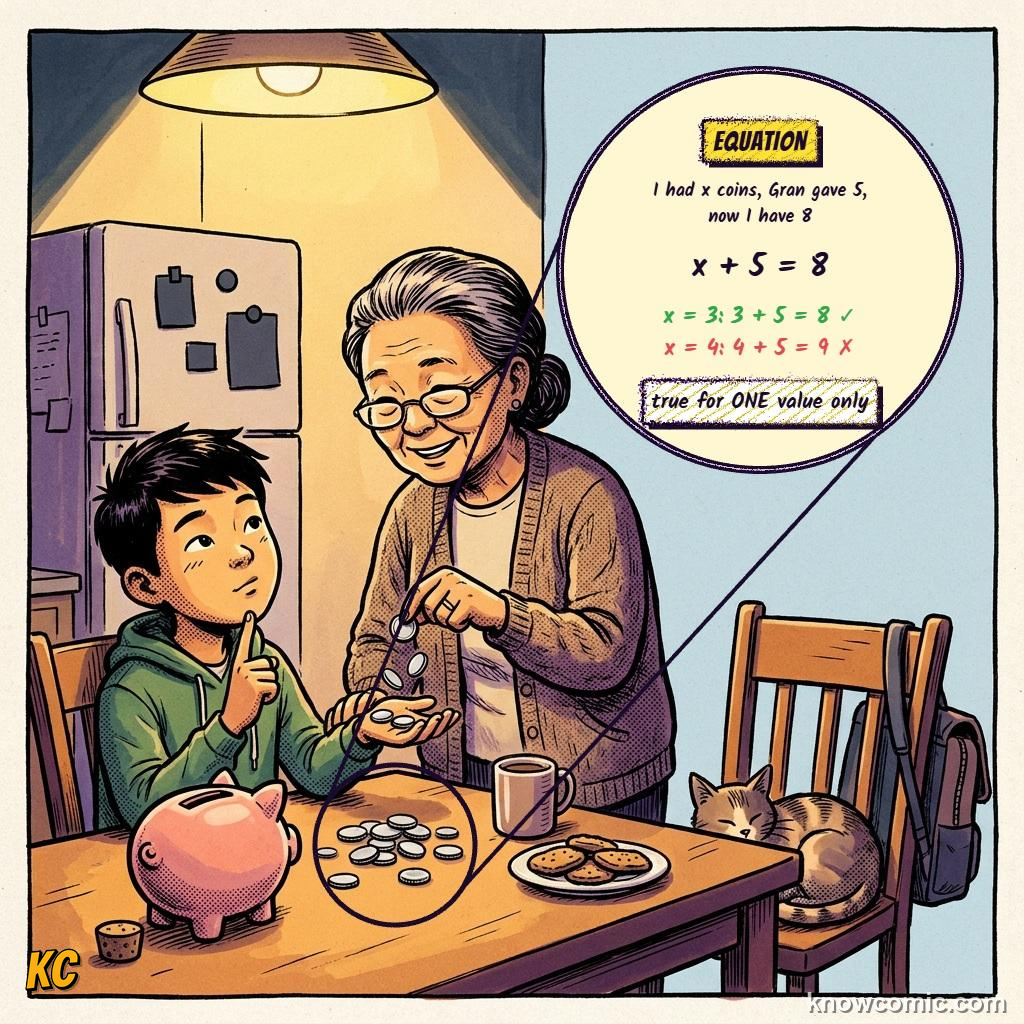
🐷 x + 5 = 8 is an equation, and it is only true when x is 3.
🔢 An equation asks you to find the number that makes both sides equal.
🔢 An equation asks you to find the number that makes both sides equal.
IDENTITY ≡

🍎 x + x ≡ 2x is an identity: two equal bags always hold twice as many apples as one bag.
♾️ The ≡ sign means it is true for every input, so any number you try works, not just one.
♾️ The ≡ sign means it is true for every input, so any number you try works, not just one.
≡ vs =
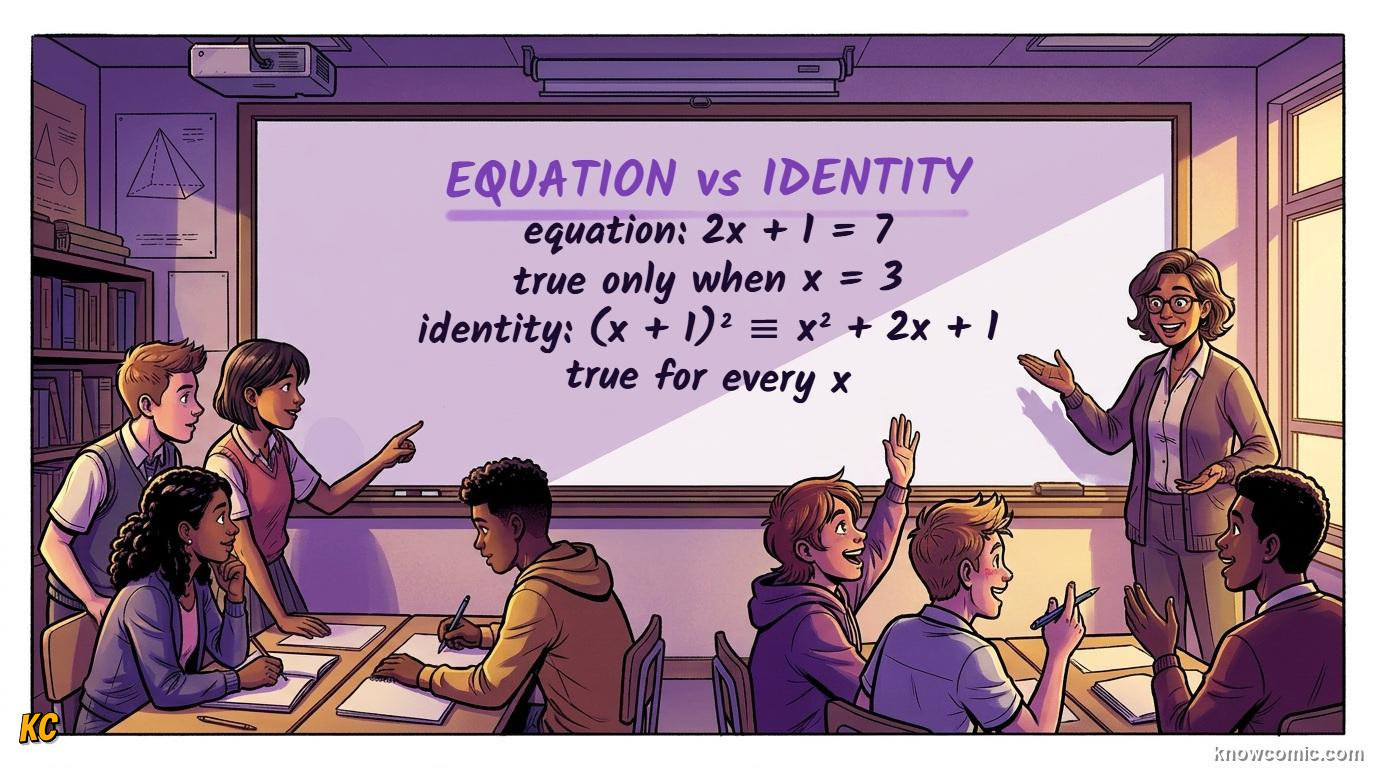
THE IDENTITY SYMBOL
The triple bar ≡ (read "is identically equal to" or "is equivalent to") says two expressions match for every value in scope, not just one substitution. The statement (x + 1)² ≡ x² + 2x + 1 is an identity: expand the left side and you get the right side for all x. By contrast, x + 1 = 5 is an equation true only when x = 4. In advanced work you also see ⇔ for "if and only if," meaning two statements imply each other. Learning this language helps you read textbooks, write clean arguments, and spot when someone has proved a universal rule versus checked one number.
📐 MINI EXAMPLE
sin²θ + cos²θ ≡ 1 is a famous identity. It is not saying the value is 1 for one angle; it holds for every angle where sine and cosine are defined.
≡
PAGE 4 OF 5, FINISHING STRONG: QED AND WRAPPING UP
QED · ∎
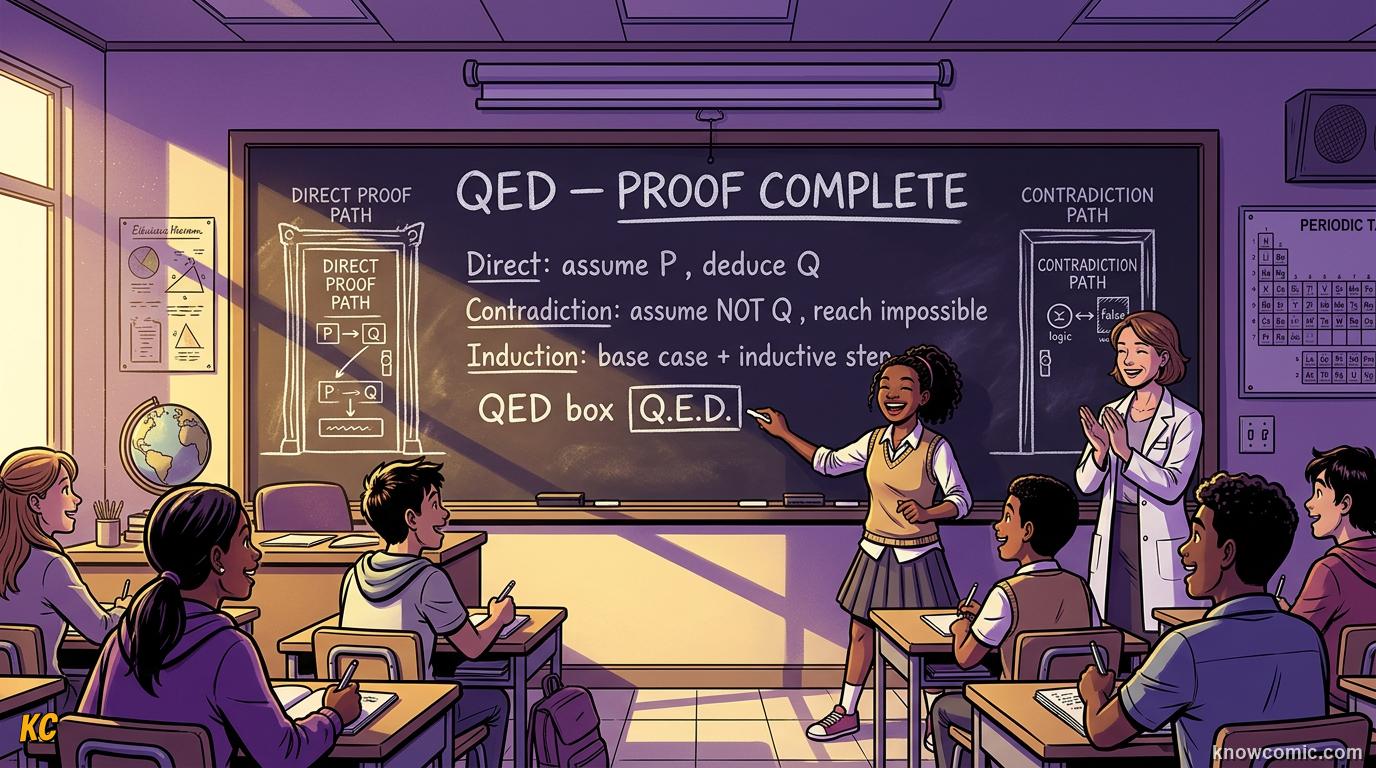
WHEN THE PROOF IS COMPLETE
Traditionally mathematicians end a proof with QED, from Latin quod erat demonstrandum, "which was to be demonstrated," or with a small square ∎ called a tombstone. These markers tell the reader: the goal has been reached, no further steps are needed. In school you might write "Hence proved" or draw a box around the final line. The habit matters because proofs can be long; a clear ending prevents someone from wondering if you forgot the last step. Computer proof assistants use similar signals so software knows the argument closed correctly.
✓ CHECK YOUR ENDING
Before you write QED, read the question again. Does your last line exactly match what you were asked to prove? A proof of the wrong statement is still wrong!
QED!
DIRECT PROOF
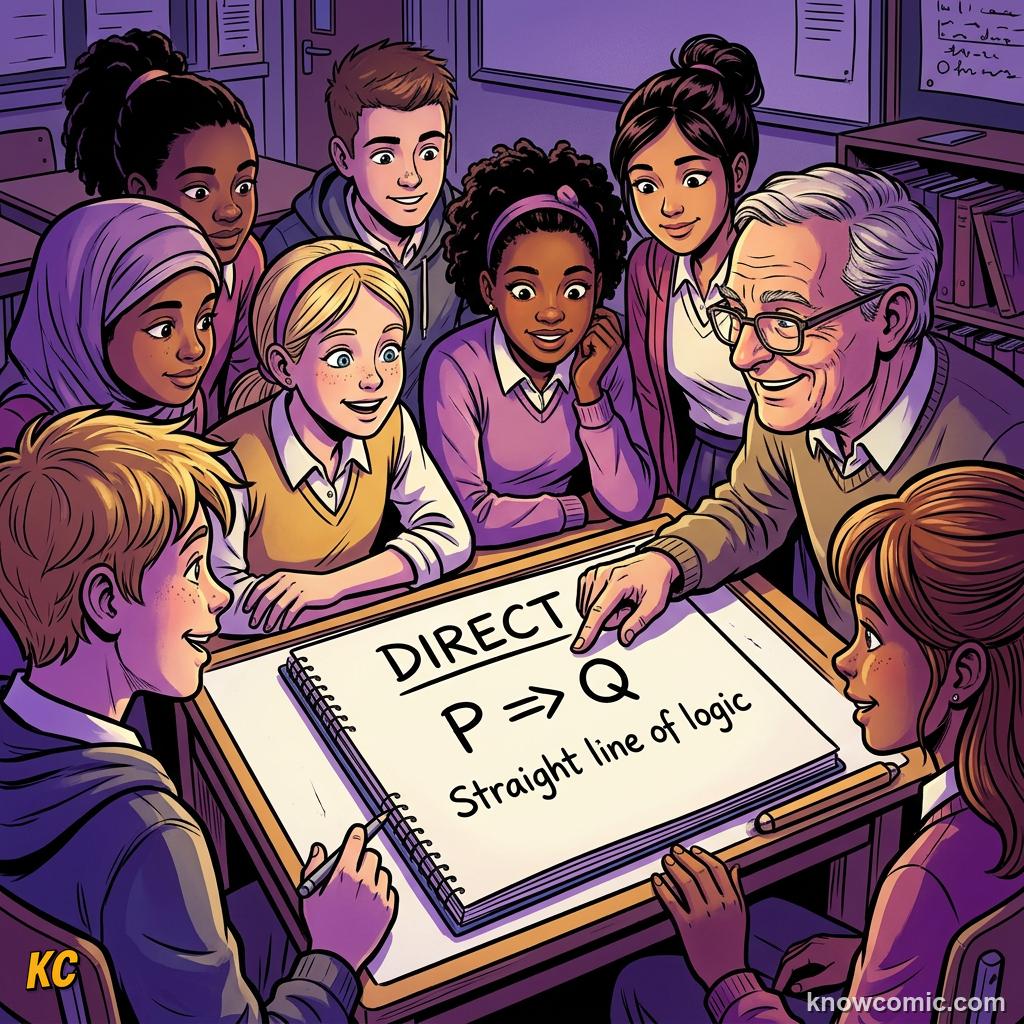
➡️ A direct proof starts from what you know and moves forward, step by step, to what you want.
📜 It is the most common kind of proof and often ends with QED, which means "this is what we had to show".
📜 It is the most common kind of proof and often ends with QED, which means "this is what we had to show".
CONTRADICTION
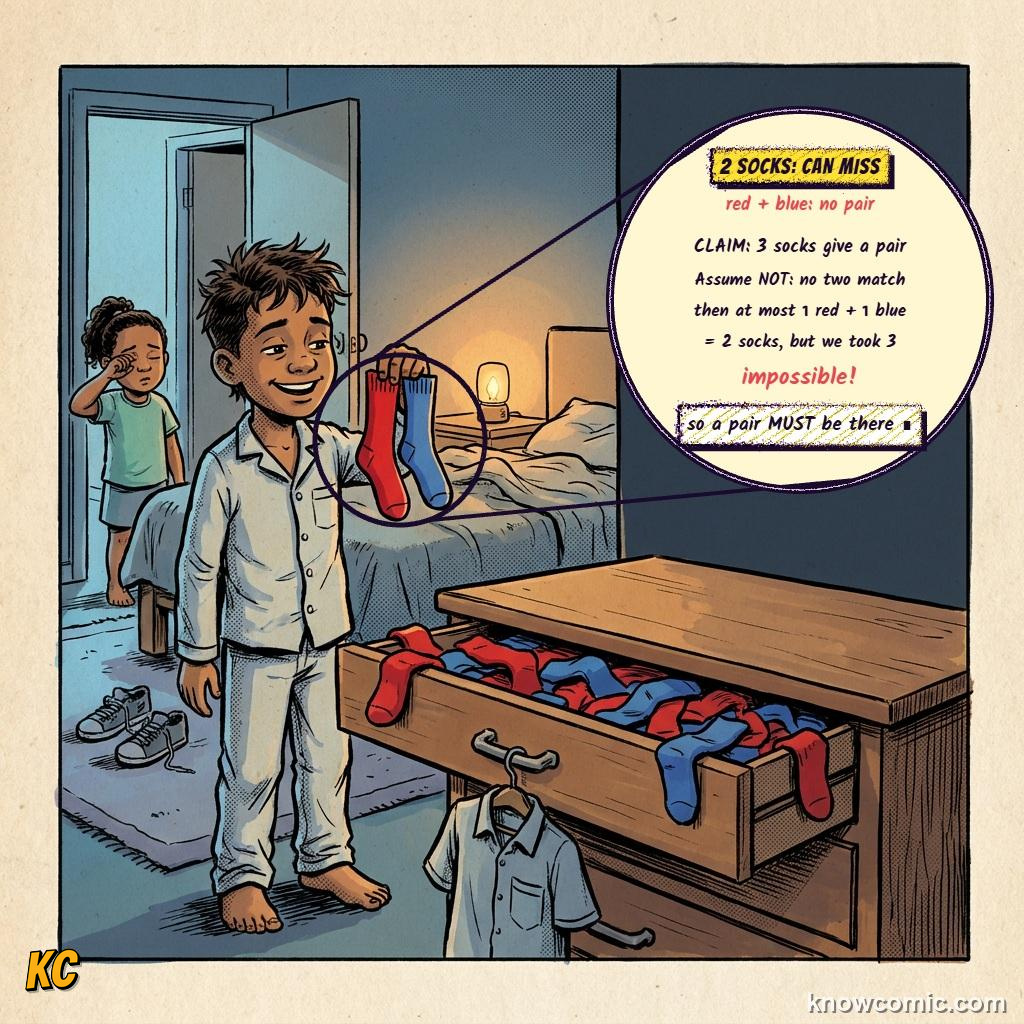
🧦 Proof by contradiction means you assume the opposite is true and see what goes wrong.
💥 Three socks with no matching pair would need three colours, but there are only two, so a pair must be there.
💥 Three socks with no matching pair would need three colours, but there are only two, so a pair must be there.
INDUCTION
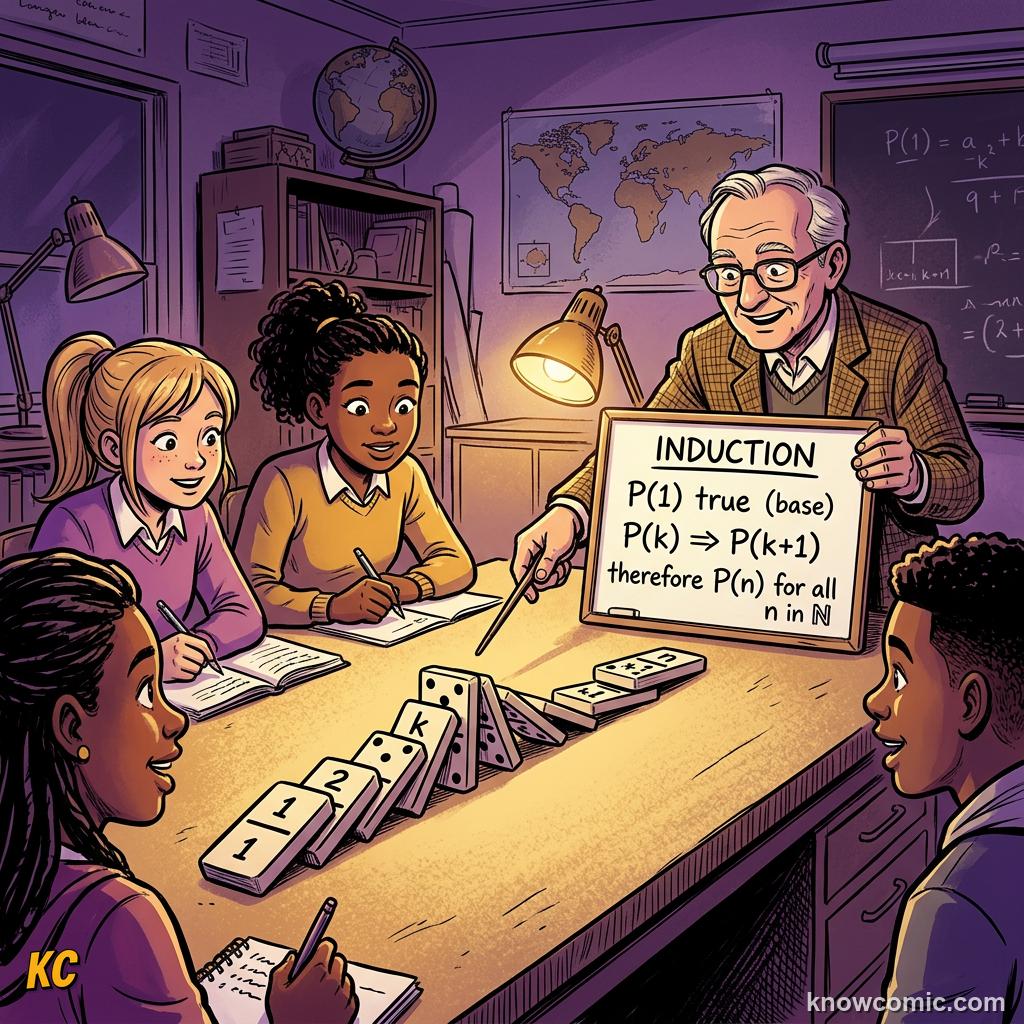
1️⃣ Induction first shows a rule works for the first number, like 1.
🔁 Then it shows that if the rule works for one number it works for the next, so it works for all counting numbers, like falling dominoes.
🔁 Then it shows that if the rule works for one number it works for the next, so it works for all counting numbers, like falling dominoes.
PAGE 5 OF 5, AXIOMS AND THE SEARCH FOR UNIVERSAL TRUTH
FOUNDATIONS
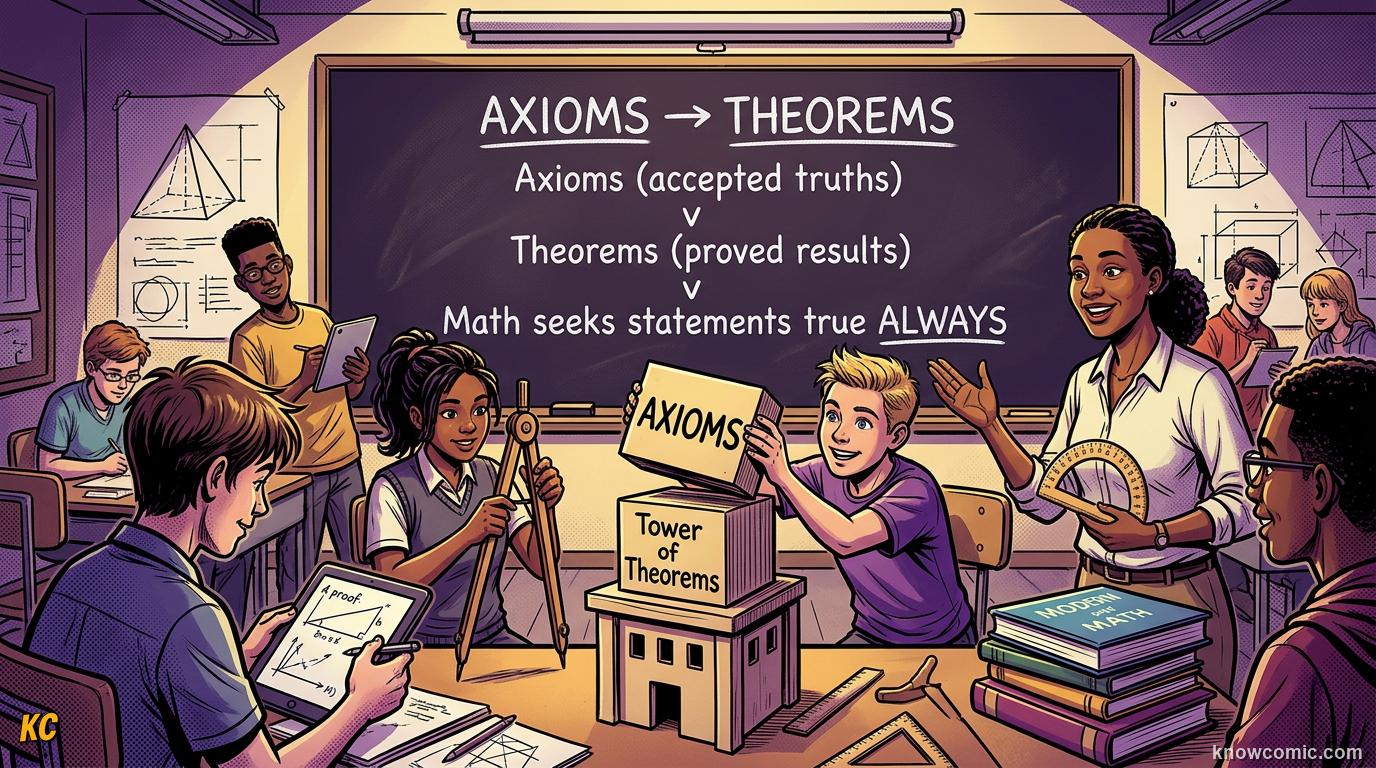
WHY MATH SEEKS TRUTH FOR ALL TIME
Every proof rests on starting points called axioms (or postulates): statements accepted without proof inside a system, like "through two points there is exactly one line." From these bricks, definitions and theorems stack up. Euclid's Elements showed the world that you could build a whole subject from a small list of rules and careful reasoning. Today we still care about universal truth: once a theorem is proved, it stays true unless someone finds a flaw in the proof itself. That permanence is why maths powers engineering, cryptography, and physics models. Learning the language of proof is learning to join a conversation that spans millennia.
🧠 TAKEAWAY
Proof beats example. Logical steps, clear symbols like ≡, and a proper ending (QED) turn a hunch into knowledge that holds for every case. That is why maths is called the ultimate truth machine.
TRUTH!
AXIOMS
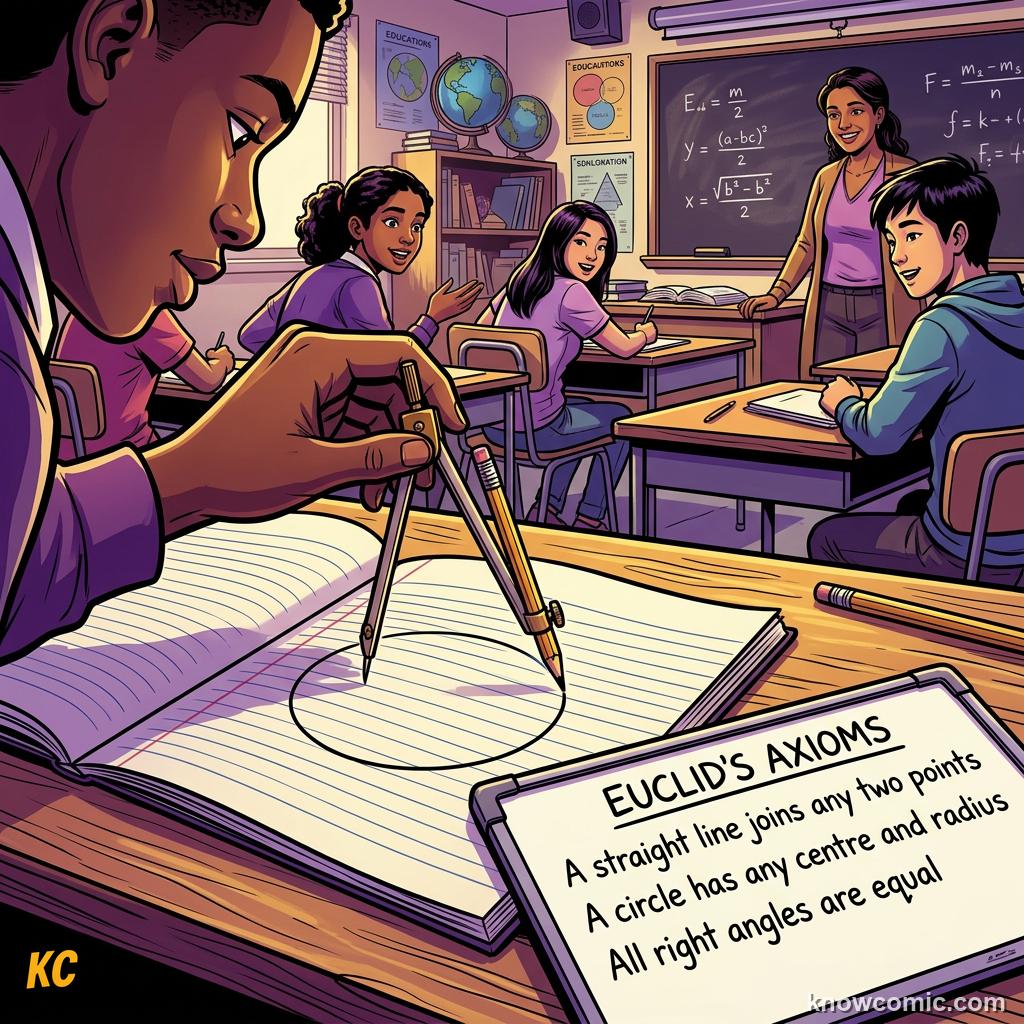
🧱 Axioms are starting facts everyone agrees on without proof, like the rules of a game.
🏛️ Over 2,000 years ago, Euclid built his whole book of geometry from just a few axioms.
🏛️ Over 2,000 years ago, Euclid built his whole book of geometry from just a few axioms.
REMEMBER
≡ KEY FACTS
Proof shows a statement is always true · Examples test one case · Each step needs a reason · ≡ means identity for all values · QED marks a finished proof · Axioms are the starting truths · Maths builds permanent knowledge.
✅ Example ≠ proof
✅ ≡ is stronger than = for all x
✅ One counterexample breaks a claim
✅ ≡ is stronger than = for all x
✅ One counterexample breaks a claim