FORCES & MOTION
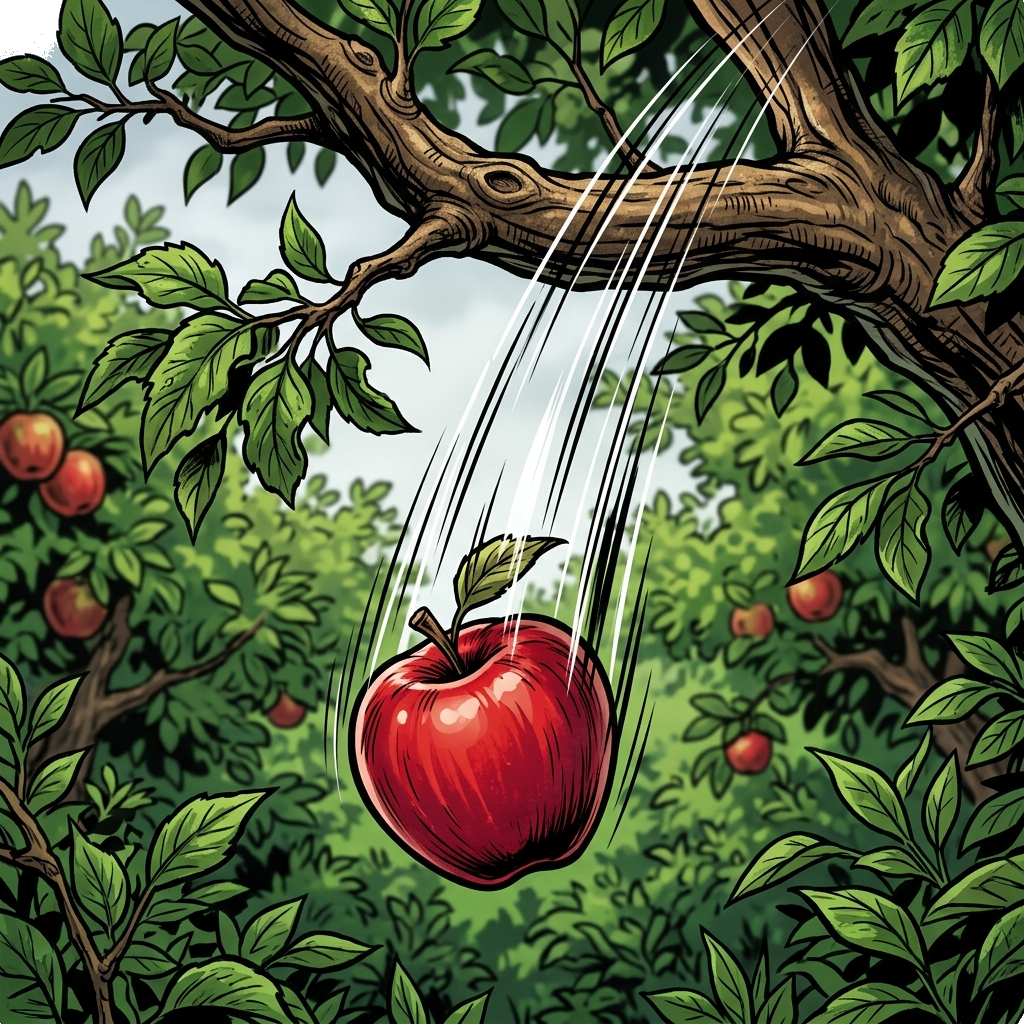
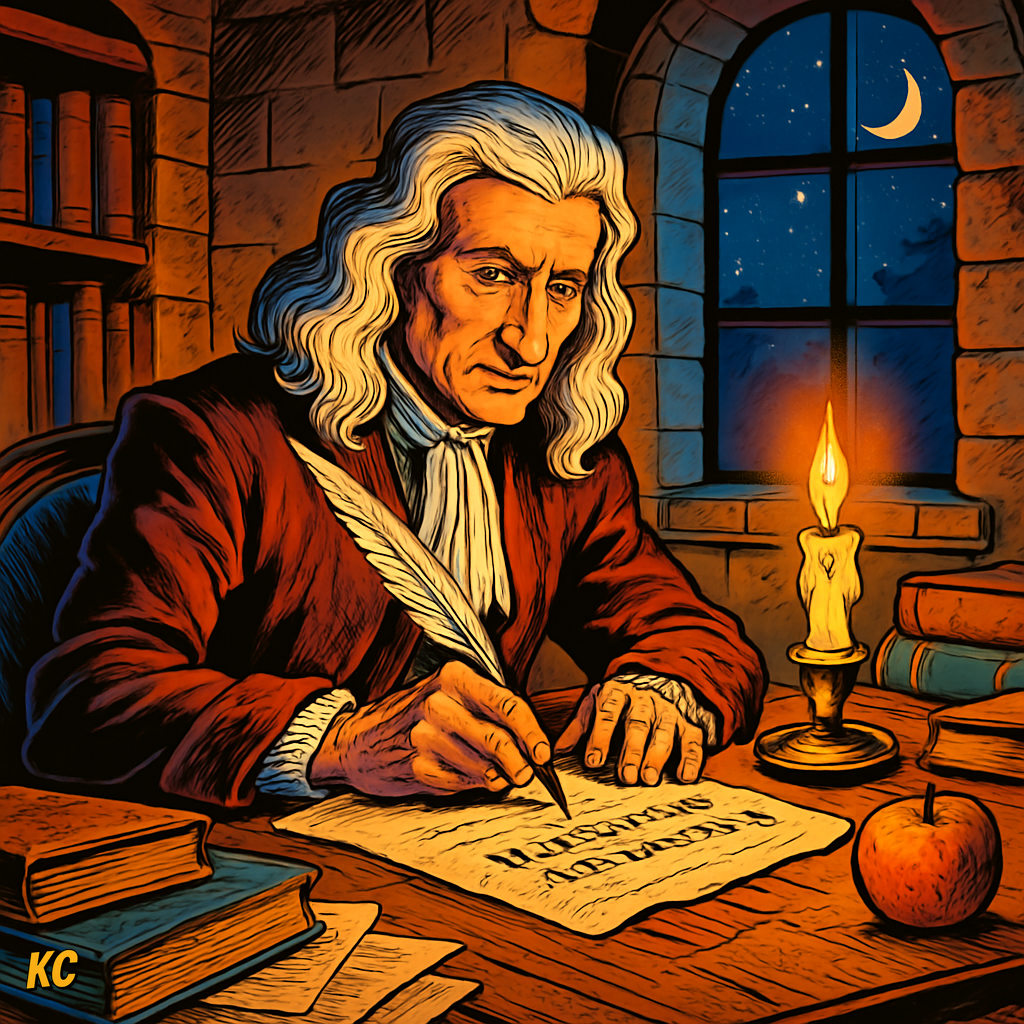
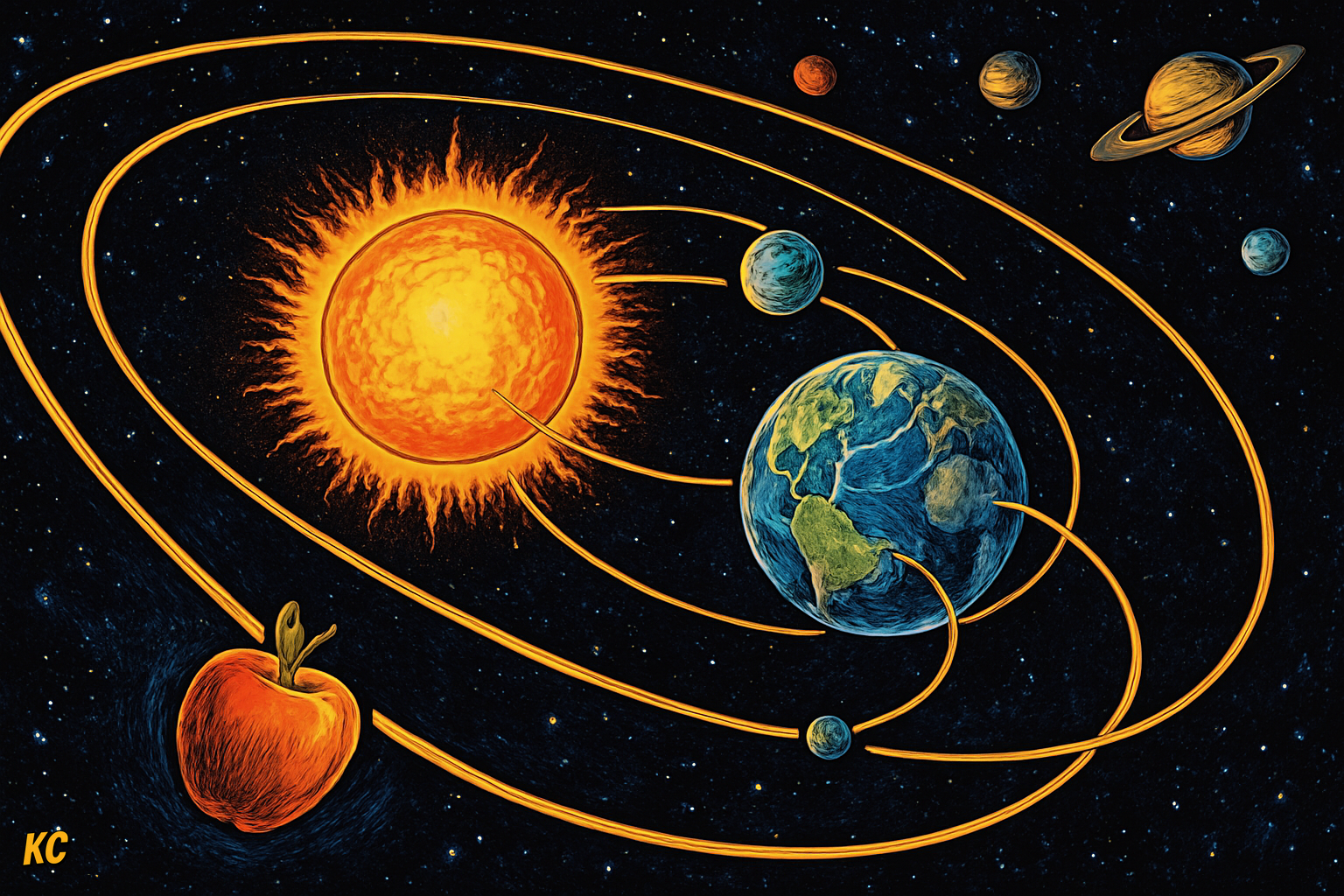
Isaac Newton sat under an apple tree and changed the world forever. His three laws explain everything from a falling apple to a rocket launch!
Every object in the universe pulls every other object toward it. Why a feather falls slower than a hammer — and why they hit together on the Moon.
Without friction you couldn't walk, write, or brake a car. Too much and machines break. The hidden force that controls almost everything we do.
A steel ship weighs thousands of tonnes yet floats. Archimedes figured out why — while jumping out of a bath and running naked through the streets.
Air pushes back on anything that moves. A parachute is a big air catcher, not magic. Why cars look smooth, and why a fall can hit a steady top speed before the chute opens.
Every force is either a push or a pull. You can't see most forces — only their effects. How forces start motion, stop motion, and change direction.
Speed = distance ÷ time. A cheetah hits 120 km/h. Light hits 300,000 km/s. How to measure, calculate, and compare the speed of almost anything.
A lever or jack can help one person lift a heavy car. A ramp makes pushing a boulder easier. Six classical simple machines have helped build tools and structures for thousands of years.
Stretch a spring and it stores energy. Let go and that energy turns into motion. The same idea powers bows, trampolines, and many toys that bounce back.
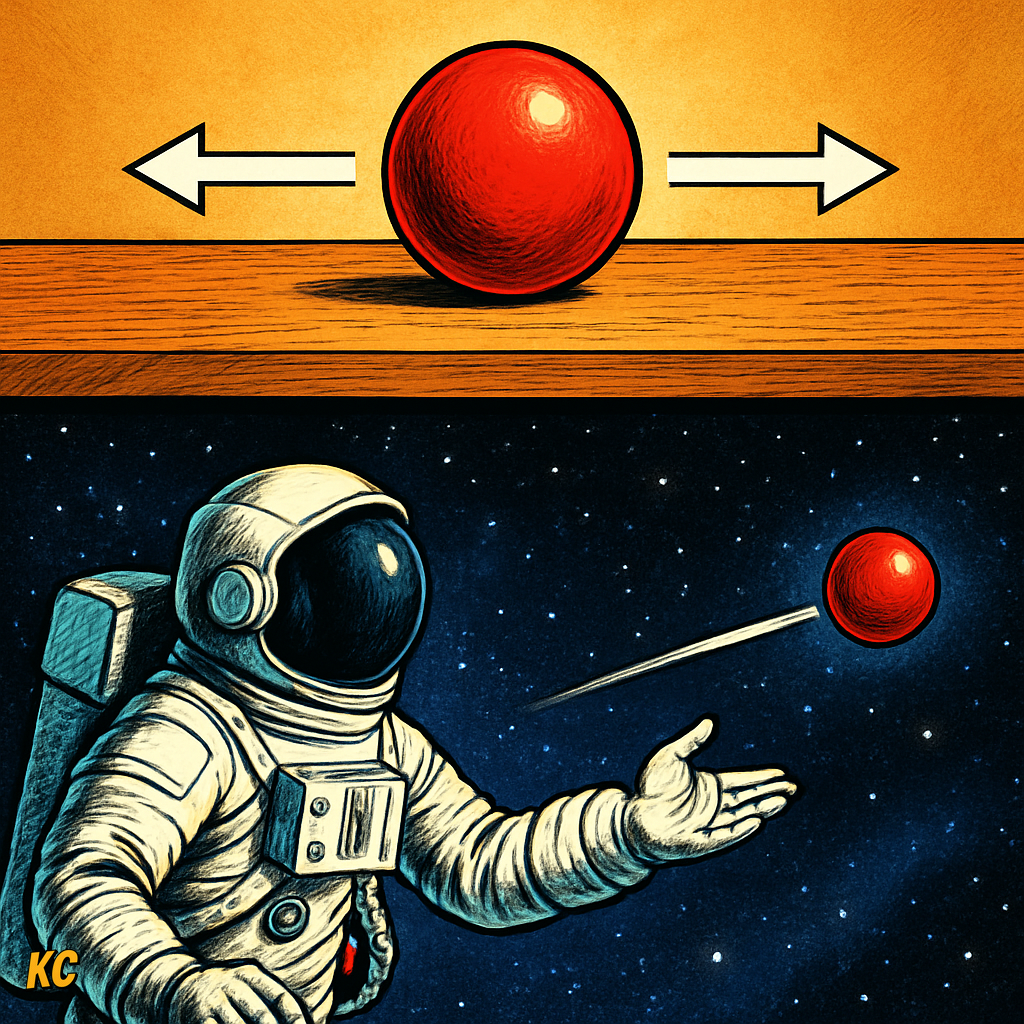
When forces balance, motion does not change: things stay still or keep a steady speed. When forces are unbalanced, objects accelerate. That tug-of-war idea helps explain bridges and flight.
Opposite poles attract and like poles repel. Invisible magnetic fields guide compass needles, stick fridge magnets, and power tools like MRI scanners in hospitals.
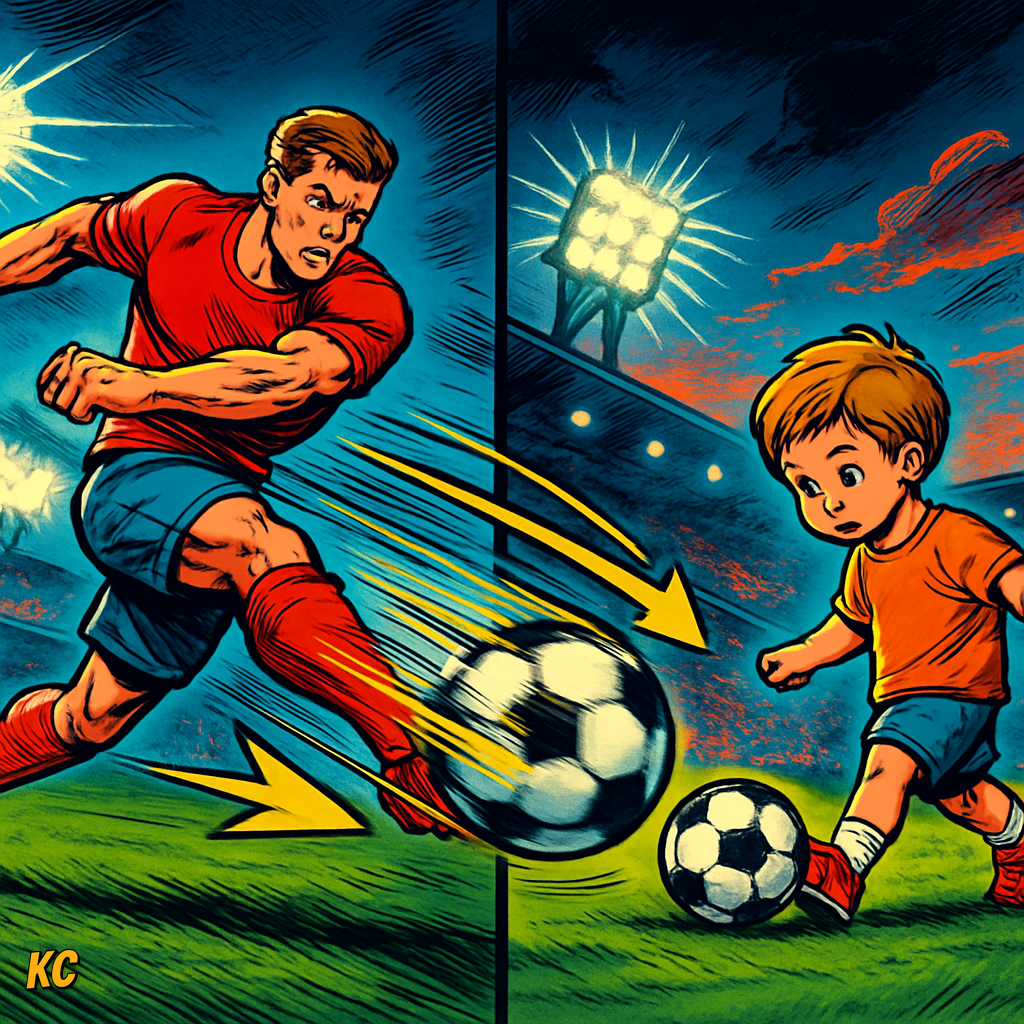
A bowling ball and a tennis ball at the same speed feel very different to catch. Momentum is mass times velocity, and it helps explain collisions, rockets, and snooker shots.
A sharp knife cuts because the same force is focused on a tiny area. Snowshoes spread your weight so you sink less in soft snow. Pressure is force divided by area.
You weigh less on the Moon but your mass stays the same. Mass is how much stuff you are made of. Weight is the pull of gravity on that mass.
A spanner has a long handle because a longer distance from the pivot means less force is needed to turn something. Moments explain door handles, seesaws, and wrenches.
Galileo studied swinging lamps and found that for small swings, each swing takes about the same time. Pendulum period depends mainly on length and gravity, which made accurate clocks possible.
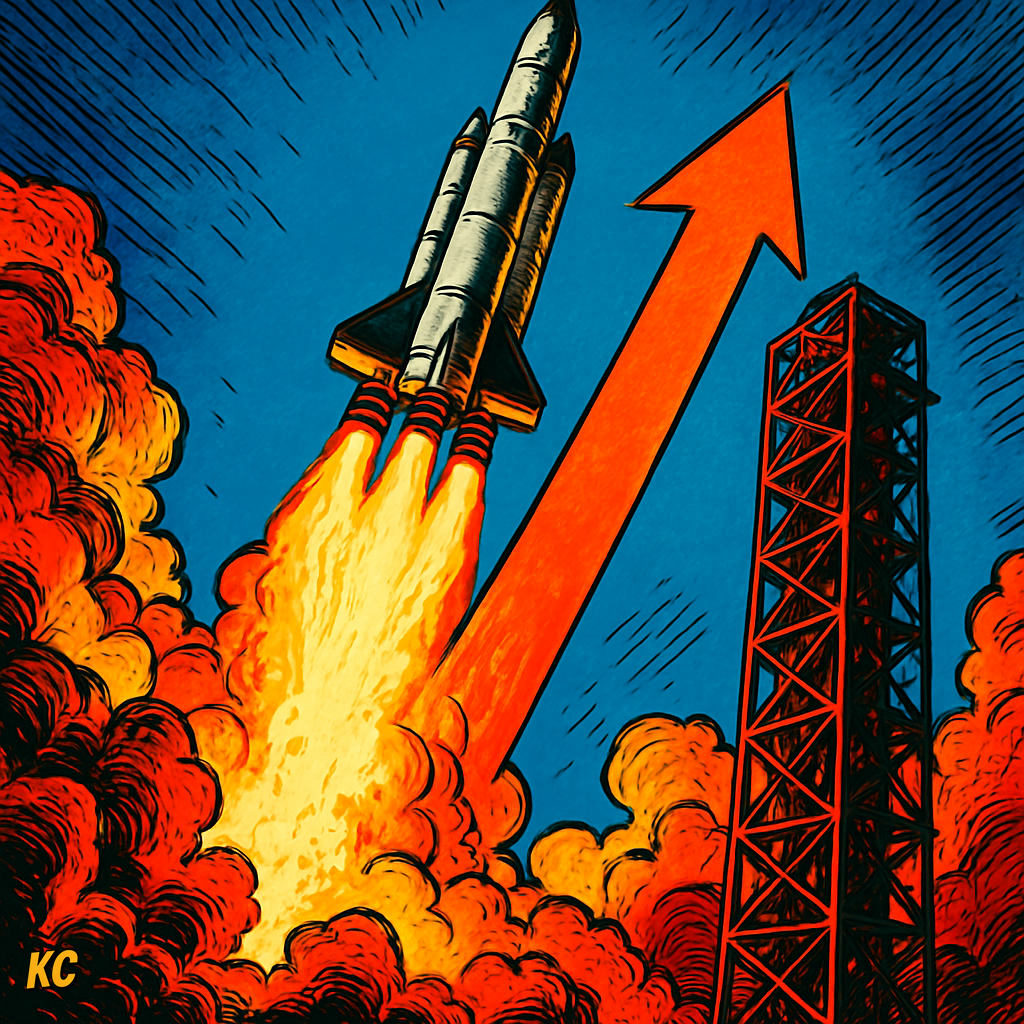
For every action there is an equal and opposite reaction. Rockets push exhaust one way and move the other way, so they work even in the vacuum of space.
Throw a ball sideways and gravity pulls it down at the same time. The curved path that explains cannonballs, football throws, and water from a hose.
Something moving in a circle is being constantly pulled inward. What keeps satellites orbiting, water in a swinging bucket, and cars on a roundabout?
Fall long enough and drag equals gravity — you stop accelerating. Why skydivers reach a top speed before the chute opens, and why a ball bearing differs from a feather.
Press a small piston and a large one pushes with enormous force. How diggers lift tonnes of earth, car brakes work, and dentist chairs rise.
Every bridge beam is being pulled apart in some places and squeezed in others. Understanding tension and compression is the key to why structures stand.
The arch was Rome's greatest engineering invention. How triangles make trusses rigid, and why modern suspension bridges can span kilometres without snapping.
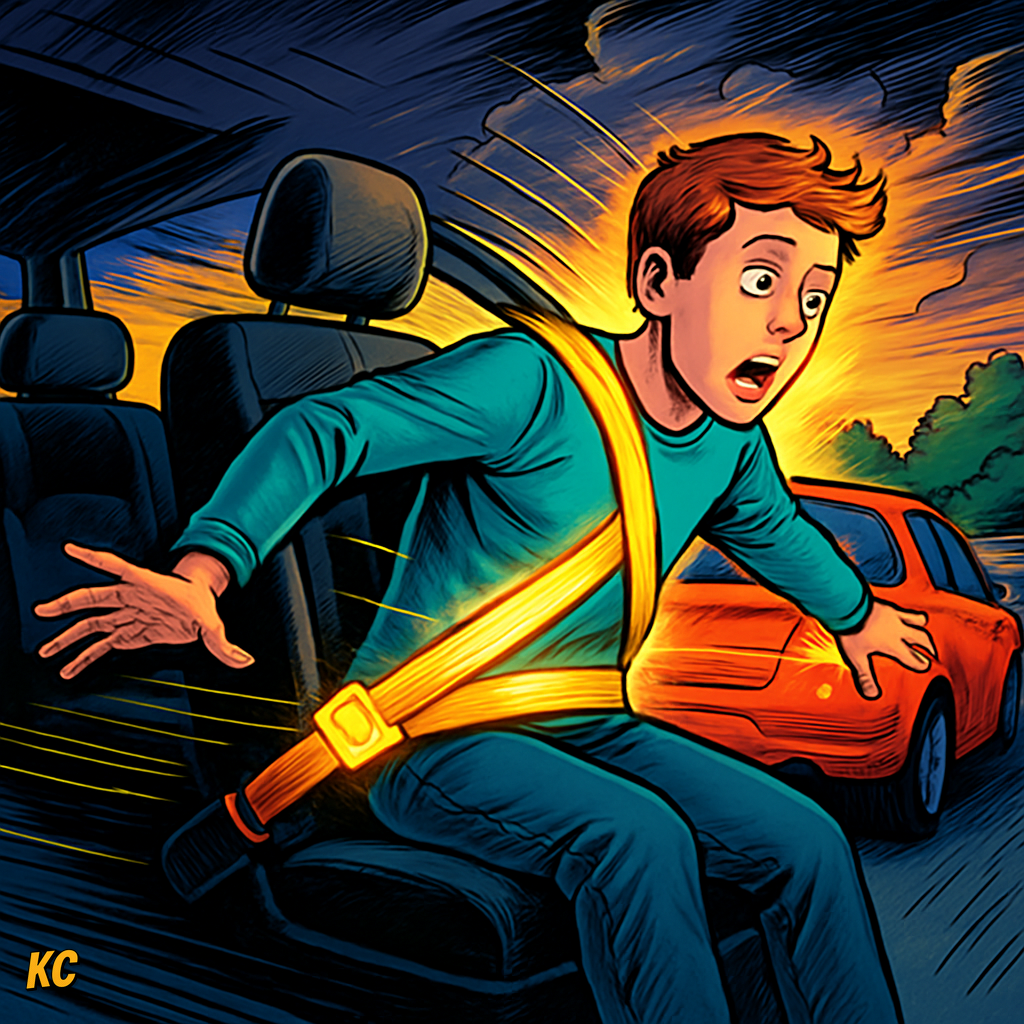
Crumple zones, seatbelts, and airbags all work by increasing stopping time — spreading the force over a longer period to protect passengers.
A moving bicycle is surprisingly hard to fall off. The self-correcting physics of rotating wheels, handlebar geometry, and why cyclists lean into corners.
Work = force × distance. Every time you push something, you transfer energy. The concept that links every mechanical process in the universe.
A ball held high has potential energy. Drop it and it becomes kinetic energy. The constant back-and-forth that makes roller coasters, pendulums, and hydroelectric dams work.
Any object moving through a fluid (liquid or gas) experiences drag. Why fish are torpedo-shaped, planes have swept wings, and Olympic swimmers shave their legs.
Every force in the universe is one of just four types. Gravity holds galaxies. Electromagnetism holds atoms together. The strong force holds the nucleus. The weak force causes decay.
Scientists draw forces as arrows — length shows size, direction shows direction. How a simple diagram can predict whether a rocket will launch or a box will slide.
MATERIALS & MATTER
Mendeleev arranged 63 elements in 1869 and predicted the missing ones. Today we have 118. Everything in the universe is made from elements on this one chart.
Everything you touch is made of particles — but depending on how close they are, it becomes solid, liquid, or gas. What's actually happening inside matter?
Add heat and particles speed up. Remove it and they slow. Why water becomes ice at exactly 0°C — and what happens to energy during the change.
Salt disappears in water — where does it go? Why sugar dissolves but sand doesn't. The science of solutions, and how to get dissolved stuff back.
Only three metals are naturally magnetic. Opposite poles attract, same repel. How Earth itself is a giant magnet — and how it protects us from the Sun.
Why is a window glass not wood? Why is a hammer metal not plastic? Matching the right material to the right job — and understanding why.
Scientists test materials for hardness, flexibility, strength, and conductivity. How we decide which material to use for which purpose.
Glass lets light through, wood doesn't, frosted glass lets some through. Three categories of material — and why their light-passing ability matters.
Cotton comes from a plant. Nylon is made from oil. How do we decide which is better — and is 'natural' always safer? The science behind material origins.
A raincoat needs to be waterproof, light, flexible, and strong. How do scientists test materials for their properties — and what makes Gore-Tex revolutionary?
Your plastic bottle becomes a fleece jacket. The chemistry of recycling — how polymers are sorted, melted, and reprocessed into new materials.
Every substance is made of atoms. 99.99% of an atom is empty space. The particles inside and why atoms of different elements behave so differently.
Two hydrogen atoms plus one oxygen atom = water. How atoms bond to form molecules — and why the shape of a molecule determines everything about a substance.
Baking soda + vinegar → bubbles. Iron + oxygen → rust. A chemical reaction makes completely new substances — and it's happening inside your body right now.
Lemon juice is acid. Bleach is alkali. In between is neutral water. Why the pH scale goes from 0 to 14, and what happens when you mix an acid with an alkali.
Sand and water can be separated by filtration. Salt and water by evaporation. The five separation techniques that chemists use every day.
Iron + water + oxygen → iron oxide (rust). Why iron rusts but gold doesn't. How galvanising, painting, and sacrificial anodes stop the rot.
All plastics are polymers — long chains of repeating molecules made from oil. How a liquid crude oil becomes a solid plastic bottle.
Pure iron is too soft, pure tin too brittle. Mix them and you get bronze — the metal that launched civilisation. How alloys combine the best of each metal.
An object floats if it is less dense than the fluid it sits in. Why wood floats, iron sinks, but a hollow iron ship floats — it's all about density.
Metals conduct heat — that's why a metal spoon in hot soup burns your hand. Wood insulates. How heat flows through different materials at different rates.
Water evaporates from oceans, rises as vapour, cools to form clouds, and falls as rain. The continuous cycle that has been recycling the same water for billions of years.
Memory foam returns to shape. Thermochromic ink changes colour with heat. Smart materials respond to their environment — and are changing medicine and engineering.
At nanoscale, materials behave differently. Carbon nanotubes are 100x stronger than steel yet lighter. The revolution in materials that is happening right now.
Concrete is strong in compression but weak in tension. Add steel reinforcement and it handles both. Composites take the best properties of two different materials.
Clay becomes ceramic when heated — the particles rearrange and lock permanently. Why ceramics can handle enormous heat but shatter with a single blow.
Sand melted at 1700°C becomes glass. Blow it, press it, float it on tin — the ancient yet surprisingly modern material that built modern architecture.
Melting ice is physical — it can be reversed. Burning wood is chemical — it can't be undone. How to tell the difference and why it matters.
Air is a mixture — its components can be separated. Water is a compound — it can't be separated without a chemical reaction. The difference explained simply.
Graphene is one atom thick, 200x stronger than steel, and conducts electricity perfectly. The marvel material discovered in 2004 with Sellotape and a pencil.
LIGHT & SOUND
Light travels at 300,000 km per second — circling Earth 7 times in one second. What light actually is, and why it needs no medium to travel through.
White light is secretly all colours mixed together. When it passes through a raindrop or prism, it bends — and the colours separate into a rainbow.
Shadows are where light can't reach. Why your shadow is longer in the morning, shorter at noon — and how shadows helped ancients measure the Earth.
Sound is vibrating particles — it can't travel through a vacuum. Why thunder comes after lightning, and how dolphins use sound to navigate.
A red apple absorbs all colours and reflects only red. Your eye has three types of cone cells. Why some people are colour-blind — and how artists mix colour.
The angle of reflection always equals the angle of incidence. Why mirrors show a reversed image, why the Moon shines, and how cats see in the dark.
A whisper is 30 dB, a jet engine is 140 dB. Each 10 dB increase is 10x louder. Why concerts damage hearing, and why whales can communicate across oceans.
A high-pitched sound vibrates many times per second; a low pitch vibrates fewer. Why a violin sounds different from a tuba — and how autotune works.
Sound travels 4x faster through water than air, and 15x faster through steel. How stethoscopes amplify heartbeats, and why you can hear trains through rails.
Light reaches you almost instantly. Sound at 343 m/s takes time. Count seconds between lightning and thunder: 3 seconds = 1 km away.
An echo is sound reflecting off a hard surface. Bats use ultrasound echoes to navigate in total darkness — a system so precise it can locate a moth mid-flight.
Every instrument creates sound by vibrating something — a string, air in a tube, or a membrane. Why a violin and a piano playing the same note sound different.
Humans can't hear above 20,000 Hz — but ultrasound scanners use 2–18 million Hz to image unborn babies without radiation. How sound becomes a camera.
Everything warm emits infrared radiation. Night-vision cameras see body heat. TV remote controls use it. And the Sun sends most of its energy to Earth as infrared.
Just beyond violet in the spectrum sits UV — invisible but energetic enough to damage DNA and cause sunburn. Why sunscreen works, and what the ozone layer blocks.
Visible light is just a tiny sliver. Radio waves, microwaves, X-rays, and gamma rays are all the same thing — electromagnetic radiation at different frequencies.
Wilhelm Röntgen accidentally discovered X-rays in 1895. Dense bone absorbs them, soft tissue lets them pass. How a single discovery revolutionised medicine.
Laser light is coherent — all the same wavelength, in phase. That's what makes it powerful enough to cut steel, accurate enough for surgery, and fun in concerts.
A rainbow needs Sun behind you and rain ahead. Light enters each droplet, reflects inside, and exits at 42° — and you see a different colour at each angle.
Light enters your eye, the lens focuses it, the retina converts it to electrical signals, and your brain assembles the image. Why we see right-side up when images land upside-down.
Sound waves make your eardrum vibrate. Three tiny bones amplify it. The cochlea converts vibrations to electrical signals. The most sensitive instrument in your body.
Light can travel around corners if the glass tube is the right angle. How the entire internet is carried at the speed of light through glass fibres thinner than a hair.
Antonie van Leeuwenhoek saw bacteria for the first time in 1676. How lenses bend light to magnify objects — and why electron microscopes can see individual atoms.
A telescope collects more light than your eye can. Hubble orbits above Earth's atmosphere to get a perfectly clear view — and looks back 13 billion years in time.
Mixing paint (subtractive) and mixing light (additive) follow completely different rules. Red + green light = yellow. But red + green paint = brown. Why?
LIVING THINGS
All life on Earth shares a common ancestor. Darwin's theory explains how a single cell became dinosaurs, dolphins, daffodils — and you.
Is a virus alive? Is fire alive? Scientists use 7 life processes to decide. The surprisingly tricky question of what separates living from non-living.
Every living thing is connected through what it eats. Remove one link and the whole chain collapses. How energy flows from the Sun through every living thing.
A polar bear's white fur, a cactus storing water, a stick insect that looks like a twig. How survival pressure shapes every living thing over millions of years.
Plants make their own food using sunlight. Animals eat other things. But what about fungi? The surprisingly complex question of how we classify life.
97% of all animal species have no backbone. Insects, worms, molluscs — invertebrates dominate Earth. What having a spine actually gives you.
Mammals are warm-blooded, have hair, and feed young with milk. From the blue whale to the bumblebee bat — what unites the most successful vertebrate group.
Reptiles don't generate body heat internally — they bask in the sun. How being cold-blooded changes everything about how you eat, move, and survive winter.
Over 1 million described species — more than all other animals combined. Why insects are so extraordinarily successful at colonising every habitat on Earth.
A caterpillar dissolves itself inside its chrysalis and rebuilds as a butterfly. The extraordinary variety of life cycles — from egg to seed to larva.
Every habitat has its specialists — animals perfectly tuned to live there and nowhere else. What happens when that habitat disappears.
Every living thing is made of cells — the smallest unit of life. A human has 37 trillion of them. What's inside a cell, and how it keeps you alive.
Plants take carbon dioxide from air, water from soil, and sunlight — and make sugar. This one reaction is the source of almost all energy in every food web on Earth.
Every cell in your body is burning sugar right now. Cellular respiration converts glucose into usable energy — and it happens 24/7 even while you sleep.
206 bones, each with a specific job. The skeleton is not just a frame — it makes blood cells, stores calcium, and protects vital organs.
Muscles can only pull, never push. That's why they come in pairs — bicep pulls the arm up, tricep pulls it back. The mechanics of every movement you make.
Your digestive system is 9 metres long. Food spends up to 4 hours in the stomach being dissolved by acid strong enough to corrode metal.
Your heart beats 100,000 times a day, pumping blood through 100,000 km of vessels. How oxygen and nutrients reach every single cell in your body.
Signals travel along nerves at 120 m/s. Your reflex arc bypasses the brain entirely for speed. How 86 billion neurons create consciousness, memory, and thought.
Most microbes are harmless or beneficial. The bacteria in your gut outnumber your body's own cells. How germs cause disease — and how your immune system fights back.
A vaccine teaches your immune system to recognise a pathogen without getting sick. How a small injection trains your body's soldiers before the real attack.
Remove wolves from Yellowstone and the rivers change course. How every species in an ecosystem is connected — and why removing one can cascade through the whole.
Linnaeus invented a system to name every living thing — genus and species. How scientists classify new organisms and why the system keeps changing.
You have two copies of every gene — one from each parent. Dominant genes mask recessive ones. Why brown eyes dominate, and why you might have your grandfather's nose.
Malaria kills 600,000 people a year — caused by a parasite that hides inside red blood cells. The strange, dark world of organisms that can't survive without a host.
Without decomposers, dead matter would pile up forever. Fungi and bacteria break everything down and return nutrients to the soil — the invisible engine of all ecosystems.
Peppered moths during the Industrial Revolution. Antibiotic-resistant bacteria. Darwin's finches. The evidence for natural selection is overwhelming — and observable in real time.
Dolly the sheep was the first mammal cloned from an adult cell in 1996. What cloning actually means, how it's done, and the ethical questions it raises.
Scientists can now cut and paste DNA like text. CRISPR has already cured sickle cell disease in patients — and raised profound questions about what we should change.
A species goes extinct every 10 minutes. Why biodiversity loss matters, what drives it, and how conservation biology tries to reverse the trend.
Clownfish and anemones both benefit. Remora fish and sharks — one gains, one doesn't care. Tapeworms — the host suffers. The three types of inter-species relationship.
Mapping all 3 billion base pairs in human DNA took 13 years and cost $3 billion. Completed in 2003, it transformed medicine, forensics, and our understanding of life.
99% of all species that ever lived are now extinct. How we know — from fossils, DNA analysis, and historical records — and whether extinction can ever be reversed.
All life on Earth is related — from bacteria to blue whales. How scientists build evolutionary trees using DNA, fossils, and anatomy to show every connection.
EARTH & ENVIRONMENT
The Earth is like a boiled egg — thin crust, thick mantle, and a solid inner core surrounded by liquid metal. How we know what's inside without ever going there.
Where two tectonic plates pull apart or collide, rock melts and bursts to the surface. Why some volcanoes explode violently and others ooze for years.
The Earth's crust is broken into huge plates that slide, grind, and crash. When stress is released, the ground shakes — and sometimes cities fall.
Every rock has a story — born in fire, buried under pressure, or built from layers of sediment over millions of years. How to read a rock's entire history.
The Earth spins at 1,670 km/h — you can't feel it, but it creates day and night. Why the Sun appears to move across the sky, and why it rises in the east.
Rock is constantly being created, destroyed, and recycled. Magma cools, sediment presses, heat transforms — the slow endless cycle that reshapes continents.
A dead creature buried in sediment slowly turns to stone over millions of years. Fossils are the evidence that tells us what life looked like before humans existed.
Soil took thousands of years to form — just 1cm takes a century. It is alive, teeming with organisms. Without soil, almost all land life on Earth would die.
Seasons are not caused by distance from the Sun — Earth's axis is tilted 23.5°. When your hemisphere tilts toward the Sun, you get summer. Away from it, winter.
The Moon doesn't change shape — we see different amounts of its lit face as it orbits Earth. How the lunar cycle takes 29.5 days and drives the ocean's tides.
Alfred Wegener proposed that continents move in 1912 — and was laughed at. Fifty years later, the evidence was undeniable. The plates still move today at fingernail speed.
An underwater earthquake displaces billions of tonnes of water. In the open ocean a tsunami is just 1m tall and 800 km/h fast. Only near shore does it become catastrophic.
Five layers of gas wrap the Earth. The troposphere gives us weather. The stratosphere blocks UV. The magnetosphere deflects solar wind. Each one essential.
Air pressure differences drive wind. Wind picks up moisture. Moisture rises and cools to form clouds. Rain falls. Weather is one continuous system of energy transfer.
The ocean is up to 11km deep. Its currents act as a global conveyor belt, moving warm and cold water around the planet and regulating the climate for all land life.
Carbon moves from air to plant to animal to soil to rock and back again. Humans have disrupted this cycle by releasing ancient carbon from fossil fuels.
Nitrogen makes up 78% of air but most life can't use it directly. Bacteria convert it into a form plants can absorb — without them, all agriculture would collapse.
The Sahara is the largest hot desert, but Antarctica is the largest desert of all. How extreme dryness creates bizarre landscapes and extraordinary adaptations.
50% of all species live in just 6% of Earth's land. How the rainforest stratifies into layers — canopy, understorey, forest floor — each with its own ecosystem.
It reaches −89°C in Antarctica. Yet emperor penguins breed there in winter. How life survives at Earth's extremes — and what melting ice caps mean for sea levels.
When tectonic plates collide, rock is pushed upward. The Himalayas grow 5mm per year — but erosion cuts them back just as fast. How mountains rise and fall over millions of years.
Rivers start as trickles in mountains and end as wide, muddy estuaries at the sea. The journey carves valleys, deposits plains, and creates deltas over millions of years.
Glaciers carved the fjords of Norway, the Great Lakes of North America, and Scotland's lochs. Today they're retreating — and their meltwater is raising sea levels.
In the 1930s American Dust Bowl, poor farming stripped topsoil bare and winds carried it across the continent. How erosion destroys agriculture and how to stop it.
CO₂ acts like a blanket, letting sunlight in but trapping heat. Without any greenhouse effect, Earth would be −18°C. Too much, and it overheats.
The ozone layer absorbs 97% of UV radiation. CFCs from aerosol cans punched a hole in it. The Montreal Protocol reversed the damage — science's greatest environmental success.
Earthquakes, hurricanes, volcanoes — science can now predict most natural disasters hours to years in advance. How early-warning systems save thousands of lives.
Why is it always hot near the equator? Why do deserts form at 30° latitude? The Earth's tilt and spherical shape create distinct climate bands around the globe.
Power stations emit SO₂. It dissolves in rain to form sulphuric acid. In the 1980s acid rain was killing European forests. The science of pollution and international law.
Rainwater, slightly acidic, dissolves limestone over hundreds of thousands of years. Caves form in darkness — and fill with crystals, underground rivers, and unique life.
ELECTRICITY & ENERGY
Electrons flowing through a wire. That's electricity. But understanding how to control that flow is what powers your phone, lights your room, and runs the modern world.
A circuit needs a complete loop for current to flow. Why Christmas lights all go out when one bulb breaks — and how parallel circuits fix that problem.
Copper lets electricity flow freely; rubber blocks it. Why wires are wrapped in plastic, why birds sit safely on power lines, and what happens if you're not careful.
Rub a balloon on your hair and it sticks to the wall. The same process — charge build-up — creates lightning bolts with a billion volts.
The Sun sends enough energy every hour to power civilisation for a year. How solar panels, wind turbines, and tidal generators harvest it.
In series, current flows through each component one by one. In parallel, it splits and takes multiple paths. Why your house wiring is parallel but your Christmas lights were series.
A switch simply breaks the circuit. Circuit breakers do the same automatically when current is too high. How one tiny gap in a wire controls enormous power.
Electric shock forces muscles to contract and can cause heart failure. Why earthing, circuit breakers, and RCDs exist — the engineering that makes electricity safe to use.
A kettle uses 3,000 watts. An LED bulb uses 10. Power = voltage × current. How to read an electricity bill, calculate energy use, and reduce your footprint.
Almost all electricity is generated the same way: spin a coil of wire in a magnetic field. Whether the heat comes from coal, nuclear, or steam — the principle is identical.
Splitting one uranium atom releases millions of times more energy than burning coal. How a nuclear reactor controls a chain reaction — and why the waste lasts 10,000 years.
Fossil fuels are compressed ancient life forms — formed over 300 million years. Humans have burned half the world's oil supply in just 150 years. It won't be replaced.
Water stored high has potential energy. Release it and gravity does the work. Hydroelectric dams produce 17% of the world's electricity — carbon free, but not consequence free.
A battery stores energy as chemical potential. When the circuit closes, a chemical reaction releases electrons. How lithium-ion batteries power everything from phones to EVs.
Every electric vehicle, washing machine, and fan uses the same principle: a current in a magnetic field produces a force. The simple idea that replaced steam engines.
Wrap wire around iron, pass current through it, and you get a magnet. Switch off the current and the magnetism vanishes. How MRI scanners, speakers, and doorbells work.
Energy cannot be created or destroyed — only transferred. Every machine wastes some energy as heat. Understanding efficiency is the key to designing better technology.
Heat moves in three ways: through solid materials (conduction), through fluids in currents (convection), and through space as waves (radiation). Each works differently.
Food is chemical energy. Your body releases it via cellular respiration. Petrol releases it via combustion. Both are controlled versions of the same chemical process.
Traditional grids send power one way. Smart grids use sensors and AI to balance supply and demand in real time — essential for a world running on intermittent renewables.
Light knocks electrons free from silicon atoms, creating a current. A solar panel is a very thin semiconductor sandwich. Why efficiency has jumped from 6% to 26% since 1954.
A wind turbine blade is an aerofoil — like an aircraft wing. As wind lifts it, the blade rotates a shaft, spinning a generator. Why offshore wind is more powerful.
An EV battery stores energy, a controller regulates it, and a motor converts it to motion. Regenerative braking converts kinetic energy back into electricity. No exhaust.
Place your phone on a pad and it charges — no plug required. Two coils create a changing magnetic field that transfers energy through air. The principle Tesla demonstrated in 1899.
Nuclear fusion — the power of the Sun — has been 30 years away for 70 years. But in 2022, scientists finally got more energy out than they put in. The breakthrough is here.
THE BIG IDEAS IN PHYSICS
E=mc². Time slows near massive objects. The faster you move, the slower you age. Einstein's theories changed everything we thought we knew about space and time.
CO₂ in the atmosphere traps heat like a blanket. The physics of the greenhouse effect — why a gas that makes up 0.04% of air is changing everything.
The most powerful idea in human history: test your idea against reality. How scientists design fair tests, record results, and change their minds when evidence demands.
You can't win, you can't break even, and you can't quit the game. The three laws of thermodynamics — and why they mean perpetual motion machines are impossible.
Everything is made of 17 fundamental particles. Quarks make protons. Electrons are leptons. The Higgs boson gives mass. The complete menu of the universe's ingredients.
Squeeze enough mass into a small enough space and nothing — not even light — can escape. How black holes form, how we detect them, and what happens at the edge.
13.8 billion years ago, all matter and energy erupted from a point smaller than an atom. The evidence: the universe is expanding, and we can see its afterglow.
27% of the universe is made of something we can't see, detect, or explain. We only know it exists because of its gravitational effects. The biggest unsolved mystery in physics.
The nucleus is tiny — 100,000 times smaller than the atom — yet holds almost all its mass. How the strong force holds it together, and what radioactivity releases.
Light behaves as a wave when you don't measure it and a particle when you do. The double-slit experiment is the most disturbing result in the history of science.
For 50 years, the Higgs boson was predicted but never seen. In 2012, CERN's Large Hadron Collider found it — completing the Standard Model of particle physics.
What if every particle is actually a tiny vibrating string, and different vibrations create different particles? String theory tries to unify all forces — but it may be untestable.
Time flows faster at altitude than at sea level — GPS satellites must correct for this. Is time real? Does it flow? Could it go backwards? Physics has surprising answers.
Nothing can travel faster than light — 299,792,458 m/s. This isn't just a practical limit but a fundamental feature of spacetime. What happens if you approach that limit?
When two black holes collide, they send ripples through the fabric of spacetime. In 2015, LIGO detected waves from a collision 1.3 billion light years away. Einstein was right.
The universe always tends toward greater disorder. Ice melts, buildings crumble, hot coffee cools. Entropy is the reason time seems to have a direction.
Quantum mechanics implies that every quantum event spawns a new universe where the opposite happened. Is the multiverse real science or metaphysics? Physicists disagree.
Newton's gravity works perfectly for everyday life. Einstein's says gravity is the curvature of spacetime. They agree on almost everything — until you get near a black hole.
Energy is one of the most important concepts in physics — and one of the hardest to define. What it actually is, how many forms it takes, and why it can never be destroyed.
In 1865, Maxwell unified electricity and magnetism into one force — and predicted the existence of radio waves. The unification that opened the age of wireless communication.
Temperature is the vibration of atoms. At absolute zero — −273.15°C — motion stops. We've never achieved it, but we've gotten within billionths of a degree.
A critical mass of enriched uranium starts an uncontrolled chain reaction. In millionths of a second, the energy in a few kilograms equals thousands of tonnes of TNT.
Some materials, cooled near absolute zero, conduct electricity with zero resistance. MRI machines use them today. Room-temperature superconductors would transform civilisation.
Dark energy is accelerating the universe's expansion but nobody knows what it is. Quantum mechanics and gravity can't be reconciled. The 10 biggest unsolved problems in physics.
FAMOUS SCIENTISTS
The man who invented calculus, explained gravity, and built the first working telescope — all during a plague lockdown. The most productive two years in science history.
The first person to win two Nobel Prizes in two different sciences — in an era when women weren't admitted to universities. Her research on radioactivity changed medicine forever.
Darwin spent 5 years sailing the world, then 20 years checking his idea before publishing it. The theory that explained all life — and caused a storm that still hasn't ended.
Her X-ray photograph of DNA — Photo 51 — was the key evidence that revealed the double helix. She never got the Nobel Prize. The most overlooked discovery in science.
He gave the world AC electricity, the radio, and the induction motor — then died broke and alone. Tesla's war with Edison and the inventions that run modern life.
In his 'miracle year' of 1905, Einstein published four papers that transformed physics. He was working as a patent clerk at the time. The greatest scientific mind of the 20th century.
Diagnosed with motor neurone disease at 21, given two years to live, he worked for 55 more. His theory that black holes emit radiation is the most important in modern cosmology.
In 1960 she sat quietly in a forest until wild chimpanzees accepted her. She discovered they make tools — until then considered uniquely human. She changed everything.
She found a malaria cure in 2,000-year-old Chinese medical texts, tested it on herself, and has saved millions of lives. The first Chinese woman to win the Nobel Prize.
Galileo improved the telescope, pointed it at Jupiter, and found moons orbiting it — proof that not everything circles Earth. The Church put him under house arrest.
He cracked Nazi Enigma codes and invented the theoretical basis for all computers. Then was prosecuted for being gay and died aged 41. The most consequential and tragic scientist of the 20th century.
In 1843 she wrote the first algorithm intended for a machine that hadn't been built yet. Ada Lovelace saw the potential of computing 100 years before computers existed.
Feynman made quantum electrodynamics understandable, played bongo drums, cracked safes at Los Alamos, and diagnosed the Challenger disaster with a glass of ice water.
Sagan made the universe accessible to billions. His Pale Blue Dot speech — triggered by a photo of Earth from 6 billion km away — is the most humbling thing ever written.
A monk growing peas in a monastery garden discovered the laws of inheritance in 1866. His work was ignored for 35 years — then recognised as the foundation of all genetics.
Pasteur proved that disease was caused by microorganisms — not bad air. He invented pasteurisation and pioneered vaccines for rabies and anthrax.
He went on holiday, forgot to wash a petri dish, came back to find mould killing bacteria around it. The accidental discovery of penicillin has saved 200 million lives.
Meitner and Otto Hahn discovered nuclear fission together. Hahn got the Nobel Prize. She didn't — because she was a woman and had fled Nazi Germany. Physics owes her a debt.
Her experiment disproved the law of conservation of parity — a result so shocking it violated physics' most basic assumptions. Her two male colleagues got the Nobel. She didn't.
The director of the Hayden Planetarium has done more than almost anyone to make science exciting for a new generation — through TV, podcasts, and viral social media.
She measured how fast stars orbit the centre of galaxies and found they moved too fast — as if most of the galaxy's mass was invisible. She discovered dark matter.
In 1955, Salk announced the polio vaccine — and refused to patent it. Asked who owned it, he replied: 'the people'. It has since prevented millions of cases of paralysis.
Using Rosalind Franklin's X-ray data (without her permission), Watson and Crick built the first model of DNA's double helix. One of science's most important — and controversial — discoveries.
She determined the 3D structure of penicillin, insulin, and vitamin B12 using X-ray crystallography. Her work on insulin directly enabled treatments for diabetes.
Which scientists had the biggest impact on humanity? The ranking, the arguments, and the surprising names that often top the list — from Ibn al-Haytham to Einstein.
HUMAN IMPACT ON EARTH
Human activity releases pollutants into air, water, and soil. From smog over Beijing to microplastics in Arctic ice — the full scope of what we're adding to the world.
The planet is warming because of greenhouse gases humans are adding to the atmosphere. The evidence is overwhelming — and the effects are already here.
One third of all food depends on bees for pollination. Their colony collapse disorder threatens global food security. What bees do, why they're dying, and how to help.
A football pitch of rainforest is cleared every 6 seconds. Why this matters beyond just the trees — the carbon, water cycles, and species that are lost with each tree.
8 million tonnes of plastic enters the ocean every year. It breaks into microplastics that enter the food chain. How the Great Pacific Garbage Patch formed — and what we can do.
When the grey wolf was reintroduced to Yellowstone, rivers changed course. Every species is connected. Why losing an 'unimportant' animal can collapse an entire ecosystem.
3% of Earth's water is fresh, and most of that is locked in glaciers. 2 billion people lack access to safe drinking water. The engineering and policy solutions being tried.
The carbon footprint of a beef burger is 15x that of a veggie burger. How individual choices add up — and why systemic change matters more than personal virtue.
Beef production uses 20x more land and emits 20x more greenhouse gases than plant protein. How the food on your plate connects to global climate systems.
Beavers reintroduced to Scotland reduced flooding downstream. Wolves brought back Yellowstone's rivers. Rewilding — letting nature recover — is one of our best climate tools.
9 out of 10 people breathe air that exceeds WHO pollution limits. Tiny particulates (PM2.5) penetrate lungs and enter bloodstream. The world's biggest environmental health risk.
Species are going extinct 1,000x faster than the natural rate. Biologists call it the sixth mass extinction — the first caused by a single species. What can still be saved.
The technology exists to run the world on renewables. The challenge is speed and politics. How fast countries are transitioning — and what's holding others back.
The world produces enough food for 10 billion people yet 800 million go hungry. One third of all food is wasted. The distribution, production, and political failures of our food system.
Coral gets its colour from algae living inside it. When water warms, the algae leave and the coral turns white and starves. 50% of the Great Barrier Reef is already gone.
Brown tree snakes wiped out 12 of Guam's 22 native bird species after arriving via military cargo. How introduced species disrupt ecosystems that evolved without them.
The Amazon creates its own weather — trees release moisture that forms clouds and falls as rain. Deforestation risks triggering a tipping point that turns it into savanna.
50 million tonnes of electronic waste is produced each year. Old phones contain gold, silver, and rare earth elements. Why e-waste is both toxic and an untapped resource.
90% of the world's large fish populations have been depleted. In 1992, the Grand Banks cod fishery collapsed overnight — and hasn't recovered in 30 years. Can oceans recover?
Climate scientists model thousands of scenarios. The worst-case is catastrophic. The best-case requires rapid action. What the science actually says — honestly.
The fashion industry produces 10% of global CO₂ emissions and uses more water than any industry except agriculture. What buying cheap clothes actually costs the planet.
Cities are up to 7°C warmer than surrounding countryside. Concrete and asphalt absorb heat; there's no vegetation to cool through evaporation. Solutions include green roofs.
Healthy soil contains more organisms per teaspoon than there are people on Earth. Industrial farming kills this microbiome. Regenerative agriculture is trying to bring it back.
In a circular economy, every product's end-of-life is designed in from the start. Instead of take-make-waste, it's make-use-return-remake. The economic model that could save the planet.
Science tells us what is happening. Policy decides what we do about it. How scientific consensus forms, why it's sometimes ignored, and what it takes to turn evidence into action.